Construction Safety andHealth
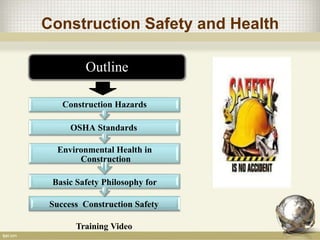
Outline
Construction Hazards
OSHA Standards
Environmental Health in
Construction
Basic Safety Philosophy for
Success Construction Safety
Training Video
3.
Construction Hazards
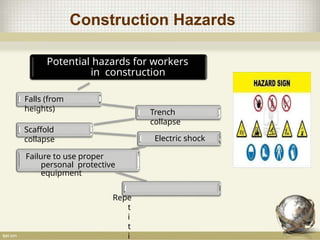
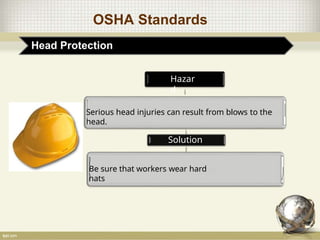
Potential hazardsfor workers
in construction
Falls (from
heights) Trench
collapse
Scaffold
collapse Electric shock
Failure to use proper
personal protective
equipment
Repe
t
i
t
i
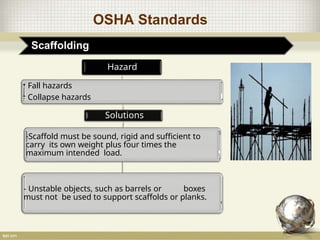
OSHA Standards
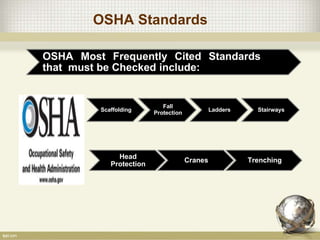
Scaffolding
Hazard
- Fallhazards
- Collapse hazards
Solutions
-Scaffold must be sound, rigid and sufficient to
carry its own weight plus four times the
maximum intended load.
- Unstable objects, such as barrels or boxes
must not be used to support scaffolds or planks.
6.
OSHA Standards
Scaffolding
Solution
s
- Scaffoldmust not be erected except under
the supervision of a competent person.
-Scaffold must be equipped with guardrails
-Scaffolds must be at least 10 feet from electric
power lines at all times.
7.
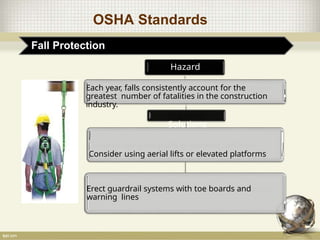
OSHA Standards
Fall Protection
Hazard
Eachyear, falls consistently account for the
greatest number of fatalities in the construction
industry.
Solutions
Consider using aerial lifts or elevated platforms
Erect guardrail systems with toe boards and
warning lines
OSHA Standards
Ladders
Hazard
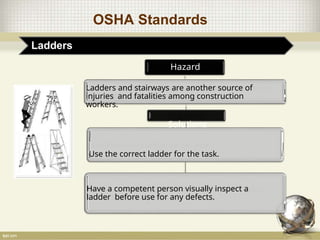
Ladders andstairways are another source of
injuries and fatalities among construction
workers.
Solutions
Use the correct ladder for the task.
Have a competent person visually inspect a
ladder before use for any defects.
10.
OSHA Standards
Ladders
Solution
s
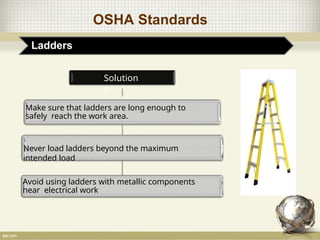
Make surethat ladders are long enough to
safely reach the work area.
Never load ladders beyond the maximum
intended load
Avoid using ladders with metallic components
near electrical work
11.
OSHA Standards
Stairways
Hazard
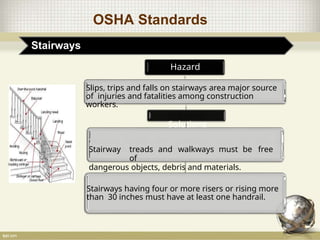
Slips, tripsand falls on stairways area major source
of injuries and fatalities among construction
workers.
Solutions
Stairway treads and walkways must be free
of
dangerous objects, debris and materials.
Stairways having four or more risers or rising more
than 30 inches must have at least one handrail.
12.
OSHA Standards
Trenching
Hazard
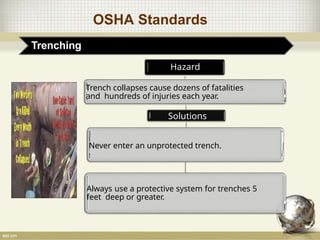
Trench collapsescause dozens of fatalities
and hundreds of injuries each year.
Solutions
Never enter an unprotected trench.
Always use a protective system for trenches 5
feet deep or greater.
13.
OSHA Standards
Trenching
Solution
s
Employ aregistered professional engineer to
design a
protective system for trenches 20 feet deep or
greater.
Always provide a way to exit a trench—such as
a ladder, stairway
Make sure that trenches are inspected by a
competent person prior to entry and after any
hazard-increasing event
14.
OSHA Standards
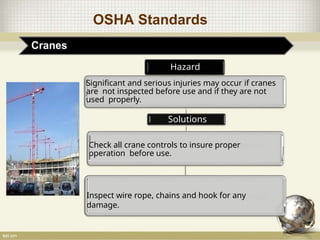
Cranes
Hazard
Significant andserious injuries may occur if cranes
are not inspected before use and if they are not
used properly.
Solutions
Check all crane controls to insure proper
operation before use.
Inspect wire rope, chains and hook for any
damage.
15.
OSHA Standards
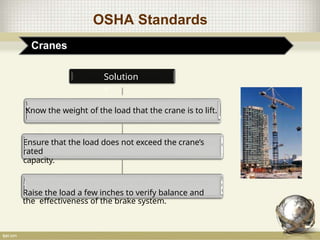
Cranes
Solution
s
Know theweight of the load that the crane is to lift.
Ensure that the load does not exceed the crane’s
rated
capacity.
Raise the load a few inches to verify balance and
the effectiveness of the brake system.
16.
OSHA Standards
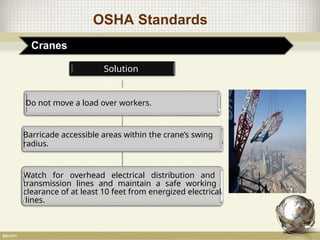
Cranes
Solution
s
Do notmove a load over workers.
Barricade accessible areas within the crane’s swing
radius.
Watch for overhead electrical distribution and
transmission lines and maintain a safe working
clearance of at least 10 feet from energized electrical
lines.
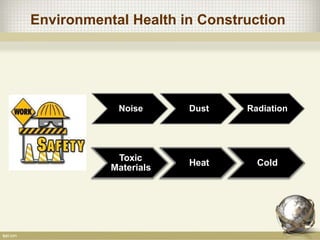
Environmental Health inConstruction
Noise Dust Radiation
Toxic Materials Heat Cold
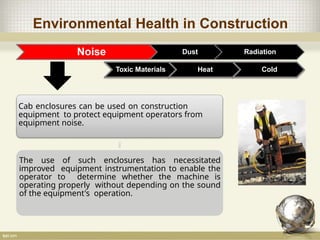
Cab enclosures can be used on construction
equipment to protect equipment operators from
equipment noise.
The use of such enclosures has necessitated
improved equipment instrumentation to enable the
operator to determine whether the machine is
operating properly without depending on the sound
of the equipment's operation.
20.
Environmental Health inConstruction
Noise Dust Radiation
Toxic Materials Heat Cold
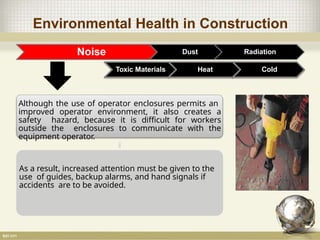
Although the use of operator enclosures permits an
improved operator environment, it also creates a
safety hazard, because it is difficult for workers
outside the enclosures to communicate with the
equipment operator.
As a result, increased attention must be given to the
use of guides, backup alarms, and hand signals if
accidents are to be avoided.
21.
Environmental Health inConstruction
Noise Dust Radiation
Toxic Materials
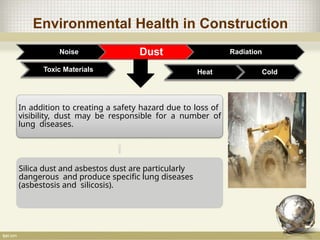
In addition to creating a safety hazard due to loss of
visibility, dust may be responsible for a number of
lung diseases.
Silica dust and asbestos dust are particularly
dangerous and produce specific lung diseases
(asbestosis and silicosis).
Heat Cold
22.
Environmental Health inConstruction
Noise Dust Radiation
Toxic Materials
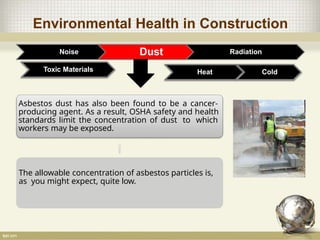
Asbestos dust has also been found to be a cancer-
producing agent. As a result, OSHA safety and health
standards limit the concentration of dust to which
workers may be exposed.
The allowable concentration of asbestos particles is,
as you might expect, quite low.
Heat Cold
23.
Environmental Health inConstruction
Noise Dust Radiation
Toxic Materials
Ionizing radiation is produced by X-ray equipment
and by radioactive material.
Such radiation may be present on the construction
site when X-raying welds, measuring soil density,
or performing nondestructive materials testing.
Heat Cold
24.
Environmental Health inConstruction
Noise Dust Radiation
Toxic Materials
only well-trained employees should be
permitted to operate such equipment.
Workers must be provided anti laser eye protection
when working in areas having a potential
exposure to laser light output greater than 5 mW.
Heat Cold
25.
Environmental Health inConstruction
Noise Dust Radiation
Toxic Materials
Construction workers may accidentally encounter
toxic materials at any time, particularly on
reconstruction projects.
Every effort must be made to locate and properly
protect utility lines during excavation operations.
Heat Cold
26.
Environmental Health inConstruction
Noise Dust Radiation
Toxic Materials
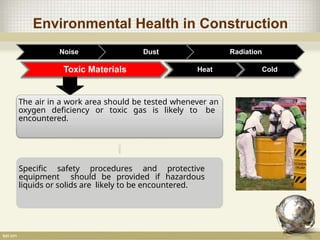
The air in a work area should be tested whenever an
oxygen deficiency or toxic gas is likely to be
encountered.
Specific safety procedures and protective
equipment should be provided if hazardous
liquids or solids are likely to be encountered.
Heat Cold
27.
Environmental Health inConstruction
Noise Dust Radiation
Toxic Materials
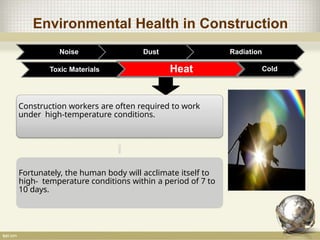
Construction workers are often required to work
under high-temperature conditions.
Fortunately, the human body will acclimate itself to
high- temperature conditions within a period of 7 to
10 days.
Heat Cold
28.
Environmental Health inConstruction
Noise Dust Radiation
Toxic Materials
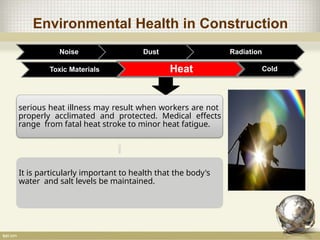
serious heat illness may result when workers are not
properly acclimated and protected. Medical effects
range from fatal heat stroke to minor heat fatigue.
It is particularly important to health that the body's
water and salt levels be maintained.
Heat Cold
29.
Environmental Health inConstruction
Noise Dust Radiation
Toxic Materials
Methods for reducing heat effect on workers
include:
-use of mechanical equipment to reduce physical
labor requirements,
- scheduling hot work for the cooler part of the day,
-use of sun shields, providing cool rest areas
[optimum temperatures about 77°F (25°C)],
-providing a water and salt supply easily accessible
to workers, and
-use of proper hot-weather clothing.
Heat Cold
30.
Environmental Health inConstruction
Noise Dust Radiation
Toxic Materials Heat Cold
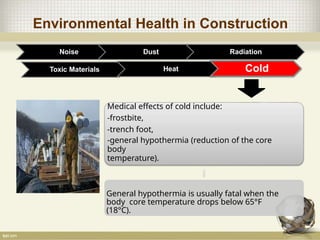
Medical effects of cold include:
-frostbite,
-trench foot,
-general hypothermia (reduction of the core
body
temperature).
General hypothermia is usually fatal when the
body core temperature drops below 65°F
(18°C).
31.
Environmental Health inConstruction
Noise Dust Radiation
Toxic Materials Heat Cold
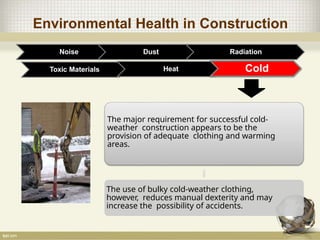
The major requirement for successful cold-
weather construction appears to be the
provision of adequate clothing and warming
areas.
The use of bulky cold-weather clothing,
however, reduces manual dexterity and may
increase the possibility of accidents.
32.
Basic Safety philosophyfor Success
Basic Safety philosophy for Success
All accidents are preventable.
No job is worth getting hurt
for. Every job will be done
safely. Incidents can be
managed.
Safety is everyone’s responsibility.
Continuous improvement.
Safety as a “way of life” for 24
hours/day
33.
Basic Safety Philosophyfor Success
Basic Safety philosophy for Success
All individuals have the responsibility and
accountability to identify eliminate or manage risks
associated with their workplace
Legal obligations will be the minimum
requirements fro our health & safety standards
Individual will be trained and equipped to have the
skills and facilities to ensure an accident free
workplace
34.
Construction Safety TrainingVideo
Introduction
http://www.youtube.com/watch?v=HEMeSRUHeAA&list=PLE0E1
94
0A2726E4AF
35.
Construction Safety TrainingVideo
Personal Protective Equipment
http://www.youtube.com/watch?v=hl0BfF30tlA&l
ist= PLE0E1940A2726E4AF
36.
Construction Safety TrainingVideo
Fall Protection
http://www.youtube.com/watch?v=adI_
Um
93xtw&list=PLE0E1940A2726E4AF
37.
Construction Safety TrainingVideo
Elevated Work Platforms
http://www.youtube.com/watch?v=hM81
CT
Gvwd8&list=PLE0E1940A2726E4AF
38.
Construction Safety TrainingVideo
Material Handling and Storage
http://www.youtube.com/watch?v=hM81
CT
Gvwd8&list=PLE0E1940A2726E4AF
39.
Construction Safety TrainingVideo
Power Tools and Electrical Safety
http://www.youtube.com/watch?v=CXga
hx
gTJUQ&list=PLE0E1940A2726E4AF
40.
Construction Safety TrainingVideo
Haz-Com Program
http://www.youtube.com/watch?v=-
MUGfIQ4f1U&list=PLE0E1940A2726E4AF
41.
Construction Safety TrainingVideo
Fire Protection
http://www.youtube.com/watch?v=1tnYy
DT
RHIo&list=PLE0E1940A2726E4AF
42.
Construction Safety TrainingVideo
Conclusion
http://www.youtube.com/watch?v=r1on
BO
OzopQ&list=PLE0E1940A2726E4AF

![Environmental Health in Construction
Noise Dust Radiation
Toxic Materials
Methods for reducing heat effect on workers
include:
-use of mechanical equipment to reduce physical
labor requirements,
- scheduling hot work for the cooler part of the day,
-use of sun shields, providing cool rest areas
[optimum temperatures about 77°F (25°C)],
-providing a water and salt supply easily accessible
to workers, and
-use of proper hot-weather clothing.
Heat Cold](https://image.slidesharecdn.com/constructionsafety-lecture-eaa-250903025056-cb6dc31d/85/safety_lecture_construction_safetyofficers-EAA-pptx-29-320.jpg)