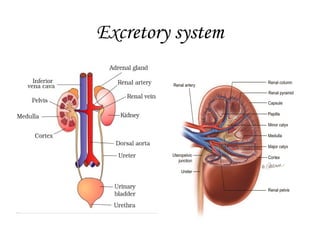
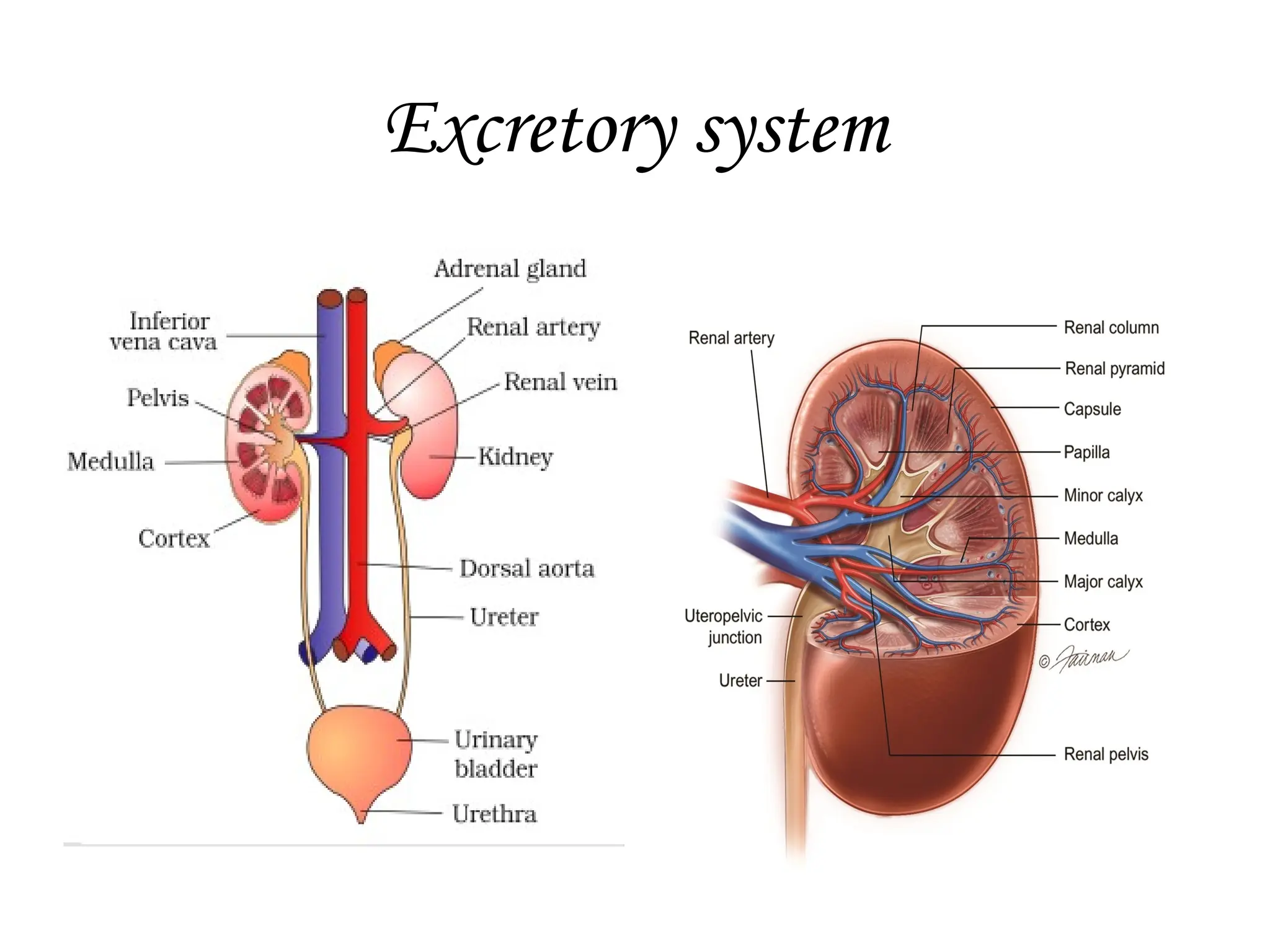
Excretory system
Excretory system
• The excretory system is the system of an organism's body that performs the
function of excretion, the bodily process of discharging wastes.
• The Excretory system is responsible for the elimination of wastes produced
by homeostasis.
• Certain waste products would become highly toxic if they were to
accumulate. This could damage tissues.
• Thus, the waste products must be removed – they continually
• move into the bloodstream, which carries them to theexcretory organs.
• There are several parts of the body that are involved in this process, such
as sweat glands, the liver, the lungs and the kidney system.
•
There
are
four
main
excretory
organs:
–
Lungs
–
Colon
–
Skin
–
Kidneys
excretory
organ,
but
produces
many
excreted
elsewhere.
Toxins
and
drugs
as
oken
down
in
the
liver.
Hence,
an
excess
tion
and
alcohol
is
extremely
harmful
to
•
The
carbon
dioxide
released
from
cellular
respira
carried
to
the
lungs
in
the
blood.
It
then
diffuses
a
respiratory
membrane
and
is
exhaled.
small
amount
of
heat
and
water
is
excreted
this
way.
the
break
down
of
haemoglobin,
and
hesised
in
the
liver.
small
intestine
as
bile
and
are
finally
es
as
bile
salts,
from
the
colon.
a
are
too
excreted
through
the
colon.
•
Sweat,
which
is
excreted
through
the
skin,
contain
salts
and
some
urea.
•
As
the
water
in
the
sweat
is
excreted,
heat
is
lost
body
is
cooled.
a
form
of
excretion
as
it
rids
the
body
of
waste,
as
orm
of
secretion
as
it
maintains
the
body
re.
•
When
amino
acids
and
nucleic
acids
are
broken
dow
nitrogenous
wastes
are
released
as
ammonia,
urea,
u
and
creatinine.
Ammonia
is
toxic
if
it
accumulates
and
therefore
converted
to
less
toxic
urea
in
the
liver.
wing
substances
are
made
in
the
liver
and
excreted
by
the
kidneys:
nitrogenous
waste
compound
secreted.
It
is
formed
by
excess
amino
acids
in
the
process
of
deamination.
trogenous
end
product
of
nucleic
acid
metabolism.
m
creatinine
phosphate,
found
in
the
muscle
cells.
CO2,
excess
water,
ions,
hormones,
s
and
drugs.
•
The
main
function
of
the
urinary
system
is
to
maintai
homeostasis
by
regulating
the
volume
and
concentrati
body
fluids.
It
filters
and
reabsorbs
certain
materials
fr
blood.
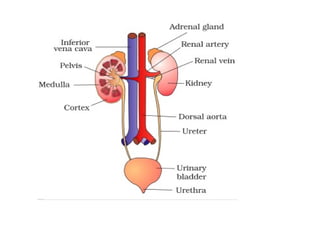
ary
system
is
made
up
of
the
following
parts:
A)
Two
kidneys
B)
A
bladder
C)
An
urethra
•
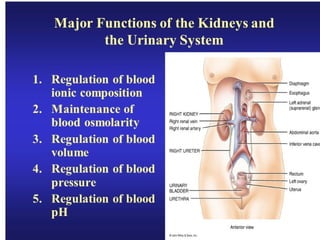
The
kidneys
aid
in:
excretion
as
they
filter
waste
out
of
the
blood
regulate
the
water
and
salt
balance
in
the
body.
One
kidney
–
the
right
kidney
–
is
slightly
lower
than
the
left
as
it
pushed
down
by
the
liver,
which
is
larger
on
the
right.
•
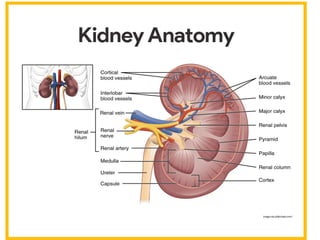
Each
kidney
contains:
nch
of
the
abdominal
aorta),
which
carries
waste
y
and
supplies
the
kidneys
with
oxygen
and
ntains
the
purest
blood
in
the
body.
It
carries
CO2
va.
rine
from
the
kidney
to
the
bladder.
•
Stores
urine
stimulated
by
impulses
from
a
motor
nerve,
to
contra
the
urine.
phincter
muscles
at
the
base
to
control
the
flow
of
uri
e
from
the
bladder
to
outside
the
body
Excretory system structure and function of

Excretory system structure and function of