EXCRETA DISPOSAL AND
SANITATION BARRIER
PUBLIC HEALTH IMPORTANCE
Human excreta is a source of infection. It is an important cause of environmental pollution. Every
society has a responsibility for its safe removal and disposal so that it does not constitute a threat
to public health.
The HEALTH HAZARDS of improper excreta disposal are:
(1) soil pollution,
(2) water pollution,
(3) contamination of foods, and
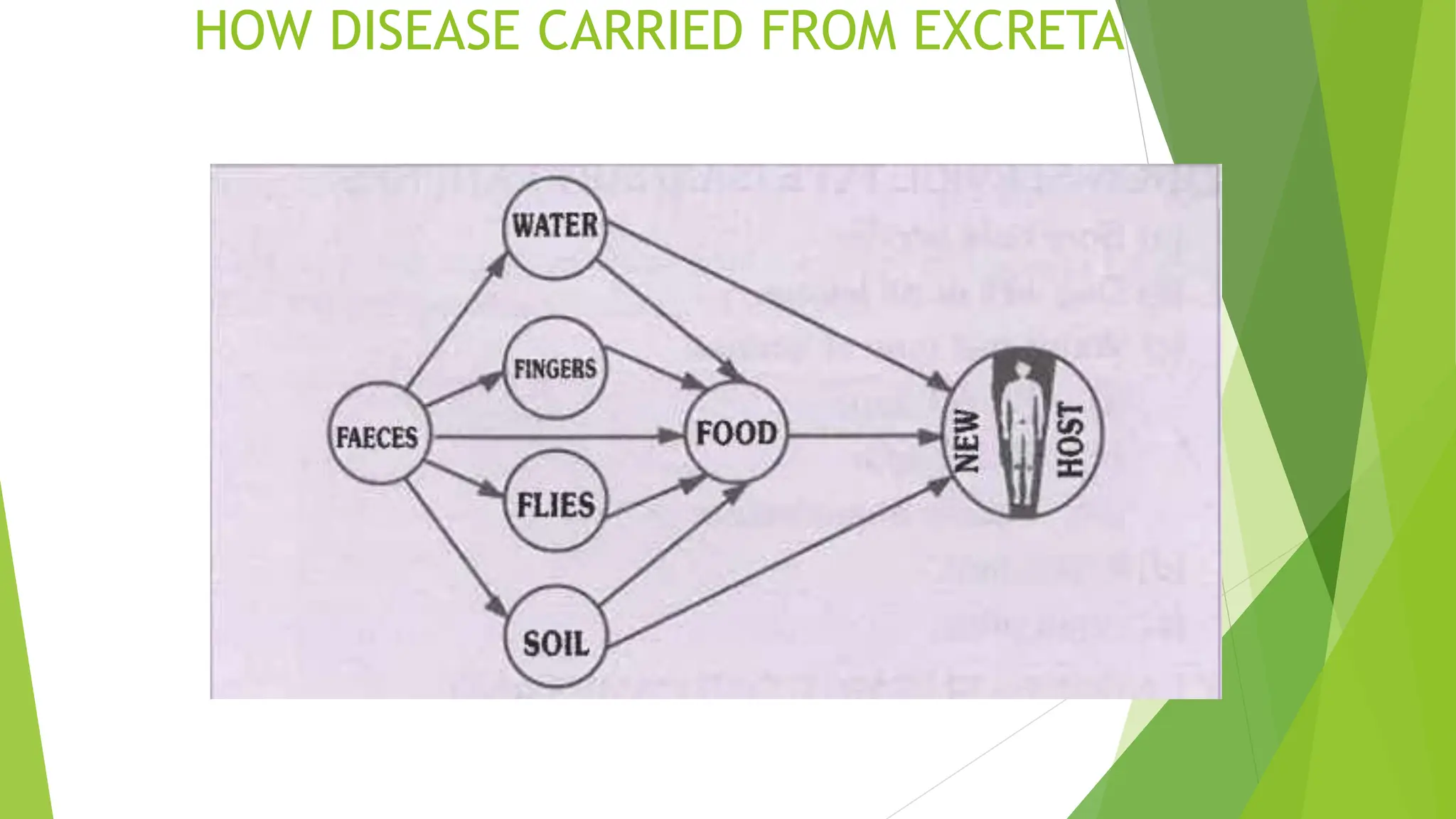
(4) propagation of flies. Fig.1
The resulting diseases are typhoid and paratyphoid fever, dysenteries, diarrhoeas, cholera,
hookworm disease, ascariasis, viral hepatitis and similar other intestinal infections and parasitic
infestations. These diseases are not only a burden on the community in terms of sickness, mortality
and a low expectation of life, but a basic deterrent to social and economic progress. Proper disposal
of human excreta, therefore, is a fundamental environmental health service without which there
cannot be any improvement in the state of community health
HOW DISEASE CARRIED FROM EXCRETA
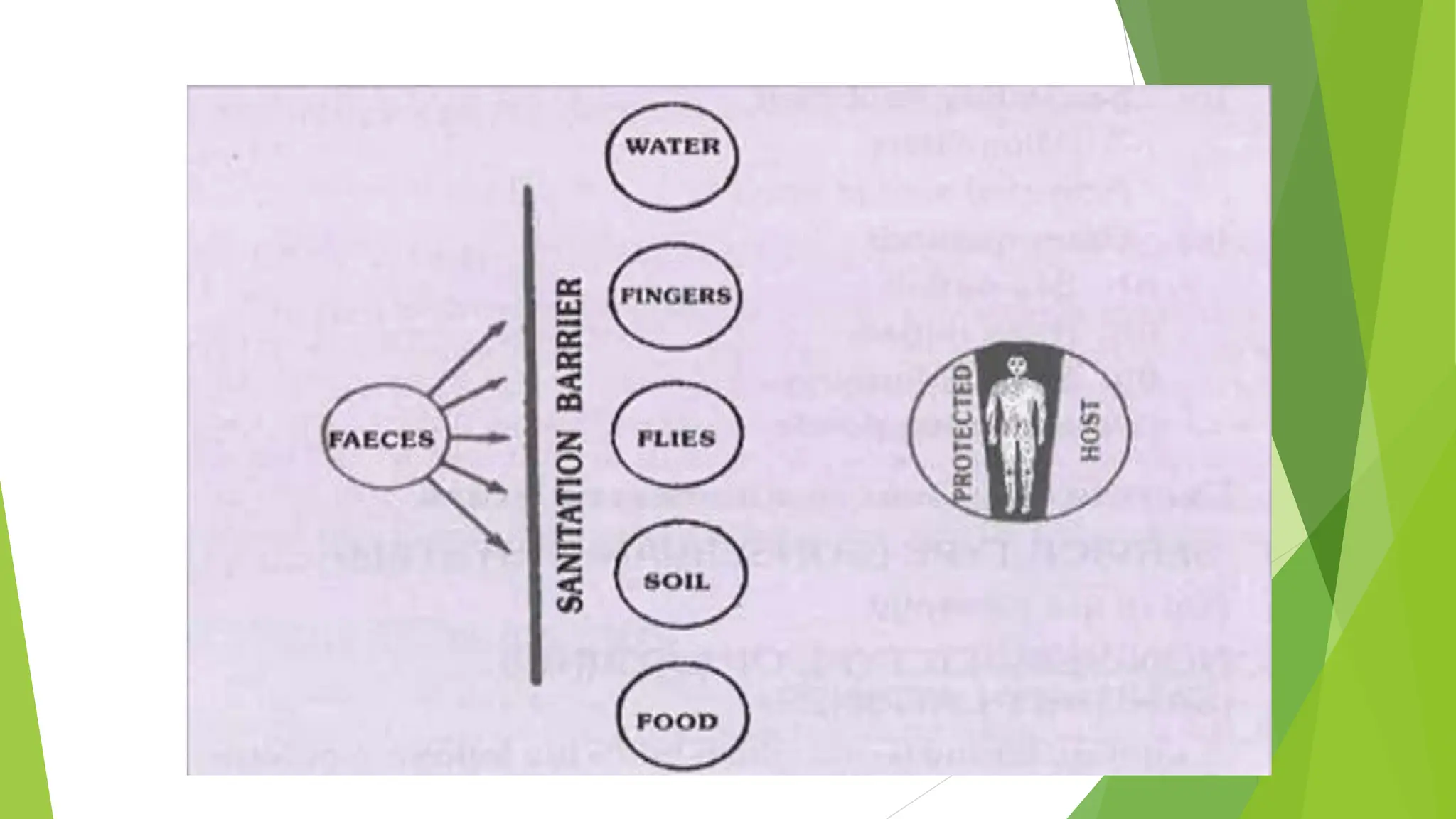
SANITATION BARRIER
 The disease cycle may be broken at various levels: segregation of faeces,
protection of water supplies, protection of foods, personal hygiene and
control of flies. Of these, the most effective step would be to segregate the
faeces and arrange for its proper disposal so that the disease agent cannot
reach the new host, directly or indirectly. Fig. 2 shows the segregation of the
excreta by imposing a barrier called the "sanitation barrier"in simple terms,
this barrier can be provided by a 'sanitary latrine' and a disposal pit. The more
elaborate schemes envisage installation of a sewerage system and sewage
treatment plants.
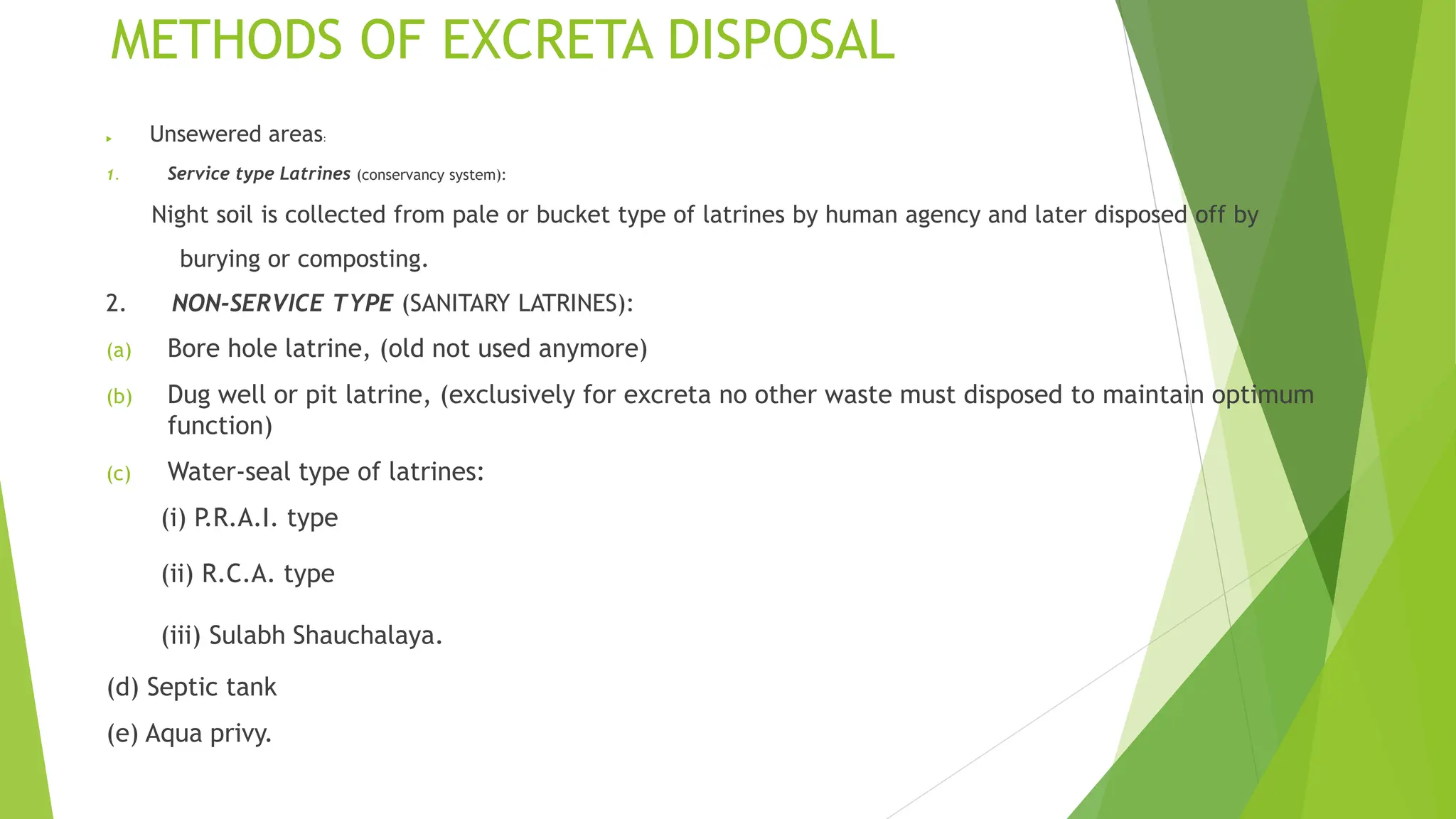
METHODS OF EXCRETA DISPOSAL
 Unsewered areas:
1. Service type Latrines (conservancy system):
Night soil is collected from pale or bucket type of latrines by human agency and later disposed off by
burying or composting.
2. NON-SERVICE TYPE (SANITARY LATRINES):
(a) Bore hole latrine, (old not used anymore)
(b) Dug well or pit latrine, (exclusively for excreta no other waste must disposed to maintain optimum
function)
(c) Water-seal type of latrines:
(i) P.R.A.I. type
(ii) R.C.A. type
(iii) Sulabh Shauchalaya.
(d) Septic tank
(e) Aqua privy.
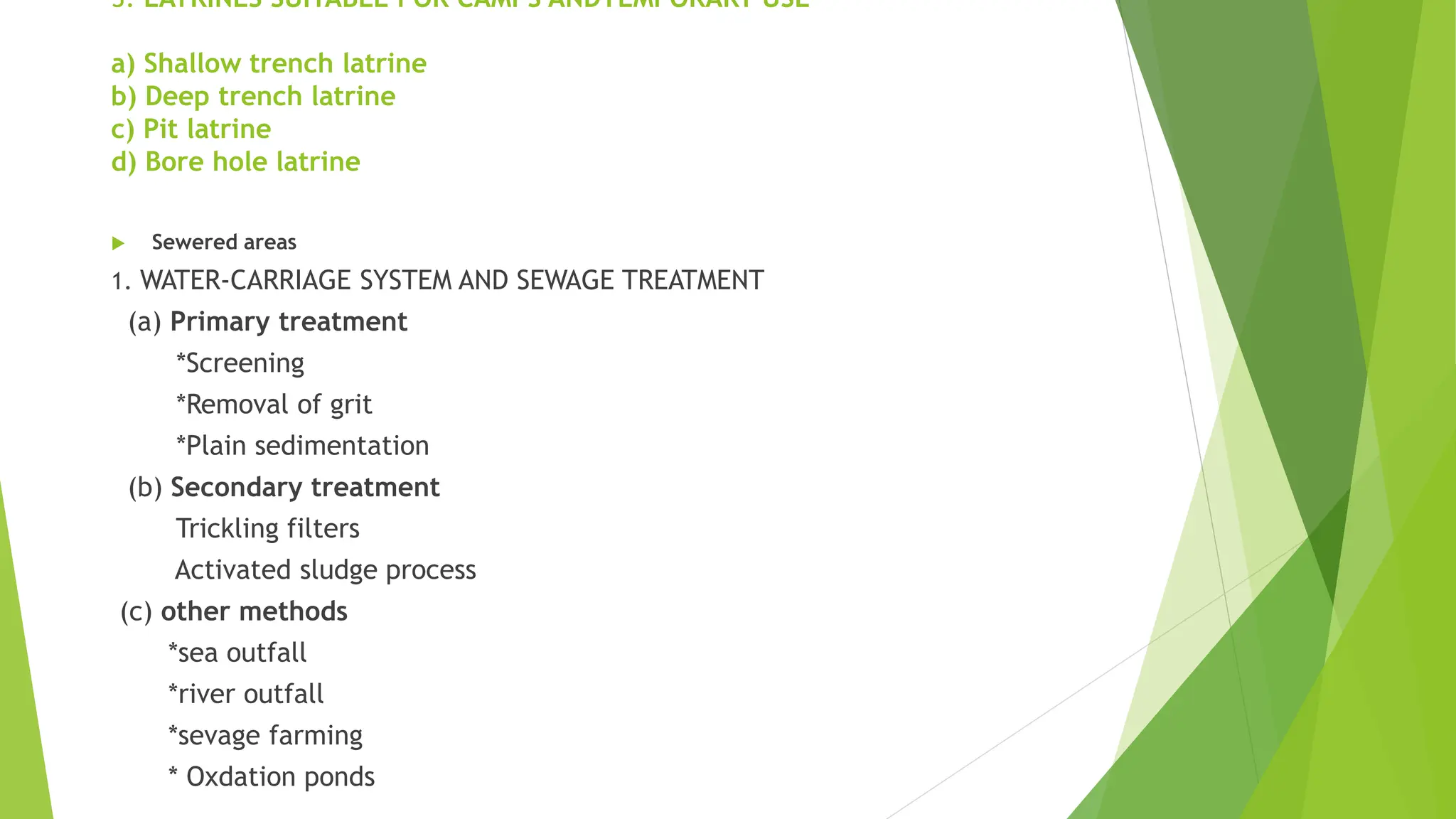
3. LATRINES SUITABLE FOR CAMPS ANDTEMPORARY USE
a) Shallow trench latrine
b) Deep trench latrine
c) Pit latrine
d) Bore hole latrine
 Sewered areas
1. WATER-CARRIAGE SYSTEM AND SEWAGE TREATMENT
(a) Primary treatment
*Screening
*Removal of grit
*Plain sedimentation
(b) Secondary treatment
Trickling filters
Activated sludge process
(c) other methods
*sea outfall
*river outfall
*sevage farming
* Oxdation ponds
NON-SERVICE TYPE (SANITARY
LATRINES):
Features of Non Service type
(Sanitary Latrines)
1. Squating plate (3x 3ft)
2. ‘S’ shaped bend pipe called trap with
water level of 2.5 cm, it makes it
sanitary as it prevent bad odour to come
out or insects from going in.
3. pipe connecting to main sevage of
size 3 inches x 3 ft.
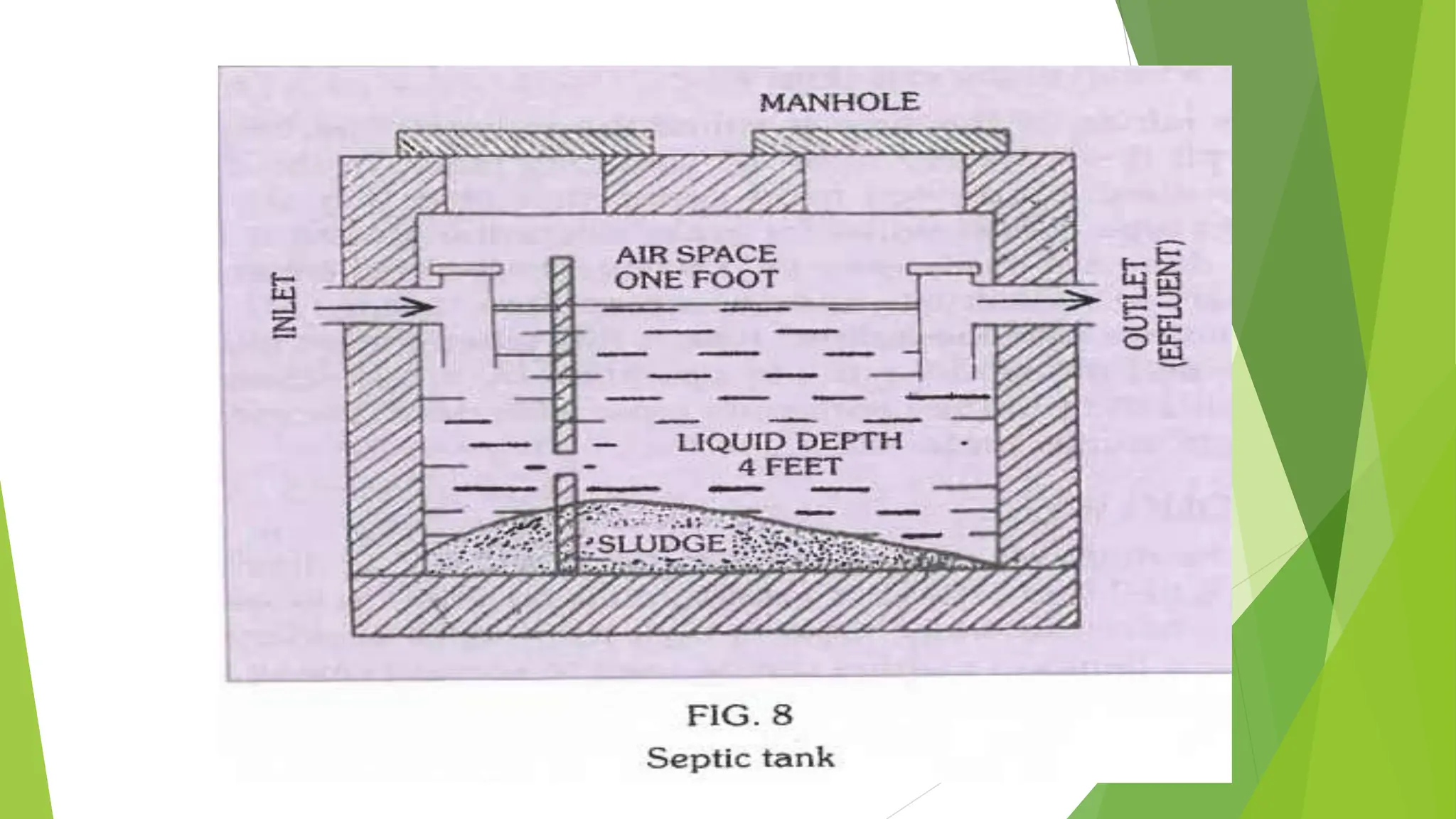
SEPTIC TANK
An ideal system for hygienic final disposal of excreta in the absence of a central
sewerage system.Excreta from many pour-flush latrines can be discharged into a
septic tank.Designed to collect and treat excreta and toilet wastewater. Use is
likely to be appropriate where- the volume of wastewater produced is too large
for disposal in pit latrines,- water-borne sewerage is uneconomic or
unaffordable. Particularly suited to systems involving high water use, especially
where water is used for flushing and anal-cleansing. Difficult to manage for very
large populations. Best suited to single households or a group of households or
institutions such as hospitals or schools. The efficiency of a septic tank system is
inferior to the sewage works but is much cheaper, quicker and easier to provide
and maintain than sewage works.
Communal Aqua-Privies
 An aqua-privy is a latrine constructed directly above a septic tank.
 Aqua-privies are appropriate where pit latrines are unacceptable.
 The amount of water required for flushing is much smaller than for a septic-tank due to the location of the tank.
 It helps to exclude odours from the superstructure. Not more than four families per latrine.
Advantages:
 Reduced odour;
 ideal where water is used for anal- cleansing; easy to clean.
Constraints :
 Increased quantity of water required.
 solid analcleansing materials may cause blockages; more expensive and difficult to construct than simple pit
latrines.
SULABH SHAUCHALAYA
 The "Sulabh Shauchalaya" model, the invention of a Patna-based firm.
 low cost pour-flush
 Water-seal type of latrine, which is now being used in many parts of India.
 Basically it is an improved version of the standard handflush latrine (e.g., RCA
type).
 It consists of a specially designed pan and a water-seal trap. It is connected to a
pit 3 feet square and deep. Excreta undergoes bacterial as decomposition and is
converted to manure (compost).
 The method requires very little water.
 Sulabh International, the investors, not only build but also maintain the system of
Sulabh Community Latrines. Their usual structure is a lavatory block of several
dozen seats, with a bathing block adjoining. The system is to charge Rs. 5 per
user. Delhi has opted for this system in all its slums. This system has drawn praise
from ecologists and planners.
EXTCRETA DISPOSAL MEHTOD –SEWER
FACILITY
 Sewage treatment plant:
sewage go through different processes:-
a) Primary treatment-
* Screen – filters out metallic objects
* Grit chamber solid particles settles down
* Primary sedimentation tank- sewage stays for 6-8 hrs
reduction in coliform by 30 to 40%
b) Secondary treatment can use trickling filters-
*air treats sewage by while passing through these filters.
Reference: PARK’S TEXT BOOK FOR
COMMMUNITY MEDCINE
THANKYOU
DR ANKITA
PG-JR 1

excreta disposal and sanitation barrier.

  • 1.
  • 2.
    PUBLIC HEALTH IMPORTANCE Humanexcreta is a source of infection. It is an important cause of environmental pollution. Every society has a responsibility for its safe removal and disposal so that it does not constitute a threat to public health. The HEALTH HAZARDS of improper excreta disposal are: (1) soil pollution, (2) water pollution, (3) contamination of foods, and (4) propagation of flies. Fig.1 The resulting diseases are typhoid and paratyphoid fever, dysenteries, diarrhoeas, cholera, hookworm disease, ascariasis, viral hepatitis and similar other intestinal infections and parasitic infestations. These diseases are not only a burden on the community in terms of sickness, mortality and a low expectation of life, but a basic deterrent to social and economic progress. Proper disposal of human excreta, therefore, is a fundamental environmental health service without which there cannot be any improvement in the state of community health
  • 3.
    HOW DISEASE CARRIEDFROM EXCRETA
  • 4.
    SANITATION BARRIER  Thedisease cycle may be broken at various levels: segregation of faeces, protection of water supplies, protection of foods, personal hygiene and control of flies. Of these, the most effective step would be to segregate the faeces and arrange for its proper disposal so that the disease agent cannot reach the new host, directly or indirectly. Fig. 2 shows the segregation of the excreta by imposing a barrier called the "sanitation barrier"in simple terms, this barrier can be provided by a 'sanitary latrine' and a disposal pit. The more elaborate schemes envisage installation of a sewerage system and sewage treatment plants.
  • 6.
    METHODS OF EXCRETADISPOSAL  Unsewered areas: 1. Service type Latrines (conservancy system): Night soil is collected from pale or bucket type of latrines by human agency and later disposed off by burying or composting. 2. NON-SERVICE TYPE (SANITARY LATRINES): (a) Bore hole latrine, (old not used anymore) (b) Dug well or pit latrine, (exclusively for excreta no other waste must disposed to maintain optimum function) (c) Water-seal type of latrines: (i) P.R.A.I. type (ii) R.C.A. type (iii) Sulabh Shauchalaya. (d) Septic tank (e) Aqua privy.
  • 7.
    3. LATRINES SUITABLEFOR CAMPS ANDTEMPORARY USE a) Shallow trench latrine b) Deep trench latrine c) Pit latrine d) Bore hole latrine  Sewered areas 1. WATER-CARRIAGE SYSTEM AND SEWAGE TREATMENT (a) Primary treatment *Screening *Removal of grit *Plain sedimentation (b) Secondary treatment Trickling filters Activated sludge process (c) other methods *sea outfall *river outfall *sevage farming * Oxdation ponds
  • 8.
  • 9.
    Features of NonService type (Sanitary Latrines) 1. Squating plate (3x 3ft) 2. ‘S’ shaped bend pipe called trap with water level of 2.5 cm, it makes it sanitary as it prevent bad odour to come out or insects from going in. 3. pipe connecting to main sevage of size 3 inches x 3 ft.
  • 10.
    SEPTIC TANK An idealsystem for hygienic final disposal of excreta in the absence of a central sewerage system.Excreta from many pour-flush latrines can be discharged into a septic tank.Designed to collect and treat excreta and toilet wastewater. Use is likely to be appropriate where- the volume of wastewater produced is too large for disposal in pit latrines,- water-borne sewerage is uneconomic or unaffordable. Particularly suited to systems involving high water use, especially where water is used for flushing and anal-cleansing. Difficult to manage for very large populations. Best suited to single households or a group of households or institutions such as hospitals or schools. The efficiency of a septic tank system is inferior to the sewage works but is much cheaper, quicker and easier to provide and maintain than sewage works.
  • 12.
    Communal Aqua-Privies  Anaqua-privy is a latrine constructed directly above a septic tank.  Aqua-privies are appropriate where pit latrines are unacceptable.  The amount of water required for flushing is much smaller than for a septic-tank due to the location of the tank.  It helps to exclude odours from the superstructure. Not more than four families per latrine. Advantages:  Reduced odour;  ideal where water is used for anal- cleansing; easy to clean. Constraints :  Increased quantity of water required.  solid analcleansing materials may cause blockages; more expensive and difficult to construct than simple pit latrines.
  • 13.
    SULABH SHAUCHALAYA  The"Sulabh Shauchalaya" model, the invention of a Patna-based firm.  low cost pour-flush  Water-seal type of latrine, which is now being used in many parts of India.  Basically it is an improved version of the standard handflush latrine (e.g., RCA type).  It consists of a specially designed pan and a water-seal trap. It is connected to a pit 3 feet square and deep. Excreta undergoes bacterial as decomposition and is converted to manure (compost).  The method requires very little water.  Sulabh International, the investors, not only build but also maintain the system of Sulabh Community Latrines. Their usual structure is a lavatory block of several dozen seats, with a bathing block adjoining. The system is to charge Rs. 5 per user. Delhi has opted for this system in all its slums. This system has drawn praise from ecologists and planners.
  • 14.
    EXTCRETA DISPOSAL MEHTOD–SEWER FACILITY  Sewage treatment plant: sewage go through different processes:- a) Primary treatment- * Screen – filters out metallic objects * Grit chamber solid particles settles down * Primary sedimentation tank- sewage stays for 6-8 hrs reduction in coliform by 30 to 40% b) Secondary treatment can use trickling filters- *air treats sewage by while passing through these filters.
  • 16.
    Reference: PARK’S TEXTBOOK FOR COMMMUNITY MEDCINE THANKYOU DR ANKITA PG-JR 1