Excellence in the Android User
Experience
Roman Nurik
Roman Nurik
Android Developer Advocate
Google
@romannurik


I care about icons, and
I think you should too ;-)
Where does the
user experience
begin?
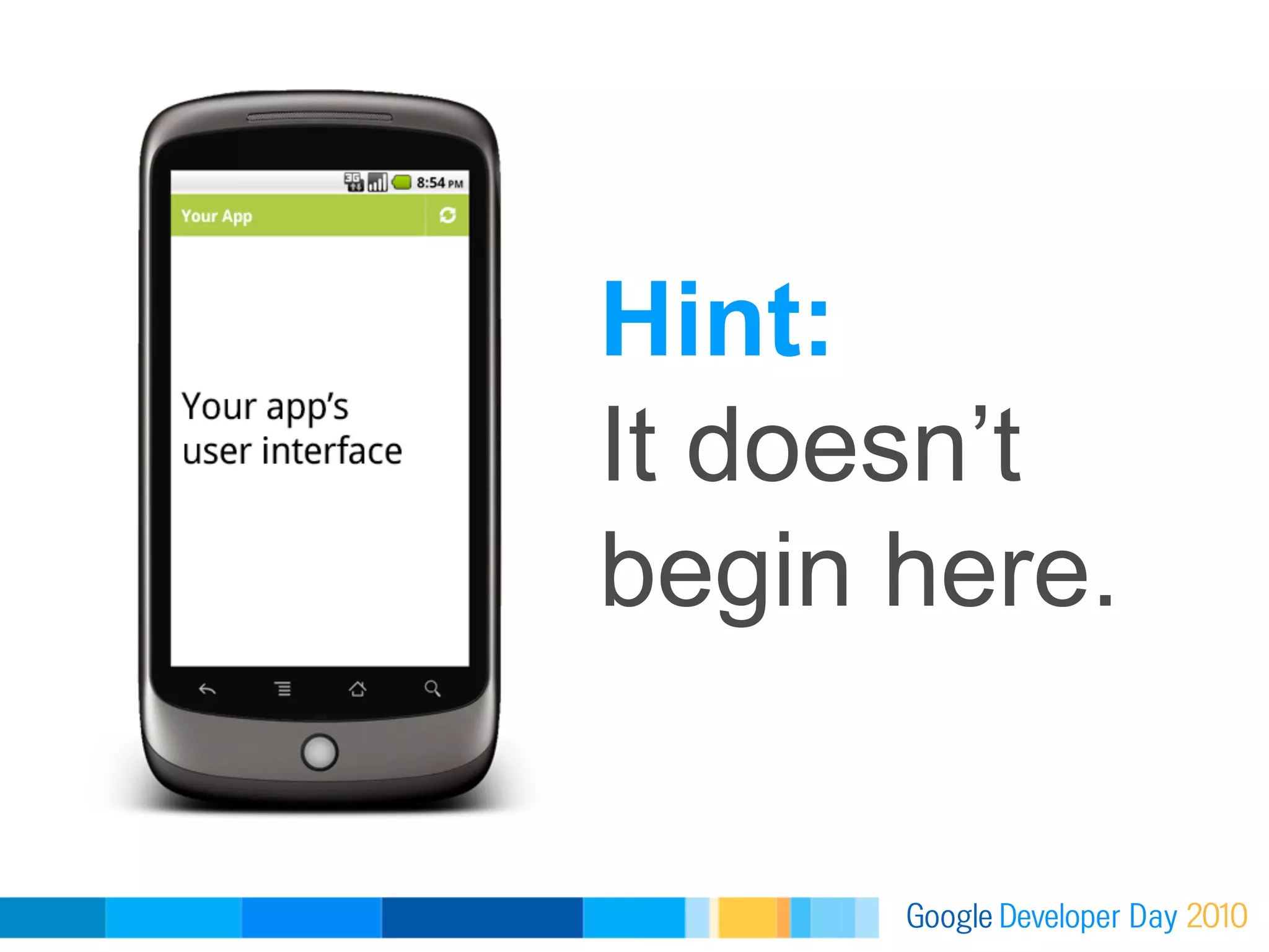
Hint:
It doesn’t
begin here.
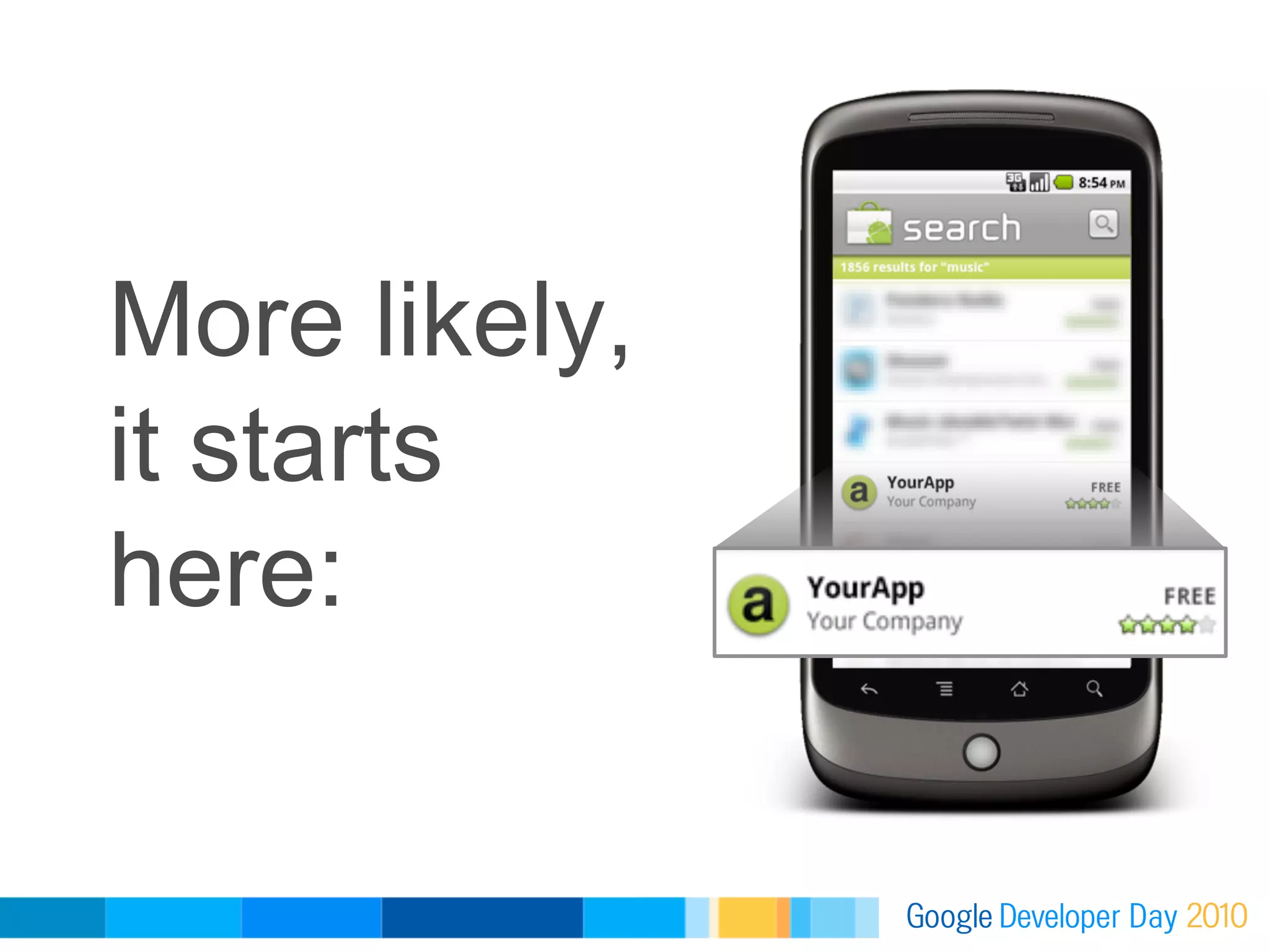
More likely,
it starts
here:
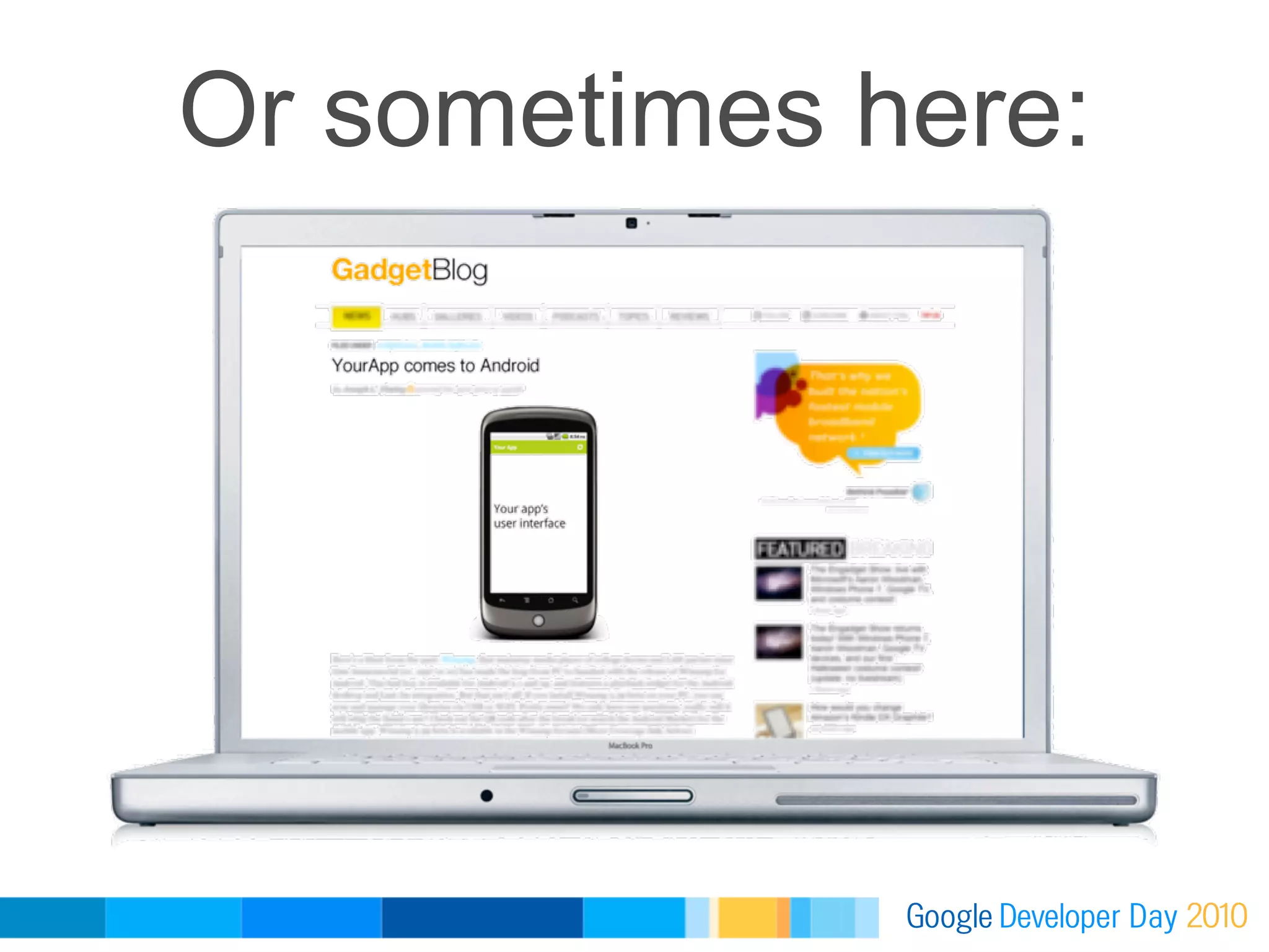
Or sometimes here:
And where does
user experience
extend to?
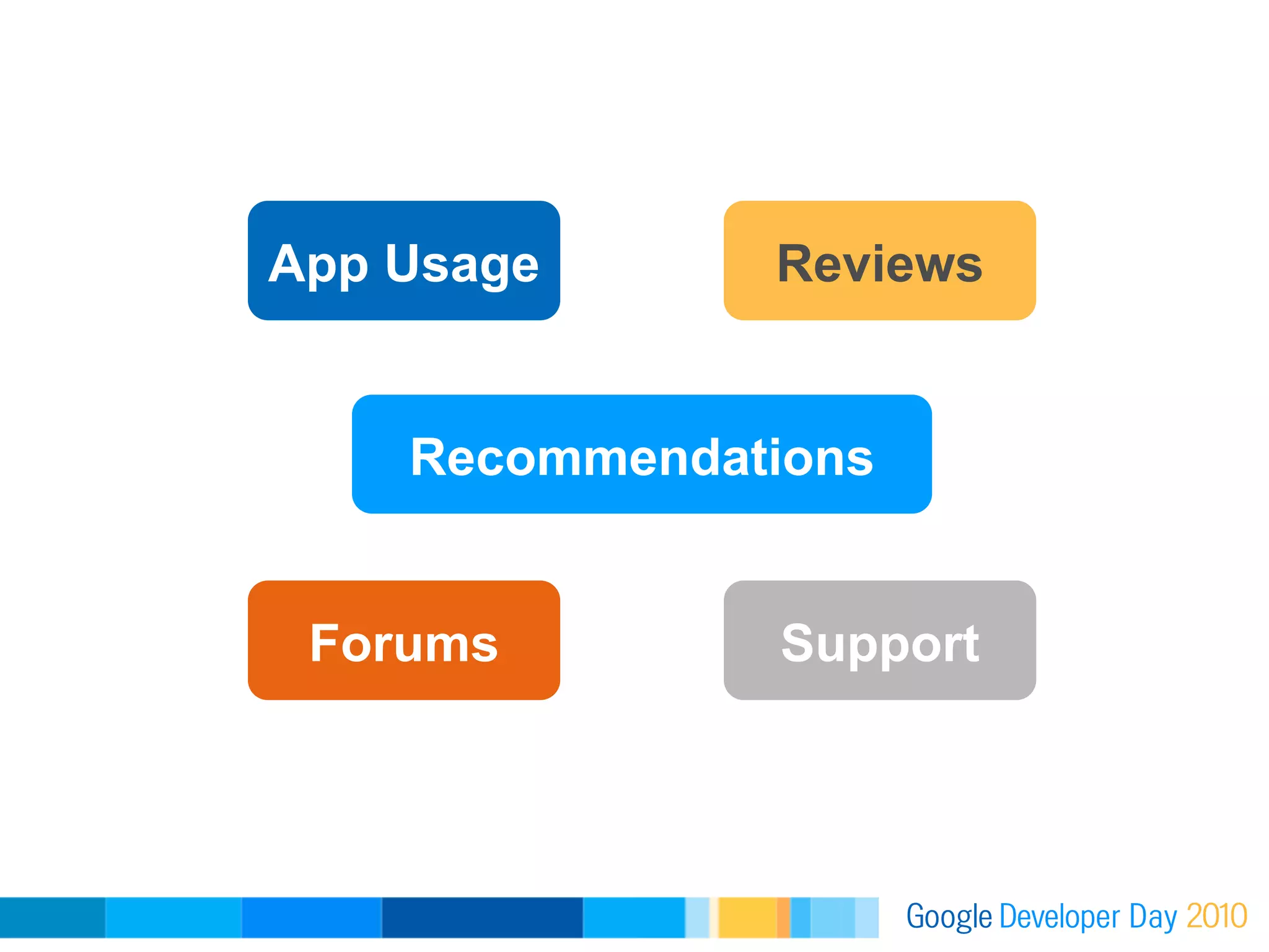
App Usage      Reviews


    Recommendations


 Forums        Support
Agenda
1.  Making a great first impression
2.  Designing for ease of use
3.  UI design + dev tips
4.  New tools
5.  Continuing to impress the user
Making a great
first impression
You can start
setting appropriate expectations and
impressing the user
sooner than you think:


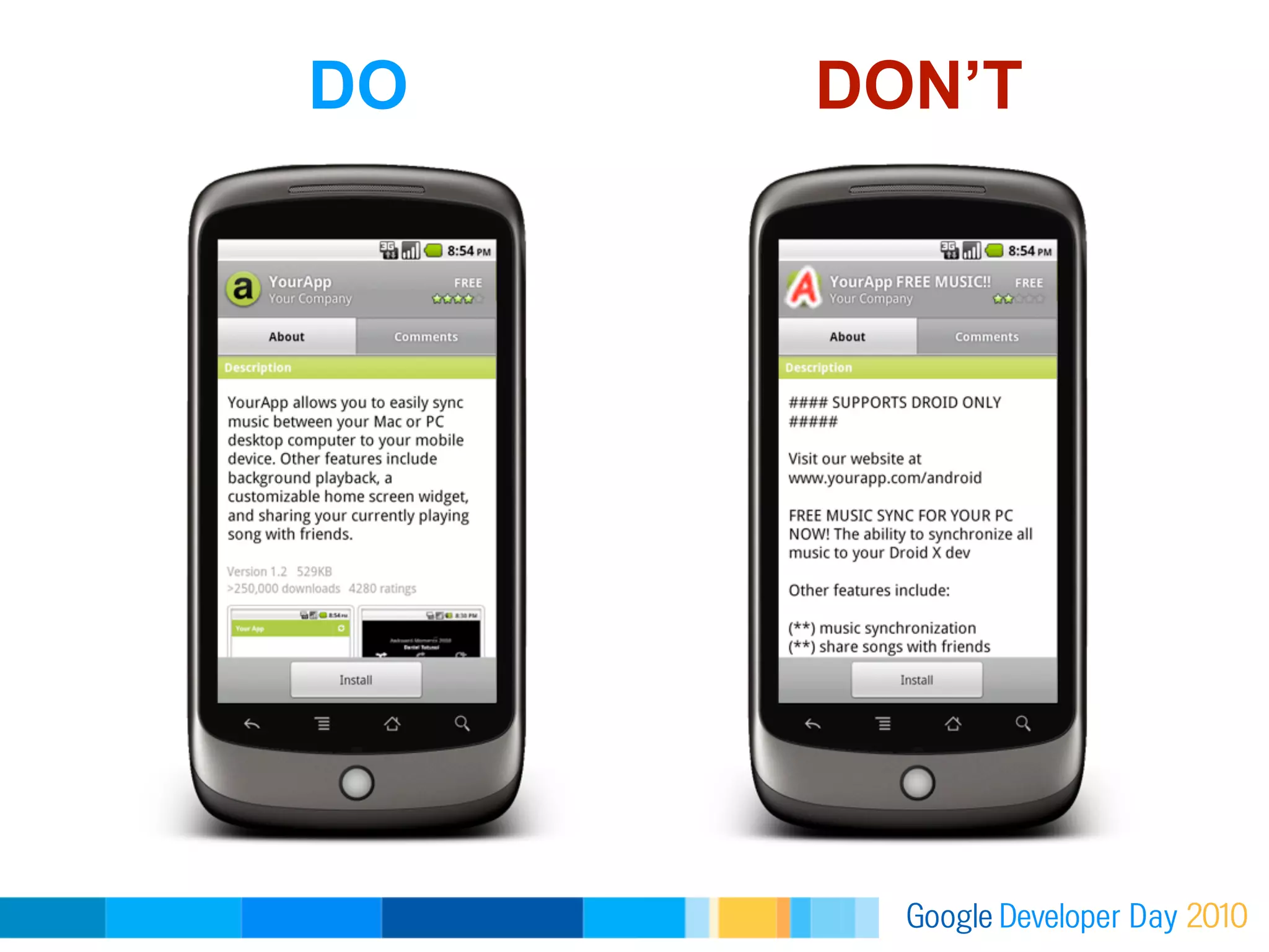
  Have a clean, beautiful and guideline-friendly icon
  Have a unique and appropriate listing title
  Have an honest and useful listing description
DO   DON’T
You don’t always have control over the
first impression.


  Press and word-of-mouth reviews
  User’s previous exposure to your brand
  Market ratings


Improving the quality of your app will help positively
influence these factors.
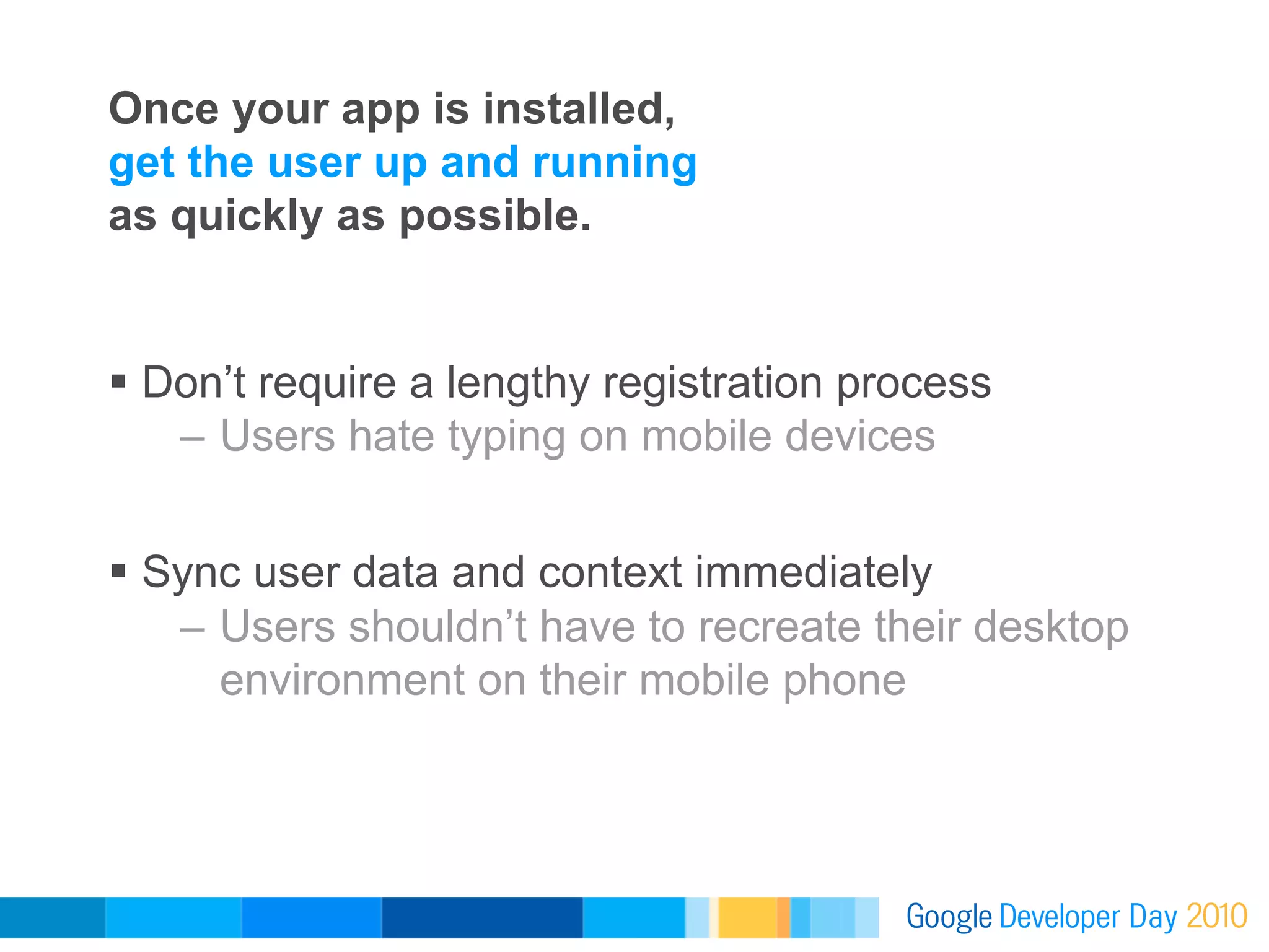
Once your app is installed,
get the user up and running
as quickly as possible.


  Don’t require a lengthy registration process
    –  Users hate typing on mobile devices


  Sync user data and context immediately
    –  Users shouldn’t have to recreate their desktop
       environment on their mobile phone
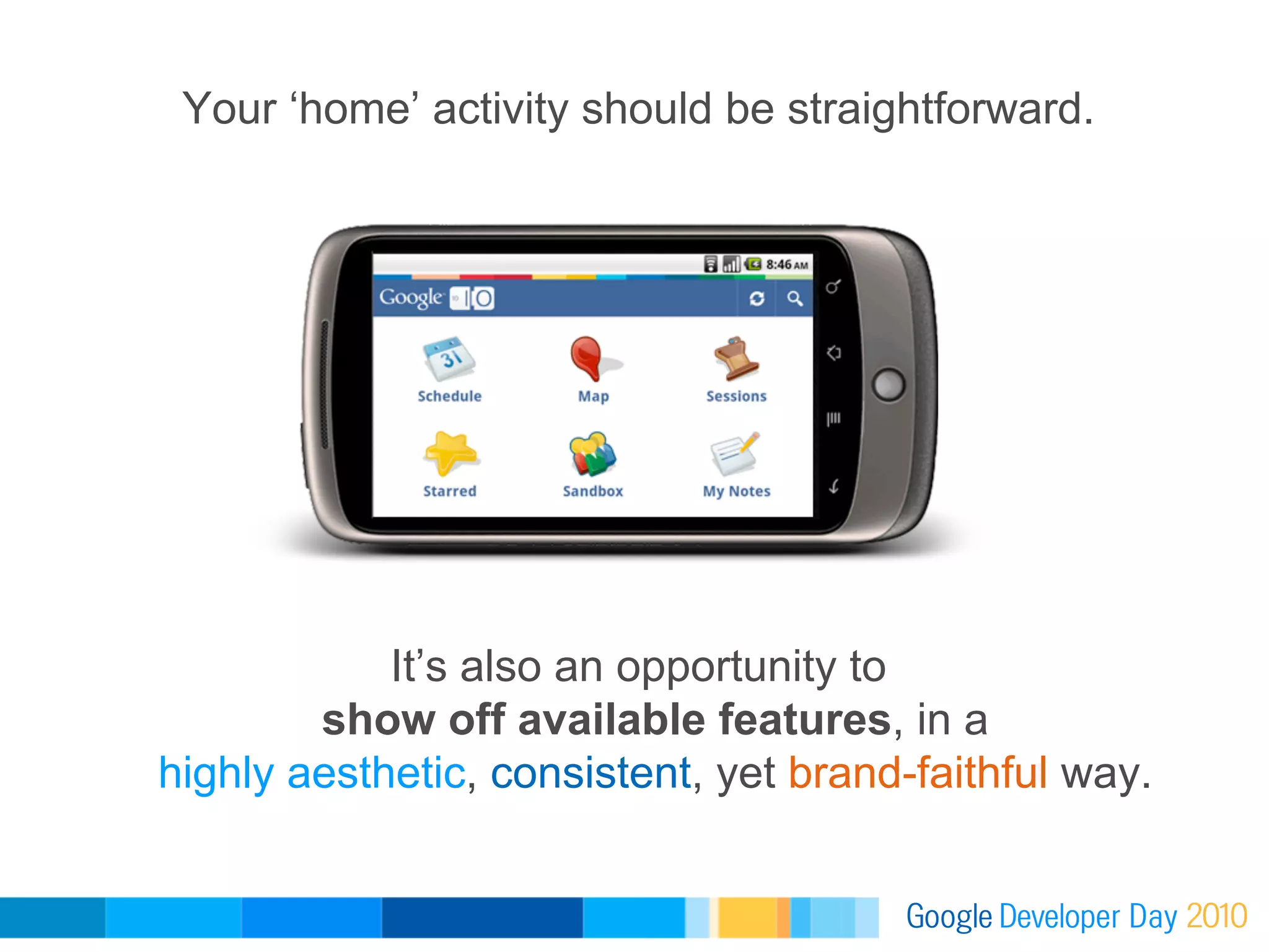
Your ‘home’ activity should be straightforward.


            It’s also an opportunity to
        show off available features, in a
highly aesthetic, consistent, yet brand-faithful way.
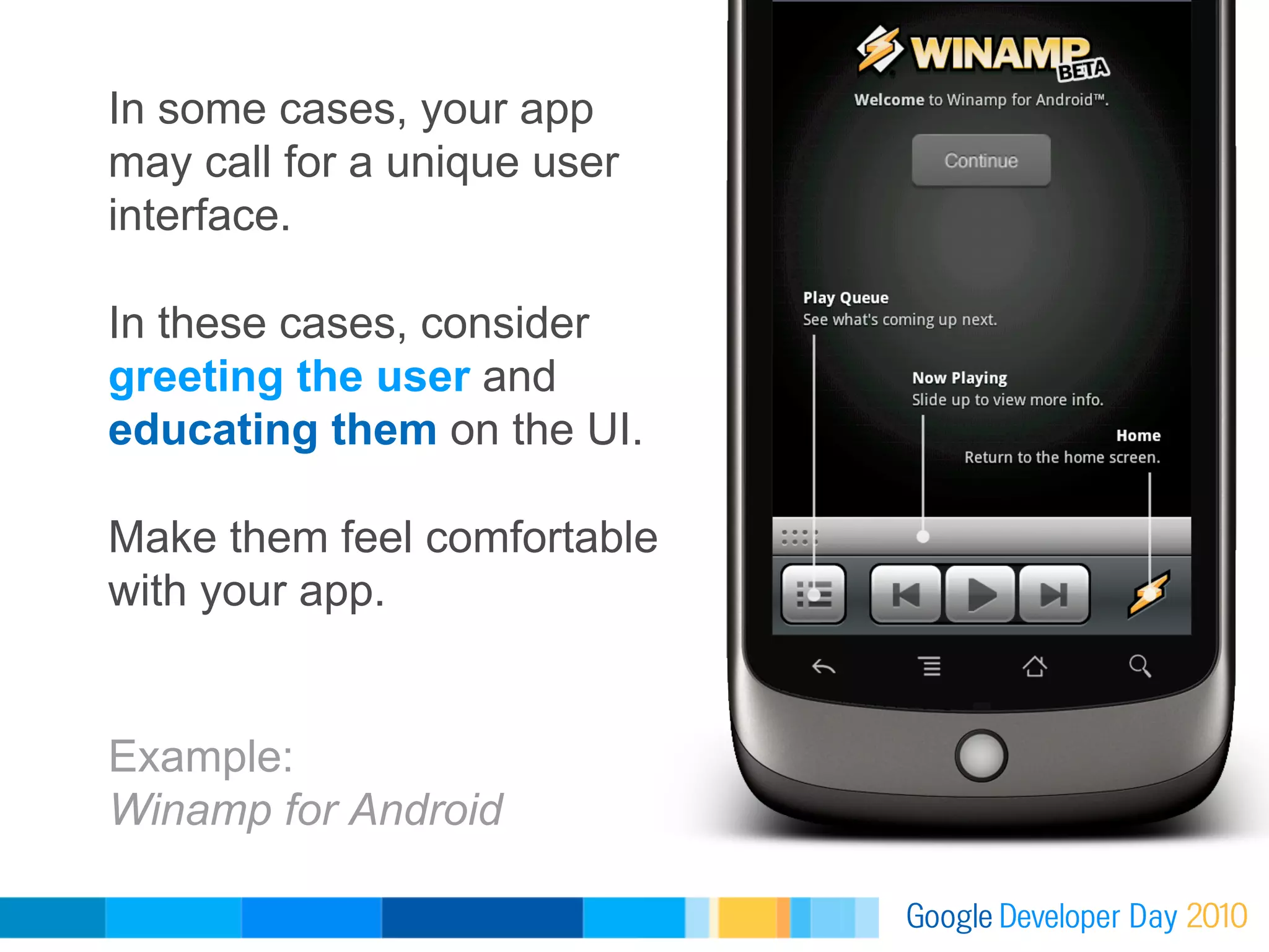
In some cases, your app
may call for a unique user
interface.

In these cases, consider
greeting the user and
educating them on the UI.

Make them feel comfortable
with your app.


Example:
Winamp for Android
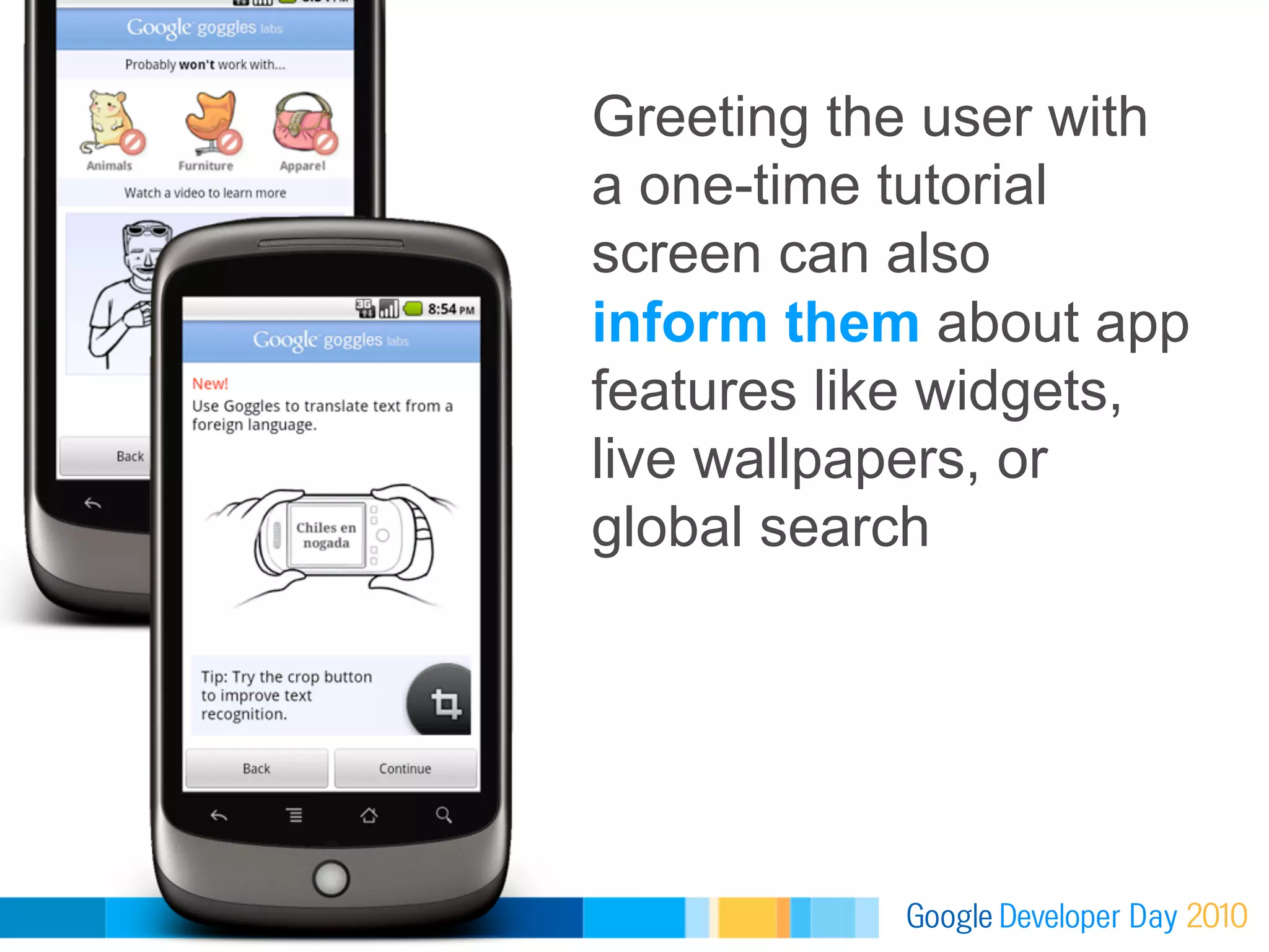
Greeting the user with
a one-time tutorial
screen can also
inform them about app
features like widgets,
live wallpapers, or
global search
Designing for
ease of use
Clarity begets ease of use.


An ideal design process:
1.  Lay out your information hierarchy
    and data model
2.  Choose a primary UI navigation pattern
3.  Sketch or otherwise prototype your UI
DO                     DON’T
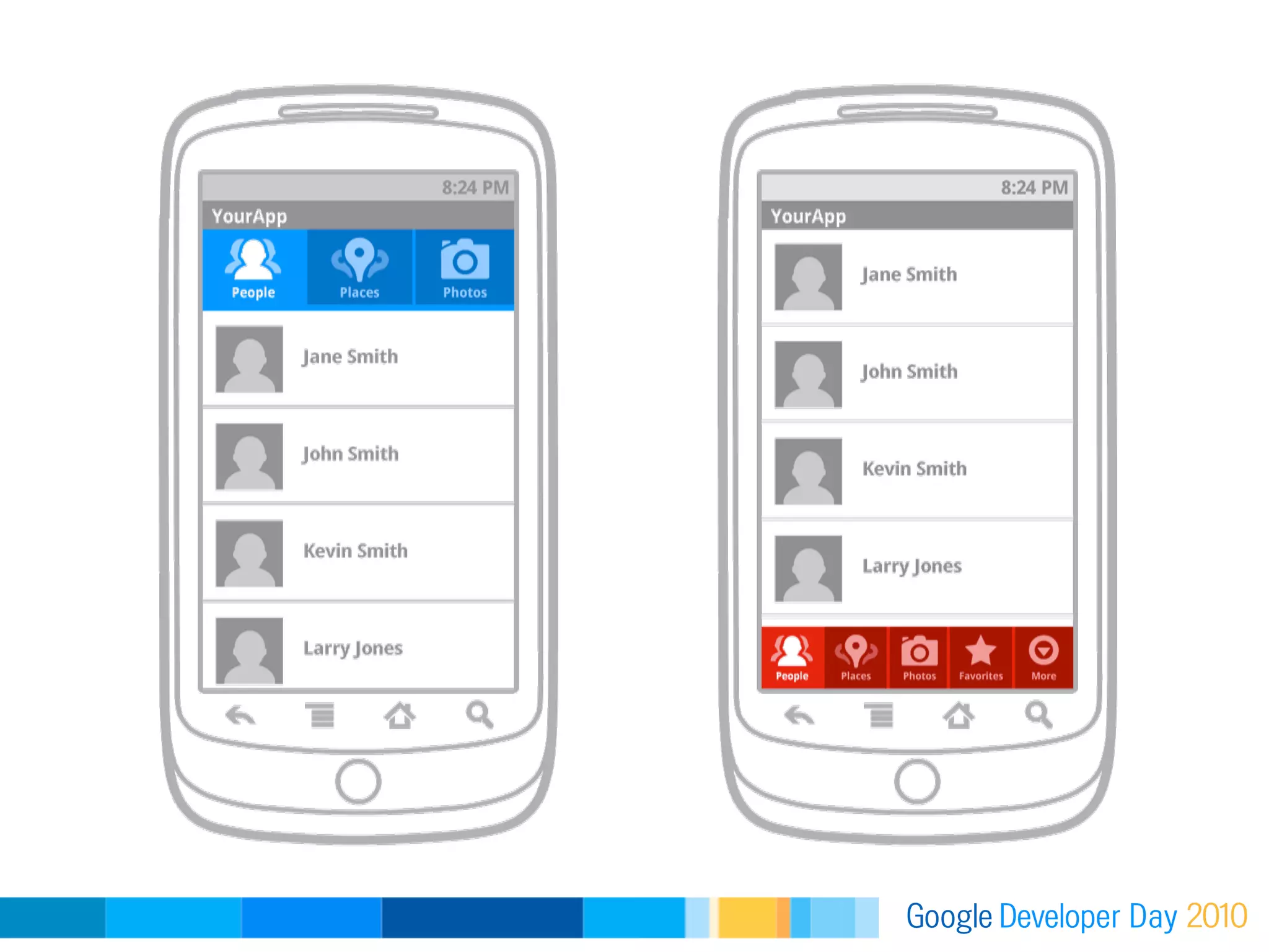
  Dashboard +              5+ tabs or bottom tabs
   Action bar
                            Navigation sections
  Top tabs (up to 4)        in options menu
  Sliding top tabs         On-screen back button
   (homogenous content)
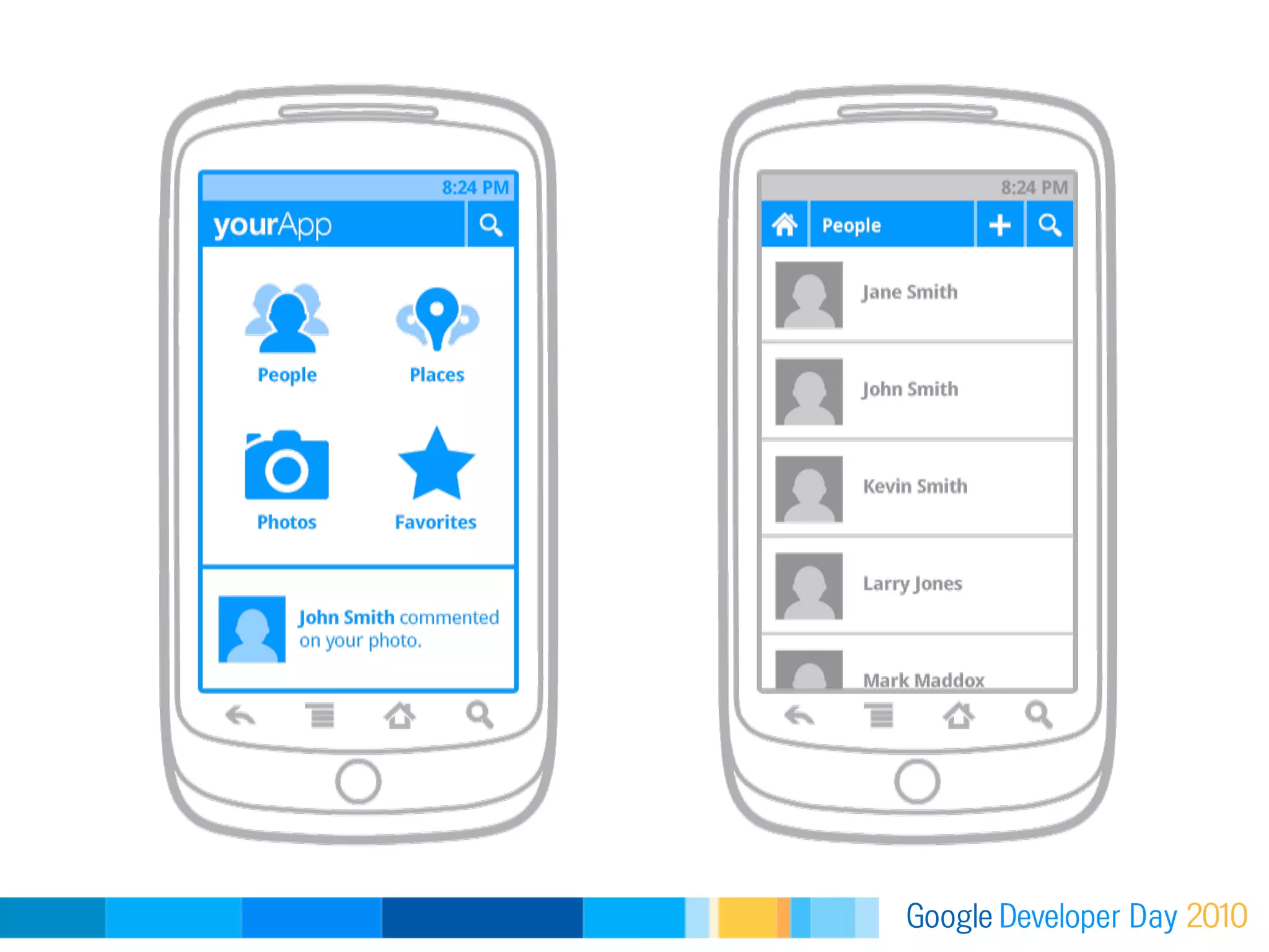
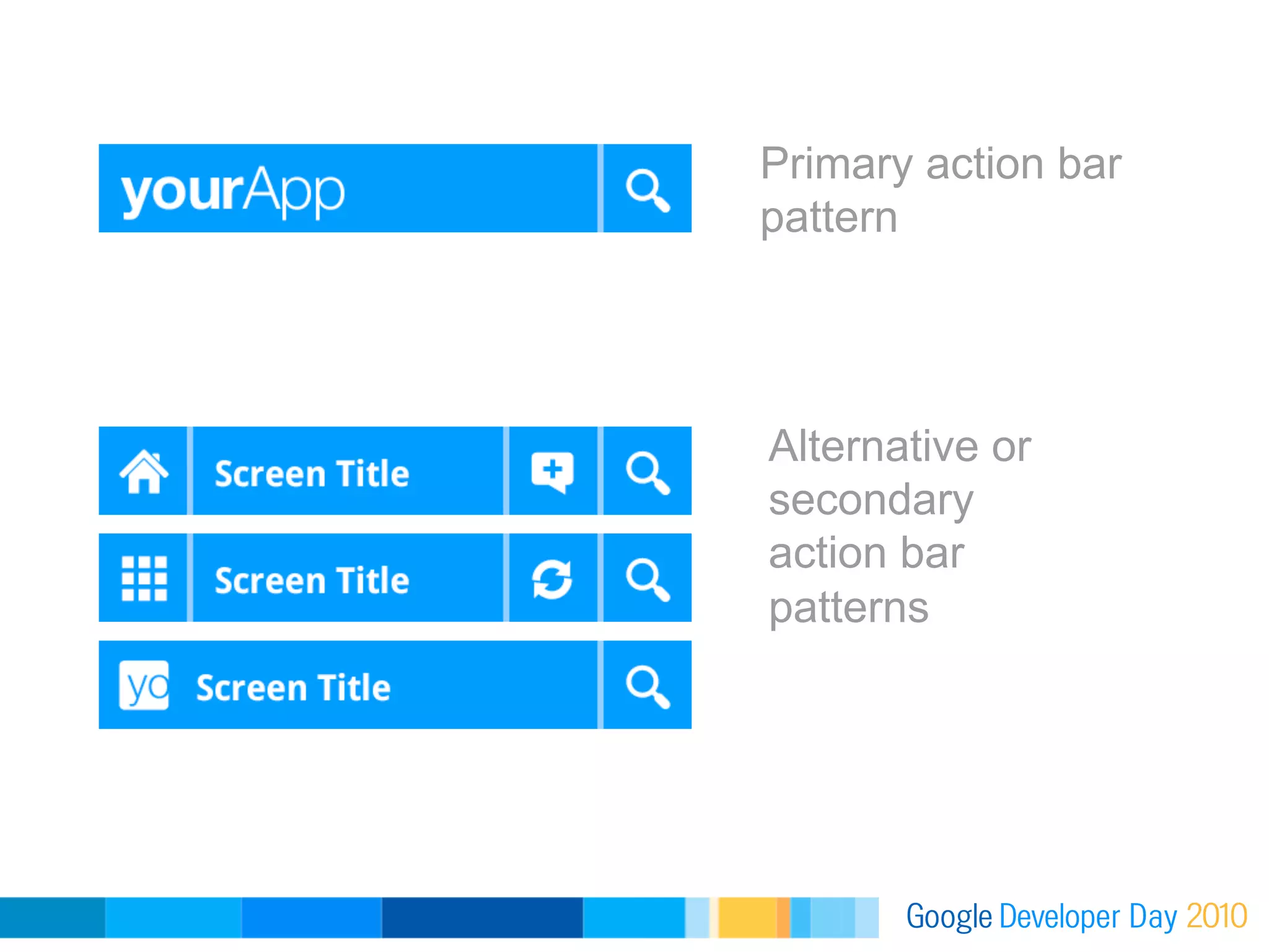
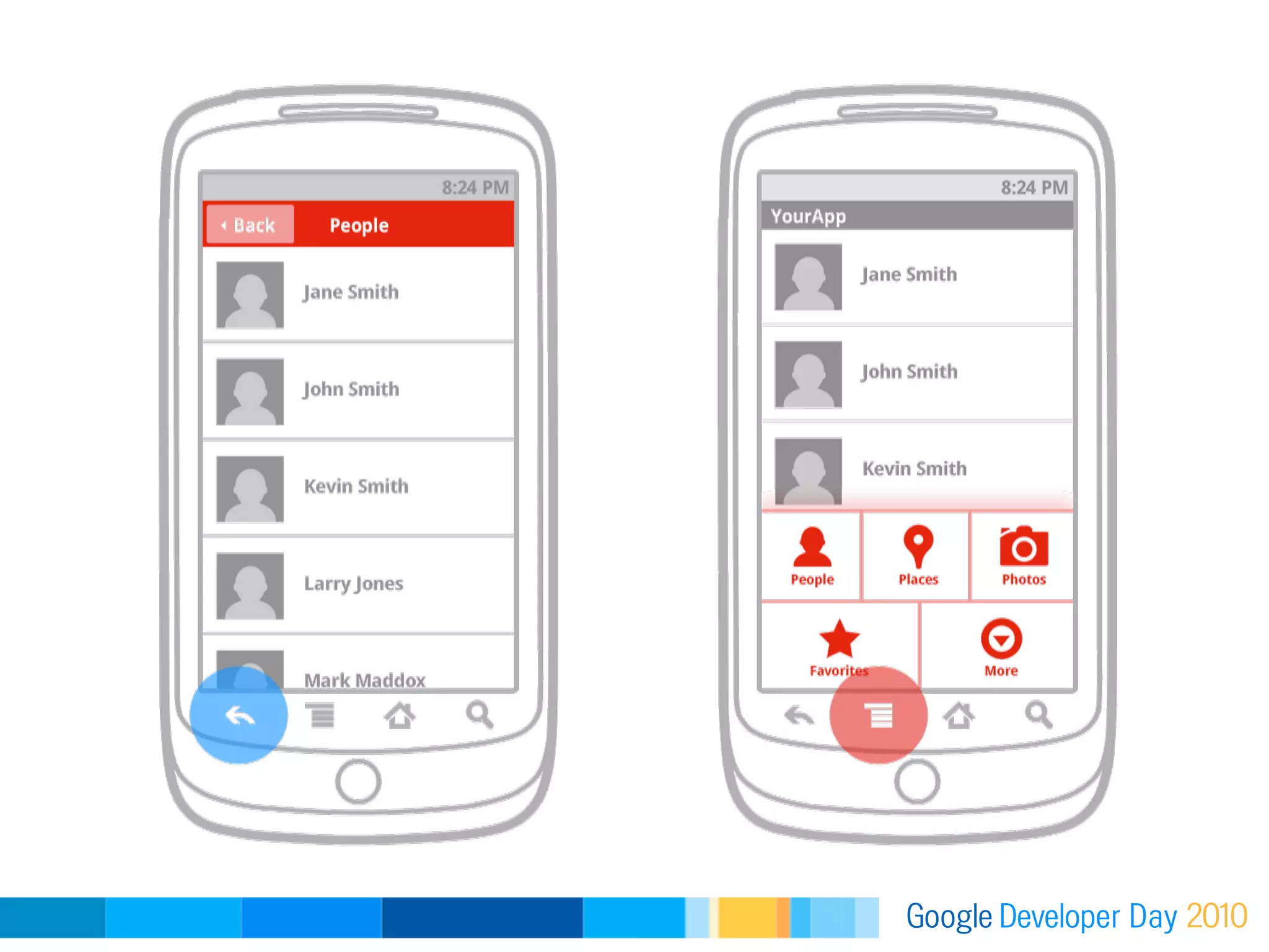
Primary action bar
pattern


Alternative or
secondary
action bar
patterns
DO feel free to customize
the way tabs look
DON’T alter the back stack
if you’re using tabs
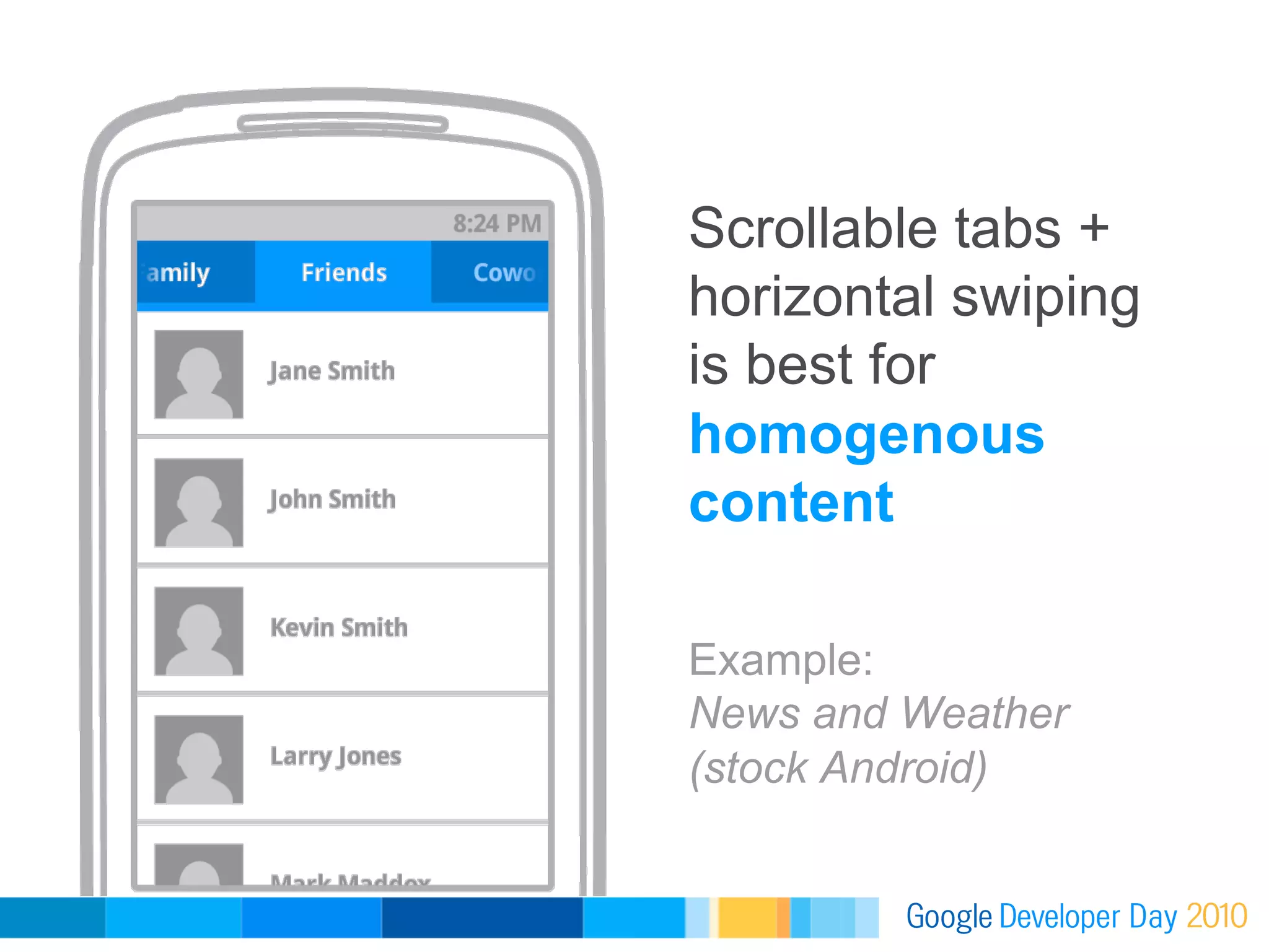
Scrollable tabs +
horizontal swiping
is best for
homogenous
content

Example:
News and Weather
(stock Android)
Prototyping tools and methods:


  Paper + pen
  Pencil for Firefox – more on this in a bit
  Adobe Fireworks – interactive prototypes
UI design + dev tips
      (abridged)
http://j.mp/androiddesigntips
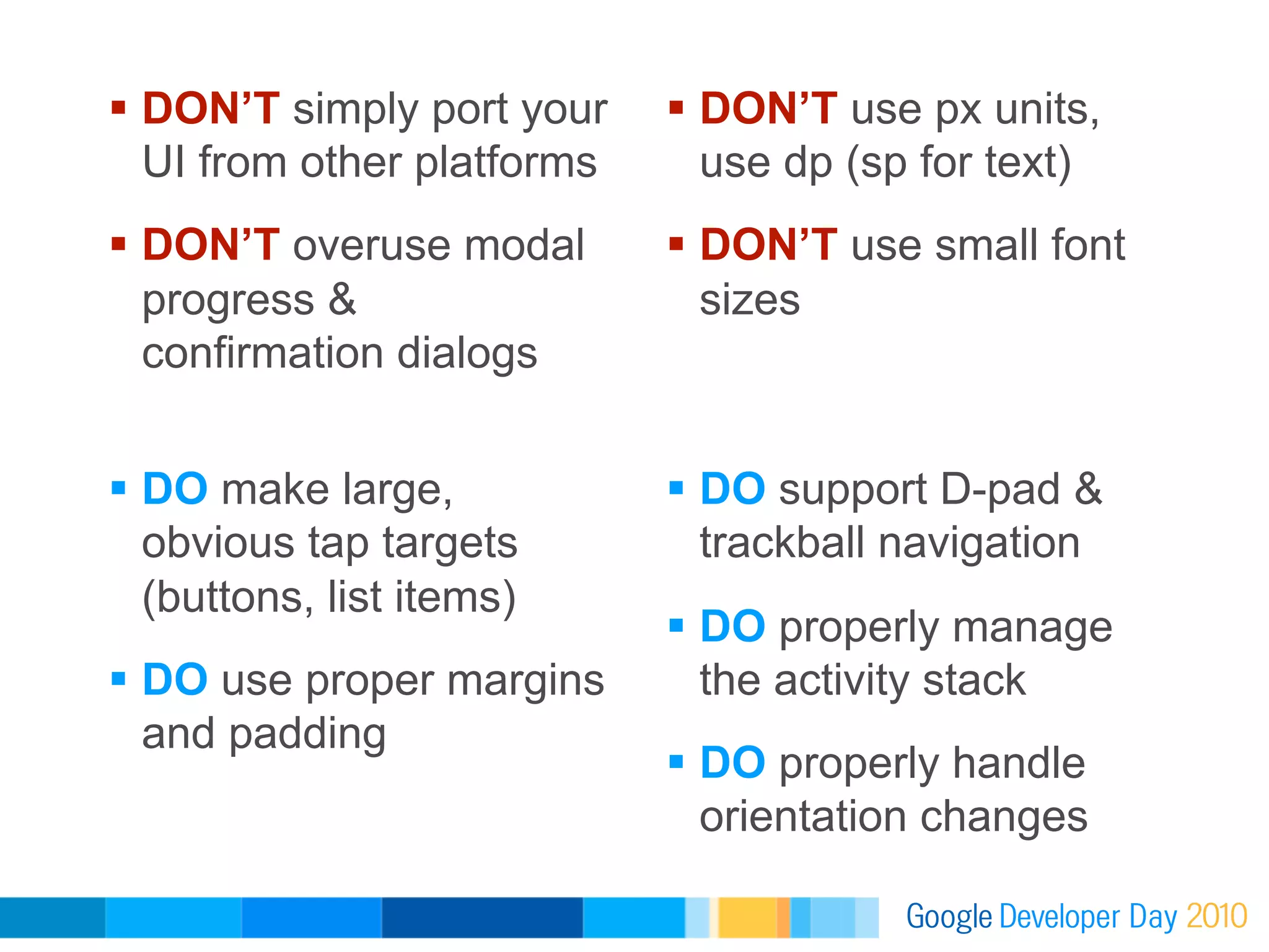
  DON’T simply port your      DON’T use px units,
   UI from other platforms      use dp (sp for text)
  DON’T overuse modal         DON’T use small font
   progress &                   sizes
   confirmation dialogs


  DO make large,              DO support D-pad &
   obvious tap targets          trackball navigation
   (buttons, list items)
                               DO properly manage
  DO use proper margins        the activity stack
   and padding
                               DO properly handle
                                orientation changes
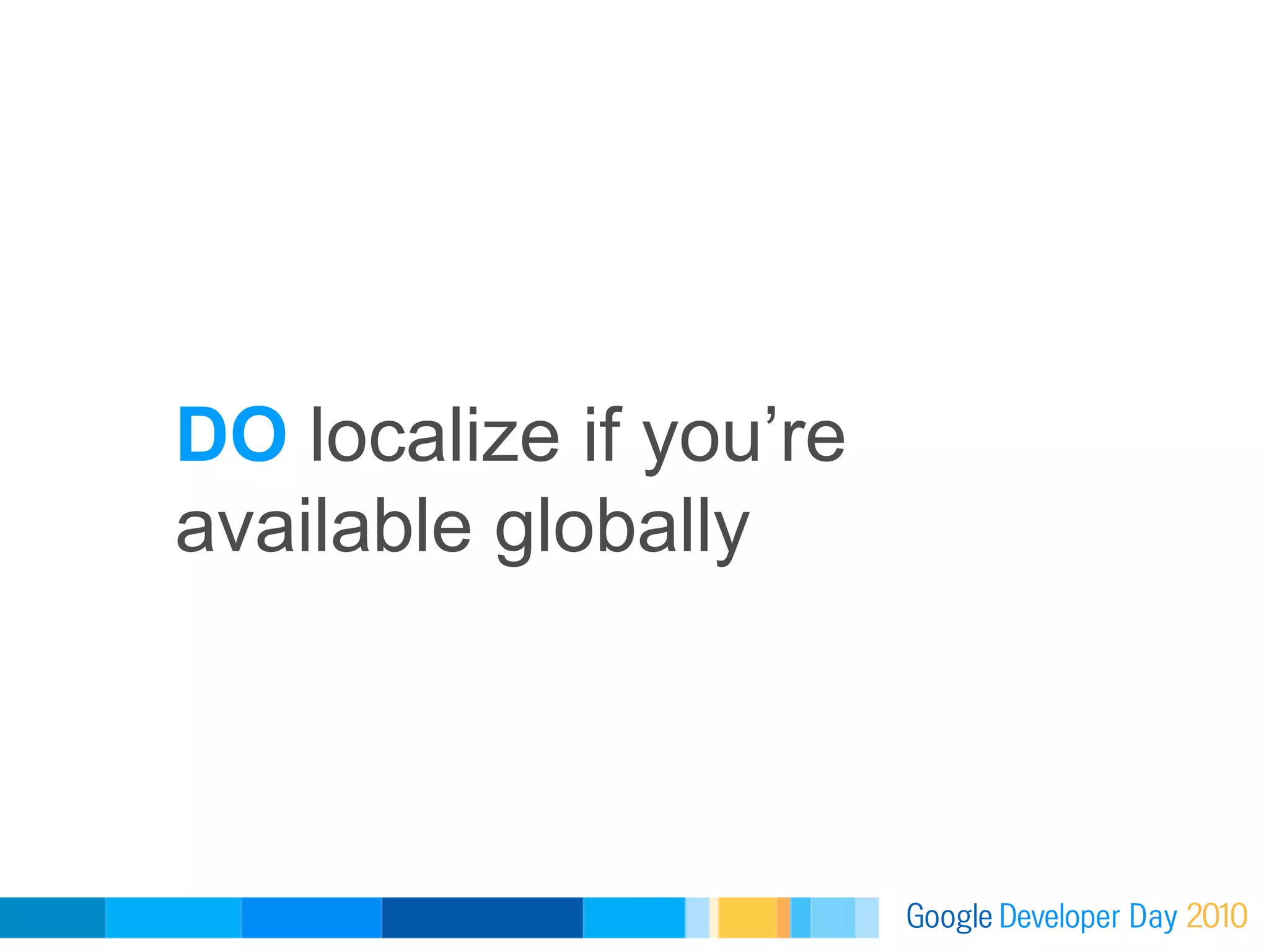
DO localize if you’re
available globally
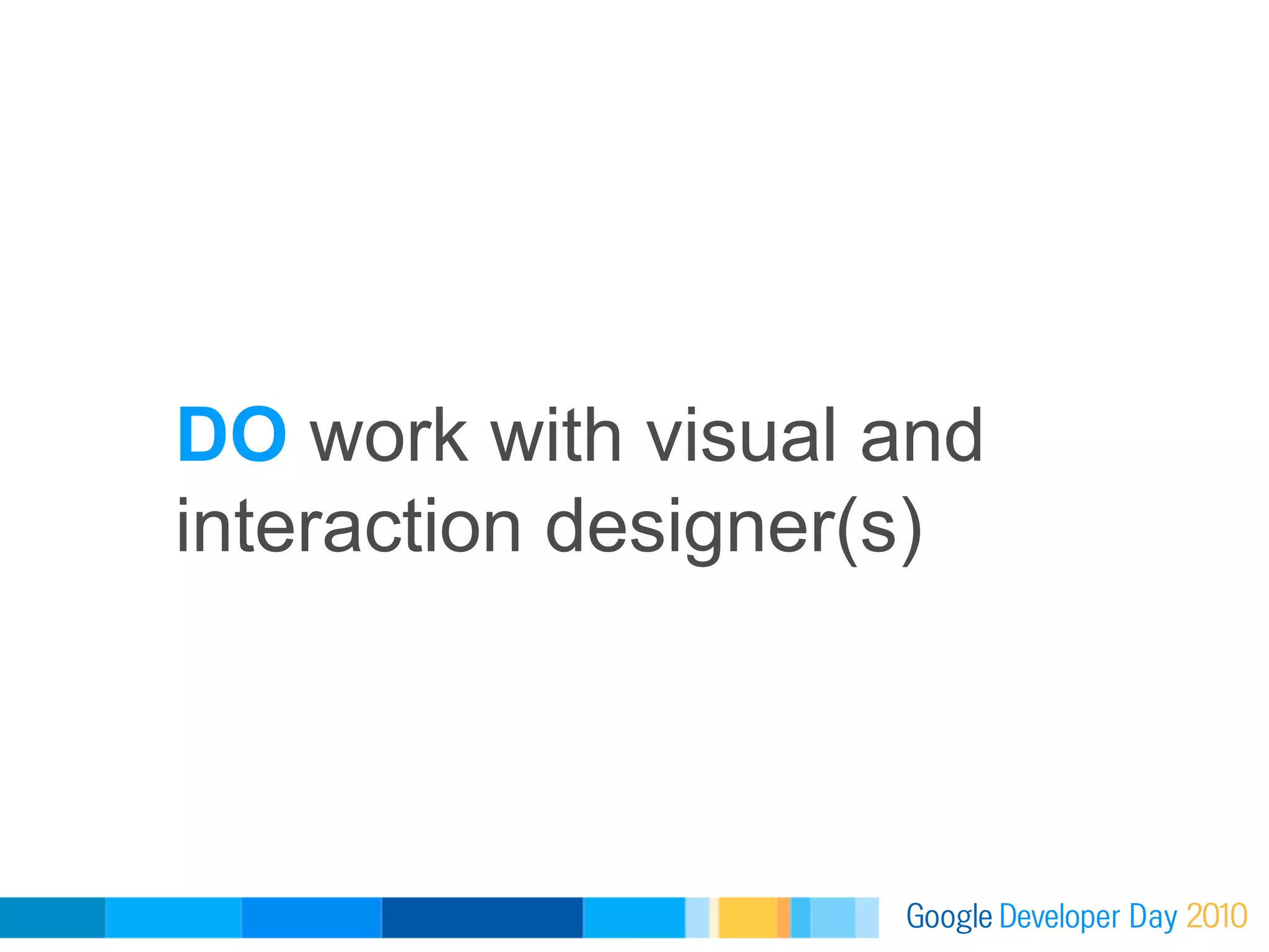
DO work with visual and
interaction designer(s)
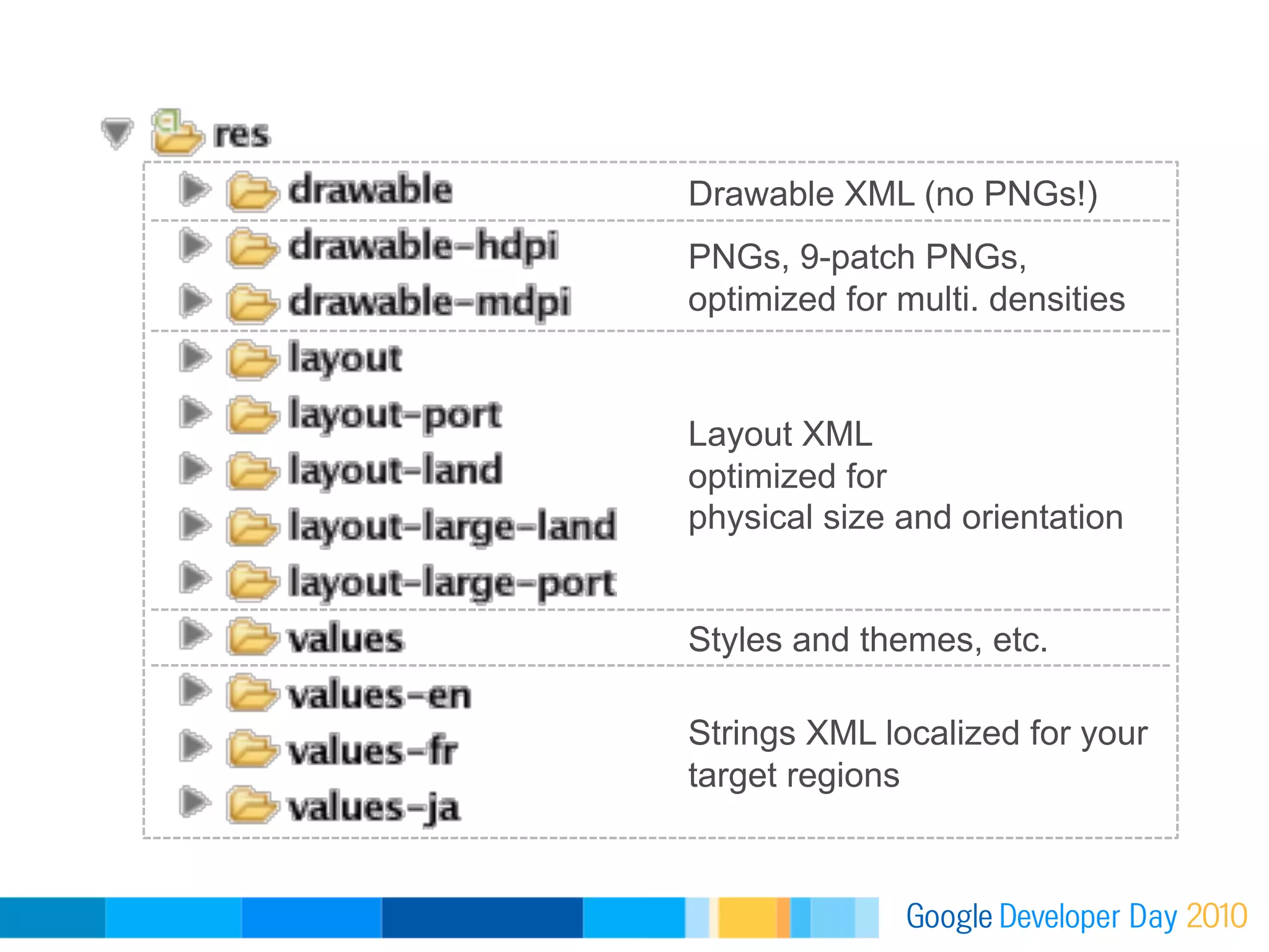
Drawable XML (no PNGs!)
PNGs, 9-patch PNGs,
optimized for multi. densities


Layout XML
optimized for
physical size and orientation


Styles and themes, etc.

Strings XML localized for your
target regions
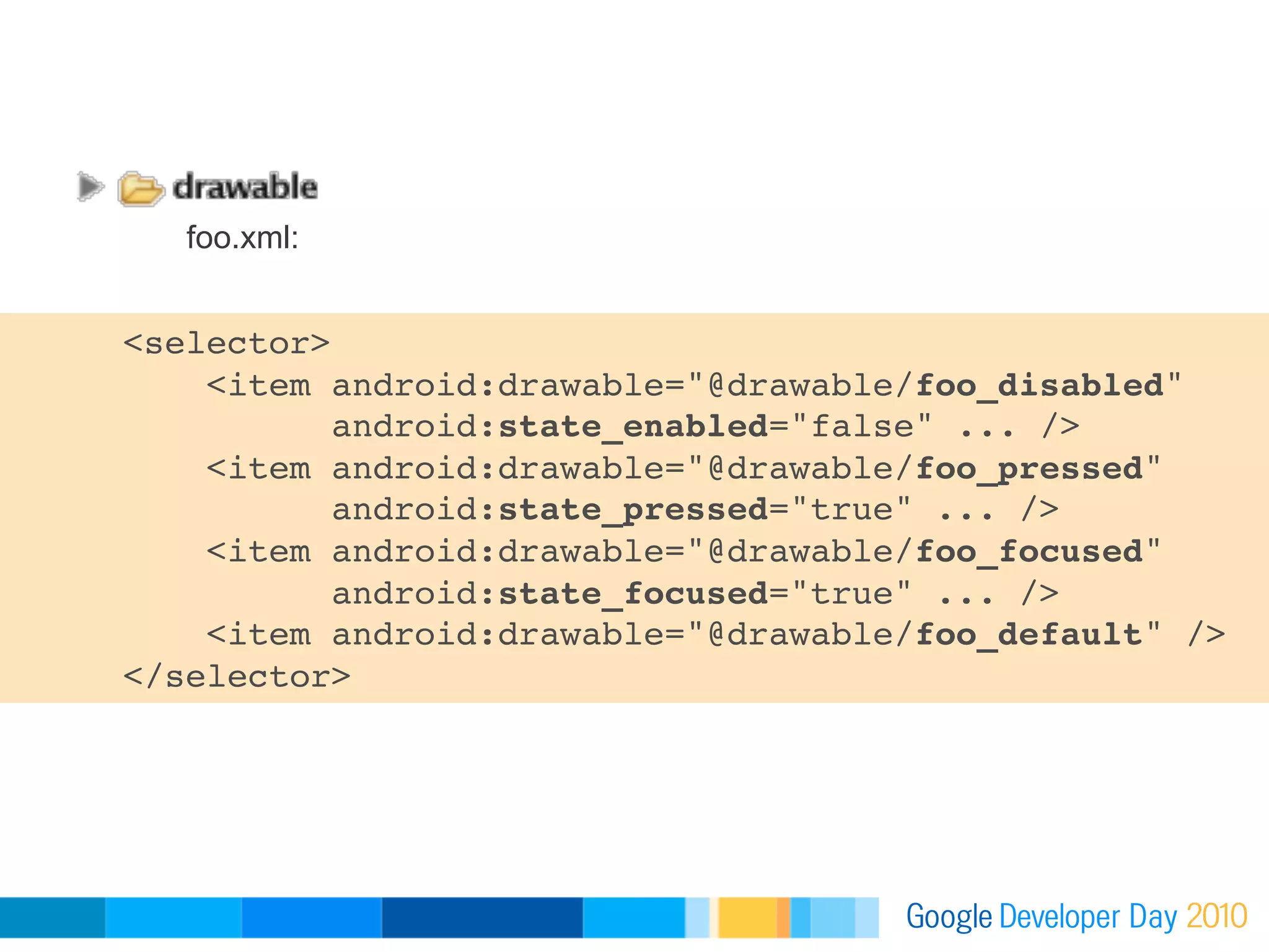
foo.xml:


<selector>
    <item android:drawable="@drawable/foo_disabled"
          android:state_enabled="false" ... />
    <item android:drawable="@drawable/foo_pressed"
          android:state_pressed="true" ... />
    <item android:drawable="@drawable/foo_focused"
          android:state_focused="true" ... />
    <item android:drawable="@drawable/foo_default" /> 
</selector>
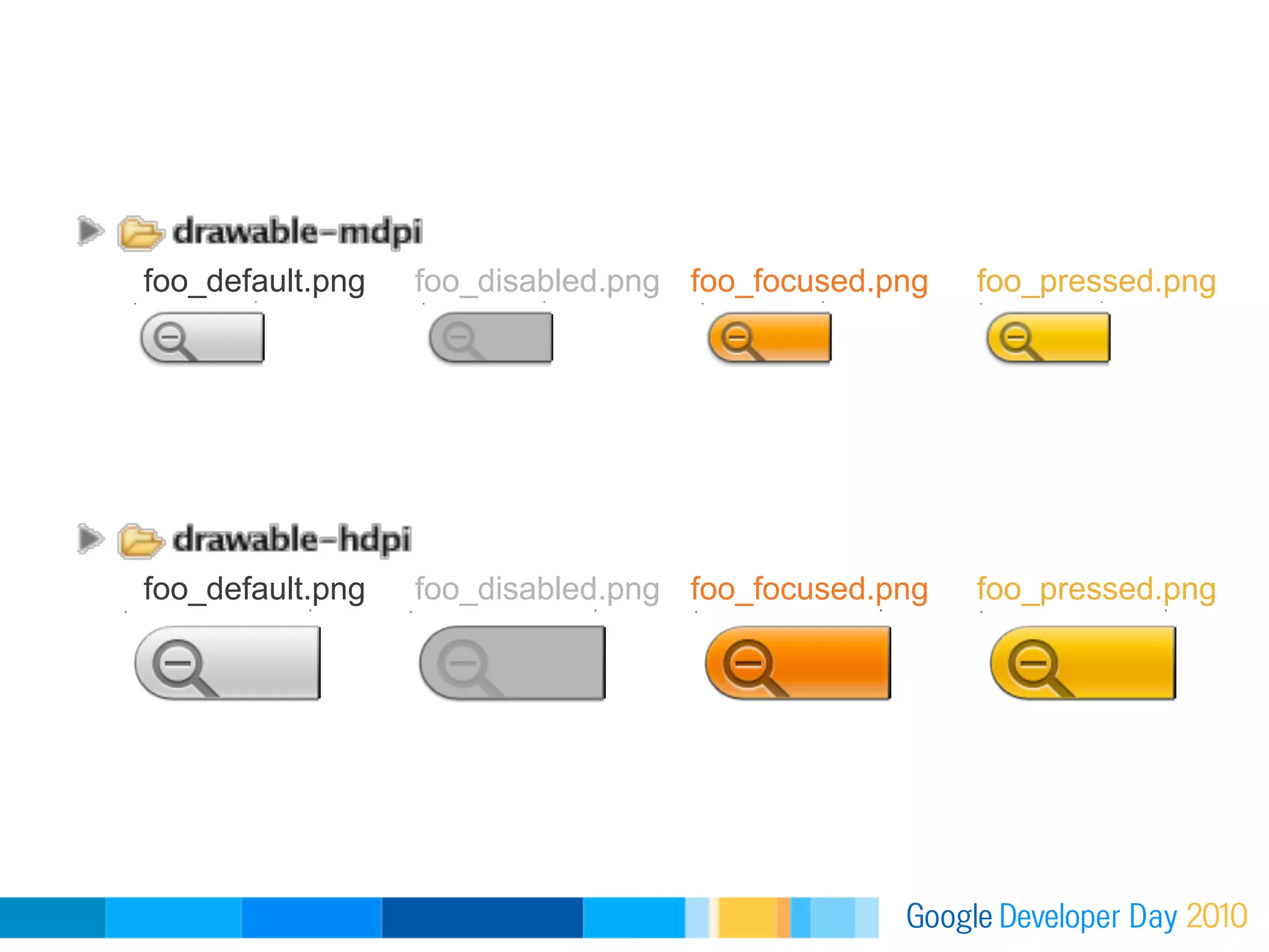
foo_default.png   foo_disabled.png foo_focused.png   foo_pressed.png


foo_default.png   foo_disabled.png foo_focused.png   foo_pressed.png
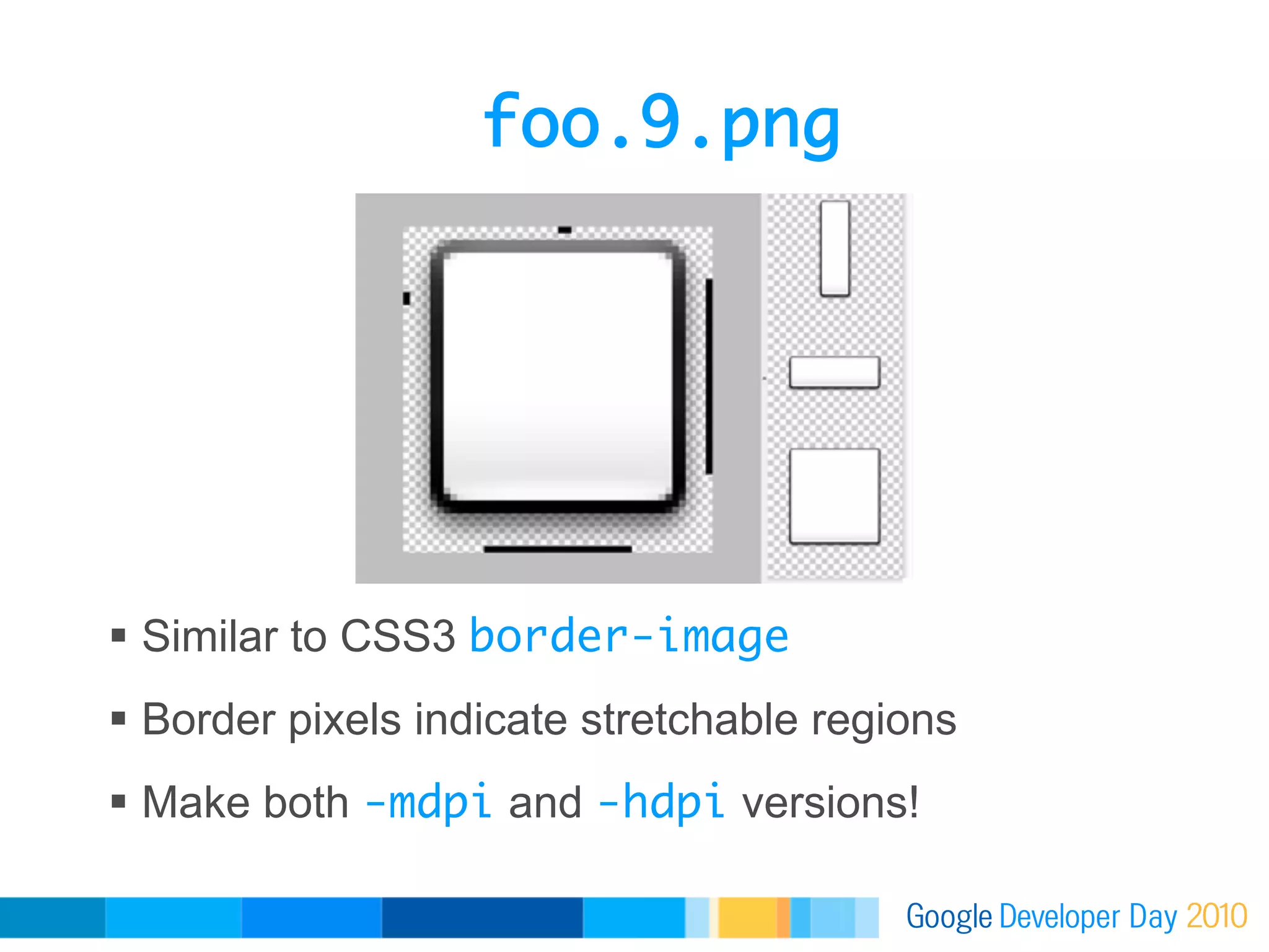
foo.9.png	


  Similar to CSS3 border-image	
  Border pixels indicate stretchable regions
  Make both -mdpi and -hdpi versions!
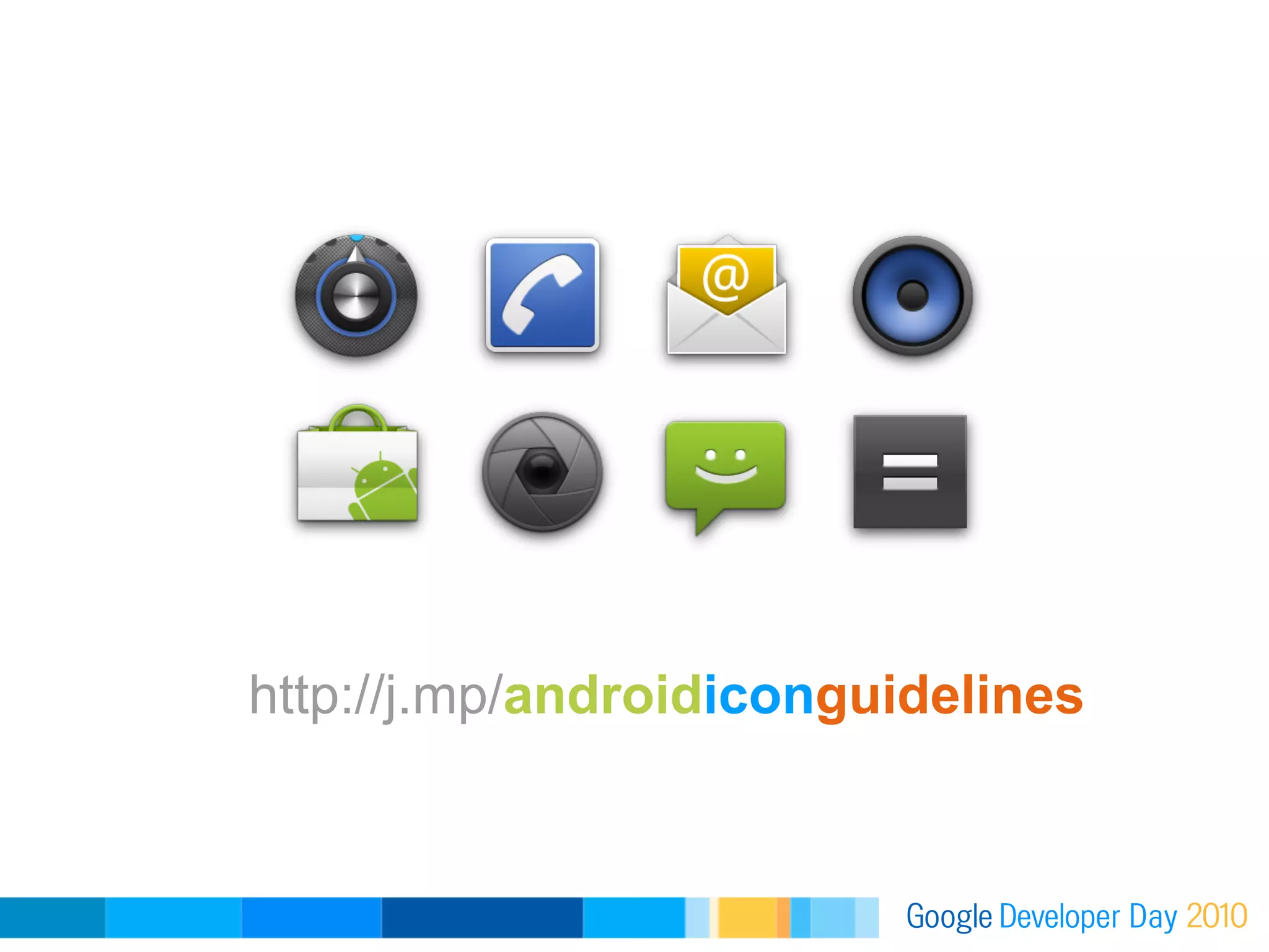
http://j.mp/androidiconguidelines
New tools
New Android UI Utilities
open source project:


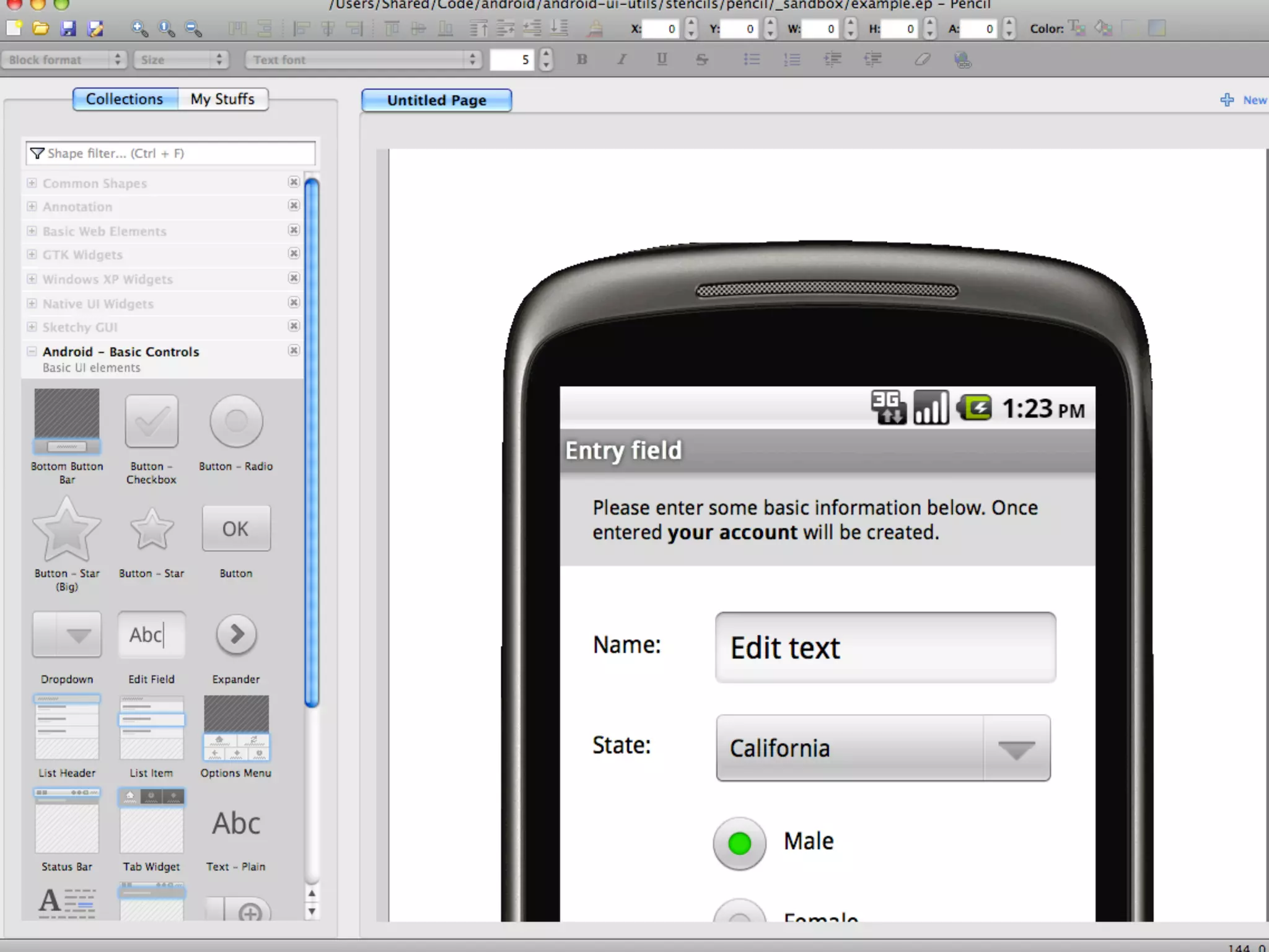
  Prototyping stencils for Pencil
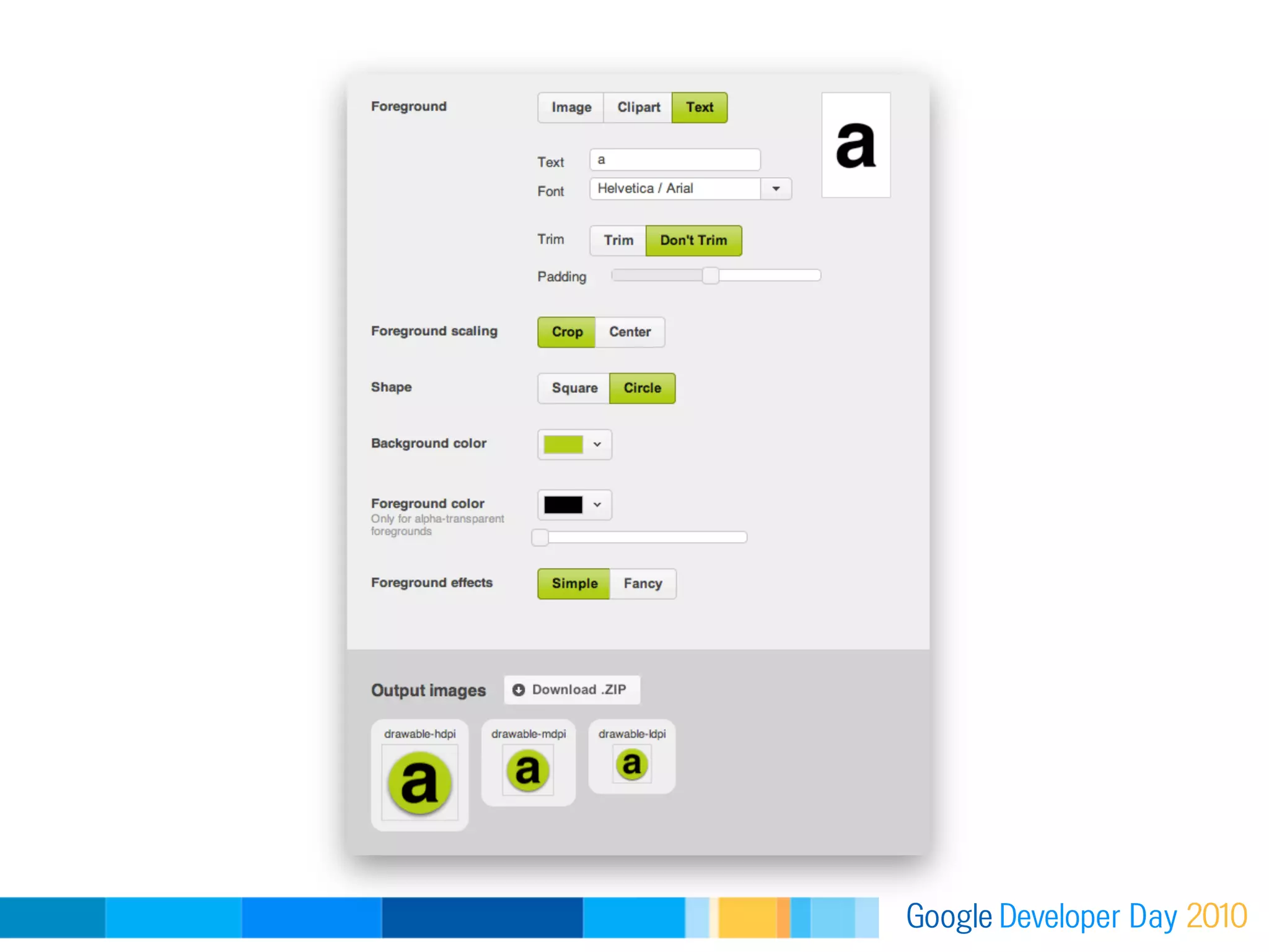
  Android Asset Studio
  Photoshop icon templates
http://j.mp/androiduiutils

http://j.mp/androidassetstudio
Continuing to
impress the user
http://j.mp/improvingappquality
Copyrights and Trademarks
  Android, Google are registered trademarks of
   Google Inc.
  All other trademarks and copyrights are the
   property of their respective owners.
Excellence in the Android User Experience

  • 2.
    Excellence in theAndroid User Experience Roman Nurik
  • 3.
    Roman Nurik Android DeveloperAdvocate Google @romannurik I care about icons, and I think you should too ;-)
  • 4.
    Where does the userexperience begin?
  • 5.
  • 6.
  • 7.
  • 8.
    And where does userexperience extend to?
  • 9.
    App Usage Reviews Recommendations Forums Support
  • 10.
    Agenda 1.  Making agreat first impression 2.  Designing for ease of use 3.  UI design + dev tips 4.  New tools 5.  Continuing to impress the user
  • 11.
  • 12.
    You can start settingappropriate expectations and impressing the user sooner than you think:   Have a clean, beautiful and guideline-friendly icon   Have a unique and appropriate listing title   Have an honest and useful listing description
  • 13.
    DO DON’T
  • 14.
    You don’t alwayshave control over the first impression.   Press and word-of-mouth reviews   User’s previous exposure to your brand   Market ratings Improving the quality of your app will help positively influence these factors.
  • 15.
    Once your appis installed, get the user up and running as quickly as possible.   Don’t require a lengthy registration process –  Users hate typing on mobile devices   Sync user data and context immediately –  Users shouldn’t have to recreate their desktop environment on their mobile phone
  • 16.
    Your ‘home’ activityshould be straightforward. It’s also an opportunity to show off available features, in a highly aesthetic, consistent, yet brand-faithful way.
  • 17.
    In some cases,your app may call for a unique user interface. In these cases, consider greeting the user and educating them on the UI. Make them feel comfortable with your app. Example: Winamp for Android
  • 18.
    Greeting the userwith a one-time tutorial screen can also inform them about app features like widgets, live wallpapers, or global search
  • 19.
  • 20.
    Clarity begets easeof use. An ideal design process: 1.  Lay out your information hierarchy and data model 2.  Choose a primary UI navigation pattern 3.  Sketch or otherwise prototype your UI
  • 21.
    DO DON’T   Dashboard +   5+ tabs or bottom tabs Action bar   Navigation sections   Top tabs (up to 4) in options menu   Sliding top tabs   On-screen back button (homogenous content)
  • 23.
    Primary action bar pattern Alternativeor secondary action bar patterns
  • 25.
    DO feel freeto customize the way tabs look
  • 26.
    DON’T alter theback stack if you’re using tabs
  • 27.
    Scrollable tabs + horizontalswiping is best for homogenous content Example: News and Weather (stock Android)
  • 29.
    Prototyping tools andmethods:   Paper + pen   Pencil for Firefox – more on this in a bit   Adobe Fireworks – interactive prototypes
  • 30.
    UI design +dev tips (abridged)
  • 31.
  • 32.
      DON’T simplyport your   DON’T use px units, UI from other platforms use dp (sp for text)   DON’T overuse modal   DON’T use small font progress & sizes confirmation dialogs   DO make large,   DO support D-pad & obvious tap targets trackball navigation (buttons, list items)   DO properly manage   DO use proper margins the activity stack and padding   DO properly handle orientation changes
  • 33.
    DO localize ifyou’re available globally
  • 34.
    DO work withvisual and interaction designer(s)
  • 35.
    Drawable XML (noPNGs!) PNGs, 9-patch PNGs, optimized for multi. densities Layout XML optimized for physical size and orientation Styles and themes, etc. Strings XML localized for your target regions
  • 36.
    foo.xml: <selector> <item android:drawable="@drawable/foo_disabled" android:state_enabled="false" ... /> <item android:drawable="@drawable/foo_pressed" android:state_pressed="true" ... /> <item android:drawable="@drawable/foo_focused" android:state_focused="true" ... /> <item android:drawable="@drawable/foo_default" /> </selector>
  • 37.
    foo_default.png foo_disabled.png foo_focused.png foo_pressed.png foo_default.png foo_disabled.png foo_focused.png foo_pressed.png
  • 38.
    foo.9.png   Similar toCSS3 border-image   Border pixels indicate stretchable regions   Make both -mdpi and -hdpi versions!
  • 39.
  • 40.
  • 41.
    New Android UIUtilities open source project:   Prototyping stencils for Pencil   Android Asset Studio   Photoshop icon templates
  • 42.
  • 45.
  • 46.
  • 47.
    Copyrights and Trademarks  Android, Google are registered trademarks of Google Inc.   All other trademarks and copyrights are the property of their respective owners.