Excellence & Equity in Maths
Aboriginal and Torres Strait Islander
Student Achievement in Mathematics and STEM
Professor Peter Buckskin, Project Director
Will Morony, AAMT Project Partner
Mark Tranthim-Fryer, Project Manager
www.xe.edu.au/natsiec
• Excellence & Equity [xe] project partnerships
• STEM landscape in Australia and overseas
• School pilot programs
• Higher education initiatives
• 2016 opportunities
www.chiefscientist.gov.au/wp-content/uploads/STEM_AustraliasFuture_Sept2014_Web.pdf
STEM MYTHS
1. Science, maths, engineering – that’s whitefeller business
2. Aboriginal people are not good at maths and science
3. Science and engineering are purely Western constructs
4. STEM alienates Indigenous students from their culture
5. Science is opposed to traditional ways of knowledge
Vital and ongoing engagement with all fields of STEM research is a crucial
element in the empowerment and advancement of Indigenous Australia
Associate Professor Rowena Ball, 2015 STEM the gap Australian Quarterly
www.aips.net.au/aq-magazine/2015-special-indigenous-edition-science-belongs-to-us-mob-too/
MAKE IT COUNT: MATHS AND INDIGENOUS LEARNERS
Make It Count is for educators working with Aboriginal and Torres Strait
Islander learners in mathematics education.
It is a teaching and learning resource, and a professional learning tool.
Make It Count is about a way of thinking – and a way of doing.
http://mic.aamt.edu.au/
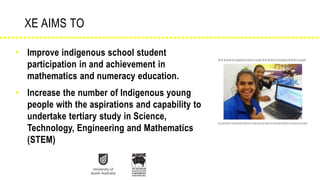
XE AIMS TO
• Improve indigenous school student
participation in and achievement in
mathematics and numeracy education.
• Increase the number of Indigenous young
people with the aspirations and capability to
undertake tertiary study in Science,
Technology, Engineering and Mathematics
(STEM)
XE PARTNERS & SUPPORTERS
[xe] project schools & universities
XE STRATEGIES
1. National review of professional practices, resources and programs
2. Series of school cluster and university pilot studies
3. Consultation with students, Indigenous educators, STEM educators
4. Publish findings to a national Mathematics portal (from 2016)
5. Presentations of findings and resources at education events
6. Evaluation and data collection to measure project progress
7. Engagement with Chief Scientist and other AMSPP projects
XE PROJECT SCHEDULE
[xe] 2015-17 project plan at www.xe.edu.au/plan
1. National approach to STEM learning for Indigenous students
Recognition of Indigenous knowledge in curriculum
Compilation of effective STEM programs and practices
2. Programs for better Indigenous student learning in STEM
Transitions between school-university and education-work
Industry engagement to place Indigenous students in the workforce
Targeted student support structures in higher education
3. Staff professional development in STEM and Indigenous students
Culturally responsive teaching in schools and universities
Student engagement with scientific thinking and practices
INTERNATIONAL FINDINGS
www.acola.org.au/PDF/SAF02Consultants/SAF02_STEM_%20FINAL.pdf
Average total enrolment of Indigenous higher education students
by field of study compared to total enrolments (2011-13)
STEM-related fields of study
Other fields of study Behrendt Review, 2012
• Clusters in metropolitan and regional locations
• Junior secondary focus; students with potential for
‘higher level’ maths courses
• Co-designed with schools
• Engage with students, parents and community, and staff
(mathematics teachers, others with role in supporting
Indigenous students, school and community leaders)
XE PROJECT – SCHOOLS COMPONENT
2015 SCHOOL PILOT STUDIES
1. Northern Adelaide
Para Hills HS, Paralowie R-12, Salisbury East HS
2. Alice Springs
Central Middle School & Senior School, Yirara School (tbc)
3. Perth
Yulebrook College, Seven Oaks SC, Balga HS, Cecil Andrews College
Pilot studies managed by Australian Association of Mathematics Teachers (AAMT)
• Students’ views
• Don’t want maths to be easy – challenges, games, competition
• More ‘real world’ - connected, making sense etc
• Collaboration with 'similar students’
• Teachers’ directions
• Resilience, perseverance, confidence.
• Core Maths hurdles (multiplicative reasoning, fractions,
algebra fundamentals, etc)
• Roles and impact of tutors
INITIAL INSIGHTS – SCHOOLS
HIGHER EDUCATION CASE STUDIES
1. University of SA STEM strategy for Indigenous students
2. CSIRO ASSETS Year 10 summer schools (Adelaide, Newcastle, Townsville)
3. University of NSW series of Indigenous student initiatives
4. University of Western Sydney Indigenous student initiatives
5. University of Newcastle Wollotuka Institute
6. Queensland University of Technology Yumi Deadly Maths
Sites selected following an environmental scan and Indigenous student participation data
2015 case studies prepared by UniSA
www.nuragili.unsw.edu.au/indigenous-astronomy
www.unisa.edu.au/IT-Engineering-and-the-Environment/student-services/
Community-Service-Learning-Project/ICES/indigenous-content-in-education-symposium
www.csiro.au/en/Education/Programs/Indigenous-STEM
XE STRATEGIES
An online portal for teachers (F–12),
mathematics leaders, and others.
To provide educators with quality
professional learning materials and
related classroom resources.
[xe] resources to be hosted on
Dimensions on conclusion of the
project.
AAMT DIMENSIONS PORTAL
Opportunities?
www.xe.edu.au
@stemXE
www.xe.edu.au/news/subscribe
.
www.xe.edu.au/natsiec
stem@xe.edu.au

Excellence & Equity in Maths

  • 1.
    Excellence & Equityin Maths Aboriginal and Torres Strait Islander Student Achievement in Mathematics and STEM Professor Peter Buckskin, Project Director Will Morony, AAMT Project Partner Mark Tranthim-Fryer, Project Manager www.xe.edu.au/natsiec
  • 4.
    • Excellence &Equity [xe] project partnerships • STEM landscape in Australia and overseas • School pilot programs • Higher education initiatives • 2016 opportunities
  • 9.
  • 10.
    STEM MYTHS 1. Science,maths, engineering – that’s whitefeller business 2. Aboriginal people are not good at maths and science 3. Science and engineering are purely Western constructs 4. STEM alienates Indigenous students from their culture 5. Science is opposed to traditional ways of knowledge Vital and ongoing engagement with all fields of STEM research is a crucial element in the empowerment and advancement of Indigenous Australia Associate Professor Rowena Ball, 2015 STEM the gap Australian Quarterly www.aips.net.au/aq-magazine/2015-special-indigenous-edition-science-belongs-to-us-mob-too/
  • 11.
    MAKE IT COUNT:MATHS AND INDIGENOUS LEARNERS Make It Count is for educators working with Aboriginal and Torres Strait Islander learners in mathematics education. It is a teaching and learning resource, and a professional learning tool. Make It Count is about a way of thinking – and a way of doing. http://mic.aamt.edu.au/
  • 12.
    XE AIMS TO •Improve indigenous school student participation in and achievement in mathematics and numeracy education. • Increase the number of Indigenous young people with the aspirations and capability to undertake tertiary study in Science, Technology, Engineering and Mathematics (STEM)
  • 13.
    XE PARTNERS &SUPPORTERS [xe] project schools & universities
  • 14.
    XE STRATEGIES 1. Nationalreview of professional practices, resources and programs 2. Series of school cluster and university pilot studies 3. Consultation with students, Indigenous educators, STEM educators 4. Publish findings to a national Mathematics portal (from 2016) 5. Presentations of findings and resources at education events 6. Evaluation and data collection to measure project progress 7. Engagement with Chief Scientist and other AMSPP projects
  • 15.
    XE PROJECT SCHEDULE [xe]2015-17 project plan at www.xe.edu.au/plan
  • 17.
    1. National approachto STEM learning for Indigenous students Recognition of Indigenous knowledge in curriculum Compilation of effective STEM programs and practices 2. Programs for better Indigenous student learning in STEM Transitions between school-university and education-work Industry engagement to place Indigenous students in the workforce Targeted student support structures in higher education 3. Staff professional development in STEM and Indigenous students Culturally responsive teaching in schools and universities Student engagement with scientific thinking and practices INTERNATIONAL FINDINGS www.acola.org.au/PDF/SAF02Consultants/SAF02_STEM_%20FINAL.pdf
  • 18.
    Average total enrolmentof Indigenous higher education students by field of study compared to total enrolments (2011-13) STEM-related fields of study Other fields of study Behrendt Review, 2012
  • 19.
    • Clusters inmetropolitan and regional locations • Junior secondary focus; students with potential for ‘higher level’ maths courses • Co-designed with schools • Engage with students, parents and community, and staff (mathematics teachers, others with role in supporting Indigenous students, school and community leaders) XE PROJECT – SCHOOLS COMPONENT
  • 20.
    2015 SCHOOL PILOTSTUDIES 1. Northern Adelaide Para Hills HS, Paralowie R-12, Salisbury East HS 2. Alice Springs Central Middle School & Senior School, Yirara School (tbc) 3. Perth Yulebrook College, Seven Oaks SC, Balga HS, Cecil Andrews College Pilot studies managed by Australian Association of Mathematics Teachers (AAMT)
  • 21.
    • Students’ views •Don’t want maths to be easy – challenges, games, competition • More ‘real world’ - connected, making sense etc • Collaboration with 'similar students’ • Teachers’ directions • Resilience, perseverance, confidence. • Core Maths hurdles (multiplicative reasoning, fractions, algebra fundamentals, etc) • Roles and impact of tutors INITIAL INSIGHTS – SCHOOLS
  • 22.
    HIGHER EDUCATION CASESTUDIES 1. University of SA STEM strategy for Indigenous students 2. CSIRO ASSETS Year 10 summer schools (Adelaide, Newcastle, Townsville) 3. University of NSW series of Indigenous student initiatives 4. University of Western Sydney Indigenous student initiatives 5. University of Newcastle Wollotuka Institute 6. Queensland University of Technology Yumi Deadly Maths Sites selected following an environmental scan and Indigenous student participation data 2015 case studies prepared by UniSA
  • 24.
  • 25.
  • 28.
  • 31.
    XE STRATEGIES An onlineportal for teachers (F–12), mathematics leaders, and others. To provide educators with quality professional learning materials and related classroom resources. [xe] resources to be hosted on Dimensions on conclusion of the project. AAMT DIMENSIONS PORTAL
  • 32.
  • 33.
  • 34.
  • 35.
  • 36.