Reference: Short, D. (2013). “Everyday hypnotic techniques.” Psychotherapy Networker Symposium 2013.
By Social Work Career Development
	
  
1	


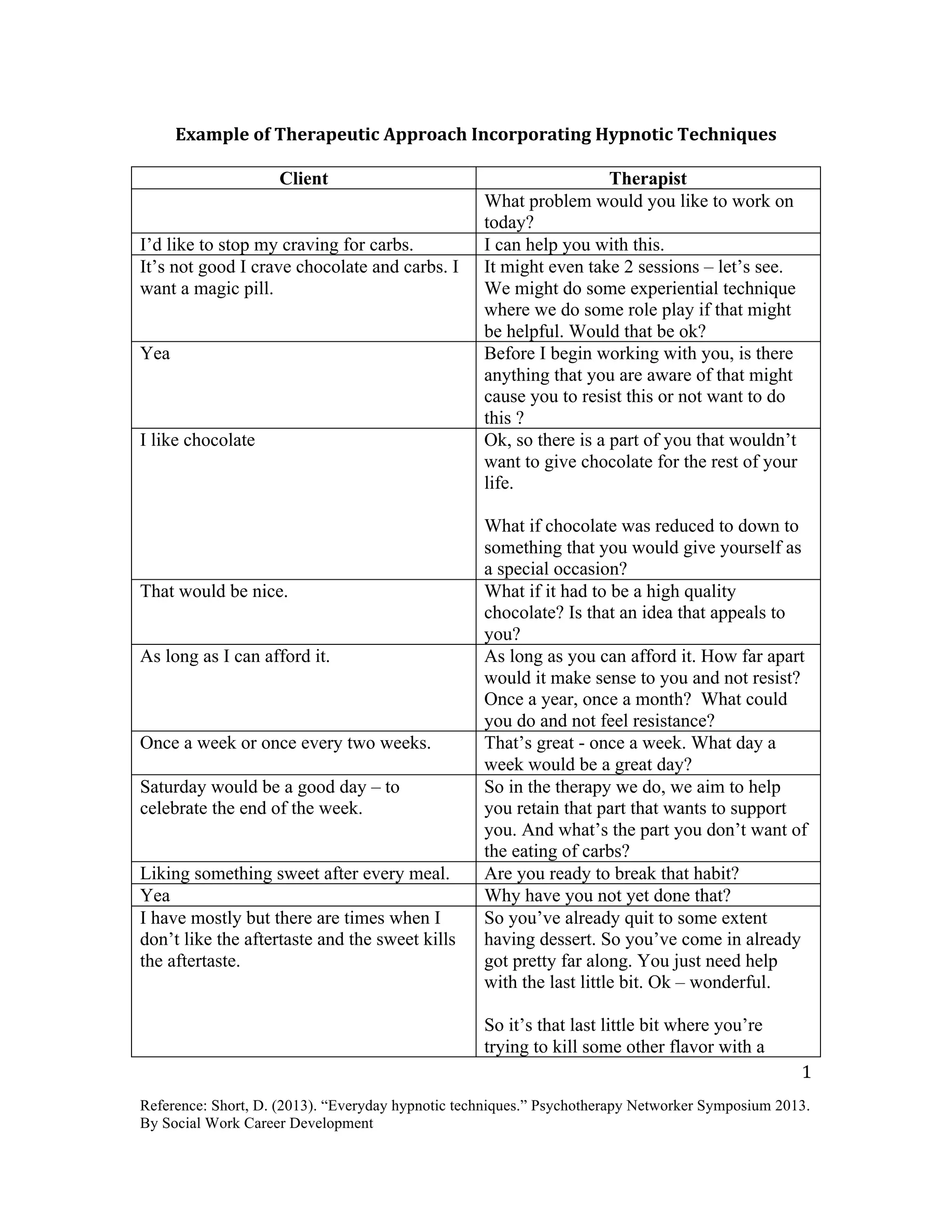
Example	
  of	
  Therapeutic	
  Approach	
  Incorporating	
  Hypnotic	
  Techniques	


Client Therapist
What problem would you like to work on
today?
I’d like to stop my craving for carbs. I can help you with this.
It’s not good I crave chocolate and carbs. I
want a magic pill.
It might even take 2 sessions – let’s see.
We might do some experiential technique
where we do some role play if that might
be helpful. Would that be ok?
Yea Before I begin working with you, is there
anything that you are aware of that might
cause you to resist this or not want to do
this ?
I like chocolate Ok, so there is a part of you that wouldn’t
want to give chocolate for the rest of your
life.
What if chocolate was reduced to down to
something that you would give yourself as
a special occasion?
That would be nice. What if it had to be a high quality
chocolate? Is that an idea that appeals to
you?
As long as I can afford it. As long as you can afford it. How far apart
would it make sense to you and not resist?
Once a year, once a month? What could
you do and not feel resistance?
Once a week or once every two weeks. That’s great - once a week. What day a
week would be a great day?
Saturday would be a good day – to
celebrate the end of the week.
So in the therapy we do, we aim to help
you retain that part that wants to support
you. And what’s the part you don’t want of
the eating of carbs?
Liking something sweet after every meal. Are you ready to break that habit?
Yea Why have you not yet done that?
I have mostly but there are times when I
don’t like the aftertaste and the sweet kills
the aftertaste.
So you’ve already quit to some extent
having dessert. So you’ve come in already
got pretty far along. You just need help
with the last little bit. Ok – wonderful.
So it’s that last little bit where you’re
trying to kill some other flavor with a
Reference: Short, D. (2013). “Everyday hypnotic techniques.” Psychotherapy Networker Symposium 2013.
By Social Work Career Development
	
  
2	
  
Client Therapist
sweet taste. Alright. Is there a particular
flavor you’re trying to kill or is it
everything that you want to kill with
something sweet?
No, something a good cup of coffee would
do it.
You just want to end on a flavor you really
like.
Yea. I like the food while I’m eating it. A
fillet of sole doesn’t taste good in your
mouth an hour later when you’re eating it.
Would it make a difference if you were to
drink lots of water at the end of a fillet of
sole so that you have less molecules in
your mouth?
I don’t know. That could work. Maybe. That would be a way of still meeting your
needs and accomplishing what you want. A
lot of what we eat has to do with smell.
And smell has to do with what comes from
the outside world and it comes from what
we imagine.
What’s your favorite smell in the world?
On I-95, you can smell the bread…[she
goes on to describe how wonderful it is]
Now, if you were to smell that at the end of
a meal, it may make you want to go find
bread which may be a problem. I don’t
know.
It’s a great smell but that would not be
helpful.
Have you had a memory or do you like
smells of the beach, the ocean or a rose? Or
A flower you would enjoy?
I like the smell of mountain air, fresh
laundry.
These are some other tools you can use if
you want to not get fixated or obsessed
with a sweet flavor after a meal.
So there are 2 tools. Do you think that’s
enough or do you think you need more?
Give me one more. You need a way so you don’t struggle with
yourself. Anything that you deny you want
more of. Erickson got his children to want
spinach by telling them that this was an
adult food, that they had to acquire a taste
for it so they would beg and beg for
spinach.
We tend to force things that are good for
our kids and deny them things that aren’t
good for them and we run into real
problems for the motivational system.
Reference: Short, D. (2013). “Everyday hypnotic techniques.” Psychotherapy Networker Symposium 2013.
By Social Work Career Development
	
  
3	
  
Client Therapist
For the third tool, we need the opportunity
to get out of any power struggle that you
might get into and get out of pretty quickly
and we’ll use one of those experiential
techniques I was talking about, ok?
Pretend that there are 2 parts of you: the
responsible part of you that wants to eat
healthfully and the part of you that wants to
eat the chocolate/carbs
Give that part of yourself [the part that
wants to each carbs] permission to meet its
needs but in a way where you can be proud
and pleased with yourself.
I’m just wondering: Is that really a need? Oh, wow – you just jumped ahead 4 or 5
steps to the insight about whether
something is indeed a need.
Ok, so let’s continue from where you’re at:
So what do you say to yourself?
You have permission to meet anything you
identify as a need. A need would be
nutrition, water and affiliation [Maslow’s
hierarchy].
Want and need are 2 different things.
Good. Was this helpful?
Yes, I’d like to be able to do this with my
clients.

Example of therapeutic approach incorporating hypnotic techniques

  • 1.
    Reference: Short, D.(2013). “Everyday hypnotic techniques.” Psychotherapy Networker Symposium 2013. By Social Work Career Development   1     Example  of  Therapeutic  Approach  Incorporating  Hypnotic  Techniques     Client Therapist What problem would you like to work on today? I’d like to stop my craving for carbs. I can help you with this. It’s not good I crave chocolate and carbs. I want a magic pill. It might even take 2 sessions – let’s see. We might do some experiential technique where we do some role play if that might be helpful. Would that be ok? Yea Before I begin working with you, is there anything that you are aware of that might cause you to resist this or not want to do this ? I like chocolate Ok, so there is a part of you that wouldn’t want to give chocolate for the rest of your life. What if chocolate was reduced to down to something that you would give yourself as a special occasion? That would be nice. What if it had to be a high quality chocolate? Is that an idea that appeals to you? As long as I can afford it. As long as you can afford it. How far apart would it make sense to you and not resist? Once a year, once a month? What could you do and not feel resistance? Once a week or once every two weeks. That’s great - once a week. What day a week would be a great day? Saturday would be a good day – to celebrate the end of the week. So in the therapy we do, we aim to help you retain that part that wants to support you. And what’s the part you don’t want of the eating of carbs? Liking something sweet after every meal. Are you ready to break that habit? Yea Why have you not yet done that? I have mostly but there are times when I don’t like the aftertaste and the sweet kills the aftertaste. So you’ve already quit to some extent having dessert. So you’ve come in already got pretty far along. You just need help with the last little bit. Ok – wonderful. So it’s that last little bit where you’re trying to kill some other flavor with a
  • 2.
    Reference: Short, D.(2013). “Everyday hypnotic techniques.” Psychotherapy Networker Symposium 2013. By Social Work Career Development   2   Client Therapist sweet taste. Alright. Is there a particular flavor you’re trying to kill or is it everything that you want to kill with something sweet? No, something a good cup of coffee would do it. You just want to end on a flavor you really like. Yea. I like the food while I’m eating it. A fillet of sole doesn’t taste good in your mouth an hour later when you’re eating it. Would it make a difference if you were to drink lots of water at the end of a fillet of sole so that you have less molecules in your mouth? I don’t know. That could work. Maybe. That would be a way of still meeting your needs and accomplishing what you want. A lot of what we eat has to do with smell. And smell has to do with what comes from the outside world and it comes from what we imagine. What’s your favorite smell in the world? On I-95, you can smell the bread…[she goes on to describe how wonderful it is] Now, if you were to smell that at the end of a meal, it may make you want to go find bread which may be a problem. I don’t know. It’s a great smell but that would not be helpful. Have you had a memory or do you like smells of the beach, the ocean or a rose? Or A flower you would enjoy? I like the smell of mountain air, fresh laundry. These are some other tools you can use if you want to not get fixated or obsessed with a sweet flavor after a meal. So there are 2 tools. Do you think that’s enough or do you think you need more? Give me one more. You need a way so you don’t struggle with yourself. Anything that you deny you want more of. Erickson got his children to want spinach by telling them that this was an adult food, that they had to acquire a taste for it so they would beg and beg for spinach. We tend to force things that are good for our kids and deny them things that aren’t good for them and we run into real problems for the motivational system.
  • 3.
    Reference: Short, D.(2013). “Everyday hypnotic techniques.” Psychotherapy Networker Symposium 2013. By Social Work Career Development   3   Client Therapist For the third tool, we need the opportunity to get out of any power struggle that you might get into and get out of pretty quickly and we’ll use one of those experiential techniques I was talking about, ok? Pretend that there are 2 parts of you: the responsible part of you that wants to eat healthfully and the part of you that wants to eat the chocolate/carbs Give that part of yourself [the part that wants to each carbs] permission to meet its needs but in a way where you can be proud and pleased with yourself. I’m just wondering: Is that really a need? Oh, wow – you just jumped ahead 4 or 5 steps to the insight about whether something is indeed a need. Ok, so let’s continue from where you’re at: So what do you say to yourself? You have permission to meet anything you identify as a need. A need would be nutrition, water and affiliation [Maslow’s hierarchy]. Want and need are 2 different things. Good. Was this helpful? Yes, I’d like to be able to do this with my clients.