6 Core Hypnotic Therapeutic Techniques
Main Message Examples of How These Messages May Be Conveyed
1 Help is available • I have seen this type of problem before and, with
just a little help, the person recovered nicely.
• People suffer most when they suffer in isolation.
But this time, you do not have to face the
problem alone.
• Call me anytime you have trouble.
2 Change is imminent • Are you ready for this change?
• Once we do _____ , you will no longer have
problems with ________ .
• Before we change anything in therapy, we
should determine if any of the negative
behaviors serve a positive function.
• I do not think the symptoms will disappear
entirely yet, but you should carefully observe
any decrease that occurs because it will be
important for me to know about.
3 The resources you need
are inside you
• Tell me about a time, in the past, when you were
not bothered by the problem.
• After a lifetime of learning, there are going to be
some valuable insights, gained from similar
situations, which apply to this problem.
• Have you asked your wise inner guide?
4 Change can be
effortless
• You do not need to consciously remember our
discussions in therapy.
• Your progress will go more smoothly if you
allow it to happen without trying to force it.
5 Progress is evident • I am sorry that the therapy has not removed all
the symptoms.
• You are talking and acting different (during
therapy). Can you feel it?
6 Reality has changed • After you learn how to overcome ________ ,
that problem will never again be able to get the
same hold on you.
• Based on the progress we've seen, I believe that
you no longer have the disorder.
Reference: Short, D. (2013). “Everyday hypnotic techniques.” Psychotherapy Networker
Symposium 2013.
Social Work Career Development

6 core hypnotic therapeutic techniques

  • 1.
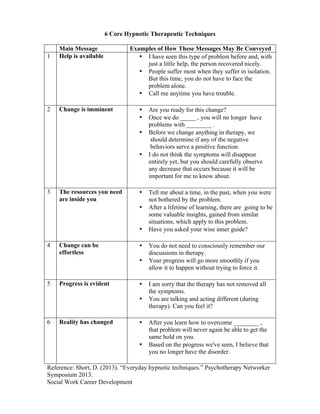
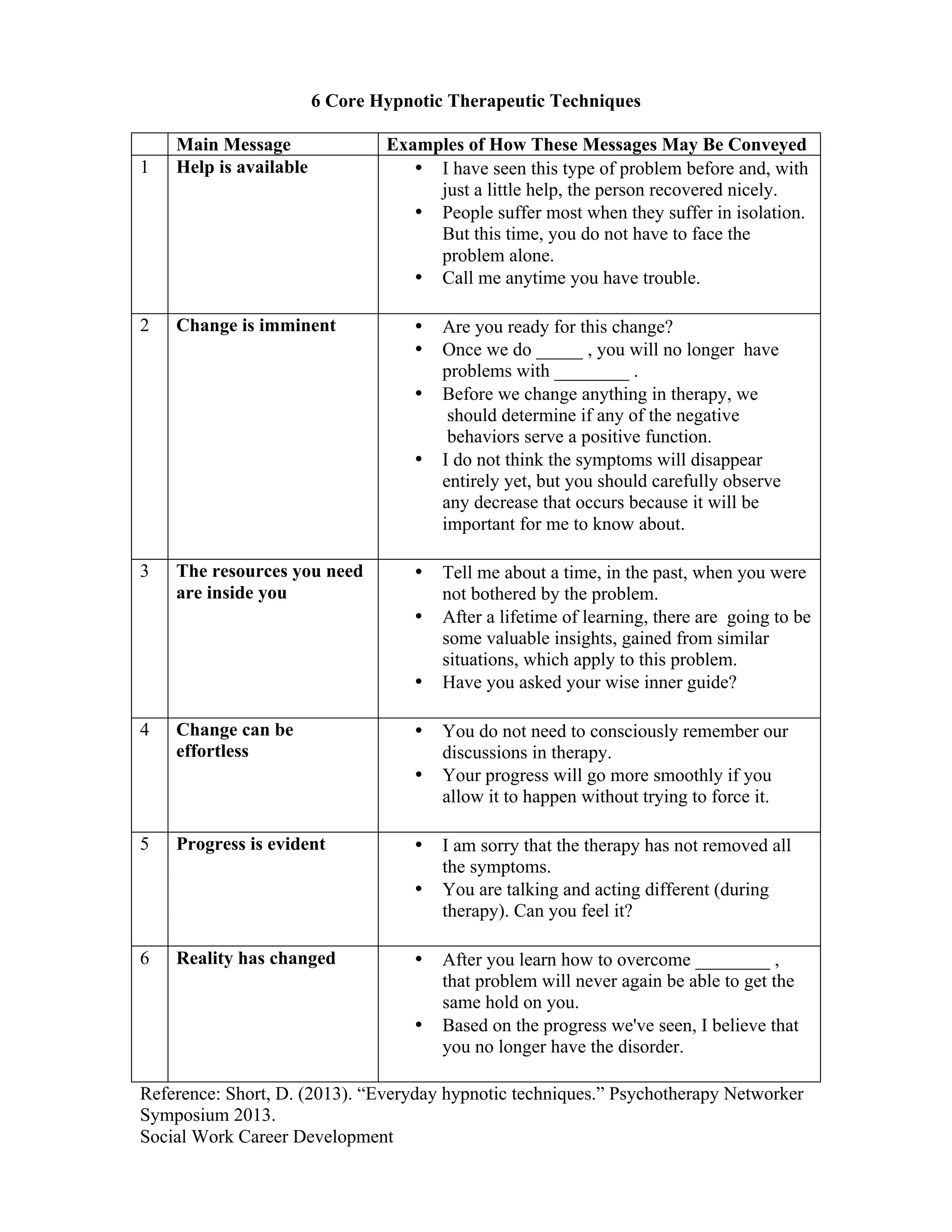
    6 Core HypnoticTherapeutic Techniques Main Message Examples of How These Messages May Be Conveyed 1 Help is available • I have seen this type of problem before and, with just a little help, the person recovered nicely. • People suffer most when they suffer in isolation. But this time, you do not have to face the problem alone. • Call me anytime you have trouble. 2 Change is imminent • Are you ready for this change? • Once we do _____ , you will no longer have problems with ________ . • Before we change anything in therapy, we should determine if any of the negative behaviors serve a positive function. • I do not think the symptoms will disappear entirely yet, but you should carefully observe any decrease that occurs because it will be important for me to know about. 3 The resources you need are inside you • Tell me about a time, in the past, when you were not bothered by the problem. • After a lifetime of learning, there are going to be some valuable insights, gained from similar situations, which apply to this problem. • Have you asked your wise inner guide? 4 Change can be effortless • You do not need to consciously remember our discussions in therapy. • Your progress will go more smoothly if you allow it to happen without trying to force it. 5 Progress is evident • I am sorry that the therapy has not removed all the symptoms. • You are talking and acting different (during therapy). Can you feel it? 6 Reality has changed • After you learn how to overcome ________ , that problem will never again be able to get the same hold on you. • Based on the progress we've seen, I believe that you no longer have the disorder. Reference: Short, D. (2013). “Everyday hypnotic techniques.” Psychotherapy Networker Symposium 2013. Social Work Career Development