Chapter 32:
Vertebrate
Animals
Kailey McNett
kmmcnett@uark.edu
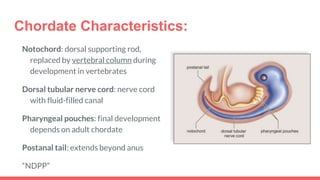
Chordate Characteristics:
Notochord: dorsal supporting rod,
replaced by vertebral column during
development in vertebrates
Dorsal tubular nerve cord: nerve cord
with fluid-filled canal
Pharyngeal pouches: final development
depends on adult chordate
Postanal tail: extends beyond anus
“NDPP”
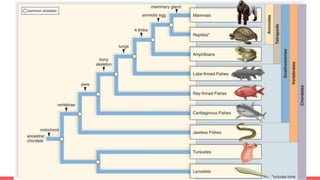
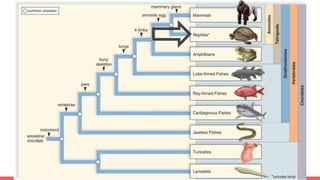
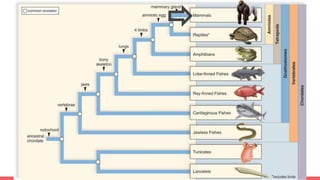
Tree and When Things Evolved!!!
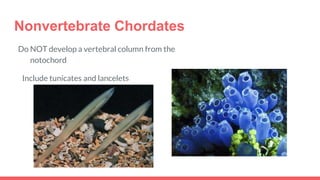
Nonvertebrate Chordates
Do NOT develop a vertebral column from the
notochord
Include tunicates and lancelets
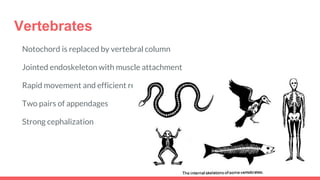
Vertebrates
Notochord is replaced by vertebral column
Jointed endoskeleton with muscle attachment
Rapid movement and efficient respiration
Two pairs of appendages
Strong cephalization
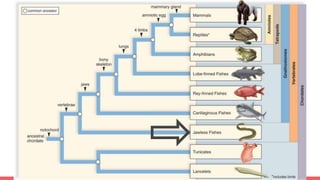
Tree and When Things Evolved!!!
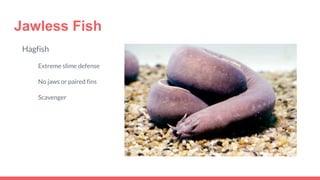
Jawless Fish
Hagfish
Extreme slime defense
No jaws or paired fins
Scavenger
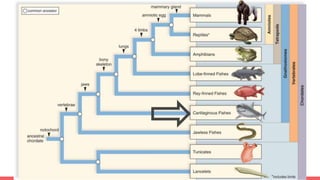
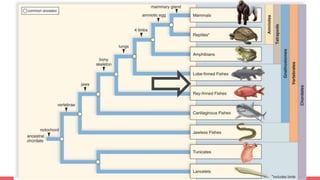
Tree and When Things Evolved!!!
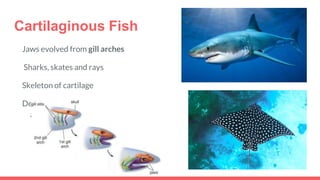
Cartilaginous Fish
Jaws evolved from gill arches
Sharks, skates and rays
Skeleton of cartilage
Detect prey through electric currents
and keen sense of smell
Tree and When Things Evolved!!!
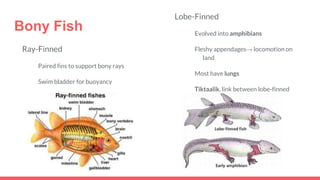
Bony Fish
Ray-Finned
Paired fins to support bony rays
Swim bladder for buoyancy
Streamlined shape
Bony scales for protection
Lobe-Finned
Evolved into amphibians
Fleshy appendages→ locomotion on
land
Most have lungs
Tiktaalik, link between lobe-finned
fish and amphibians
Tree and When Things Evolved!!!
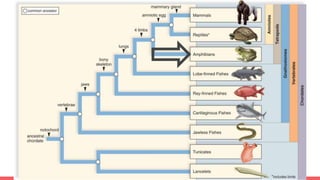
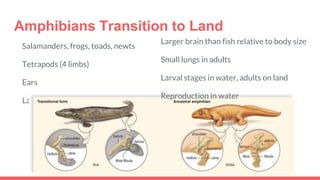
Amphibians Transition to Land
Salamanders, frogs, toads, newts
Tetrapods (4 limbs)
Ears
Larynx for vocalization
Larger brain than fish relative to body size
Small lungs in adults
Larval stages in water, adults on land
Reproduction in water
Tree and When Things Evolved!!!
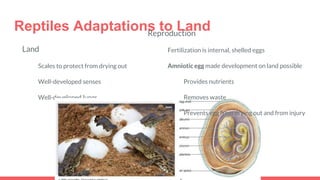
Reptiles Adaptations to Land
Land
Scales to protect from drying out
Well-developed senses
Well-developed lungs
Reproduction
Fertilization is internal, shelled eggs
Amniotic egg made development on land possible
Provides nutrients
Removes waste
Prevents egg from drying out and from injury
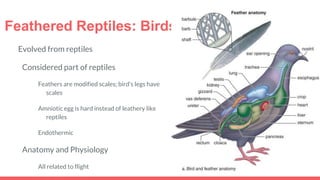
Feathered Reptiles: Birds
Evolved from reptiles
Considered part of reptiles
Feathers are modified scales; bird’s legs have
scales
Amniotic egg is hard instead of leathery like
reptiles
Endothermic
Anatomy and Physiology
All related to flight
Tree and When Things Evolved!!!
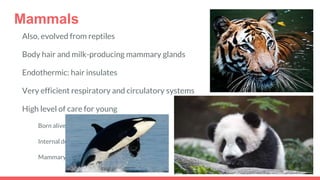
Mammals
Also, evolved from reptiles
Body hair and milk-producing mammary glands
Endothermic: hair insulates
Very efficient respiratory and circulatory systems
High level of care for young
Born alive
Internal development
Mammary glands: nursing
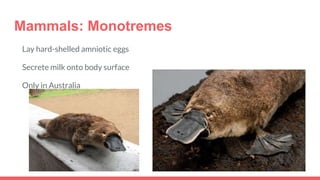
Mammals: Monotremes
Lay hard-shelled amniotic eggs
Secrete milk onto body surface
Only in Australia
Platypus
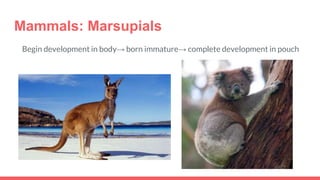
Mammals: Marsupials
Begin development in body→ born immature→ complete development in pouch
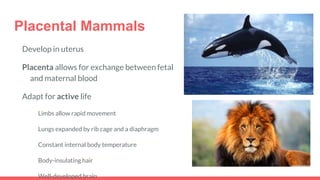
Placental Mammals
Develop in uterus
Placenta allows for exchange between fetal
and maternal blood
Adapt for active life
Limbs allow rapid movement
Lungs expanded by rib cage and a diaphragm
Constant internal body temperature
Body-insulating hair
Well-developed brain
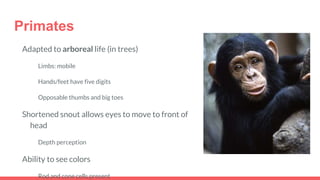
Primates
Adapted to arboreal life (in trees)
Limbs: mobile
Hands/feet have five digits
Opposable thumbs and big toes
Shortened snout allows eyes to move to front of
head
Depth perception
Ability to see colors
Rod and cone cells present
Chapter 33:
Behavioral
Ecology
Kailey McNett
kmmcnett@uark.edu
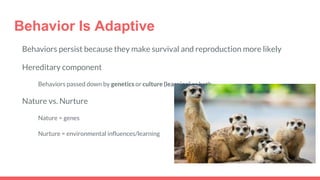
Behavior Is Adaptive
Behaviors persist because they make survival and reproduction more likely
Hereditary component
Behaviors passed down by genetics or culture (learning) or both
Nature vs. Nurture
Nature = genes
Nurture = environmental influences/learning
Proximate vs. Ultimate Questions
Proximate: “What” brings about the particular behavior? “How” does it happen?
Physical/chemical structures
Genes
Hormonal reactions
Ultimate: “Why” does this behavior persist?
Evolutionary pressure and adaptation
Evolutionary history
Example: Hand pulling away from hot stove
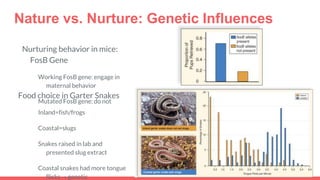
Nature vs. Nurture: Genetic Influences
Nurturing behavior in mice:
FosB Gene
Working FosB gene: engage in
maternal behavior
Mutated FosB gene: do not
Food choice in Garter Snakes
Inland=fish/frogs
Coastal=slugs
Snakes raised in lab and
presented slug extract
Coastal snakes had more tongue
flicks→ genetic
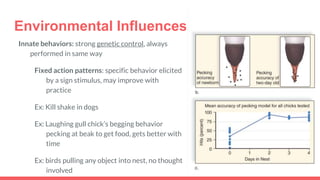
Environmental Influences
Innate behaviors: strong genetic control, always
performed in same way
Fixed action patterns: specific behavior elicited
by a sign stimulus, may improve with
practice
Ex: Kill shake in dogs
Ex: Laughing gull chick’s begging behavior
pecking at beak to get food, gets better with
time
Ex: birds pulling any object into nest, no thought
involved
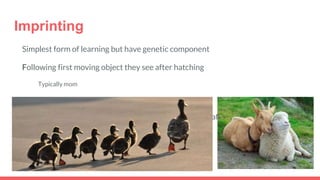
Imprinting
Simplest form of learning but have genetic component
Following first moving object they see after hatching
Typically mom
Could be something else
Only develops during sensitive period (two/three days after hatching)
Social Interactions and Learning
Song learning in birds
No songs→ undeveloped songs as adult
Recorded species song → sang in that dialect as long as tape was played during
sensitive period
Adult tutor of different species → tutor’s song regardless of different species
Singing is innate, learning right song needs social learning
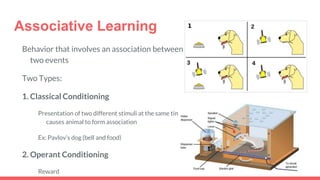
Associative Learning
Behavior that involves an association between
two events
Two Types:
1. Classical Conditioning
Presentation of two different stimuli at the same time
causes animal to form association
Ex: Pavlov’s dog (bell and food)
2. Operant Conditioning
Reward
Chapter 34:
Population and
Community
Ecology
Kailey McNett
kmmcnett@uark.edu
Levels of Organization
Population
Single species interacting
Ex: Students at U of A
Community
All the different species at a locale
Ex: Students, squirrels, bees, etc.
Ecosystem
Community of populations and nonliving environment
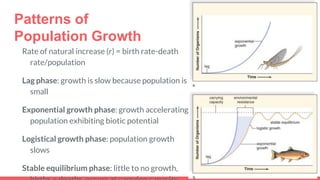
Patterns of
Population Growth
Rate of natural increase (r) = birth rate-death
rate/population
Lag phase: growth is slow because population is
small
Exponential growth phase: growth accelerating,
population exhibiting biotic potential
Logistical growth phase: population growth
slows
Stable equilibrium phase: little to no growth,
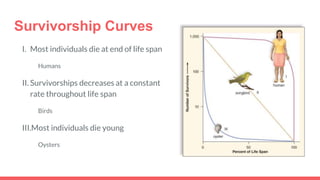
Survivorship Curves
I. Most individuals die at end of life span
Humans
II. Survivorships decreases at a constant
rate throughout life span
Birds
III.Most individuals die young
Oysters
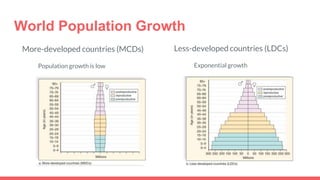
World Population Growth
More-developed countries (MCDs)
Population growth is low
Less-developed countries (LDCs)
Exponential growth
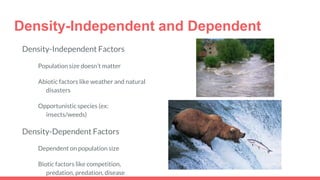
Density-Independent and Dependent
Density-Independent Factors
Population size doesn’t matter
Abiotic factors like weather and natural
disasters
Opportunistic species (ex:
insects/weeds)
Density-Dependent Factors
Dependent on population size
Biotic factors like competition,
predation, predation, disease
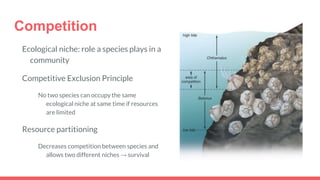
Competition
Ecological niche: role a species plays in a
community
Competitive Exclusion Principle
No two species can occupy the same
ecological niche at same time if resources
are limited
Resource partitioning
Decreases competition between species and
allows two different niches → survival
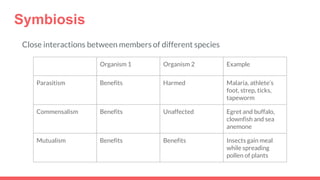
Symbiosis
Close interactions between members of different species
Organism 1 Organism 2 Example
Parasitism Benefits Harmed Malaria, athlete’s
foot, strep, ticks,
tapeworm
Commensalism Benefits Unaffected Egret and buffalo,
clownfish and sea
anemone
Mutualism Benefits Benefits Insects gain meal
while spreading
pollen of plants
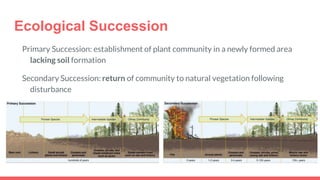
Ecological Succession
Primary Succession: establishment of plant community in a newly formed area
lacking soil formation
Secondary Succession: return of community to natural vegetation following
disturbance
Pioneer species
Chapter 35:
Nature of
Ecosystems
Kailey McNett
kmmcnett@uark.edu
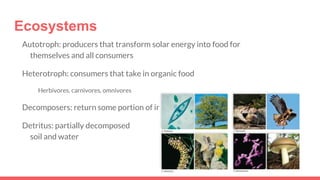
Ecosystems
Autotroph: producers that transform solar energy into food for
themselves and all consumers
Heterotroph: consumers that take in organic food
Herbivores, carnivores, omnivores
Decomposers: return some portion of inorganic nutrients to autotrophs
Detritus: partially decomposed matter in the
soil and water
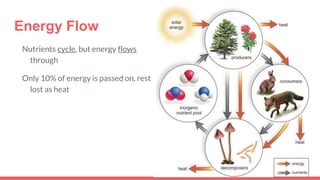
Energy Flow
Nutrients cycle, but energy flows
through
Only 10% of energy is passed on, rest
lost as heat
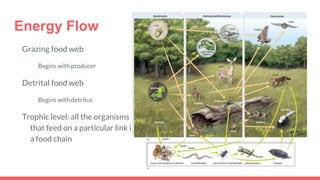
Energy Flow
Grazing food web
Begins with producer
Detrital food web
Begins with detritus
Trophic level: all the organisms
that feed on a particular link in
a food chain
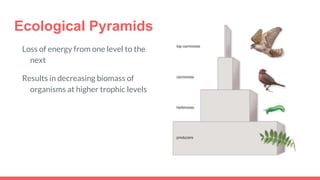
Ecological Pyramids
Loss of energy from one level to the
next
Results in decreasing biomass of
organisms at higher trophic levels
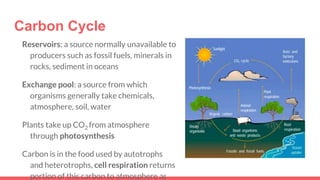
Carbon Cycle
Reservoirs: a source normally unavailable to
producers such as fossil fuels, minerals in
rocks, sediment in oceans
Exchange pool: a source from which
organisms generally take chemicals,
atmosphere, soil, water
Plants take up CO2 from atmosphere
through photosynthesis
Carbon is in the food used by autotrophs
and heterotrophs, cell respiration returns
portion of this carbon to atmosphere as

Exam 4 Review Part 2

  • 1.
  • 2.
    Chordate Characteristics: Notochord: dorsalsupporting rod, replaced by vertebral column during development in vertebrates Dorsal tubular nerve cord: nerve cord with fluid-filled canal Pharyngeal pouches: final development depends on adult chordate Postanal tail: extends beyond anus “NDPP”
  • 3.
    Tree and WhenThings Evolved!!!
  • 4.
    Nonvertebrate Chordates Do NOTdevelop a vertebral column from the notochord Include tunicates and lancelets
  • 5.
    Vertebrates Notochord is replacedby vertebral column Jointed endoskeleton with muscle attachment Rapid movement and efficient respiration Two pairs of appendages Strong cephalization
  • 6.
    Tree and WhenThings Evolved!!!
  • 7.
    Jawless Fish Hagfish Extreme slimedefense No jaws or paired fins Scavenger
  • 8.
    Tree and WhenThings Evolved!!!
  • 9.
    Cartilaginous Fish Jaws evolvedfrom gill arches Sharks, skates and rays Skeleton of cartilage Detect prey through electric currents and keen sense of smell
  • 10.
    Tree and WhenThings Evolved!!!
  • 11.
    Bony Fish Ray-Finned Paired finsto support bony rays Swim bladder for buoyancy Streamlined shape Bony scales for protection Lobe-Finned Evolved into amphibians Fleshy appendages→ locomotion on land Most have lungs Tiktaalik, link between lobe-finned fish and amphibians
  • 12.
    Tree and WhenThings Evolved!!!
  • 13.
    Amphibians Transition toLand Salamanders, frogs, toads, newts Tetrapods (4 limbs) Ears Larynx for vocalization Larger brain than fish relative to body size Small lungs in adults Larval stages in water, adults on land Reproduction in water
  • 14.
    Tree and WhenThings Evolved!!!
  • 15.
    Reptiles Adaptations toLand Land Scales to protect from drying out Well-developed senses Well-developed lungs Reproduction Fertilization is internal, shelled eggs Amniotic egg made development on land possible Provides nutrients Removes waste Prevents egg from drying out and from injury
  • 16.
    Feathered Reptiles: Birds Evolvedfrom reptiles Considered part of reptiles Feathers are modified scales; bird’s legs have scales Amniotic egg is hard instead of leathery like reptiles Endothermic Anatomy and Physiology All related to flight
  • 17.
    Tree and WhenThings Evolved!!!
  • 18.
    Mammals Also, evolved fromreptiles Body hair and milk-producing mammary glands Endothermic: hair insulates Very efficient respiratory and circulatory systems High level of care for young Born alive Internal development Mammary glands: nursing
  • 19.
    Mammals: Monotremes Lay hard-shelledamniotic eggs Secrete milk onto body surface Only in Australia Platypus
  • 20.
    Mammals: Marsupials Begin developmentin body→ born immature→ complete development in pouch
  • 21.
    Placental Mammals Develop inuterus Placenta allows for exchange between fetal and maternal blood Adapt for active life Limbs allow rapid movement Lungs expanded by rib cage and a diaphragm Constant internal body temperature Body-insulating hair Well-developed brain
  • 22.
    Primates Adapted to arboreallife (in trees) Limbs: mobile Hands/feet have five digits Opposable thumbs and big toes Shortened snout allows eyes to move to front of head Depth perception Ability to see colors Rod and cone cells present
  • 23.
  • 24.
    Behavior Is Adaptive Behaviorspersist because they make survival and reproduction more likely Hereditary component Behaviors passed down by genetics or culture (learning) or both Nature vs. Nurture Nature = genes Nurture = environmental influences/learning
  • 25.
    Proximate vs. UltimateQuestions Proximate: “What” brings about the particular behavior? “How” does it happen? Physical/chemical structures Genes Hormonal reactions Ultimate: “Why” does this behavior persist? Evolutionary pressure and adaptation Evolutionary history Example: Hand pulling away from hot stove
  • 26.
    Nature vs. Nurture:Genetic Influences Nurturing behavior in mice: FosB Gene Working FosB gene: engage in maternal behavior Mutated FosB gene: do not Food choice in Garter Snakes Inland=fish/frogs Coastal=slugs Snakes raised in lab and presented slug extract Coastal snakes had more tongue flicks→ genetic
  • 27.
    Environmental Influences Innate behaviors:strong genetic control, always performed in same way Fixed action patterns: specific behavior elicited by a sign stimulus, may improve with practice Ex: Kill shake in dogs Ex: Laughing gull chick’s begging behavior pecking at beak to get food, gets better with time Ex: birds pulling any object into nest, no thought involved
  • 28.
    Imprinting Simplest form oflearning but have genetic component Following first moving object they see after hatching Typically mom Could be something else Only develops during sensitive period (two/three days after hatching)
  • 29.
    Social Interactions andLearning Song learning in birds No songs→ undeveloped songs as adult Recorded species song → sang in that dialect as long as tape was played during sensitive period Adult tutor of different species → tutor’s song regardless of different species Singing is innate, learning right song needs social learning
  • 30.
    Associative Learning Behavior thatinvolves an association between two events Two Types: 1. Classical Conditioning Presentation of two different stimuli at the same time causes animal to form association Ex: Pavlov’s dog (bell and food) 2. Operant Conditioning Reward
  • 31.
  • 32.
    Levels of Organization Population Singlespecies interacting Ex: Students at U of A Community All the different species at a locale Ex: Students, squirrels, bees, etc. Ecosystem Community of populations and nonliving environment
  • 33.
    Patterns of Population Growth Rateof natural increase (r) = birth rate-death rate/population Lag phase: growth is slow because population is small Exponential growth phase: growth accelerating, population exhibiting biotic potential Logistical growth phase: population growth slows Stable equilibrium phase: little to no growth,
  • 34.
    Survivorship Curves I. Mostindividuals die at end of life span Humans II. Survivorships decreases at a constant rate throughout life span Birds III.Most individuals die young Oysters
  • 35.
    World Population Growth More-developedcountries (MCDs) Population growth is low Less-developed countries (LDCs) Exponential growth
  • 36.
    Density-Independent and Dependent Density-IndependentFactors Population size doesn’t matter Abiotic factors like weather and natural disasters Opportunistic species (ex: insects/weeds) Density-Dependent Factors Dependent on population size Biotic factors like competition, predation, predation, disease
  • 37.
    Competition Ecological niche: rolea species plays in a community Competitive Exclusion Principle No two species can occupy the same ecological niche at same time if resources are limited Resource partitioning Decreases competition between species and allows two different niches → survival
  • 38.
    Symbiosis Close interactions betweenmembers of different species Organism 1 Organism 2 Example Parasitism Benefits Harmed Malaria, athlete’s foot, strep, ticks, tapeworm Commensalism Benefits Unaffected Egret and buffalo, clownfish and sea anemone Mutualism Benefits Benefits Insects gain meal while spreading pollen of plants
  • 39.
    Ecological Succession Primary Succession:establishment of plant community in a newly formed area lacking soil formation Secondary Succession: return of community to natural vegetation following disturbance Pioneer species
  • 40.
  • 41.
    Ecosystems Autotroph: producers thattransform solar energy into food for themselves and all consumers Heterotroph: consumers that take in organic food Herbivores, carnivores, omnivores Decomposers: return some portion of inorganic nutrients to autotrophs Detritus: partially decomposed matter in the soil and water
  • 42.
    Energy Flow Nutrients cycle,but energy flows through Only 10% of energy is passed on, rest lost as heat
  • 43.
    Energy Flow Grazing foodweb Begins with producer Detrital food web Begins with detritus Trophic level: all the organisms that feed on a particular link in a food chain
  • 44.
    Ecological Pyramids Loss ofenergy from one level to the next Results in decreasing biomass of organisms at higher trophic levels
  • 45.
    Carbon Cycle Reservoirs: asource normally unavailable to producers such as fossil fuels, minerals in rocks, sediment in oceans Exchange pool: a source from which organisms generally take chemicals, atmosphere, soil, water Plants take up CO2 from atmosphere through photosynthesis Carbon is in the food used by autotrophs and heterotrophs, cell respiration returns portion of this carbon to atmosphere as