EWRT
30
Class
4
AGENDA
Terms 17-23
Discussion: Sonnet
Lecture: Form and
Structure:
Sestina/Villanelle:
Guided Writing:
Sestina/Villanelle
Terms 17-23
17. Shakespearian or English Sonnet
A fourteen-line poem in iambic pentameter. The
Shakespearean or English sonnet is arranged as
three quatrains and a final couplet, rhyming abab
cdcd efef gg.
18. The Petrarchan or Italian Sonnet A fourteen-line
poem in iambic pentameter. It is divided into two
parts: an eight-line octave and a six-line sestet,
rhyming abba abba cde cde or abba abba cd cd cd
(or other combination of cde).
19. Stanza
A division or unit of a poem that is repeated in the same
form--either with similar or identical patterns or rhyme and
meter, or with variations from one stanza to another.
20. Couplet
A pair of rhymed lines that may or may not constitute a
separate stanza in a poem. Shakespeare's sonnets end
in rhymed couplets, as in "For thy sweet love
remembered such wealth brings / That then I scorn to
change my state with kings."
21. Quatrain
A four-line stanza in a poem, the first four lines and the
second four lines in a Petrarchan sonnet. A
Shakespearean sonnet contains three quatrains followed
by a couplet.
22.Octave
An eight-line unit, which may constitute a
stanza; or a section of a poem, as in the
octave of a sonnet.
22.Sestet
A six-line unit of verse constituting a stanza or
section of a poem; the last six lines of an
Italian sonnet. Examples: Petrarch's "If it is
not love, then what is it that I feel," and Frost's
"Design."
The Review 5
minutes
12.Rhyme
13.Feminine Rhyme
14.Internal Rhyme
15.Slant Rhyme
16.Eye Rhyme
17.Identical Rhyme
18.English Sonnet
19.Italian Sonnet
20.Stanza
21.Couplet
22.Quatrain
23.Octave
24.Sestet
Discussion Subject: 10 minutes
Sonnets: Share your work. Identify both
sonnet and poetry conventions!
 Line number
 Rhyme Scheme
 Structure
 Quatrains
 Couplets
 Octave/sestet
 Meter/Feet
 A turn or volta
 Rhyme (of all types)
 Metaphor/Simile
 Alliteration
 Assonance
 Onomatopoeia
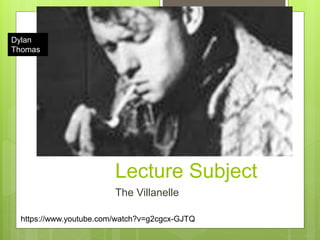
Lecture Subject
The Villanelle
Dylan
Thomas
https://www.youtube.com/watch?v=g2cgcx-GJTQ
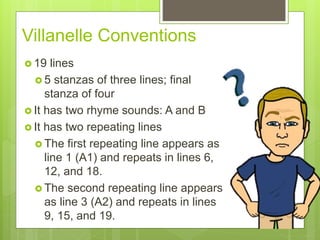
Villanelle Conventions
 19 lines
 5 stanzas of three lines; final
stanza of four
 It has two rhyme sounds: A and B
 It has two repeating lines
 The first repeating line appears as
line 1 (A1) and repeats in lines 6,
12, and 18.
 The second repeating line appears
as line 3 (A2) and repeats in lines
9, 15, and 19.
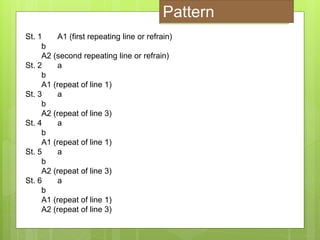
St. 1 A1 (first repeating line or refrain)
b
A2 (second repeating line or refrain)
St. 2 a
b
A1 (repeat of line 1)
St. 3 a
b
A2 (repeat of line 3)
St. 4 a
b
A1 (repeat of line 1)
St. 5 a
b
A2 (repeat of line 3)
St. 6 a
b
A1 (repeat of line 1)
A2 (repeat of line 3)
Pattern
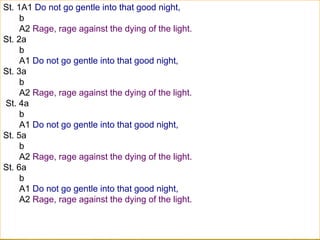
St. 1A1 Do not go gentle into that good night,
b
A2 Rage, rage against the dying of the light.
St. 2a
b
A1 Do not go gentle into that good night,
St. 3a
b
A2 Rage, rage against the dying of the light.
St. 4a
b
A1 Do not go gentle into that good night,
St. 5a
b
A2 Rage, rage against the dying of the light.
St. 6a
b
A1 Do not go gentle into that good night,
A2 Rage, rage against the dying of the light.
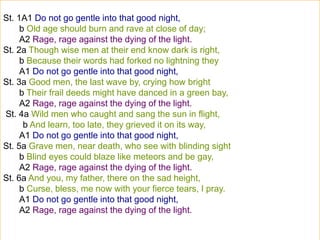
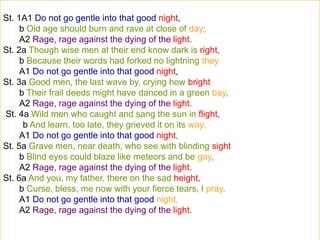
St. 1A1 Do not go gentle into that good night,
b Old age should burn and rave at close of day;
A2 Rage, rage against the dying of the light.
St. 2a Though wise men at their end know dark is right,
b Because their words had forked no lightning they
A1 Do not go gentle into that good night,
St. 3a Good men, the last wave by, crying how bright
b Their frail deeds might have danced in a green bay,
A2 Rage, rage against the dying of the light.
St. 4a Wild men who caught and sang the sun in flight,
b And learn, too late, they grieved it on its way,
A1 Do not go gentle into that good night,
St. 5a Grave men, near death, who see with blinding sight
b Blind eyes could blaze like meteors and be gay,
A2 Rage, rage against the dying of the light.
St. 6a And you, my father, there on the sad height,
b Curse, bless, me now with your fierce tears, I pray.
A1 Do not go gentle into that good night,
A2 Rage, rage against the dying of the light.
St. 1A1 Do not go gentle into that good night,
b Old age should burn and rave at close of day;
A2 Rage, rage against the dying of the light.
St. 2a Though wise men at their end know dark is right,
b Because their words had forked no lightning they
A1 Do not go gentle into that good night,
St. 3a Good men, the last wave by, crying how bright
b Their frail deeds might have danced in a green bay,
A2 Rage, rage against the dying of the light.
St. 4a Wild men who caught and sang the sun in flight,
b And learn, too late, they grieved it on its way,
A1 Do not go gentle into that good night,
St. 5a Grave men, near death, who see with blinding sight
b Blind eyes could blaze like meteors and be gay,
A2 Rage, rage against the dying of the light.
St. 6a And you, my father, there on the sad height,
b Curse, bless, me now with your fierce tears, I pray.
A1 Do not go gentle into that good night,
A2 Rage, rage against the dying of the light.
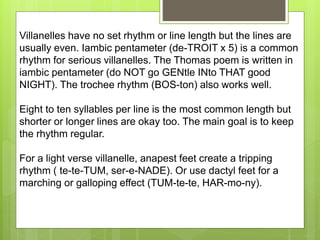
Villanelles have no set rhythm or line length but the lines are
usually even. Iambic pentameter (de-TROIT x 5) is a common
rhythm for serious villanelles. The Thomas poem is written in
iambic pentameter (do NOT go GENtle INto THAT good
NIGHT). The trochee rhythm (BOS-ton) also works well.
Eight to ten syllables per line is the most common length but
shorter or longer lines are okay too. The main goal is to keep
the rhythm regular.
For a light verse villanelle, anapest feet create a tripping
rhythm ( te-te-TUM, ser-e-NADE). Or use dactyl feet for a
marching or galloping effect (TUM-te-te, HAR-mo-ny).
Guided Writing
Villanelle
1. Choose a subject.
 W. H. Auden, when asked whether the form or content came
first, replied, “At any given time, I have two things on my mind—
a theme that interests me and a problem of verbal form. The
theme looks for the right form; the form looks for the right
theme. When the two come together, I am able to start writing.”
 Some subjects or themes that lend themselves well to the
villanelles:
 Duality, for example two differing points of view, or two unlike
things or people forced together. Consider a poem about Christmas
in a prison or care home. Note the duality: happy time, sad place.
 Ironic subjects. Actor, writer and poetry aficionado Stephen Fry
describes many villanelles as consisting of “a rueful, ironic
reiteration of pain or fatalism.”
 Humorous subjects—especially those rooted in irony.
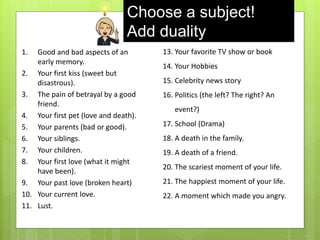
Choose a subject!
Add duality
1. Good and bad aspects of an
early memory.
2. Your first kiss (sweet but
disastrous).
3. The pain of betrayal by a good
friend.
4. Your first pet (love and death).
5. Your parents (bad or good).
6. Your siblings.
7. Your children.
8. Your first love (what it might
have been).
9. Your past love (broken heart)
10. Your current love.
11. Lust.
13. Your favorite TV show or book
14. Your Hobbies
15. Celebrity news story
16. Politics (the left? The right? An
event?)
17. School (Drama)
18. A death in the family.
19. A death of a friend.
20. The scariest moment of your life.
21. The happiest moment of your life.
22. A moment which made you angry.
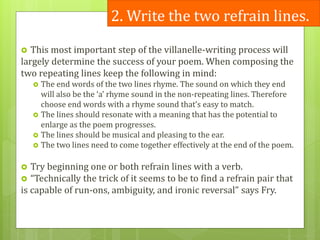
2. Write the two refrain lines.
 This most important step of the villanelle-writing process will
largely determine the success of your poem. When composing the
two repeating lines keep the following in mind:
 The end words of the two lines rhyme. The sound on which they end
will also be the ‘a’ rhyme sound in the non-repeating lines. Therefore
choose end words with a rhyme sound that’s easy to match.
 The lines should resonate with a meaning that has the potential to
enlarge as the poem progresses.
 The lines should be musical and pleasing to the ear.
 The two lines need to come together effectively at the end of the poem.
 Try beginning one or both refrain lines with a verb.
 “Technically the trick of it seems to be to find a refrain pair that
is capable of run-ons, ambiguity, and ironic reversal” says Fry.
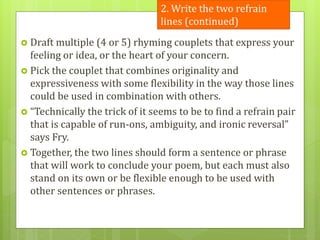
 Draft multiple (4 or 5) rhyming couplets that express your
feeling or idea, or the heart of your concern.
 Pick the couplet that combines originality and
expressiveness with some flexibility in the way those lines
could be used in combination with others.
 “Technically the trick of it seems to be to find a refrain pair
that is capable of run-ons, ambiguity, and ironic reversal”
says Fry.
 Together, the two lines should form a sentence or phrase
that will work to conclude your poem, but each must also
stand on its own or be flexible enough to be used with
other sentences or phrases.
2. Write the two refrain
lines (continued)
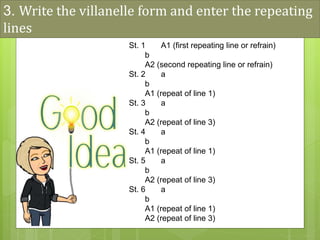
3. Write the villanelle form and enter the repeating
lines
St. 1 A1 (first repeating line or refrain)
b
A2 (second repeating line or refrain)
St. 2 a
b
A1 (repeat of line 1)
St. 3 a
b
A2 (repeat of line 3)
St. 4 a
b
A1 (repeat of line 1)
St. 5 a
b
A2 (repeat of line 3)
St. 6 a
b
A1 (repeat of line 1)
A2 (repeat of line 3)
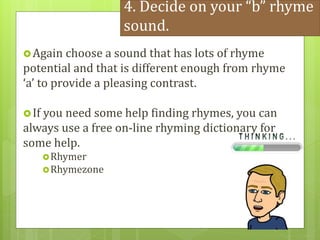
4. Decide on your “b” rhyme
sound.
Again choose a sound that has lots of rhyme
potential and that is different enough from rhyme
‘a’ to provide a pleasing contrast.
If you need some help finding rhymes, you can
always use a free on-line rhyming dictionary for
some help.
Rhymer
Rhymezone
 .
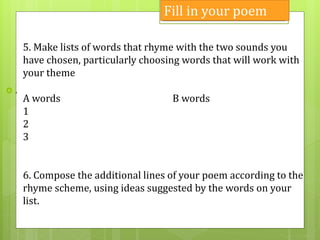
5. Make lists of words that rhyme with the two sounds you
have chosen, particularly choosing words that will work with
your theme
A words B words
1
2
3
6. Compose the additional lines of your poem according to the
rhyme scheme, using ideas suggested by the words on your
list.
Fill in your poem
 Make changes to enhance and add meaning, not simply for the
sake of variety. “The repetition cannot be static,” says Frances
Mayes. “Each time a repeating line appears it should have added
significance.”
 If this way of composing a poem seems contrived and non-
poetic, be reassured that you’re not the first person to feel this
way. Despite the seemingly un-poetic method of composing,
villanelles often appear spontaneous. Strive for such an effect,
even if it takes much crossing out, agonizing over, and rewriting
lines to get exactly what you’re after.
 Once you’re familiar with writing by-the-rules villanelles, you
may be tempted to join poets who have written villanelles that
break the rules. Some poets leave out or add stanzas, rhyme only
some of the lines, or none at all, or even write in free verse. For
this assignment, please try to conform to the rules.
7. Revise
 Use enjambment sometimes, so that your
repeated lines are less obvious.
 Change the punctuation to alter meaning.
 Feel free to slightly modify the lines that you
set up for your original couplet.
 Then, repeat this modification throughout
the poem (if you are following the form of
strict repetition), or use the modifications to
reflect something (such as a progression of
internal emotions).
Tips
Elizabeth Bishop https://www.youtube.com/watch?v=1JbffGo
Ii30&t=16s
Sestina
Conventions
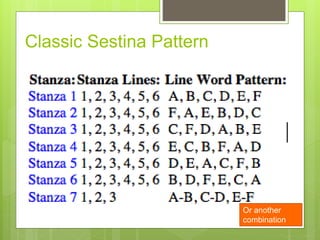
The sestina makes no demands on the poet in terms of meter or rhyme or
foot. Its requirements border on the mathematical and its prescriptions are
mainly syntactical.
In Questions of Possibility: Contemporary Poetry and Poetic Form, David Caplan
explains,
The opening stanza introduces six endwords […]
which repeat through the six sestets. Starting with the
second sestet, each stanza duplicates the previous
stanza’s endwords in the following order: last, first, fifth,
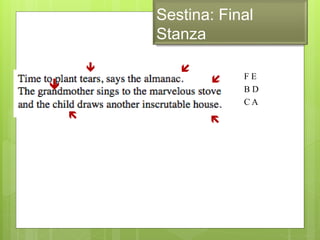
second, fourth, then third. […] By the poem’s end, each
end word appears in all six lines. Finally […] the
concluding [stanza] features two endwords in each of its
three lines, one as an endword and one in the middleof the
line (18).
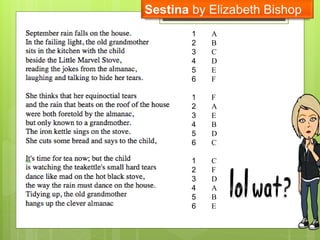
Sestina by Elizabeth Bishop
1
2
3
4
5
6
1
2
3
4
5
6
1
2
3
4
5
6
A
B
C
D
E
F
F
A
E
B
D
C
C
F
D
A
B
E
Classic Sestina Pattern
Or another
combination
Sestina: Final
Stanza
F E
B D
C A



 

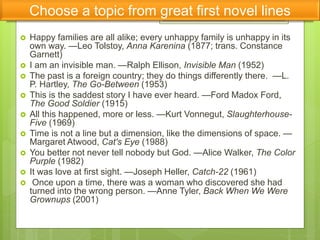
Guided Writing
 Happy families are all alike; every unhappy family is unhappy in its
own way. —Leo Tolstoy, Anna Karenina (1877; trans. Constance
Garnett)
 I am an invisible man. —Ralph Ellison, Invisible Man (1952)
 The past is a foreign country; they do things differently there. —L.
P. Hartley, The Go-Between (1953)
 This is the saddest story I have ever heard. —Ford Madox Ford,
The Good Soldier (1915)
 All this happened, more or less. —Kurt Vonnegut, Slaughterhouse-
Five (1969)
 Time is not a line but a dimension, like the dimensions of space. —
Margaret Atwood, Cat's Eye (1988)
 You better not never tell nobody but God. —Alice Walker, The Color
Purple (1982)
 It was love at first sight. —Joseph Heller, Catch-22 (1961)
 Once upon a time, there was a woman who discovered she had
turned into the wrong person. —Anne Tyler, Back When We Were
Grownups (2001)
Choose a topic from great first novel lines
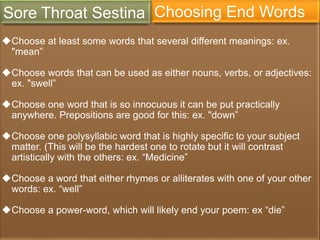
Choose at least some words that several different meanings: ex.
"mean”
Choose words that can be used as either nouns, verbs, or adjectives:
ex. "swell”
Choose one word that is so innocuous it can be put practically
anywhere. Prepositions are good for this: ex. "down”
Choose one polysyllabic word that is highly specific to your subject
matter. (This will be the hardest one to rotate but it will contrast
artistically with the others: ex. “Medicine”
Choose a word that either rhymes or alliterates with one of your other
words: ex. “well”
Choose a power-word, which will likely end your poem: ex “die”
Choosing End WordsSore Throat Sestina
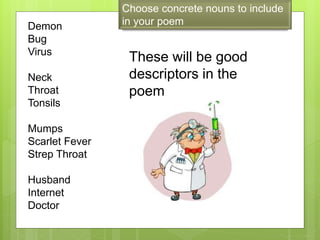
Choose concrete nouns to include
in your poemDemon
Bug
Virus
Neck
Throat
Tonsils
Mumps
Scarlet Fever
Strep Throat
Husband
Internet
Doctor
These will be good
descriptors in the
poem
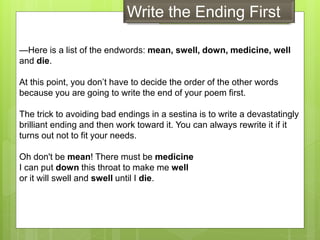
—Here is a list of the endwords: mean, swell, down, medicine, well
and die.
At this point, you don’t have to decide the order of the other words
because you are going to write the end of your poem first.
The trick to avoiding bad endings in a sestina is to write a devastatingly
brilliant ending and then work toward it. You can always rewrite it if it
turns out not to fit your needs.
Oh don't be mean! There must be medicine
I can put down this throat to make me well
or it will swell and swell until I die.
Write the Ending First
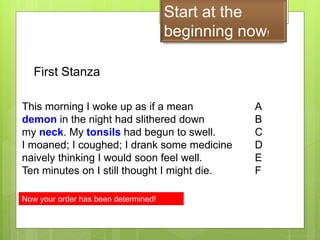
Start at the
beginning now!
This morning I woke up as if a mean
demon in the night had slithered down
my neck. My tonsils had begun to swell.
I moaned; I coughed; I drank some medicine
naively thinking I would soon feel well.
Ten minutes on I still thought I might die.
First Stanza
A
B
C
D
E
F
Now your order has been determined!
Second Stanza
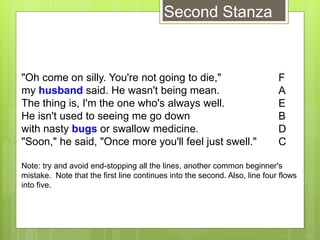
"Oh come on silly. You're not going to die,"
my husband said. He wasn't being mean.
The thing is, I'm the one who's always well.
He isn't used to seeing me go down
with nasty bugs or swallow medicine.
"Soon," he said, "Once more you'll feel just swell."
Note: try and avoid end-stopping all the lines, another common beginner's
mistake. Note that the first line continues into the second. Also, line four flows
into five.
F
A
E
B
D
C
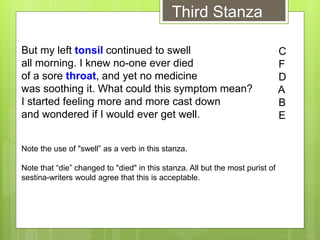
But my left tonsil continued to swell
all morning. I knew no-one ever died
of a sore throat, and yet no medicine
was soothing it. What could this symptom mean?
I started feeling more and more cast down
and wondered if I would ever get well.
Note the use of "swell” as a verb in this stanza.
Note that “die” changed to "died" in this stanza. All but the most purist of
sestina-writers would agree that this is acceptable.
C
F
D
A
B
E
Third Stanza
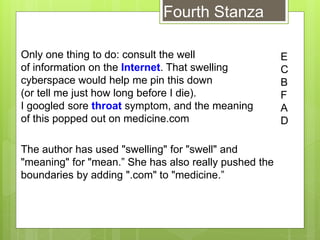
Only one thing to do: consult the well
of information on the Internet. That swelling
cyberspace would help me pin this down
(or tell me just how long before I die).
I googled sore throat symptom, and the meaning
of this popped out on medicine.com
The author has used "swelling" for "swell" and
"meaning" for "mean.” She has also really pushed the
boundaries by adding ".com" to "medicine.”
Fourth Stanza
E
C
B
F
A
D
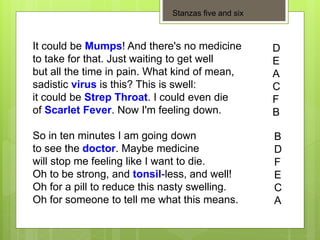
It could be Mumps! And there's no medicine
to take for that. Just waiting to get well
but all the time in pain. What kind of mean,
sadistic virus is this? This is swell:
it could be Strep Throat. I could even die
of Scarlet Fever. Now I'm feeling down.
So in ten minutes I am going down
to see the doctor. Maybe medicine
will stop me feeling like I want to die.
Oh to be strong, and tonsil-less, and well!
Oh for a pill to reduce this nasty swelling.
Oh for someone to tell me what this means.
Stanzas five and six
D
E
A
C
F
B
B
D
F
E
C
A
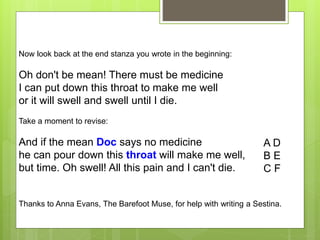
Now look back at the end stanza you wrote in the beginning:
Oh don't be mean! There must be medicine
I can put down this throat to make me well
or it will swell and swell until I die.
Take a moment to revise:
And if the mean Doc says no medicine
he can pour down this throat will make me well,
but time. Oh swell! All this pain and I can't die.
A D
B E
C F
Thanks to Anna Evans, The Barefoot Muse, for help with writing a Sestina.
Ewrt 30 class 4

Ewrt 30 class 4

  • 1.
  • 2.
    AGENDA Terms 17-23 Discussion: Sonnet Lecture:Form and Structure: Sestina/Villanelle: Guided Writing: Sestina/Villanelle
  • 3.
    Terms 17-23 17. Shakespearianor English Sonnet A fourteen-line poem in iambic pentameter. The Shakespearean or English sonnet is arranged as three quatrains and a final couplet, rhyming abab cdcd efef gg. 18. The Petrarchan or Italian Sonnet A fourteen-line poem in iambic pentameter. It is divided into two parts: an eight-line octave and a six-line sestet, rhyming abba abba cde cde or abba abba cd cd cd (or other combination of cde).
  • 4.
    19. Stanza A divisionor unit of a poem that is repeated in the same form--either with similar or identical patterns or rhyme and meter, or with variations from one stanza to another. 20. Couplet A pair of rhymed lines that may or may not constitute a separate stanza in a poem. Shakespeare's sonnets end in rhymed couplets, as in "For thy sweet love remembered such wealth brings / That then I scorn to change my state with kings." 21. Quatrain A four-line stanza in a poem, the first four lines and the second four lines in a Petrarchan sonnet. A Shakespearean sonnet contains three quatrains followed by a couplet.
  • 5.
    22.Octave An eight-line unit,which may constitute a stanza; or a section of a poem, as in the octave of a sonnet. 22.Sestet A six-line unit of verse constituting a stanza or section of a poem; the last six lines of an Italian sonnet. Examples: Petrarch's "If it is not love, then what is it that I feel," and Frost's "Design."
  • 6.
    The Review 5 minutes 12.Rhyme 13.FeminineRhyme 14.Internal Rhyme 15.Slant Rhyme 16.Eye Rhyme 17.Identical Rhyme 18.English Sonnet 19.Italian Sonnet 20.Stanza 21.Couplet 22.Quatrain 23.Octave 24.Sestet
  • 7.
    Discussion Subject: 10minutes Sonnets: Share your work. Identify both sonnet and poetry conventions!  Line number  Rhyme Scheme  Structure  Quatrains  Couplets  Octave/sestet  Meter/Feet  A turn or volta  Rhyme (of all types)  Metaphor/Simile  Alliteration  Assonance  Onomatopoeia
  • 8.
  • 9.
    Villanelle Conventions  19lines  5 stanzas of three lines; final stanza of four  It has two rhyme sounds: A and B  It has two repeating lines  The first repeating line appears as line 1 (A1) and repeats in lines 6, 12, and 18.  The second repeating line appears as line 3 (A2) and repeats in lines 9, 15, and 19.
  • 10.
    St. 1 A1(first repeating line or refrain) b A2 (second repeating line or refrain) St. 2 a b A1 (repeat of line 1) St. 3 a b A2 (repeat of line 3) St. 4 a b A1 (repeat of line 1) St. 5 a b A2 (repeat of line 3) St. 6 a b A1 (repeat of line 1) A2 (repeat of line 3) Pattern
  • 11.
    St. 1A1 Donot go gentle into that good night, b A2 Rage, rage against the dying of the light. St. 2a b A1 Do not go gentle into that good night, St. 3a b A2 Rage, rage against the dying of the light. St. 4a b A1 Do not go gentle into that good night, St. 5a b A2 Rage, rage against the dying of the light. St. 6a b A1 Do not go gentle into that good night, A2 Rage, rage against the dying of the light.
  • 12.
    St. 1A1 Donot go gentle into that good night, b Old age should burn and rave at close of day; A2 Rage, rage against the dying of the light. St. 2a Though wise men at their end know dark is right, b Because their words had forked no lightning they A1 Do not go gentle into that good night, St. 3a Good men, the last wave by, crying how bright b Their frail deeds might have danced in a green bay, A2 Rage, rage against the dying of the light. St. 4a Wild men who caught and sang the sun in flight, b And learn, too late, they grieved it on its way, A1 Do not go gentle into that good night, St. 5a Grave men, near death, who see with blinding sight b Blind eyes could blaze like meteors and be gay, A2 Rage, rage against the dying of the light. St. 6a And you, my father, there on the sad height, b Curse, bless, me now with your fierce tears, I pray. A1 Do not go gentle into that good night, A2 Rage, rage against the dying of the light.
  • 13.
    St. 1A1 Donot go gentle into that good night, b Old age should burn and rave at close of day; A2 Rage, rage against the dying of the light. St. 2a Though wise men at their end know dark is right, b Because their words had forked no lightning they A1 Do not go gentle into that good night, St. 3a Good men, the last wave by, crying how bright b Their frail deeds might have danced in a green bay, A2 Rage, rage against the dying of the light. St. 4a Wild men who caught and sang the sun in flight, b And learn, too late, they grieved it on its way, A1 Do not go gentle into that good night, St. 5a Grave men, near death, who see with blinding sight b Blind eyes could blaze like meteors and be gay, A2 Rage, rage against the dying of the light. St. 6a And you, my father, there on the sad height, b Curse, bless, me now with your fierce tears, I pray. A1 Do not go gentle into that good night, A2 Rage, rage against the dying of the light.
  • 14.
    Villanelles have noset rhythm or line length but the lines are usually even. Iambic pentameter (de-TROIT x 5) is a common rhythm for serious villanelles. The Thomas poem is written in iambic pentameter (do NOT go GENtle INto THAT good NIGHT). The trochee rhythm (BOS-ton) also works well. Eight to ten syllables per line is the most common length but shorter or longer lines are okay too. The main goal is to keep the rhythm regular. For a light verse villanelle, anapest feet create a tripping rhythm ( te-te-TUM, ser-e-NADE). Or use dactyl feet for a marching or galloping effect (TUM-te-te, HAR-mo-ny).
  • 15.
  • 16.
    1. Choose asubject.  W. H. Auden, when asked whether the form or content came first, replied, “At any given time, I have two things on my mind— a theme that interests me and a problem of verbal form. The theme looks for the right form; the form looks for the right theme. When the two come together, I am able to start writing.”  Some subjects or themes that lend themselves well to the villanelles:  Duality, for example two differing points of view, or two unlike things or people forced together. Consider a poem about Christmas in a prison or care home. Note the duality: happy time, sad place.  Ironic subjects. Actor, writer and poetry aficionado Stephen Fry describes many villanelles as consisting of “a rueful, ironic reiteration of pain or fatalism.”  Humorous subjects—especially those rooted in irony.
  • 17.
    Choose a subject! Addduality 1. Good and bad aspects of an early memory. 2. Your first kiss (sweet but disastrous). 3. The pain of betrayal by a good friend. 4. Your first pet (love and death). 5. Your parents (bad or good). 6. Your siblings. 7. Your children. 8. Your first love (what it might have been). 9. Your past love (broken heart) 10. Your current love. 11. Lust. 13. Your favorite TV show or book 14. Your Hobbies 15. Celebrity news story 16. Politics (the left? The right? An event?) 17. School (Drama) 18. A death in the family. 19. A death of a friend. 20. The scariest moment of your life. 21. The happiest moment of your life. 22. A moment which made you angry.
  • 18.
    2. Write thetwo refrain lines.  This most important step of the villanelle-writing process will largely determine the success of your poem. When composing the two repeating lines keep the following in mind:  The end words of the two lines rhyme. The sound on which they end will also be the ‘a’ rhyme sound in the non-repeating lines. Therefore choose end words with a rhyme sound that’s easy to match.  The lines should resonate with a meaning that has the potential to enlarge as the poem progresses.  The lines should be musical and pleasing to the ear.  The two lines need to come together effectively at the end of the poem.  Try beginning one or both refrain lines with a verb.  “Technically the trick of it seems to be to find a refrain pair that is capable of run-ons, ambiguity, and ironic reversal” says Fry.
  • 19.
     Draft multiple(4 or 5) rhyming couplets that express your feeling or idea, or the heart of your concern.  Pick the couplet that combines originality and expressiveness with some flexibility in the way those lines could be used in combination with others.  “Technically the trick of it seems to be to find a refrain pair that is capable of run-ons, ambiguity, and ironic reversal” says Fry.  Together, the two lines should form a sentence or phrase that will work to conclude your poem, but each must also stand on its own or be flexible enough to be used with other sentences or phrases. 2. Write the two refrain lines (continued)
  • 20.
    3. Write thevillanelle form and enter the repeating lines St. 1 A1 (first repeating line or refrain) b A2 (second repeating line or refrain) St. 2 a b A1 (repeat of line 1) St. 3 a b A2 (repeat of line 3) St. 4 a b A1 (repeat of line 1) St. 5 a b A2 (repeat of line 3) St. 6 a b A1 (repeat of line 1) A2 (repeat of line 3)
  • 21.
    4. Decide onyour “b” rhyme sound. Again choose a sound that has lots of rhyme potential and that is different enough from rhyme ‘a’ to provide a pleasing contrast. If you need some help finding rhymes, you can always use a free on-line rhyming dictionary for some help. Rhymer Rhymezone
  • 22.
     . 5. Makelists of words that rhyme with the two sounds you have chosen, particularly choosing words that will work with your theme A words B words 1 2 3 6. Compose the additional lines of your poem according to the rhyme scheme, using ideas suggested by the words on your list. Fill in your poem
  • 23.
     Make changesto enhance and add meaning, not simply for the sake of variety. “The repetition cannot be static,” says Frances Mayes. “Each time a repeating line appears it should have added significance.”  If this way of composing a poem seems contrived and non- poetic, be reassured that you’re not the first person to feel this way. Despite the seemingly un-poetic method of composing, villanelles often appear spontaneous. Strive for such an effect, even if it takes much crossing out, agonizing over, and rewriting lines to get exactly what you’re after.  Once you’re familiar with writing by-the-rules villanelles, you may be tempted to join poets who have written villanelles that break the rules. Some poets leave out or add stanzas, rhyme only some of the lines, or none at all, or even write in free verse. For this assignment, please try to conform to the rules. 7. Revise
  • 24.
     Use enjambmentsometimes, so that your repeated lines are less obvious.  Change the punctuation to alter meaning.  Feel free to slightly modify the lines that you set up for your original couplet.  Then, repeat this modification throughout the poem (if you are following the form of strict repetition), or use the modifications to reflect something (such as a progression of internal emotions). Tips
  • 25.
  • 26.
    Sestina Conventions The sestina makesno demands on the poet in terms of meter or rhyme or foot. Its requirements border on the mathematical and its prescriptions are mainly syntactical. In Questions of Possibility: Contemporary Poetry and Poetic Form, David Caplan explains, The opening stanza introduces six endwords […] which repeat through the six sestets. Starting with the second sestet, each stanza duplicates the previous stanza’s endwords in the following order: last, first, fifth, second, fourth, then third. […] By the poem’s end, each end word appears in all six lines. Finally […] the concluding [stanza] features two endwords in each of its three lines, one as an endword and one in the middleof the line (18).
  • 27.
    Sestina by ElizabethBishop 1 2 3 4 5 6 1 2 3 4 5 6 1 2 3 4 5 6 A B C D E F F A E B D C C F D A B E
  • 28.
    Classic Sestina Pattern Oranother combination
  • 29.
    Sestina: Final Stanza F E BD C A      
  • 30.
  • 31.
     Happy familiesare all alike; every unhappy family is unhappy in its own way. —Leo Tolstoy, Anna Karenina (1877; trans. Constance Garnett)  I am an invisible man. —Ralph Ellison, Invisible Man (1952)  The past is a foreign country; they do things differently there. —L. P. Hartley, The Go-Between (1953)  This is the saddest story I have ever heard. —Ford Madox Ford, The Good Soldier (1915)  All this happened, more or less. —Kurt Vonnegut, Slaughterhouse- Five (1969)  Time is not a line but a dimension, like the dimensions of space. — Margaret Atwood, Cat's Eye (1988)  You better not never tell nobody but God. —Alice Walker, The Color Purple (1982)  It was love at first sight. —Joseph Heller, Catch-22 (1961)  Once upon a time, there was a woman who discovered she had turned into the wrong person. —Anne Tyler, Back When We Were Grownups (2001) Choose a topic from great first novel lines
  • 32.
    Choose at leastsome words that several different meanings: ex. "mean” Choose words that can be used as either nouns, verbs, or adjectives: ex. "swell” Choose one word that is so innocuous it can be put practically anywhere. Prepositions are good for this: ex. "down” Choose one polysyllabic word that is highly specific to your subject matter. (This will be the hardest one to rotate but it will contrast artistically with the others: ex. “Medicine” Choose a word that either rhymes or alliterates with one of your other words: ex. “well” Choose a power-word, which will likely end your poem: ex “die” Choosing End WordsSore Throat Sestina
  • 33.
    Choose concrete nounsto include in your poemDemon Bug Virus Neck Throat Tonsils Mumps Scarlet Fever Strep Throat Husband Internet Doctor These will be good descriptors in the poem
  • 34.
    —Here is alist of the endwords: mean, swell, down, medicine, well and die. At this point, you don’t have to decide the order of the other words because you are going to write the end of your poem first. The trick to avoiding bad endings in a sestina is to write a devastatingly brilliant ending and then work toward it. You can always rewrite it if it turns out not to fit your needs. Oh don't be mean! There must be medicine I can put down this throat to make me well or it will swell and swell until I die. Write the Ending First
  • 35.
    Start at the beginningnow! This morning I woke up as if a mean demon in the night had slithered down my neck. My tonsils had begun to swell. I moaned; I coughed; I drank some medicine naively thinking I would soon feel well. Ten minutes on I still thought I might die. First Stanza A B C D E F Now your order has been determined!
  • 36.
    Second Stanza "Oh comeon silly. You're not going to die," my husband said. He wasn't being mean. The thing is, I'm the one who's always well. He isn't used to seeing me go down with nasty bugs or swallow medicine. "Soon," he said, "Once more you'll feel just swell." Note: try and avoid end-stopping all the lines, another common beginner's mistake. Note that the first line continues into the second. Also, line four flows into five. F A E B D C
  • 37.
    But my lefttonsil continued to swell all morning. I knew no-one ever died of a sore throat, and yet no medicine was soothing it. What could this symptom mean? I started feeling more and more cast down and wondered if I would ever get well. Note the use of "swell” as a verb in this stanza. Note that “die” changed to "died" in this stanza. All but the most purist of sestina-writers would agree that this is acceptable. C F D A B E Third Stanza
  • 38.
    Only one thingto do: consult the well of information on the Internet. That swelling cyberspace would help me pin this down (or tell me just how long before I die). I googled sore throat symptom, and the meaning of this popped out on medicine.com The author has used "swelling" for "swell" and "meaning" for "mean.” She has also really pushed the boundaries by adding ".com" to "medicine.” Fourth Stanza E C B F A D
  • 39.
    It could beMumps! And there's no medicine to take for that. Just waiting to get well but all the time in pain. What kind of mean, sadistic virus is this? This is swell: it could be Strep Throat. I could even die of Scarlet Fever. Now I'm feeling down. So in ten minutes I am going down to see the doctor. Maybe medicine will stop me feeling like I want to die. Oh to be strong, and tonsil-less, and well! Oh for a pill to reduce this nasty swelling. Oh for someone to tell me what this means. Stanzas five and six D E A C F B B D F E C A
  • 40.
    Now look backat the end stanza you wrote in the beginning: Oh don't be mean! There must be medicine I can put down this throat to make me well or it will swell and swell until I die. Take a moment to revise: And if the mean Doc says no medicine he can pour down this throat will make me well, but time. Oh swell! All this pain and I can't die. A D B E C F Thanks to Anna Evans, The Barefoot Muse, for help with writing a Sestina.