Writing
Shakespearean Sonnets:
    A How-To Guide
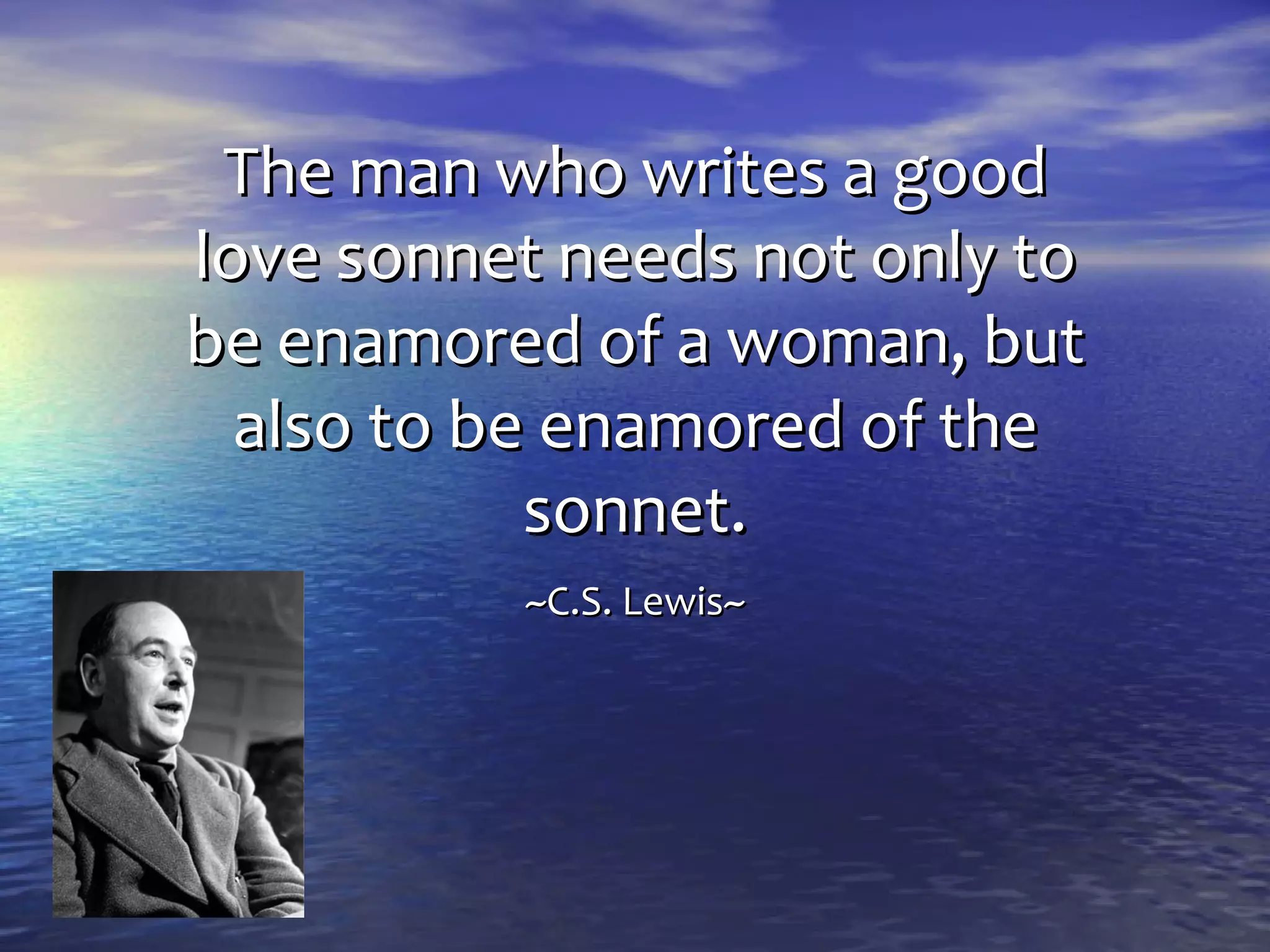
The man who writes a good
love sonnet needs not only to
be enamored of a woman, but
  also to be enamored of the
            sonnet.
          ~C.S. Lewis~
Thank you for choosing this guide to assist
you in your sonnet-writing journey! This
step-by-step guide should be an excellent
source for you as you embark on this
exciting endeavor!
Now, before we get started writing a
sonnet, it’s important to understand how
sonnets are set up. Let’s take a look at
one of Shakespeare’s most famous
sonnets so that you can visually see how
the poem should look.
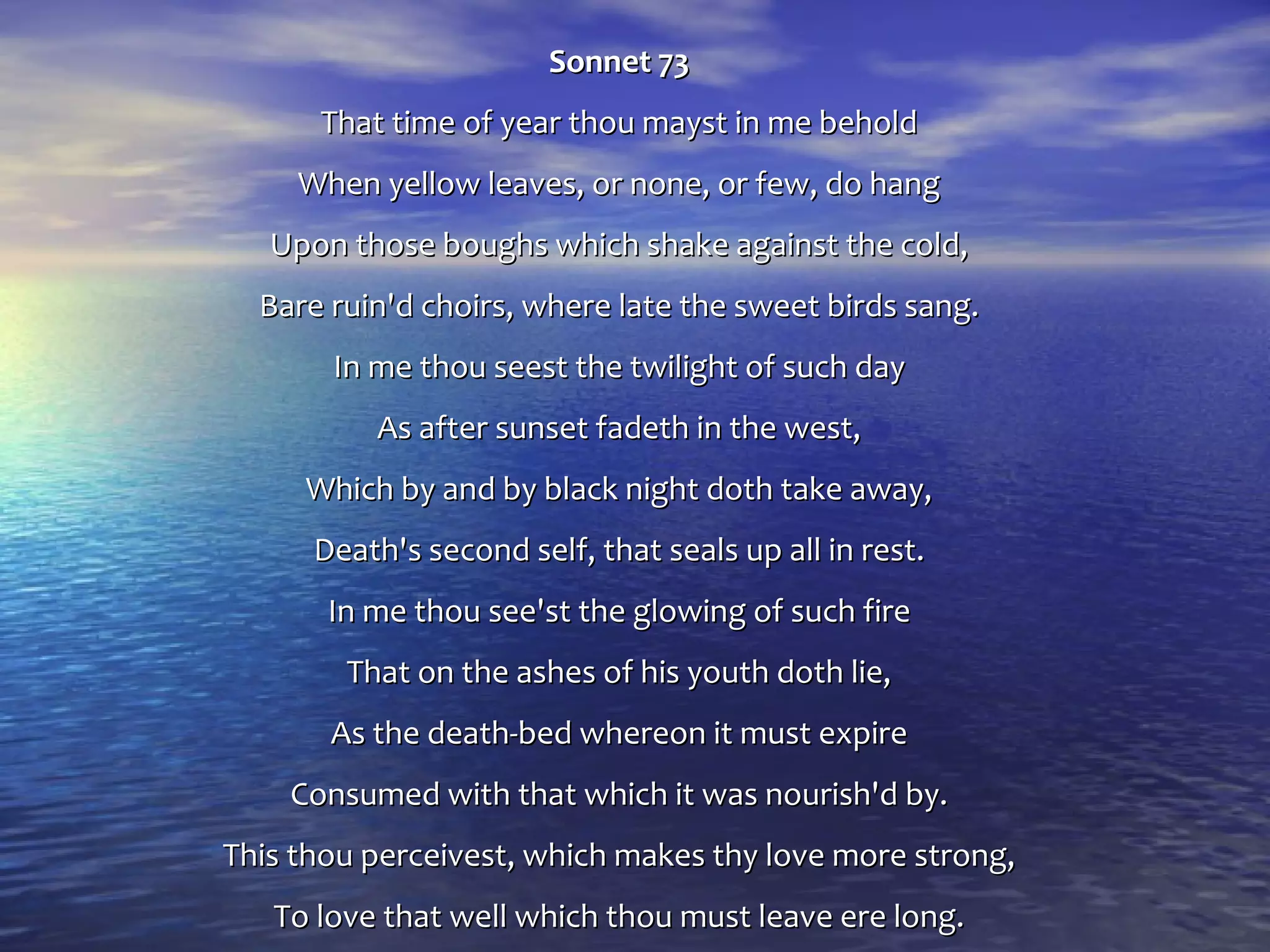
Sonnet 73
      That time of year thou mayst in me behold
     When yellow leaves, or none, or few, do hang
   Upon those boughs which shake against the cold,
  Bare ruin'd choirs, where late the sweet birds sang.
       In me thou seest the twilight of such day
          As after sunset fadeth in the west,
     Which by and by black night doth take away,
      Death's second self, that seals up all in rest.
       In me thou see'st the glowing of such fire
        That on the ashes of his youth doth lie,
       As the death-bed whereon it must expire
    Consumed with that which it was nourish'd by.
This thou perceivest, which makes thy love more strong,
   To love that well which thou must leave ere long.
On first glance, this might just seem like a regular old
poem, but we would be doing the sonnet a great injustice
if we thought that. The sonnet is actually a carefully
crafted argument that builds in a very particular way. Let’s
take a look at the format of a sonnet and use
Shakespeare’s Sonnet 73 as an example of how each
section functions.


Once you understand how each section of a sonnet is
supposed to work, you will be able to write one on your
own!
Quatrain #1: These four lines introduce the main
  metaphor and theme of the sonnet.


           That time of year thou mayst in me behold
         When yellow leaves, or none, or few, do hang
        Upon those boughs which shake against the cold,
       Bare ruin'd choirs, where late the sweet birds sang.


Here, we find out that this poem is about a man who’s
growing old. He’s comparing his life to the changing of the
seasons. The year is coming to a close as fall slowly gives way
to winter, and so too is his life. In the first line he makes it
clear that he is addressing another person, as he uses the
word “thou.” This is the first stage of the sonnet’s argument.
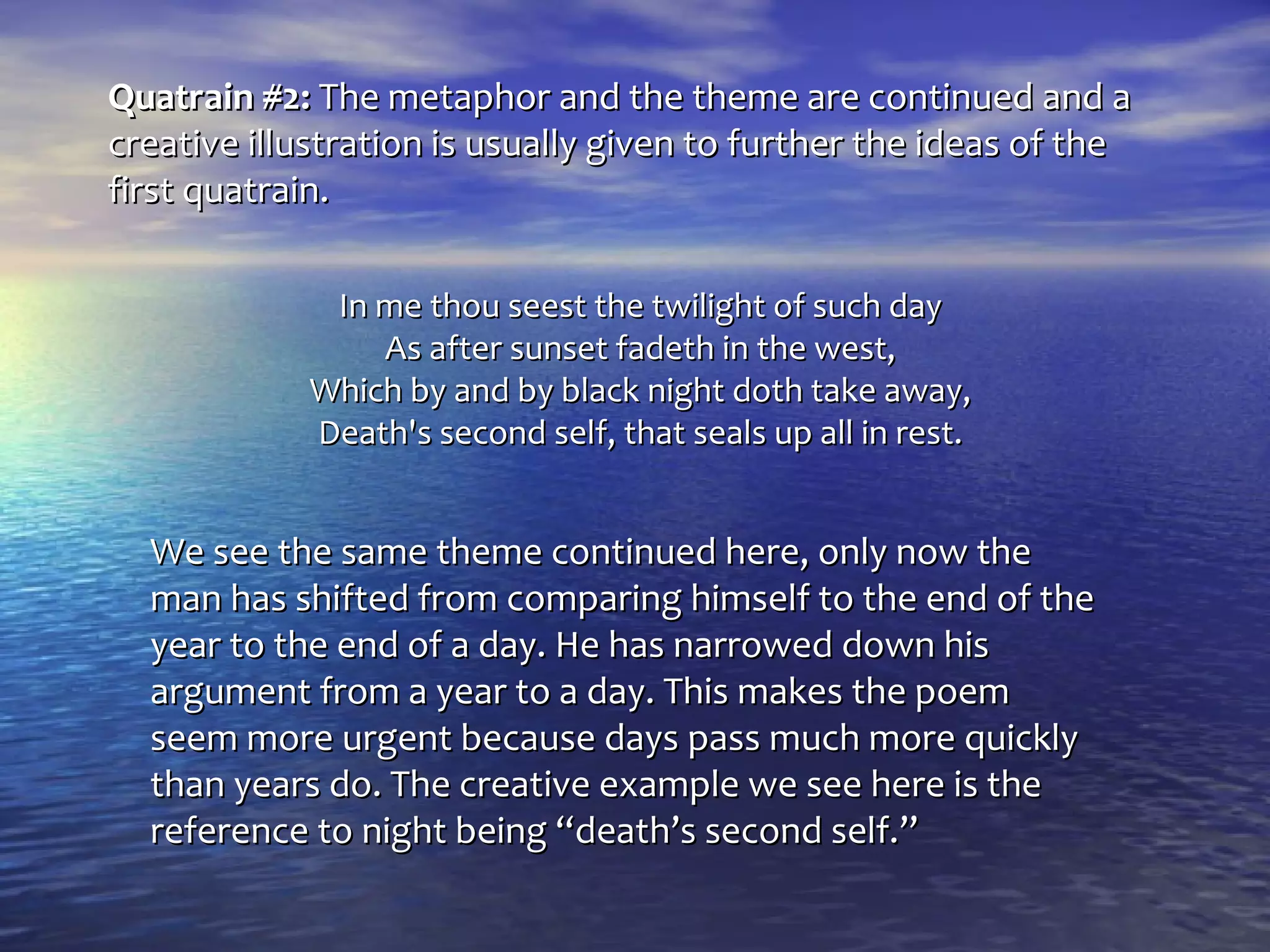
Quatrain #2: The metaphor and the theme are continued and a
creative illustration is usually given to further the ideas of the
first quatrain.

             In me thou seest the twilight of such day
                As after sunset fadeth in the west,
            Which by and by black night doth take away,
            Death's second self, that seals up all in rest.


  We see the same theme continued here, only now the
  man has shifted from comparing himself to the end of the
  year to the end of a day. He has narrowed down his
  argument from a year to a day. This makes the poem
  seem more urgent because days pass much more quickly
  than years do. The creative example we see here is the
  reference to night being “death’s second self.”
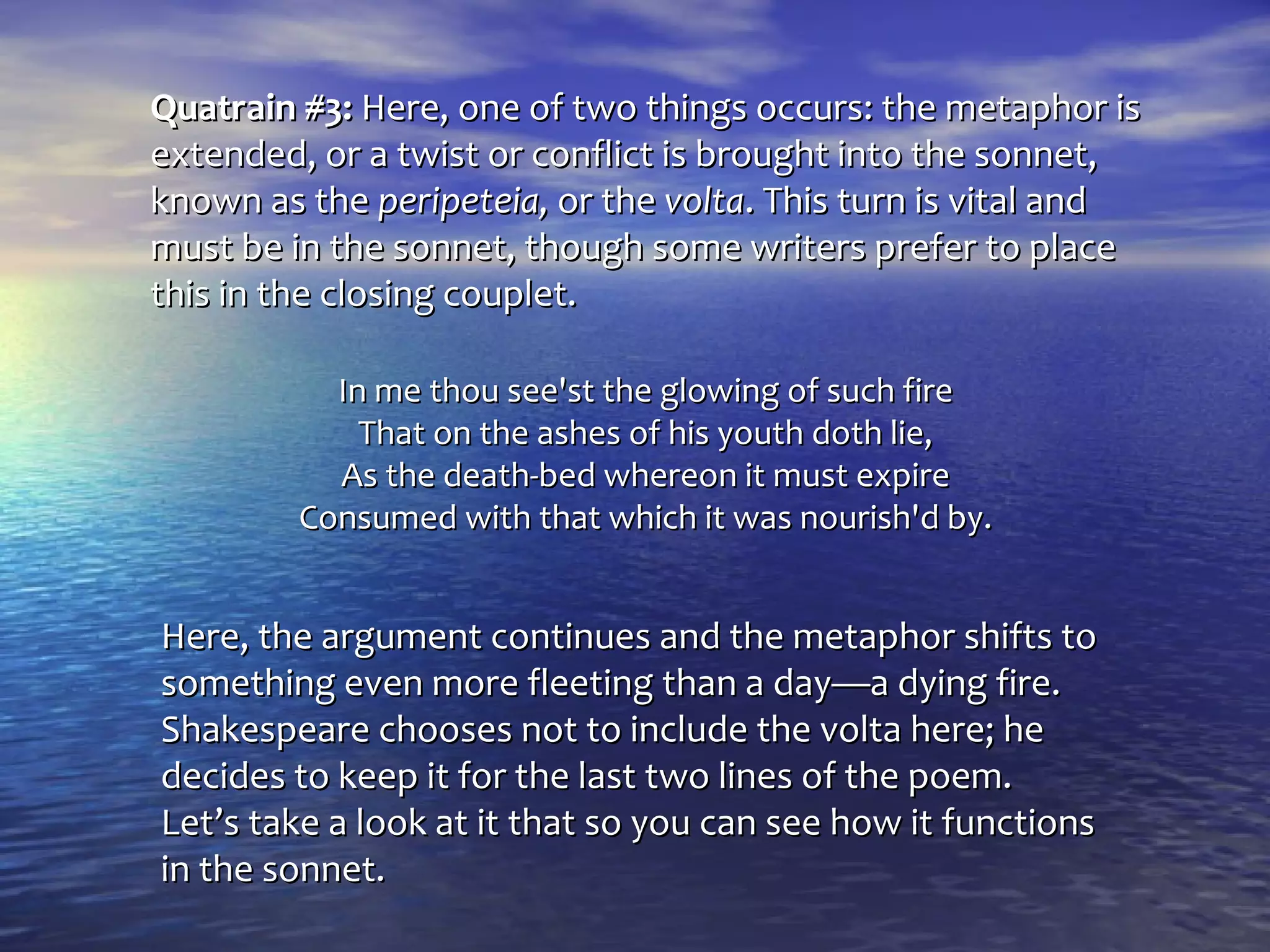
Quatrain #3: Here, one of two things occurs: the metaphor is
extended, or a twist or conflict is brought into the sonnet,
known as the peripeteia, or the volta. This turn is vital and
must be in the sonnet, though some writers prefer to place
this in the closing couplet.

           In me thou see'st the glowing of such fire
             That on the ashes of his youth doth lie,
           As the death-bed whereon it must expire
         Consumed with that which it was nourish'd by.


Here, the argument continues and the metaphor shifts to
something even more fleeting than a day—a dying fire.
Shakespeare chooses not to include the volta here; he
decides to keep it for the last two lines of the poem.
Let’s take a look at it that so you can see how it functions
in the sonnet.
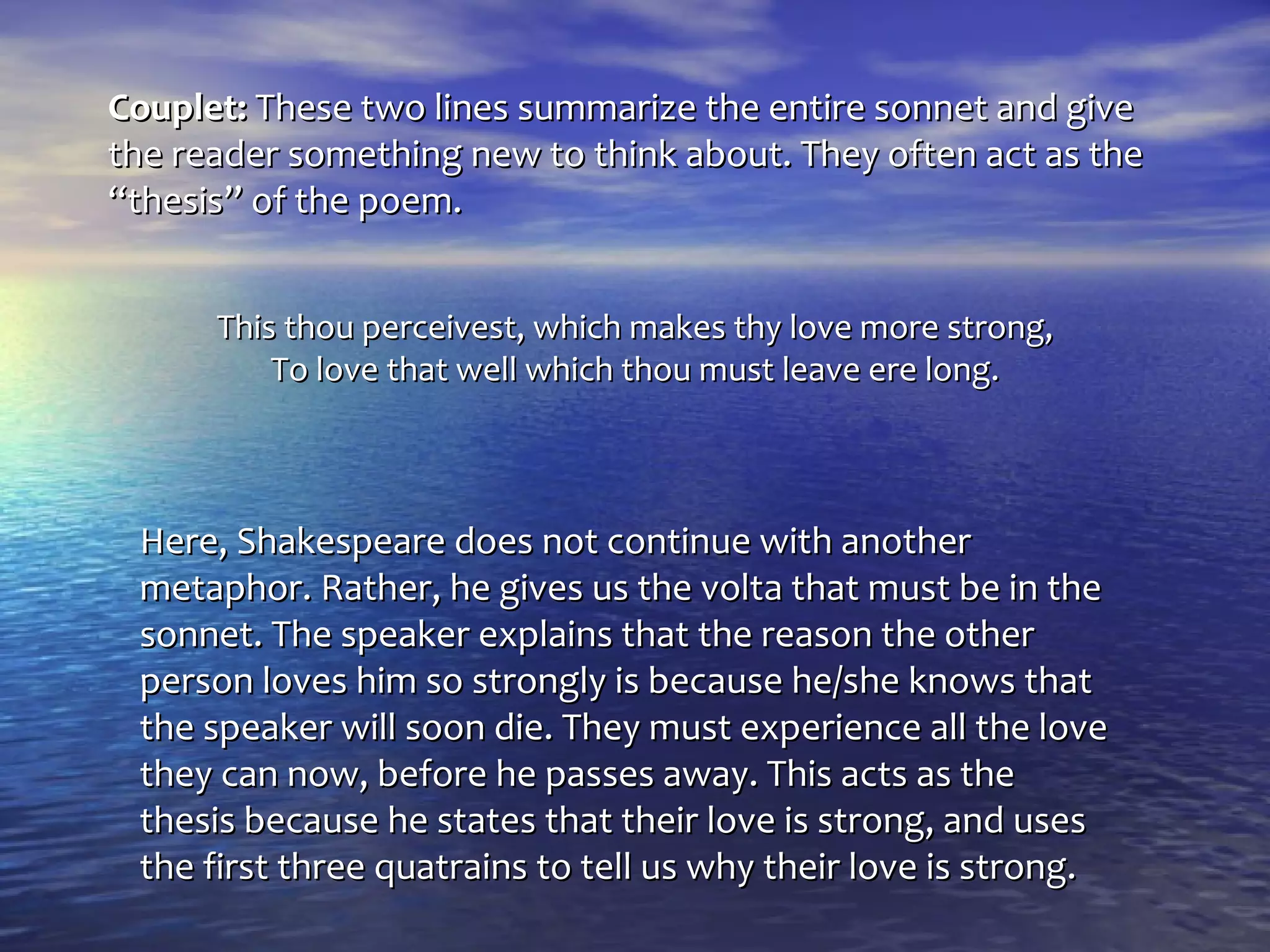
Couplet: These two lines summarize the entire sonnet and give
the reader something new to think about. They often act as the
“thesis” of the poem.


      This thou perceivest, which makes thy love more strong,
          To love that well which thou must leave ere long.


 Here, Shakespeare does not continue with another
 metaphor. Rather, he gives us the volta that must be in the
 sonnet. The speaker explains that the reason the other
 person loves him so strongly is because he/she knows that
 the speaker will soon die. They must experience all the love
 they can now, before he passes away. This acts as the
 thesis because he states that their love is strong, and uses
 the first three quatrains to tell us why their love is strong.
Now that you know all the different sections of the
Shakespearean sonnet and understand how each one
functions, you’re almost ready to write one of your own. We
just need to go over a few things about style and form first.
All sonnets require the following stylistically:
 1. 3 quatrains
 2. 1 couplet
 3. 14 lines
 4. ABABCDCDEFEFGG rhyme scheme
 5. Iambic pentameter


Let’s take one more look at Shakespeare’s Sonnet 73 so that
you can see how each of these are included.
Sonnet 73
      That time of year thou mayst in me behold
     When yellow leaves, or none, or few, do hang
   Upon those boughs which shake against the cold,
  Bare ruin'd choirs, where late the sweet birds sang.
       In me thou seest the twilight of such day
          As after sunset fadeth in the west,
     Which by and by black night doth take away,
      Death's second self, that seals up all in rest.
       In me thou see'st the glowing of such fire
        That on the ashes of his youth doth lie,
       As the death-bed whereon it must expire
    Consumed with that which it was nourish'd by.
This thou perceivest, which makes thy love more strong,
   To love that well which thou must leave ere long.
Let’s start by brainstorming. Make sure you have a paper and
pencil handy. A good eraser is also recommended! Now, let’s
begin. What do you want to say in your sonnet? A lot of
sonnets pertain to love in some way, but yours doesn’t have
to. If you are having trouble coming up with some ideas, here
are some things to think about:
-school
-sports
-losing a loved one
-falling in love
-a pet
-a problem
-an emotion
Now that you have your topic, think of a
metaphor that you want to use throughout
your sonnet. Try to think of something that
wouldn’t normally be compared to your topic,
and then figure out ways that they are similar.
Once you have your metaphor and how you
want to compare it to your topic, write it down
so you don’t forget it later.
Now you are ready to begin composing. Make sure that you use
only 10 syllables in each line, and do your best to keep them all in
iambic pentameter. Also, choose your words that come at the
end of each line carefully; remember that another word will need
to rhyme with it. Also remember that you want to introduce your
topic and your metaphor here.


Hint: If you’re having trouble with iambic pentameter, go back to
Shakespeare’s Sonnet 73 and read each line to this beat: duh-
DUH-duh-DUH-duh-DUH-duh-DUH-duh-DUH.

  Quatrain 1:
  1. ___________________________________________________________ a
  2. ___________________________________________________________ b
  3. ___________________________________________________________ a
  4. ___________________________________________________________ b
Here, you want to continue your metaphor and your argument,
  but you want to build on what you wrote in the first quatrain.
  Remember that you are setting up for an eventual turn that
  will come either in the next quatrain or in the couplet, so be
  preparing for that.


Quatrain 2:
5. ___________________________________________________________ c
6. ___________________________________________________________ d
7. ___________________________________________________________ c
8. ___________________________________________________________ d
Here is where it starts getting even more exciting! Hang
tough; it’s hard to write a sonnet and you may be feeling
frustrated, but you can do it. This is where a lot of
Shakespearean sonnets bring in the volta, or the turn. How
can you shift your argument through the use of your
metaphor? Do that here in this quatrain. Or, if you wish, save
the twist for the final couplet, and build up your metaphor
some more here.


Quatrain 3:
9. ___________________________________________________________ e
10. ___________________________________________________________ f
11. ___________________________________________________________ e
12. ___________________________________________________________ f
Okay, we’ve come to the final couplet. Make sure to put your
  turn here if you haven’t done so yet. This is where you need
  to summarize your argument—remember to think of it as
  your thesis. Why do the previous twelve lines matter? Also
  remember that this is a couplet, so both lines will rhyme at
  the end.


Couplet:
13. ___________________________________________________________ g
14. ___________________________________________________________ g
Now put your sonnet together. All of your lines should come together
 in the following manner:
1. ______________________________________________________________ a
2. ______________________________________________________________ b
3. ______________________________________________________________ a
4. ______________________________________________________________ b
5. ______________________________________________________________ c
6. ______________________________________________________________ d
7. ______________________________________________________________ c
8. ______________________________________________________________ d
9. ______________________________________________________________ e
10. ______________________________________________________________ f
11. ______________________________________________________________ e
12. ______________________________________________________________ f
13. ______________________________________________________________ g
14. ______________________________________________________________ g
Congratulations! You’ve just written your own
Shakespearean sonnet! Now remember, just because
you’ve finished doesn’t mean you’re done. Good writing
is all about revision. Go back and make sure your sonnet
is as strong in all areas as you would like it to be. Feel
free to edit and revise until you feel like you’ve
perfected it.
The End.
 We hope that this guide has helped you
  learn how to write a Shakespearean
sonnet. Please contact us if you have any
         questions or concerns.


           How To Guides, Inc.
           1564 Stratford St.
           Avon, England 01616

Sonnet writing

  • 1.
  • 2.
    The man whowrites a good love sonnet needs not only to be enamored of a woman, but also to be enamored of the sonnet. ~C.S. Lewis~
  • 3.
    Thank you forchoosing this guide to assist you in your sonnet-writing journey! This step-by-step guide should be an excellent source for you as you embark on this exciting endeavor!
  • 4.
    Now, before weget started writing a sonnet, it’s important to understand how sonnets are set up. Let’s take a look at one of Shakespeare’s most famous sonnets so that you can visually see how the poem should look.
  • 5.
    Sonnet 73 That time of year thou mayst in me behold When yellow leaves, or none, or few, do hang Upon those boughs which shake against the cold, Bare ruin'd choirs, where late the sweet birds sang. In me thou seest the twilight of such day As after sunset fadeth in the west, Which by and by black night doth take away, Death's second self, that seals up all in rest. In me thou see'st the glowing of such fire That on the ashes of his youth doth lie, As the death-bed whereon it must expire Consumed with that which it was nourish'd by. This thou perceivest, which makes thy love more strong, To love that well which thou must leave ere long.
  • 6.
    On first glance,this might just seem like a regular old poem, but we would be doing the sonnet a great injustice if we thought that. The sonnet is actually a carefully crafted argument that builds in a very particular way. Let’s take a look at the format of a sonnet and use Shakespeare’s Sonnet 73 as an example of how each section functions. Once you understand how each section of a sonnet is supposed to work, you will be able to write one on your own!
  • 7.
    Quatrain #1: Thesefour lines introduce the main metaphor and theme of the sonnet. That time of year thou mayst in me behold When yellow leaves, or none, or few, do hang Upon those boughs which shake against the cold, Bare ruin'd choirs, where late the sweet birds sang. Here, we find out that this poem is about a man who’s growing old. He’s comparing his life to the changing of the seasons. The year is coming to a close as fall slowly gives way to winter, and so too is his life. In the first line he makes it clear that he is addressing another person, as he uses the word “thou.” This is the first stage of the sonnet’s argument.
  • 8.
    Quatrain #2: Themetaphor and the theme are continued and a creative illustration is usually given to further the ideas of the first quatrain. In me thou seest the twilight of such day As after sunset fadeth in the west, Which by and by black night doth take away, Death's second self, that seals up all in rest. We see the same theme continued here, only now the man has shifted from comparing himself to the end of the year to the end of a day. He has narrowed down his argument from a year to a day. This makes the poem seem more urgent because days pass much more quickly than years do. The creative example we see here is the reference to night being “death’s second self.”
  • 9.
    Quatrain #3: Here,one of two things occurs: the metaphor is extended, or a twist or conflict is brought into the sonnet, known as the peripeteia, or the volta. This turn is vital and must be in the sonnet, though some writers prefer to place this in the closing couplet. In me thou see'st the glowing of such fire That on the ashes of his youth doth lie, As the death-bed whereon it must expire Consumed with that which it was nourish'd by. Here, the argument continues and the metaphor shifts to something even more fleeting than a day—a dying fire. Shakespeare chooses not to include the volta here; he decides to keep it for the last two lines of the poem. Let’s take a look at it that so you can see how it functions in the sonnet.
  • 10.
    Couplet: These twolines summarize the entire sonnet and give the reader something new to think about. They often act as the “thesis” of the poem. This thou perceivest, which makes thy love more strong, To love that well which thou must leave ere long. Here, Shakespeare does not continue with another metaphor. Rather, he gives us the volta that must be in the sonnet. The speaker explains that the reason the other person loves him so strongly is because he/she knows that the speaker will soon die. They must experience all the love they can now, before he passes away. This acts as the thesis because he states that their love is strong, and uses the first three quatrains to tell us why their love is strong.
  • 11.
    Now that youknow all the different sections of the Shakespearean sonnet and understand how each one functions, you’re almost ready to write one of your own. We just need to go over a few things about style and form first. All sonnets require the following stylistically: 1. 3 quatrains 2. 1 couplet 3. 14 lines 4. ABABCDCDEFEFGG rhyme scheme 5. Iambic pentameter Let’s take one more look at Shakespeare’s Sonnet 73 so that you can see how each of these are included.
  • 12.
    Sonnet 73 That time of year thou mayst in me behold When yellow leaves, or none, or few, do hang Upon those boughs which shake against the cold, Bare ruin'd choirs, where late the sweet birds sang. In me thou seest the twilight of such day As after sunset fadeth in the west, Which by and by black night doth take away, Death's second self, that seals up all in rest. In me thou see'st the glowing of such fire That on the ashes of his youth doth lie, As the death-bed whereon it must expire Consumed with that which it was nourish'd by. This thou perceivest, which makes thy love more strong, To love that well which thou must leave ere long.
  • 13.
    Let’s start bybrainstorming. Make sure you have a paper and pencil handy. A good eraser is also recommended! Now, let’s begin. What do you want to say in your sonnet? A lot of sonnets pertain to love in some way, but yours doesn’t have to. If you are having trouble coming up with some ideas, here are some things to think about: -school -sports -losing a loved one -falling in love -a pet -a problem -an emotion
  • 14.
    Now that youhave your topic, think of a metaphor that you want to use throughout your sonnet. Try to think of something that wouldn’t normally be compared to your topic, and then figure out ways that they are similar. Once you have your metaphor and how you want to compare it to your topic, write it down so you don’t forget it later.
  • 15.
    Now you areready to begin composing. Make sure that you use only 10 syllables in each line, and do your best to keep them all in iambic pentameter. Also, choose your words that come at the end of each line carefully; remember that another word will need to rhyme with it. Also remember that you want to introduce your topic and your metaphor here. Hint: If you’re having trouble with iambic pentameter, go back to Shakespeare’s Sonnet 73 and read each line to this beat: duh- DUH-duh-DUH-duh-DUH-duh-DUH-duh-DUH. Quatrain 1: 1. ___________________________________________________________ a 2. ___________________________________________________________ b 3. ___________________________________________________________ a 4. ___________________________________________________________ b
  • 16.
    Here, you wantto continue your metaphor and your argument, but you want to build on what you wrote in the first quatrain. Remember that you are setting up for an eventual turn that will come either in the next quatrain or in the couplet, so be preparing for that. Quatrain 2: 5. ___________________________________________________________ c 6. ___________________________________________________________ d 7. ___________________________________________________________ c 8. ___________________________________________________________ d
  • 17.
    Here is whereit starts getting even more exciting! Hang tough; it’s hard to write a sonnet and you may be feeling frustrated, but you can do it. This is where a lot of Shakespearean sonnets bring in the volta, or the turn. How can you shift your argument through the use of your metaphor? Do that here in this quatrain. Or, if you wish, save the twist for the final couplet, and build up your metaphor some more here. Quatrain 3: 9. ___________________________________________________________ e 10. ___________________________________________________________ f 11. ___________________________________________________________ e 12. ___________________________________________________________ f
  • 18.
    Okay, we’ve cometo the final couplet. Make sure to put your turn here if you haven’t done so yet. This is where you need to summarize your argument—remember to think of it as your thesis. Why do the previous twelve lines matter? Also remember that this is a couplet, so both lines will rhyme at the end. Couplet: 13. ___________________________________________________________ g 14. ___________________________________________________________ g
  • 19.
    Now put yoursonnet together. All of your lines should come together in the following manner: 1. ______________________________________________________________ a 2. ______________________________________________________________ b 3. ______________________________________________________________ a 4. ______________________________________________________________ b 5. ______________________________________________________________ c 6. ______________________________________________________________ d 7. ______________________________________________________________ c 8. ______________________________________________________________ d 9. ______________________________________________________________ e 10. ______________________________________________________________ f 11. ______________________________________________________________ e 12. ______________________________________________________________ f 13. ______________________________________________________________ g 14. ______________________________________________________________ g
  • 20.
    Congratulations! You’ve justwritten your own Shakespearean sonnet! Now remember, just because you’ve finished doesn’t mean you’re done. Good writing is all about revision. Go back and make sure your sonnet is as strong in all areas as you would like it to be. Feel free to edit and revise until you feel like you’ve perfected it.
  • 21.
    The End. Wehope that this guide has helped you learn how to write a Shakespearean sonnet. Please contact us if you have any questions or concerns. How To Guides, Inc. 1564 Stratford St. Avon, England 01616