Villanelle   Carole Matthews Adolescent Literature March 13, 2006
The History originally from France 1800s:  first appearance in English Among first users:  Oscar Wilde Subject matter: light-hearted or serious.
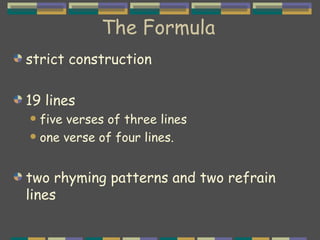
strict construction  19 lines  five verses of three lines  one verse of four lines.  two rhyming patterns and two refrain lines  The Formula
The Verses and Rhyming Pattern line 1 -  A  - 1st refrain line 2 -   B line 3 -  A  - 2nd refrain line 4 -   A line 5 -   B line 6 -  A  - 1st refrain  (same as line 1)   line 7 -   A line 8 -   B line 9 -  A  - 2nd refrain  (same as line 2)   line 10 -   A line 11 -   B line 12 -  A  - 1st refrain  (same as line 1)   line 13 -   A line 14 -   B line 15 -  A  - 2nd refrain  (same as line 2)  line 16 -   A line 17 -   B line 18 -  A  - 1st refrain  (same as line 1) line 19 -  A  - 2nd refrain  (same as line 2)
Writing a Villanelle –  “The House on the Hill”  by Edwin Arlington Robison  Begin with two lines that rhyme, iambic pentameter or tetrameter is good to start with, but not mandatory.  They are all gone away, There is nothing more to say. These two lines should express the main point of your poem.  They should also be able to express variations of meaning when coupled with other lines.
Add a line between the two.  This line is the base for the second rhyming pattern . They are all gone away, The House is shut and still,   There is nothing more to say. Verse one complete.
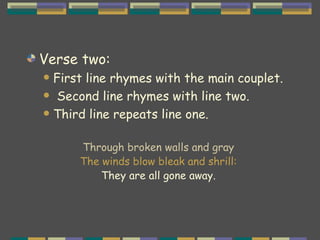
Verse two:  First line rhymes with the main couplet. Second line rhymes with line two. Third line repeats line one. Through broken walls and gray  The winds blow bleak and shrill:   They are all gone away.
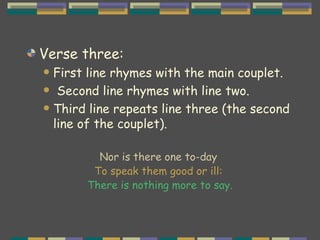
Verse three:  First line rhymes with the main couplet. Second line rhymes with line two. Third line repeats line three (the second line of the couplet). Nor is there one to-day  To speak them good or ill:  There is nothing more to say.
Verse four repeats the pattern of verse two   Why is it then we stray  Around the sunken sill?  They are all gone away,  Verse five repeats the pattern of verse three. And our poor fancy-play  For them is wasted skill:   There is nothing more to say.
And the finale The poem finishes with a four line verse repeating the couplet in the final two lines. The first two lines follow the a b rhyming pattern. There is ruin and decay In the House on the Hill:  They are all gone away,   There is nothing more to say.
The complete poem They are all gone away, The House is shut and still,   There is nothing more to say.   Through broken walls and gray  The winds blow bleak and shrill:   They are all gone away.  Nor is there one to-day  To speak them good or ill:  There is nothing more to say.   Why is it then we stray  Around the sunken sill?  They are all gone away,  And our poor fancy-play  For them is wasted skill:   There is nothing more to say.  There is ruin and decay In the House on the Hill:  They are all gone away,   There is nothing more to say.
The meter can vary tetrameter and pentameter are most common An unusual example is a minimalist poem by Peter Schaeffer. I think   she'll pour   my drink.   I wink  at more,   I think,   than minx  who pours   my drink.   I sink to floor,   and think   she stinks!  I roar, "My drink,   you fink!"  I snore,   and think   I drink.   One Drunken Night
Recent poets have taken some liberties with both rhyming and refrains.  “ Daughters, 1900” by Marilyn Nelson demonstrates variations in refrain wording yet retains the pattern
    Five daughters, in the slant light on the porch, are bickering. The eldest has come home with new truths she can hardly wait to teach . She lectures them: the younger daughters search the sky, elbow each others' ribs, and groan.  Five daughters, in the slant light on the porch Daughters, 1900 by  Marilyn Nelson Waniek
and blue-sprigged dresses, like a stand of birch saplings whose leaves are going yellow-brown with new truths. They can hardly wait to teach, themselves, to be called "Ma'am," to march high-heeled across the hanging bridge to town. Five daughters. In the slant light on the porch Pomp lowers his paper for a while, to watch  the beauties he's begotten with his Ann: these new truths they can hardly wait to teach. The eldest sniffs, "A lady doesn't scratch." The third snorts back, "Knock, knock: nobody home." The fourth concedes, "Well, maybe not in church. . ." Five daughters in the slant light on the porch.
One Final  (and excellent) Example written about the death of his father.
Do not go gentle into that good night, Old age should burn and rave at close of day; Rage, rage, against the dying of the light.  Though Wise men at their end know dark is right, Because their words had forked no lightning they Do not go gentle into that good night.  “ Do Not Go Gentle Into That Good Night” by Dylan Thomas
Good men, the last wave by, crying how bright Their frail deeds might have danced in a green bay, Rage, rage against the dying of the light.  Wild men who caught and sang the sun in flight, And learn, too late, they grieved it on its way, Do not go gentle into that good night.  Grave men, near death, who see with blinding sight Blind eyes could blaze like meteors and be gay, Rage, rage against the dying of the light.  And you, my father, there on the sad height, Curse, bless me now with your fierce tears, I pray. Do not go gentle into that good night. Rage, rage against the dying of the light .

Villanelle 2revised

  • 1.
    Villanelle Carole Matthews Adolescent Literature March 13, 2006
  • 2.
    The History originallyfrom France 1800s: first appearance in English Among first users: Oscar Wilde Subject matter: light-hearted or serious.
  • 3.
    strict construction 19 lines five verses of three lines one verse of four lines. two rhyming patterns and two refrain lines The Formula
  • 4.
    The Verses andRhyming Pattern line 1 - A - 1st refrain line 2 - B line 3 - A - 2nd refrain line 4 - A line 5 - B line 6 - A - 1st refrain (same as line 1) line 7 - A line 8 - B line 9 - A - 2nd refrain (same as line 2) line 10 - A line 11 - B line 12 - A - 1st refrain (same as line 1) line 13 - A line 14 - B line 15 - A - 2nd refrain (same as line 2) line 16 - A line 17 - B line 18 - A - 1st refrain (same as line 1) line 19 - A - 2nd refrain (same as line 2)
  • 5.
    Writing a Villanelle– “The House on the Hill” by Edwin Arlington Robison Begin with two lines that rhyme, iambic pentameter or tetrameter is good to start with, but not mandatory. They are all gone away, There is nothing more to say. These two lines should express the main point of your poem. They should also be able to express variations of meaning when coupled with other lines.
  • 6.
    Add a linebetween the two. This line is the base for the second rhyming pattern . They are all gone away, The House is shut and still, There is nothing more to say. Verse one complete.
  • 7.
    Verse two: First line rhymes with the main couplet. Second line rhymes with line two. Third line repeats line one. Through broken walls and gray The winds blow bleak and shrill: They are all gone away.
  • 8.
    Verse three: First line rhymes with the main couplet. Second line rhymes with line two. Third line repeats line three (the second line of the couplet). Nor is there one to-day To speak them good or ill: There is nothing more to say.
  • 9.
    Verse four repeatsthe pattern of verse two Why is it then we stray Around the sunken sill? They are all gone away, Verse five repeats the pattern of verse three. And our poor fancy-play For them is wasted skill: There is nothing more to say.
  • 10.
    And the finaleThe poem finishes with a four line verse repeating the couplet in the final two lines. The first two lines follow the a b rhyming pattern. There is ruin and decay In the House on the Hill: They are all gone away, There is nothing more to say.
  • 11.
    The complete poemThey are all gone away, The House is shut and still, There is nothing more to say. Through broken walls and gray The winds blow bleak and shrill: They are all gone away. Nor is there one to-day To speak them good or ill: There is nothing more to say. Why is it then we stray Around the sunken sill? They are all gone away, And our poor fancy-play For them is wasted skill: There is nothing more to say. There is ruin and decay In the House on the Hill: They are all gone away, There is nothing more to say.
  • 12.
    The meter canvary tetrameter and pentameter are most common An unusual example is a minimalist poem by Peter Schaeffer. I think she'll pour my drink. I wink at more, I think, than minx who pours my drink. I sink to floor, and think she stinks! I roar, "My drink, you fink!" I snore, and think I drink. One Drunken Night
  • 13.
    Recent poets havetaken some liberties with both rhyming and refrains. “ Daughters, 1900” by Marilyn Nelson demonstrates variations in refrain wording yet retains the pattern
  • 14.
        Fivedaughters, in the slant light on the porch, are bickering. The eldest has come home with new truths she can hardly wait to teach . She lectures them: the younger daughters search the sky, elbow each others' ribs, and groan. Five daughters, in the slant light on the porch Daughters, 1900 by Marilyn Nelson Waniek
  • 15.
    and blue-sprigged dresses,like a stand of birch saplings whose leaves are going yellow-brown with new truths. They can hardly wait to teach, themselves, to be called "Ma'am," to march high-heeled across the hanging bridge to town. Five daughters. In the slant light on the porch Pomp lowers his paper for a while, to watch the beauties he's begotten with his Ann: these new truths they can hardly wait to teach. The eldest sniffs, "A lady doesn't scratch." The third snorts back, "Knock, knock: nobody home." The fourth concedes, "Well, maybe not in church. . ." Five daughters in the slant light on the porch.
  • 16.
    One Final (and excellent) Example written about the death of his father.
  • 17.
    Do not gogentle into that good night, Old age should burn and rave at close of day; Rage, rage, against the dying of the light. Though Wise men at their end know dark is right, Because their words had forked no lightning they Do not go gentle into that good night. “ Do Not Go Gentle Into That Good Night” by Dylan Thomas
  • 18.
    Good men, thelast wave by, crying how bright Their frail deeds might have danced in a green bay, Rage, rage against the dying of the light. Wild men who caught and sang the sun in flight, And learn, too late, they grieved it on its way, Do not go gentle into that good night. Grave men, near death, who see with blinding sight Blind eyes could blaze like meteors and be gay, Rage, rage against the dying of the light. And you, my father, there on the sad height, Curse, bless me now with your fierce tears, I pray. Do not go gentle into that good night. Rage, rage against the dying of the light .