Week 1 Class 1
Agenda
• Adding the Class
• Syllabus/Green Sheet
• Website
• Terms
• In-class writing
Adding the Class
• If you are on the waiting list,
you can stay. I won’t hand out
add codes until next week, and
then, only if there is room.
• As we go over the syllabus,
consider whether you will stay
in the class. If you want out,
please let me know, so I can
offer your seat to another
student.
The Green Sheet
• What you will find
here
– Course Requirements
• Assignments and values
• Participation
– Required Materials
– Class Policies
• Plagiarism
• Conduct and Courtesy
– The Class Website
• How to sign up for an
account
• How to post your
homework.
– How to use Kaizena to
submit your Paper
Texts and Suggested Materials:
• Reading assignments will be posted on the
course website. There is no text book for you to
buy.
• A stapler, USB flash drive, loose-leaf paper or a
notebook for notes and drafts, and pens or
pencils. Alternatively, you may use your
computer for drafting.
Course Requirements:
• Active participation in class
discussions and regular
attendance. You will earn real
points for your participation in
activities.
• Keeping up-to-date on the
assignments and reading.
• Formal writing: a poetry project,
two fiction projects, and a drama
project (small groups).
• A series of creative writing posts
to the class website
• Terms tests, reading quizzes,
and in-class assignments.
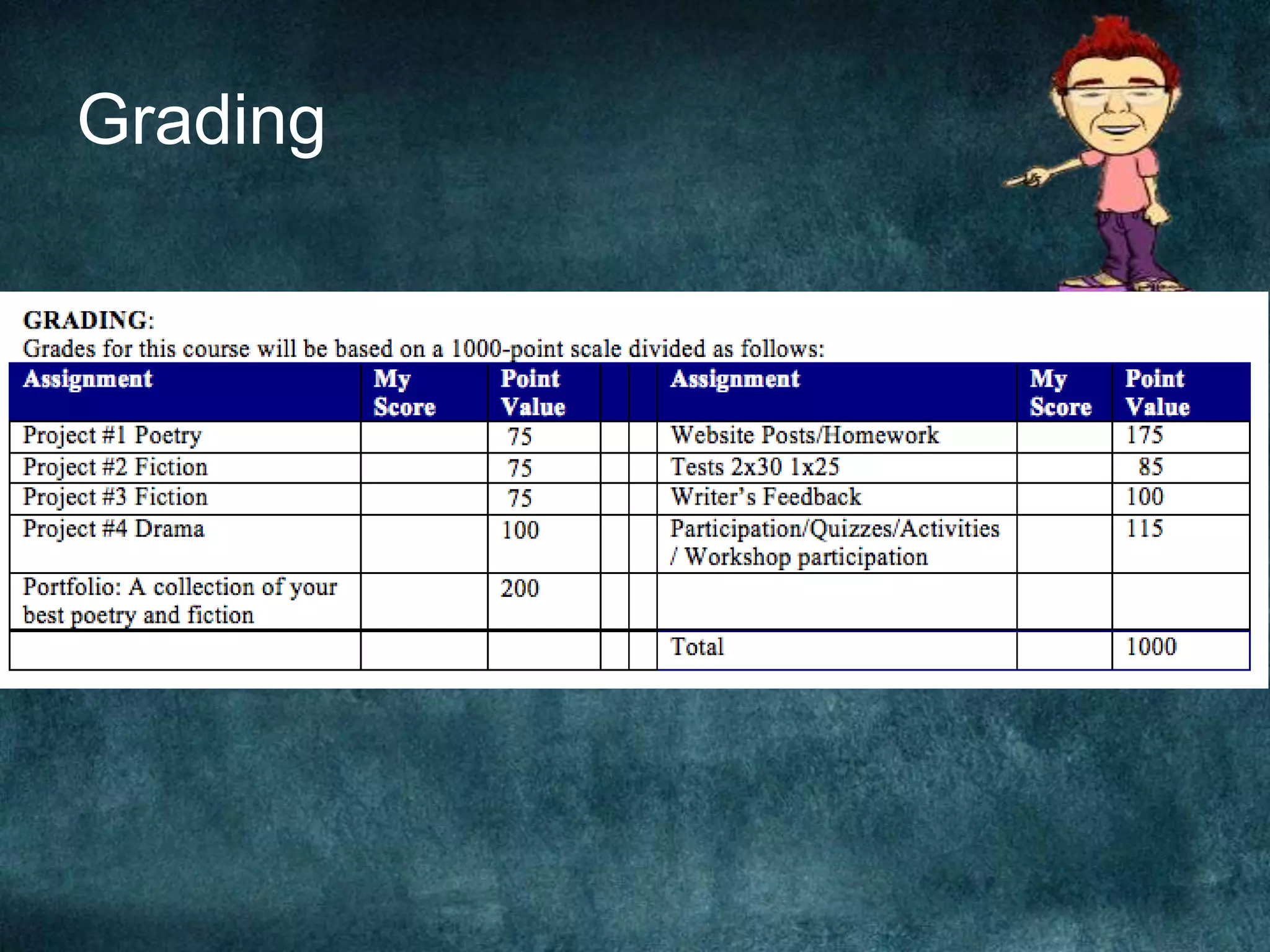
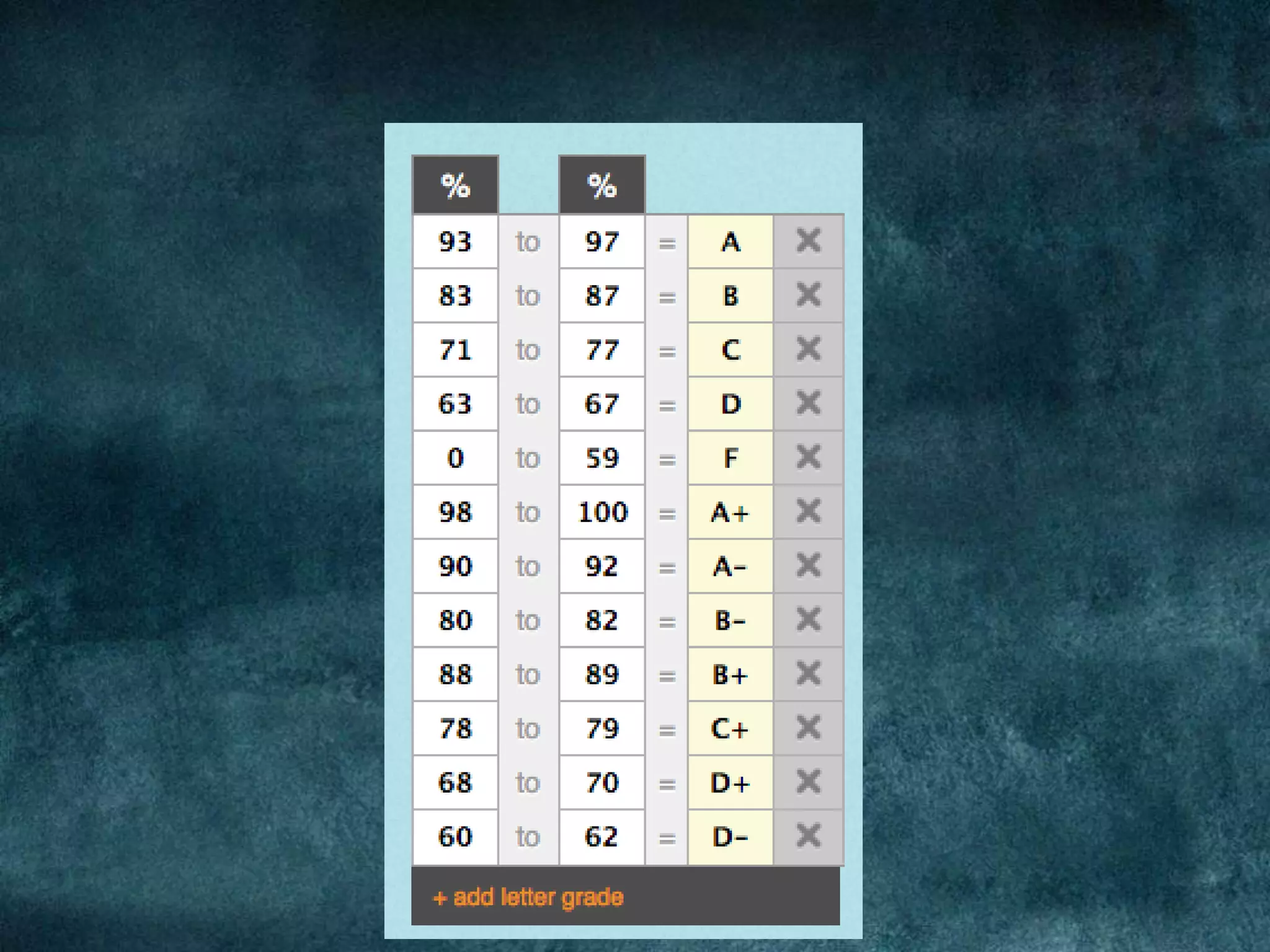
Grading
Class Policies
Writing Submissions
1. Kaizena allows me to respond to your essay with both voice and written
comments and to insert helpful links.
2. Create your account. Go to Kaizena.com or simply use the link on our class
website home page. Click “Sign up.” Choose “Student.” Enter your group code
(you can find this on the right side of the website or in the slideshow directions
for how to use Kaizena.
3. Files are added to Conversations in Kaizena. To add a file to a conversation,
click the "Add File" button.
4. Next, choose to add a file from Google Drive or to upload a file from your
computer. Use the box that pops up to find your file. When you find your file,
click it; next, click "Select" (for a Google Docs file) or open (for an uploaded
file). The file will be added to your conversation.
5. If you experience formatting errors when you upload a Word file, try saving
the file as a PDF, and uploading it again.
6. Once I have graded your paper, you can access it by going to the
“conversations” link in Kaizena.
7. Click on the highlighted sections of the paper to find both audio and written
comments concerning your essay or links to materials that will help you
improve your writing.
All out of class work is to be submitted to me electronically
before the due date.
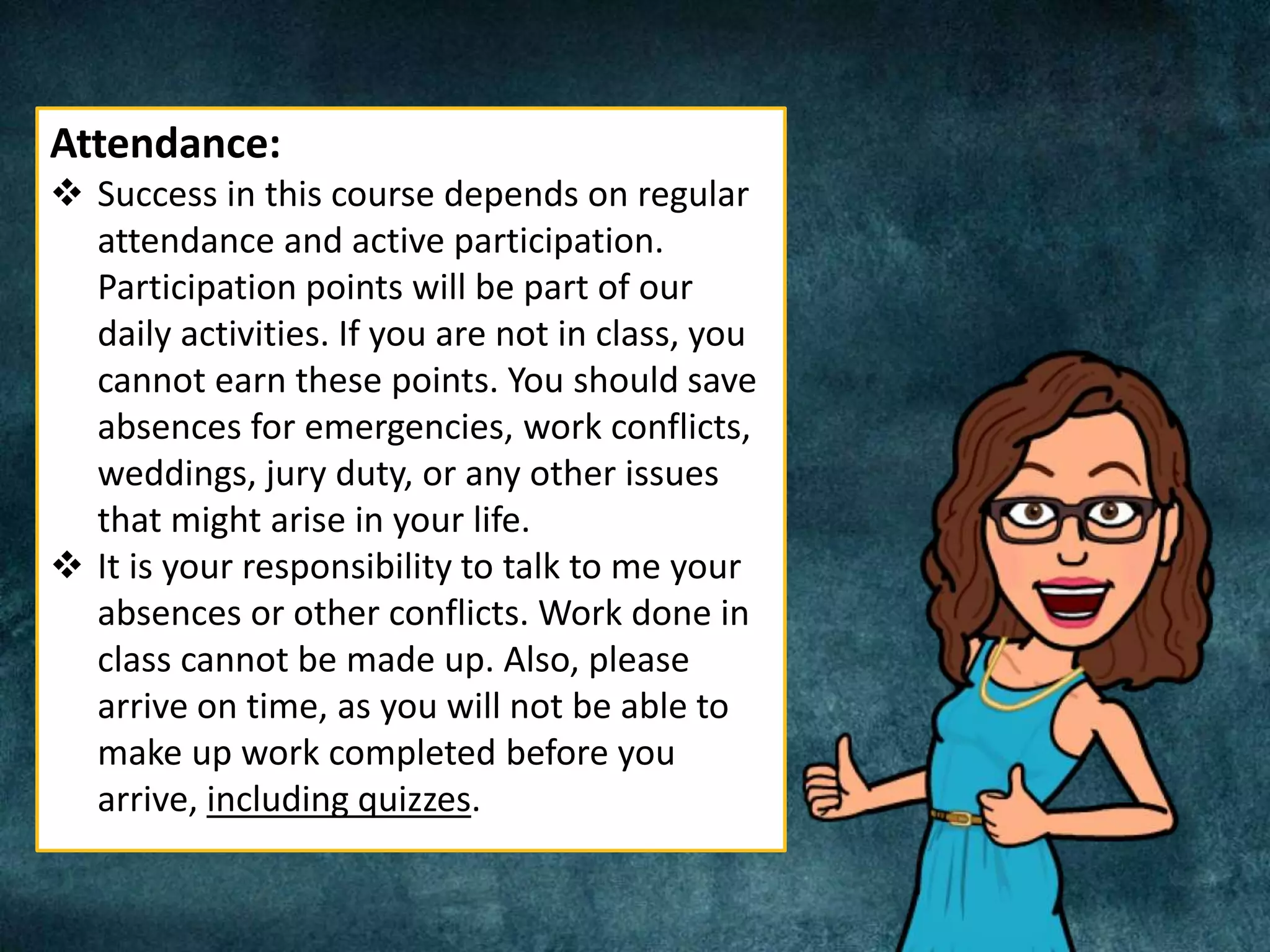
Attendance:
 Success in this course depends on regular
attendance and active participation.
Participation points will be part of our
daily activities. If you are not in class, you
cannot earn these points. You should save
absences for emergencies, work conflicts,
weddings, jury duty, or any other issues
that might arise in your life.
 It is your responsibility to talk to me your
absences or other conflicts. Work done in
class cannot be made up. Also, please
arrive on time, as you will not be able to
make up work completed before you
arrive, including quizzes.
• Tests:
– We will have three terms
tests during the quarter. I
will offer one opportunity
late in the quarter to retake
(or make-up) one of the
first three terms tests.
• Late Work
– I do not accept late work
except in the case of
extreme emergencies.
Please talk to me as soon
as possible if you find
yourself in this situation.
Conduct, Courtesy, and Electronic Devices:
• In this class, we will regularly engage in the
discussion of each other’s work. Because writing
is so personal, I ask each of you to be both kind
and honest. Do share helpful critiques so each
writer may grow. Courtesy will allow each person
to have the opportunity to express his or her
ideas in a comfortable environment.
• Courtesy includes but is not limited to politely
listening to others when they contribute to class
discussions or while they give presentations, not
slamming the classroom door or walking in front
of classmates giving presentations if you do
arrive late, and maintaining a positive learning
environment for your fellow classmates. To help
maintain a positive learning environment, please
focus on the work assigned, turn off all cell
phones and iPods before class, and do not text-
message in class. If your behavior becomes
disruptive to the learning environment of the
class, you may be asked to leave and/or be
marked absent.
Academic Dishonesty:
Plagiarism includes quoting or
paraphrasing material without
documentation and copying from
other students or professionals.
Intentional plagiarism is a grave
offense; the resulting response will
be distasteful. Depending upon the
severity, instances of plagiarism may
result in a failing grade for the paper
or the course and possible
administrative action. All
assignments will be scanned and
scrutinized for academic dishonesty.
Please refer to your handbook for
more information regarding
plagiarism.
The
Syllabus
Syllabus
• The syllabus is a tentative schedule.
• It may be revised during the quarter.
• Use it to determine how to prepare
for class.
What we
will do in
class 
Homework due
before the next
class  Current
Project
Week and
Days 
Website:palmoreewrt30.wordpress.com
palm• Our class website is
http://palmoreewrt30.wordpress.com. (You can
also access our course page through canvas). In
order to do the homework, you must establish an
account. To make your own FREE Word Press
account, go to wordpress.com. The system will walk
you through the steps to signup for a username or
to set up your own user-friendly Word Press blog.
Alternatively, you can sign into our website through
Facebook.
• If you prefer not to use your own name, you may
use a pseudonym. Please email me your username
if it is significantly different from your real name.
• If you cannot establish your website and username,
please come to my office hours as soon as possible,
and I will help you with the process. Much of our
work will take place online, so establishing this
connection is mandatory. Your grades will be
available through Canvas.
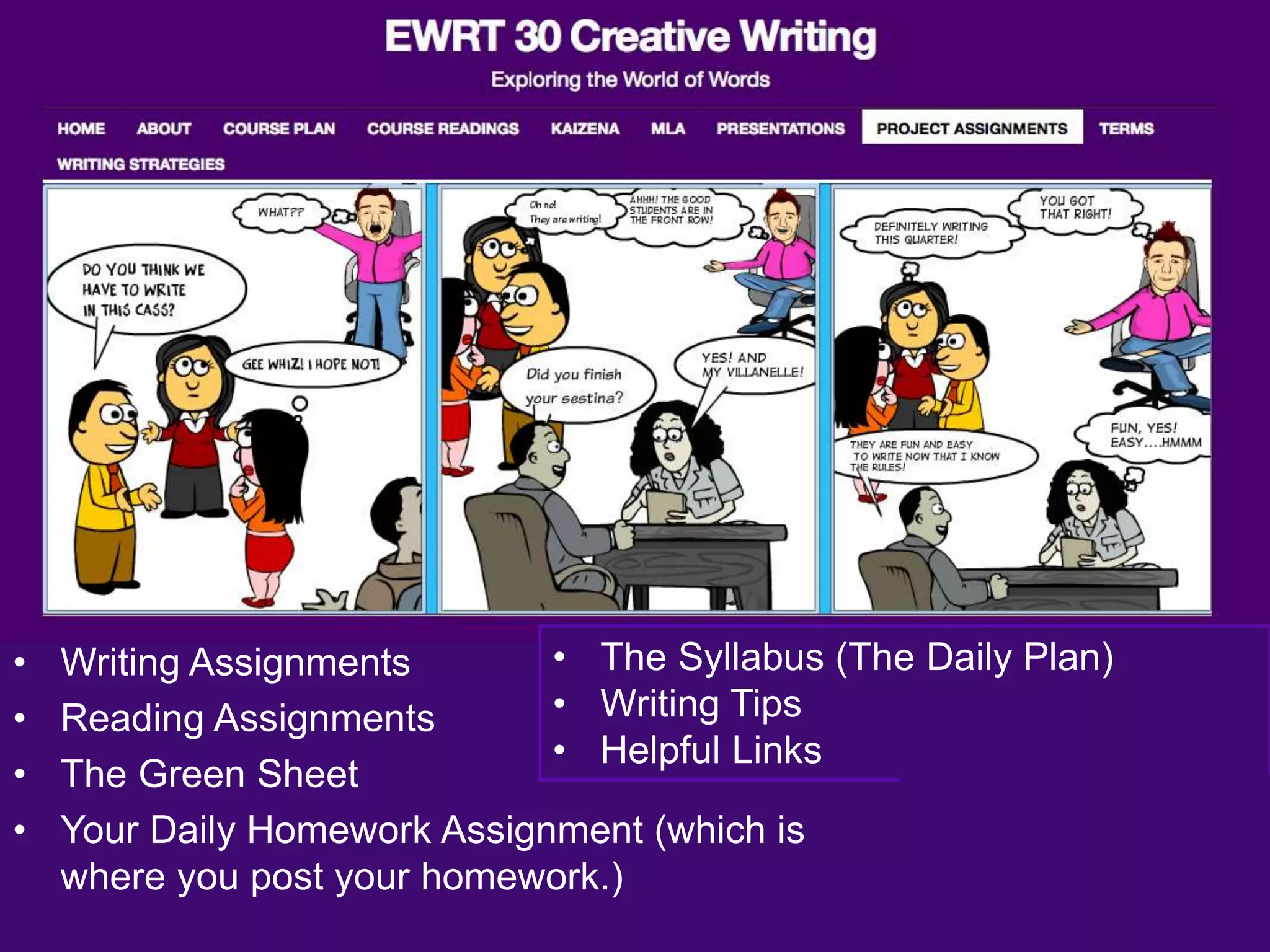
• Writing Assignments
• Reading Assignments
• The Green Sheet
• Your Daily Homework Assignment (which is
where you post your homework.)
• The Syllabus (The Daily Plan)
• Writing Tips
• Helpful Links
Homework
There is writing homework due the
evening before each meeting. This is both
to help you think about your reading and
to help you produce ideas for your writing.
In order to earn an A on your homework,
you must do the following:
 Complete all of the posts.
 Post them on time.
 Be thoughtful in your writing.
Posting Homework
• On the front page of the website, you will find the
homework post after each class. (text me if you don’t
see it)
• Below that post on the right, are the words “Leave a
comment.”
• Click there and a comment box will open. Copy and
paste your homework into the comment box
• Click “Post Comment.”
Suggestions
• Your homework for this class is worth 175
points because it requires significant
work. Take this part of the course very
seriously. It is easy to skip a few
assignments, and then a few more, but
failing the homework section of this class
will be detrimental to your grade.
• Make a word document for your
homework. Write the assigned work
there. Date it and record the post #.
Revise and edit before you post. Post
your homework in a timely manner. This
will keep you on track by reminding you of
how many you have done or missed.
• At the end of the quarter, I will ask you to
assess your work, so make sure you stay
on top of what you have accomplished!
Is this class
too hard?
Is this class
History 10?
Will I be the
teacher’s favorite?
TERMS
Haiku
The haiku is composed of 17 sound units divided into three
parts - one with 5 syllables, one with 7 syllables and
another with 5 syllables.
Alliteration
The repetition of consonant sounds, especially at the
beginning of words. Example: "Fetched fresh, as I suppose,
off some sweet wood." Hopkins, "In the Valley of the Elwy.”
Assonance
The repetition of similar vowel sounds in a sentence or a
line of poetry or prose, as in "I rose and told him of my
woe." Whitman's "When I Heard the Learn'd Astronomer"
contains assonantal "I's" in the following lines: "How soon
unaccountable I became tired and sick, / Till rising and
gliding out I wander'd off by myself."
Convention
A customary feature of a literary work, such as the use of a chorus in Greek tragedy, the
inclusion of an explicit moral in a fable, or the use of a particular rhyme scheme in a
villanelle. Conventions of the Haiku include the line and syllable count, the use of a word that
marks a season, and the “phrase and fragment” style.
Onomatopoeia
The use of words to imitate the sounds they describe. Words such as buzz and crack are
onomatopoetic. The following line from Pope's "Sound and Sense" onomatopoetically
imitates in sound what it describes:
When Ajax strives some rock's vast weight to throw,
The line too labors, and the words move slow.
Most often, however, onomatopoeia refers to words and groups of words, such as Tennyson's
description of the "murmur of innumerable bees," which attempts to capture the sound of a
swarm of bees buzzing.
Let’s get ready
to write!
Haiku
“Haiku show[s] us the world in a water drop,
providing a tiny lens through which to glimpse the
miracle and mystery of life” (National Endowment
for the Humanities).
• It is a traditional form of
Japanese poetry
• It describes nature, every
day life, or the human
condition
• It is based on personal
reflection
• Its value is in sudden
discovery or revelation
What is Haiku?
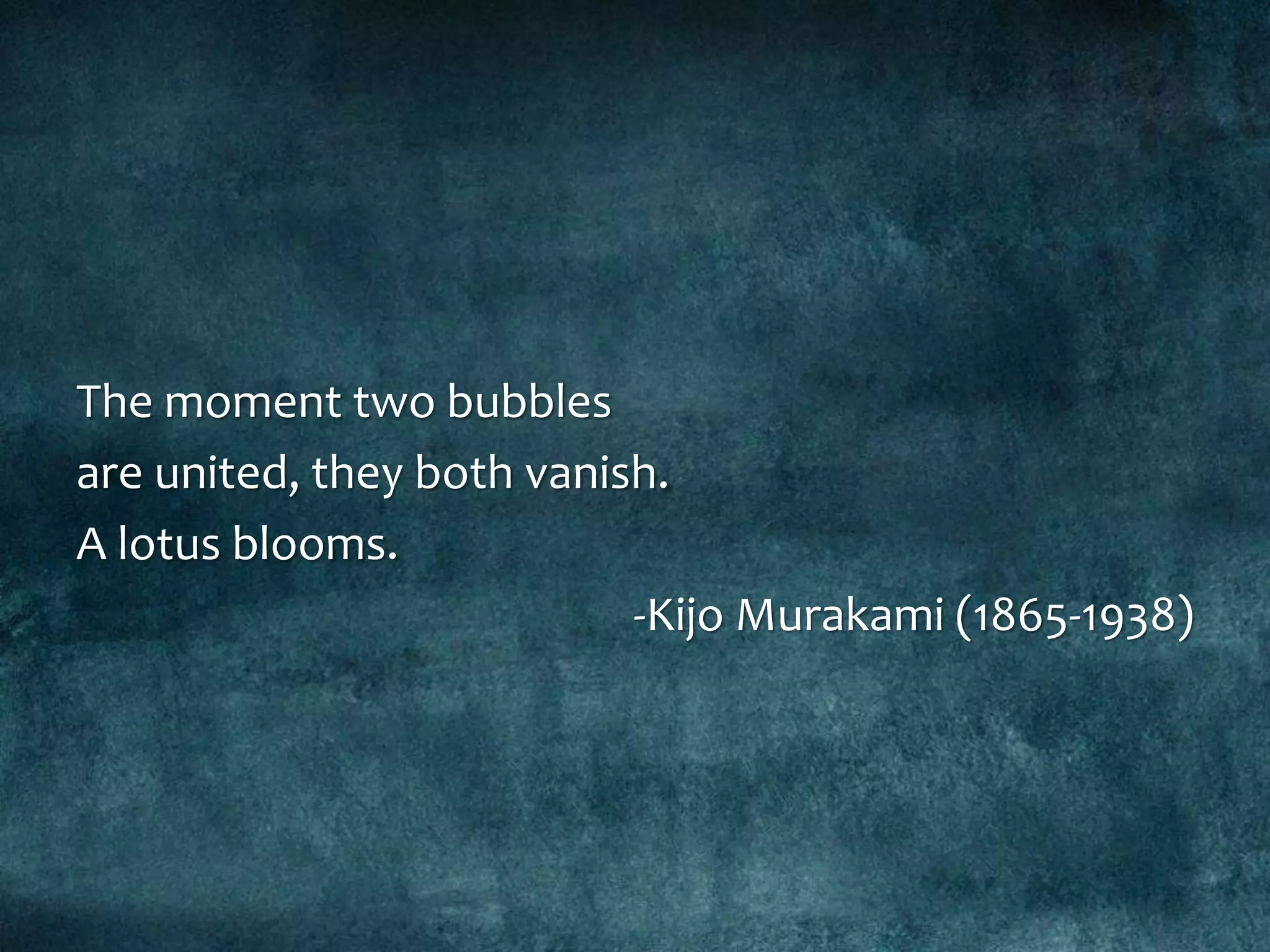
The moment two bubbles
are united, they both vanish.
A lotus blooms.
-Kijo Murakami (1865-1938)
Why Haiku?
• It is a great mode of self-
expression
• It demands both brevity and
clarity in writing
• It captures one moment and
its emotions perfectly
• It expresses complex ideas
through simple observations
• Writing and understanding Haiku
requires multiple skills:
– Close observation
– Careful reflection
– Concise word choice
– An open mind
Writing Haiku
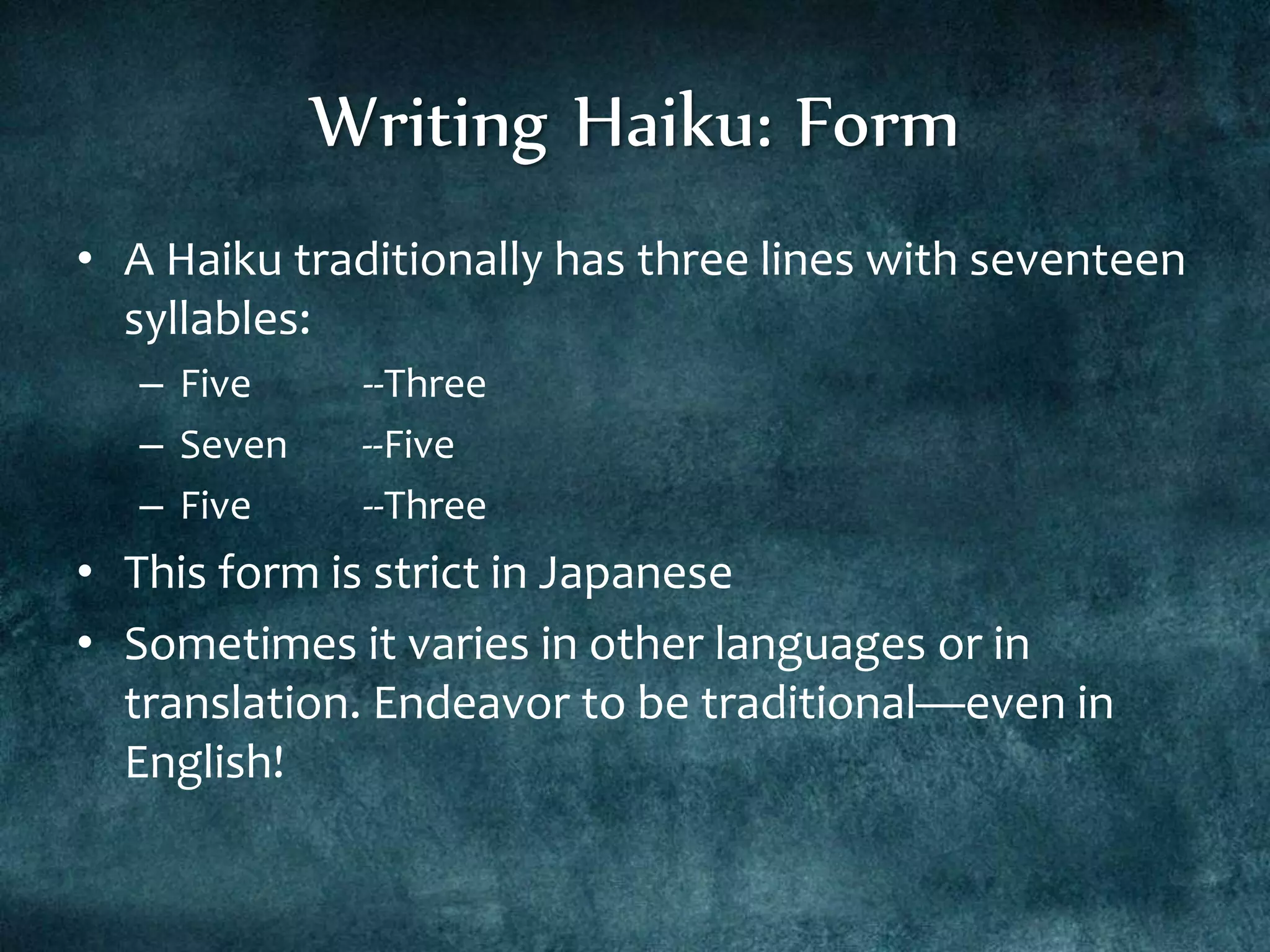
• A Haiku traditionally has three lines with seventeen
syllables:
– Five --Three
– Seven --Five
– Five --Three
• This form is strict in Japanese
• Sometimes it varies in other languages or in
translation. Endeavor to be traditional—even in
English!
Writing Haiku: Form
• A haiku consists of two parts: The description and the
reflection.
• Each part depends on the other for meaning.
• In Japanese Haiku, the break is marked by a “cutting word.”
In English, the break is often marked by punctuation (e.g.
colon, long dash, ellipsis)
• A haiku usually includes a kigo, a word that indicates a
season. This does not have to be a traditional season like fall
or winter. It could be baseball season or voting time; the
reader just has to be able to determine when the event takes
place.
Writing Haiku: Structure and Language
English Haiku
the rhythm
of her old brown hands
weaving thin wet reeds
Elizabeth St Jacques
1991 Charles B. Dickson International Haiku
Contest--winners
old pond . . .
a frog leaps in
water's sound
Matsuo Bashô
(1644-1694)
Billboards . . .
wet
in spring
rain . . .
Eric W. Amann
Write Your Own Haiku
– Try the five, seven, five
syllable form
– Try the three, five, three
syllable form
– Include a kigo to indicate the
season
– Use both a description and a
reflection.
– Remember to identify the
break between the two
with punctuation.
• Natural Endowment for the Humanities. EDSITEment. Can You
Haiku? May 2002. 10 October 2009.
<http://edsitement.neh.gov/view_lesson_plan.asp?ID=250>.
• Toyomasu, Kei Grieg. HAIKU for PEOPLE. 10 Jan. 2001. 10
October 2009. <http://www.toyomasu.com/haiku>.
• Herrlin, Jackie. HA-KU. 2004. Internet Archive. 10 October
2009. <http://www.archive.org/details/cie_haku>.
(Attribution, Non Commercial, No Derivatives)
• Russo, Dave. North Carolina Haiku Society. Unknown. 10
October 2009. <http://nc-haiku.org/haiku-misc.htm>.
Works Cited
Homework
• Make your Word Press
Website or establish your user
name
• Post #1: 2-3 Haiku
• Bring a copy of your work to
our next meeting.
• Reading: Blank Verse-All (on
the website under “course
readings,” “poetry,” and
“blank verse”).
• Study Terms 1-5

Ewrt 30 class 1

  • 1.
  • 2.
    Agenda • Adding theClass • Syllabus/Green Sheet • Website • Terms • In-class writing
  • 3.
    Adding the Class •If you are on the waiting list, you can stay. I won’t hand out add codes until next week, and then, only if there is room. • As we go over the syllabus, consider whether you will stay in the class. If you want out, please let me know, so I can offer your seat to another student.
  • 4.
    The Green Sheet •What you will find here – Course Requirements • Assignments and values • Participation – Required Materials – Class Policies • Plagiarism • Conduct and Courtesy – The Class Website • How to sign up for an account • How to post your homework. – How to use Kaizena to submit your Paper
  • 5.
    Texts and SuggestedMaterials: • Reading assignments will be posted on the course website. There is no text book for you to buy. • A stapler, USB flash drive, loose-leaf paper or a notebook for notes and drafts, and pens or pencils. Alternatively, you may use your computer for drafting.
  • 6.
    Course Requirements: • Activeparticipation in class discussions and regular attendance. You will earn real points for your participation in activities. • Keeping up-to-date on the assignments and reading. • Formal writing: a poetry project, two fiction projects, and a drama project (small groups). • A series of creative writing posts to the class website • Terms tests, reading quizzes, and in-class assignments.
  • 7.
  • 9.
  • 10.
    Writing Submissions 1. Kaizenaallows me to respond to your essay with both voice and written comments and to insert helpful links. 2. Create your account. Go to Kaizena.com or simply use the link on our class website home page. Click “Sign up.” Choose “Student.” Enter your group code (you can find this on the right side of the website or in the slideshow directions for how to use Kaizena. 3. Files are added to Conversations in Kaizena. To add a file to a conversation, click the "Add File" button. 4. Next, choose to add a file from Google Drive or to upload a file from your computer. Use the box that pops up to find your file. When you find your file, click it; next, click "Select" (for a Google Docs file) or open (for an uploaded file). The file will be added to your conversation. 5. If you experience formatting errors when you upload a Word file, try saving the file as a PDF, and uploading it again. 6. Once I have graded your paper, you can access it by going to the “conversations” link in Kaizena. 7. Click on the highlighted sections of the paper to find both audio and written comments concerning your essay or links to materials that will help you improve your writing. All out of class work is to be submitted to me electronically before the due date.
  • 11.
    Attendance:  Success inthis course depends on regular attendance and active participation. Participation points will be part of our daily activities. If you are not in class, you cannot earn these points. You should save absences for emergencies, work conflicts, weddings, jury duty, or any other issues that might arise in your life.  It is your responsibility to talk to me your absences or other conflicts. Work done in class cannot be made up. Also, please arrive on time, as you will not be able to make up work completed before you arrive, including quizzes.
  • 12.
    • Tests: – Wewill have three terms tests during the quarter. I will offer one opportunity late in the quarter to retake (or make-up) one of the first three terms tests. • Late Work – I do not accept late work except in the case of extreme emergencies. Please talk to me as soon as possible if you find yourself in this situation.
  • 13.
    Conduct, Courtesy, andElectronic Devices: • In this class, we will regularly engage in the discussion of each other’s work. Because writing is so personal, I ask each of you to be both kind and honest. Do share helpful critiques so each writer may grow. Courtesy will allow each person to have the opportunity to express his or her ideas in a comfortable environment. • Courtesy includes but is not limited to politely listening to others when they contribute to class discussions or while they give presentations, not slamming the classroom door or walking in front of classmates giving presentations if you do arrive late, and maintaining a positive learning environment for your fellow classmates. To help maintain a positive learning environment, please focus on the work assigned, turn off all cell phones and iPods before class, and do not text- message in class. If your behavior becomes disruptive to the learning environment of the class, you may be asked to leave and/or be marked absent.
  • 14.
    Academic Dishonesty: Plagiarism includesquoting or paraphrasing material without documentation and copying from other students or professionals. Intentional plagiarism is a grave offense; the resulting response will be distasteful. Depending upon the severity, instances of plagiarism may result in a failing grade for the paper or the course and possible administrative action. All assignments will be scanned and scrutinized for academic dishonesty. Please refer to your handbook for more information regarding plagiarism.
  • 15.
  • 16.
    Syllabus • The syllabusis a tentative schedule. • It may be revised during the quarter. • Use it to determine how to prepare for class. What we will do in class  Homework due before the next class  Current Project Week and Days 
  • 17.
    Website:palmoreewrt30.wordpress.com palm• Our classwebsite is http://palmoreewrt30.wordpress.com. (You can also access our course page through canvas). In order to do the homework, you must establish an account. To make your own FREE Word Press account, go to wordpress.com. The system will walk you through the steps to signup for a username or to set up your own user-friendly Word Press blog. Alternatively, you can sign into our website through Facebook. • If you prefer not to use your own name, you may use a pseudonym. Please email me your username if it is significantly different from your real name. • If you cannot establish your website and username, please come to my office hours as soon as possible, and I will help you with the process. Much of our work will take place online, so establishing this connection is mandatory. Your grades will be available through Canvas.
  • 18.
    • Writing Assignments •Reading Assignments • The Green Sheet • Your Daily Homework Assignment (which is where you post your homework.) • The Syllabus (The Daily Plan) • Writing Tips • Helpful Links
  • 19.
    Homework There is writinghomework due the evening before each meeting. This is both to help you think about your reading and to help you produce ideas for your writing. In order to earn an A on your homework, you must do the following:  Complete all of the posts.  Post them on time.  Be thoughtful in your writing.
  • 20.
    Posting Homework • Onthe front page of the website, you will find the homework post after each class. (text me if you don’t see it) • Below that post on the right, are the words “Leave a comment.” • Click there and a comment box will open. Copy and paste your homework into the comment box • Click “Post Comment.”
  • 21.
    Suggestions • Your homeworkfor this class is worth 175 points because it requires significant work. Take this part of the course very seriously. It is easy to skip a few assignments, and then a few more, but failing the homework section of this class will be detrimental to your grade. • Make a word document for your homework. Write the assigned work there. Date it and record the post #. Revise and edit before you post. Post your homework in a timely manner. This will keep you on track by reminding you of how many you have done or missed. • At the end of the quarter, I will ask you to assess your work, so make sure you stay on top of what you have accomplished!
  • 22.
    Is this class toohard? Is this class History 10? Will I be the teacher’s favorite?
  • 23.
  • 24.
    Haiku The haiku iscomposed of 17 sound units divided into three parts - one with 5 syllables, one with 7 syllables and another with 5 syllables. Alliteration The repetition of consonant sounds, especially at the beginning of words. Example: "Fetched fresh, as I suppose, off some sweet wood." Hopkins, "In the Valley of the Elwy.” Assonance The repetition of similar vowel sounds in a sentence or a line of poetry or prose, as in "I rose and told him of my woe." Whitman's "When I Heard the Learn'd Astronomer" contains assonantal "I's" in the following lines: "How soon unaccountable I became tired and sick, / Till rising and gliding out I wander'd off by myself."
  • 25.
    Convention A customary featureof a literary work, such as the use of a chorus in Greek tragedy, the inclusion of an explicit moral in a fable, or the use of a particular rhyme scheme in a villanelle. Conventions of the Haiku include the line and syllable count, the use of a word that marks a season, and the “phrase and fragment” style. Onomatopoeia The use of words to imitate the sounds they describe. Words such as buzz and crack are onomatopoetic. The following line from Pope's "Sound and Sense" onomatopoetically imitates in sound what it describes: When Ajax strives some rock's vast weight to throw, The line too labors, and the words move slow. Most often, however, onomatopoeia refers to words and groups of words, such as Tennyson's description of the "murmur of innumerable bees," which attempts to capture the sound of a swarm of bees buzzing.
  • 26.
  • 27.
    “Haiku show[s] usthe world in a water drop, providing a tiny lens through which to glimpse the miracle and mystery of life” (National Endowment for the Humanities).
  • 28.
    • It isa traditional form of Japanese poetry • It describes nature, every day life, or the human condition • It is based on personal reflection • Its value is in sudden discovery or revelation What is Haiku?
  • 29.
    The moment twobubbles are united, they both vanish. A lotus blooms. -Kijo Murakami (1865-1938)
  • 30.
    Why Haiku? • Itis a great mode of self- expression • It demands both brevity and clarity in writing • It captures one moment and its emotions perfectly • It expresses complex ideas through simple observations
  • 31.
    • Writing andunderstanding Haiku requires multiple skills: – Close observation – Careful reflection – Concise word choice – An open mind Writing Haiku
  • 32.
    • A Haikutraditionally has three lines with seventeen syllables: – Five --Three – Seven --Five – Five --Three • This form is strict in Japanese • Sometimes it varies in other languages or in translation. Endeavor to be traditional—even in English! Writing Haiku: Form
  • 33.
    • A haikuconsists of two parts: The description and the reflection. • Each part depends on the other for meaning. • In Japanese Haiku, the break is marked by a “cutting word.” In English, the break is often marked by punctuation (e.g. colon, long dash, ellipsis) • A haiku usually includes a kigo, a word that indicates a season. This does not have to be a traditional season like fall or winter. It could be baseball season or voting time; the reader just has to be able to determine when the event takes place. Writing Haiku: Structure and Language
  • 34.
    English Haiku the rhythm ofher old brown hands weaving thin wet reeds Elizabeth St Jacques 1991 Charles B. Dickson International Haiku Contest--winners
  • 35.
    old pond .. . a frog leaps in water's sound Matsuo Bashô (1644-1694) Billboards . . . wet in spring rain . . . Eric W. Amann
  • 36.
    Write Your OwnHaiku – Try the five, seven, five syllable form – Try the three, five, three syllable form – Include a kigo to indicate the season – Use both a description and a reflection. – Remember to identify the break between the two with punctuation.
  • 38.
    • Natural Endowmentfor the Humanities. EDSITEment. Can You Haiku? May 2002. 10 October 2009. <http://edsitement.neh.gov/view_lesson_plan.asp?ID=250>. • Toyomasu, Kei Grieg. HAIKU for PEOPLE. 10 Jan. 2001. 10 October 2009. <http://www.toyomasu.com/haiku>. • Herrlin, Jackie. HA-KU. 2004. Internet Archive. 10 October 2009. <http://www.archive.org/details/cie_haku>. (Attribution, Non Commercial, No Derivatives) • Russo, Dave. North Carolina Haiku Society. Unknown. 10 October 2009. <http://nc-haiku.org/haiku-misc.htm>. Works Cited
  • 39.
    Homework • Make yourWord Press Website or establish your user name • Post #1: 2-3 Haiku • Bring a copy of your work to our next meeting. • Reading: Blank Verse-All (on the website under “course readings,” “poetry,” and “blank verse”). • Study Terms 1-5