EWRT 1C CLASS 35
Email me if you
need help!
Agenda
 Draft Paper #2
 Study for exam #2
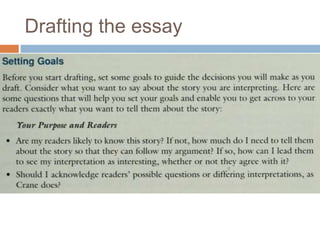
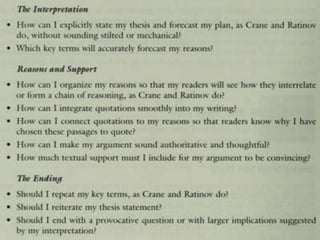
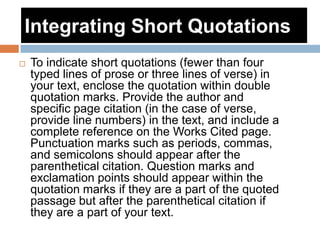
Drafting the essay
Technical Details: Review
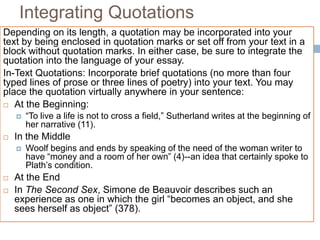
Integrating Short Quotations
 To indicate short quotations (fewer than four
typed lines of prose or three lines of verse) in
your text, enclose the quotation within double
quotation marks. Provide the author and
specific page citation (in the case of verse,
provide line numbers) in the text, and include a
complete reference on the Works Cited page.
Punctuation marks such as periods, commas,
and semicolons should appear after the
parenthetical citation. Question marks and
exclamation points should appear within the
quotation marks if they are a part of the quoted
passage but after the parenthetical citation if
they are a part of your text.
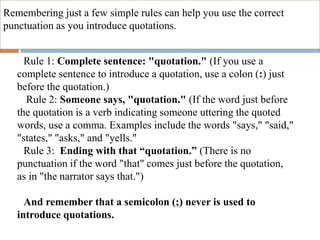
Integrating Quotations
Depending on its length, a quotation may be incorporated into your
text by being enclosed in quotation marks or set off from your text in a
block without quotation marks. In either case, be sure to integrate the
quotation into the language of your essay.
In-Text Quotations: Incorporate brief quotations (no more than four
typed lines of prose or three lines of poetry) into your text. You may
place the quotation virtually anywhere in your sentence:
 At the Beginning:
 “To live a life is not to cross a field,” Sutherland writes at the beginning of
her narrative (11).
 In the Middle
 Woolf begins and ends by speaking of the need of the woman writer to
have “money and a room of her own” (4)--an idea that certainly spoke to
Plath’s condition.
 At the End
 In The Second Sex, Simone de Beauvoir describes such an
experience as one in which the girl “becomes an object, and she
sees herself as object” (378).
Remembering just a few simple rules can help you use the correct
punctuation as you introduce quotations.
oRule 1: Complete sentence: "quotation." (If you use a
complete sentence to introduce a quotation, use a colon (:) just
before the quotation.)
o Rule 2: Someone says, "quotation." (If the word just before
the quotation is a verb indicating someone uttering the quoted
words, use a comma. Examples include the words "says," "said,"
"states," "asks," and "yells."
oRule 3: Ending with that “quotation.” (There is no
punctuation if the word "that" comes just before the quotation,
as in "the narrator says that.")
oAnd remember that a semicolon (;) never is used to
introduce quotations.
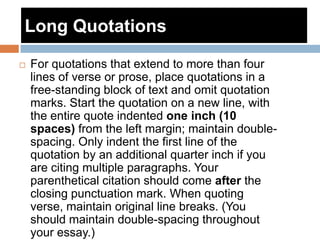
Long Quotations
 For quotations that extend to more than four
lines of verse or prose, place quotations in a
free-standing block of text and omit quotation
marks. Start the quotation on a new line, with
the entire quote indented one inch (10
spaces) from the left margin; maintain double-
spacing. Only indent the first line of the
quotation by an additional quarter inch if you
are citing multiple paragraphs. Your
parenthetical citation should come after the
closing punctuation mark. When quoting
verse, maintain original line breaks. (You
should maintain double-spacing throughout
your essay.)
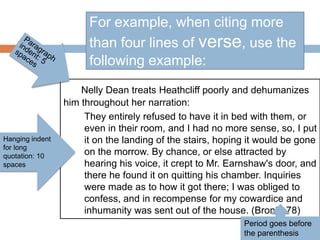
Nelly Dean treats Heathcliff poorly and dehumanizes
him throughout her narration:
They entirely refused to have it in bed with them, or
even in their room, and I had no more sense, so, I put
it on the landing of the stairs, hoping it would be gone
on the morrow. By chance, or else attracted by
hearing his voice, it crept to Mr. Earnshaw's door, and
there he found it on quitting his chamber. Inquiries
were made as to how it got there; I was obliged to
confess, and in recompense for my cowardice and
inhumanity was sent out of the house. (Bronte 78)
For example, when citing more
than four lines of verse, use the
following example:
Hanging indent
for long
quotation: 10
spaces
Period goes before
the parenthesis
Avoiding Grammatical Tangles
 When you incorporate quotations into
your writing, and especially when you
omit words from quotations, you run
the risk of creating ungrammatical
sentences. Three common errors you
should try to avoid are verb
incompatibility and ungrammatical
omissions.
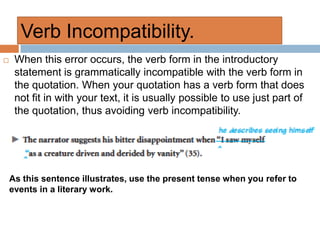
Verb Incompatibility.
 When this error occurs, the verb form in the introductory
statement is grammatically incompatible with the verb form in
the quotation. When your quotation has a verb form that does
not fit in with your text, it is usually possible to use just part of
the quotation, thus avoiding verb incompatibility.
As this sentence illustrates, use the present tense when you refer to
events in a literary work.
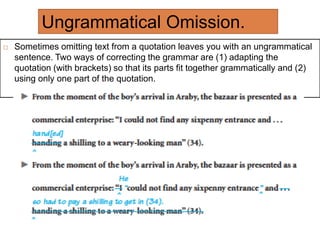
Ungrammatical Omission.
 Sometimes omitting text from a quotation leaves you with an ungrammatical
sentence. Two ways of correcting the grammar are (1) adapting the
quotation (with brackets) so that its parts fit together grammatically and (2)
using only one part of the quotation.
Citing
Summarized
Material
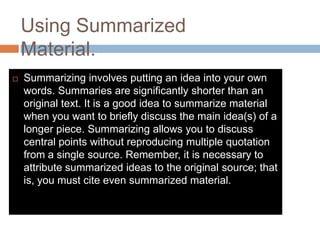
Using Summarized
Material.
 Summarizing involves putting an idea into your own
words. Summaries are significantly shorter than an
original text. It is a good idea to summarize material
when you want to briefly discuss the main idea(s) of a
longer piece. Summarizing allows you to discuss
central points without reproducing multiple quotation
from a single source. Remember, it is necessary to
attribute summarized ideas to the original source; that
is, you must cite even summarized material.
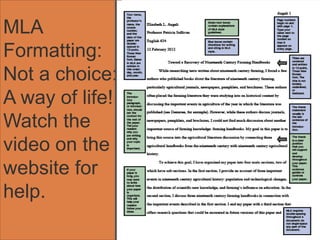
MLA
Formatting:
Not a choice:
A way of life!
Watch the
video on the
website for
help.
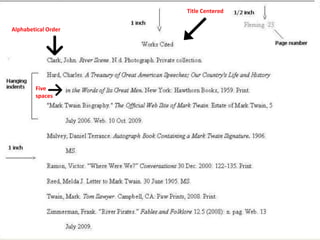
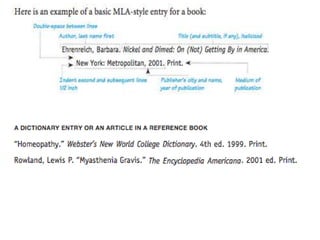
The Works Cited
page
Alphabetical Order
Title Centered
Five
spaces
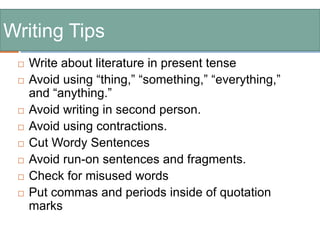
Writing Tips
 Write about literature in present tense
 Avoid using “thing,” “something,” “everything,”
and “anything.”
 Avoid writing in second person.
 Avoid using contractions.
 Cut Wordy Sentences
 Avoid run-on sentences and fragments.
 Check for misused words
 Put commas and periods inside of quotation
marks
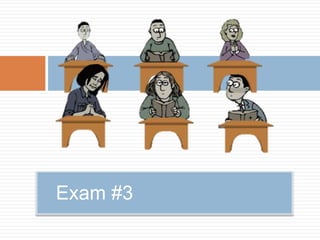
Exam #3
Exam #2 50 points
Class 36
 “Araby” by James Joyce
 “The Story of an Hour” by Kate Chopin
 “A Very Old Man with Enormous Wings” by Gabriel
García Márquez
 “Rita Hayworth and Shawshank Redemption” by
Stephen King
 The Metamorphosis by Franz Kafka
Class Presentations: 22-29
Name the work and the author
Section 1: : 2x5 points =10
Use complete titles for works and complete names for
authors.
 And hardly had the women left the room with the
chest, squeezing against it and groaning, than
Gregor stuck his head out from under the couch
to see how he could feel his way into the
situation as considerately as possible.
Identify the writer
 Section 2: 2x5 points =10
 This writer’s fiction did not attract
significant attention outside literary circles
until the publication of his masterpiece,
Cien años de soledad (1967; One Hundred
Years of Solitude, 1970).
Identify the character
 Section 3: 2x5 points=10
 "Some distant lamp or lighted window
gleamed below me. I was thankful that I
could see so little. All my senses seemed
to desire to veil themselves and, feeling
that I was about to slip from them, I
pressed the palms of my hands together
until they trembled, murmuring: "O love! O
love!" many times."
Terms
 Section 4: 2x5 points = 10
_____________ refers to the
perspective from which the story is
told.
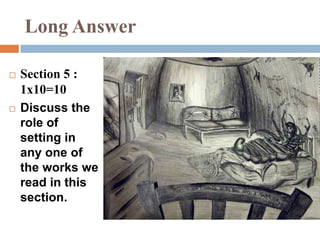
Long Answer
 Section 5 :
1x10=10
 Discuss the
role of
setting in
any one of
the works we
read in this
section.
Homework
 Draft Paper #2
 Study for exam #2
 Post #25: Your best
body paragraph and
your conclusion.

Ewrt 1 c class 35 online

  • 1.
    EWRT 1C CLASS35 Email me if you need help!
  • 2.
    Agenda  Draft Paper#2  Study for exam #2
  • 3.
  • 6.
  • 7.
    Integrating Short Quotations To indicate short quotations (fewer than four typed lines of prose or three lines of verse) in your text, enclose the quotation within double quotation marks. Provide the author and specific page citation (in the case of verse, provide line numbers) in the text, and include a complete reference on the Works Cited page. Punctuation marks such as periods, commas, and semicolons should appear after the parenthetical citation. Question marks and exclamation points should appear within the quotation marks if they are a part of the quoted passage but after the parenthetical citation if they are a part of your text.
  • 8.
    Integrating Quotations Depending onits length, a quotation may be incorporated into your text by being enclosed in quotation marks or set off from your text in a block without quotation marks. In either case, be sure to integrate the quotation into the language of your essay. In-Text Quotations: Incorporate brief quotations (no more than four typed lines of prose or three lines of poetry) into your text. You may place the quotation virtually anywhere in your sentence:  At the Beginning:  “To live a life is not to cross a field,” Sutherland writes at the beginning of her narrative (11).  In the Middle  Woolf begins and ends by speaking of the need of the woman writer to have “money and a room of her own” (4)--an idea that certainly spoke to Plath’s condition.  At the End  In The Second Sex, Simone de Beauvoir describes such an experience as one in which the girl “becomes an object, and she sees herself as object” (378).
  • 9.
    Remembering just afew simple rules can help you use the correct punctuation as you introduce quotations. oRule 1: Complete sentence: "quotation." (If you use a complete sentence to introduce a quotation, use a colon (:) just before the quotation.) o Rule 2: Someone says, "quotation." (If the word just before the quotation is a verb indicating someone uttering the quoted words, use a comma. Examples include the words "says," "said," "states," "asks," and "yells." oRule 3: Ending with that “quotation.” (There is no punctuation if the word "that" comes just before the quotation, as in "the narrator says that.") oAnd remember that a semicolon (;) never is used to introduce quotations.
  • 10.
    Long Quotations  Forquotations that extend to more than four lines of verse or prose, place quotations in a free-standing block of text and omit quotation marks. Start the quotation on a new line, with the entire quote indented one inch (10 spaces) from the left margin; maintain double- spacing. Only indent the first line of the quotation by an additional quarter inch if you are citing multiple paragraphs. Your parenthetical citation should come after the closing punctuation mark. When quoting verse, maintain original line breaks. (You should maintain double-spacing throughout your essay.)
  • 11.
    Nelly Dean treatsHeathcliff poorly and dehumanizes him throughout her narration: They entirely refused to have it in bed with them, or even in their room, and I had no more sense, so, I put it on the landing of the stairs, hoping it would be gone on the morrow. By chance, or else attracted by hearing his voice, it crept to Mr. Earnshaw's door, and there he found it on quitting his chamber. Inquiries were made as to how it got there; I was obliged to confess, and in recompense for my cowardice and inhumanity was sent out of the house. (Bronte 78) For example, when citing more than four lines of verse, use the following example: Hanging indent for long quotation: 10 spaces Period goes before the parenthesis
  • 12.
    Avoiding Grammatical Tangles When you incorporate quotations into your writing, and especially when you omit words from quotations, you run the risk of creating ungrammatical sentences. Three common errors you should try to avoid are verb incompatibility and ungrammatical omissions.
  • 13.
    Verb Incompatibility.  Whenthis error occurs, the verb form in the introductory statement is grammatically incompatible with the verb form in the quotation. When your quotation has a verb form that does not fit in with your text, it is usually possible to use just part of the quotation, thus avoiding verb incompatibility. As this sentence illustrates, use the present tense when you refer to events in a literary work.
  • 14.
    Ungrammatical Omission.  Sometimesomitting text from a quotation leaves you with an ungrammatical sentence. Two ways of correcting the grammar are (1) adapting the quotation (with brackets) so that its parts fit together grammatically and (2) using only one part of the quotation.
  • 15.
  • 16.
    Using Summarized Material.  Summarizinginvolves putting an idea into your own words. Summaries are significantly shorter than an original text. It is a good idea to summarize material when you want to briefly discuss the main idea(s) of a longer piece. Summarizing allows you to discuss central points without reproducing multiple quotation from a single source. Remember, it is necessary to attribute summarized ideas to the original source; that is, you must cite even summarized material.
  • 17.
    MLA Formatting: Not a choice: Away of life! Watch the video on the website for help.
  • 18.
  • 19.
  • 21.
    Writing Tips  Writeabout literature in present tense  Avoid using “thing,” “something,” “everything,” and “anything.”  Avoid writing in second person.  Avoid using contractions.  Cut Wordy Sentences  Avoid run-on sentences and fragments.  Check for misused words  Put commas and periods inside of quotation marks
  • 22.
  • 23.
    Exam #2 50points Class 36  “Araby” by James Joyce  “The Story of an Hour” by Kate Chopin  “A Very Old Man with Enormous Wings” by Gabriel García Márquez  “Rita Hayworth and Shawshank Redemption” by Stephen King  The Metamorphosis by Franz Kafka Class Presentations: 22-29
  • 24.
    Name the workand the author Section 1: : 2x5 points =10 Use complete titles for works and complete names for authors.  And hardly had the women left the room with the chest, squeezing against it and groaning, than Gregor stuck his head out from under the couch to see how he could feel his way into the situation as considerately as possible.
  • 25.
    Identify the writer Section 2: 2x5 points =10  This writer’s fiction did not attract significant attention outside literary circles until the publication of his masterpiece, Cien años de soledad (1967; One Hundred Years of Solitude, 1970).
  • 26.
    Identify the character Section 3: 2x5 points=10  "Some distant lamp or lighted window gleamed below me. I was thankful that I could see so little. All my senses seemed to desire to veil themselves and, feeling that I was about to slip from them, I pressed the palms of my hands together until they trembled, murmuring: "O love! O love!" many times."
  • 27.
    Terms  Section 4:2x5 points = 10 _____________ refers to the perspective from which the story is told.
  • 28.
    Long Answer  Section5 : 1x10=10  Discuss the role of setting in any one of the works we read in this section.
  • 29.
    Homework  Draft Paper#2  Study for exam #2  Post #25: Your best body paragraph and your conclusion.