A single, centralized contract workforce management
system can help Indian manufacturers achieve cost
savings and operational efficiencies
The Evolving Role of
Automation in Managing
Contract Labour
2
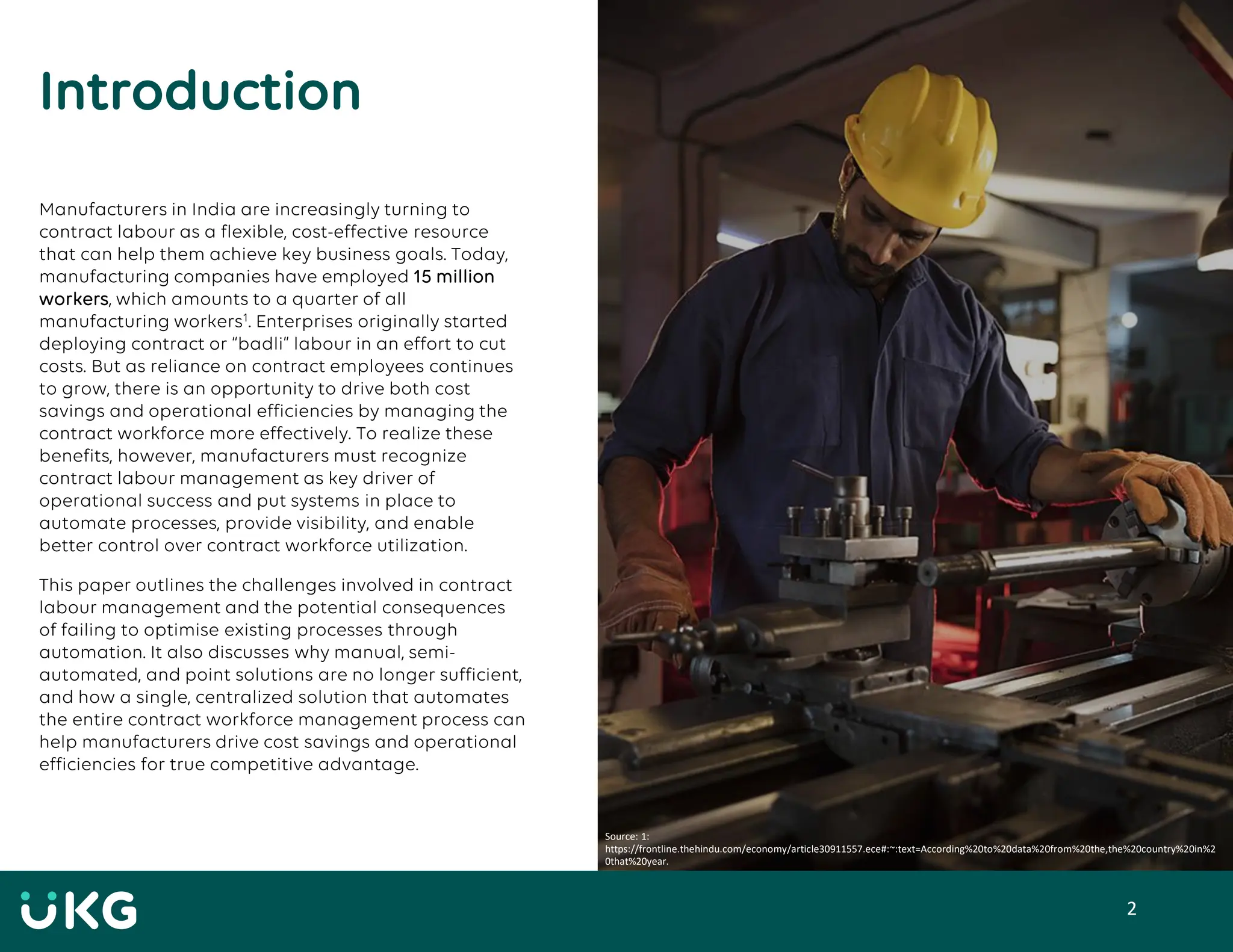
Manufacturers in India are increasingly turning to
contract labour as a flexible, cost-effective resource
that can help them achieve key business goals. Today,
manufacturing companies have employed 15 million
workers, which amounts to a quarter of all
manufacturing workers1. Enterprises originally started
deploying contract or “badli” labour in an effort to cut
costs. But as reliance on contract employees continues
to grow, there is an opportunity to drive both cost
savings and operational efficiencies by managing the
contract workforce more effectively. To realize these
benefits, however, manufacturers must recognize
contract labour management as key driver of
operational success and put systems in place to
automate processes, provide visibility, and enable
better control over contract workforce utilization.
This paper outlines the challenges involved in contract
labour management and the potential consequences
of failing to optimise existing processes through
automation. It also discusses why manual, semi-
automated, and point solutions are no longer sufficient,
and how a single, centralized solution that automates
the entire contract workforce management process can
help manufacturers drive cost savings and operational
efficiencies for true competitive advantage.
Introduction
Source: 1:
https://frontline.thehindu.com/economy/article30911557.ece#:~:text=According%20to%20data%20from%20the,the%20country%20in%2
0that%20year.
3
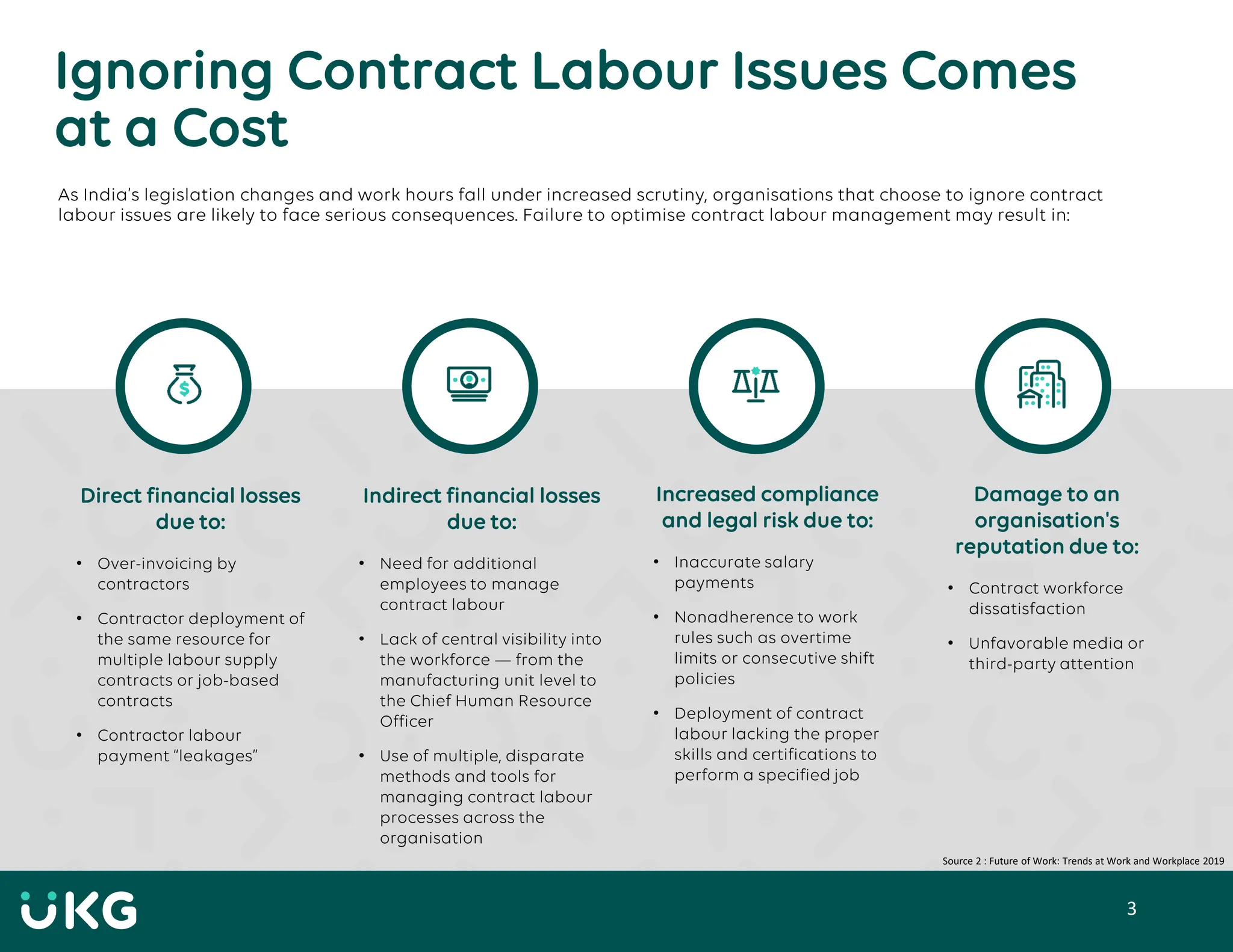
Direct financial losses
due to:
• Over-invoicing by
contractors
• Contractor deployment of
the same resource for
multiple labour supply
contracts or job-based
contracts
• Contractor labour
payment “leakages”
Indirect financial losses
due to:
• Need for additional
employees to manage
contract labour
• Lack of central visibility into
the workforce — from the
manufacturing unit level to
the Chief Human Resource
Officer
• Use of multiple, disparate
methods and tools for
managing contract labour
processes across the
organisation
Increased compliance
and legal risk due to:
• Inaccurate salary
payments
• Nonadherence to work
rules such as overtime
limits or consecutive shift
policies
• Deployment of contract
labour lacking the proper
skills and certifications to
perform a specified job
Damage to an
organisation's
reputation due to:
• Contract workforce
dissatisfaction
• Unfavorable media or
third-party attention
As India’s legislation changes and work hours fall under increased scrutiny, organisations that choose to ignore contract
labour issues are likely to face serious consequences. Failure to optimise contract labour management may result in:
Ignoring Contract Labour Issues Comes
at a Cost
Source 2 : Future of Work: Trends at Work and Workplace 2019
1
2
3
4
5
4
Why Current
Solutions Are
No Longer
Enough
In India, the systems used by manufacturers to
manage contract labour are typically individual
software modules that address specific workforce
management functions rather than the entire
process. These point solutions were developed for
the basic purpose of keeping track of contractors,
and as the contractor ecosystem continues to
flourish, they have failed to scale to meet evolving
requirements. Reasons for these failures include:
Contractor reluctance: In many cases, contractors may be hesitant to deploy an automated system that
provides labour tracking and a detailed audit trail because it eliminates any chance of manipulating
data and gaming the system for monetary gain.
Paper-based processes: Because manufacturers’ contract labour-related processes are essentially paper
trails, it is difficult to automate these manual workflows using existing systems due to the dynamic
nature of managing a contract workforce.
Contract workforce churn: Many contract labour jobs require minimal skill levels, and as a result,
employees are easily replaceable. This leads to greater churn amongst contract employees, which in turn
creates challenges in setting up an automated process for effective tracking.
Geographic challenges: Because many manufacturers in India operate units across multiple locations
and maintain relationships with multiple contractor vendors, it is challenging to build a single system
that meets all enterprise requirements. Most manufacturers have chosen to build local contract labour
management systems to address the specific requirements of individual units.
Compliance issues: Since contract labour is not considered to be part of the organisation's workforce,
many manufacturers maintain manual systems for contract employees and automated systems for
direct employees — an approach that results in additional complexities and compliance challenges.
5
A Better Approach to Contract
Workforce Management
When it comes to managing the growing contract workforce, disparate point
solutions will no longer suffice. Today’s Indian manufacturing organisations
require a complete contract labour management system that provides an
integrated suite of automated tools and real-time visibility into high-quality
labour information to help them control costs, improve productivity, and
minimise compliance risk enterprise wide. Key characteristics of an effective
contract labour management system include:
Complete process automation: A solution that simply captures contract
employee attendance data leaves HR and Finance with time-consuming
manual reconciliation tasks to help ensure accurate billing and payment.
Automated enforcement of work-related policies: Because manufacturing
organisations carry liability for contract employees, it is critical that the system
accurately implements and consistently applies work-related policies across the
contract workforce.
Real-time visibility: Manufacturing organisations need visibility into the contract workforce — from the unit and plant level rolling
up to the enterprise level — in order to gain unified and cross-functional insights and drive better decision making.
Compliance support: Manufacturers require an automated system that accurately enforces internal policies and local government
rules to help facilitate compliance.
Process standardisation across multiple locations: By using a single contract labour management system across multiple locations
and units, manufacturers are better able to enforce local policies while maintaining enterprise-level governance and validation
control.
6
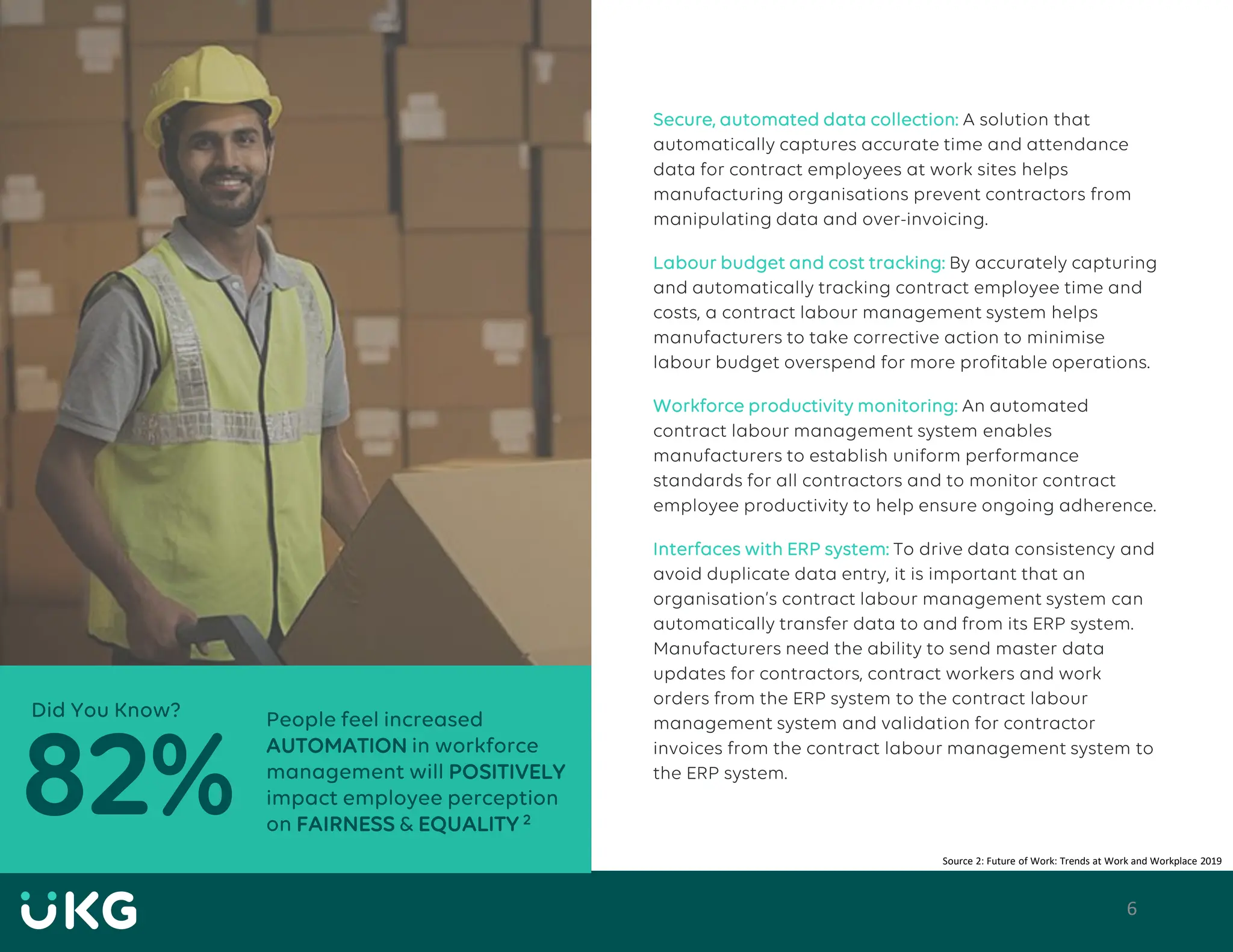
Secure, automated data collection: A solution that
automatically captures accurate time and attendance
data for contract employees at work sites helps
manufacturing organisations prevent contractors from
manipulating data and over-invoicing.
Labour budget and cost tracking: By accurately capturing
and automatically tracking contract employee time and
costs, a contract labour management system helps
manufacturers to take corrective action to minimise
labour budget overspend for more profitable operations.
Workforce productivity monitoring: An automated
contract labour management system enables
manufacturers to establish uniform performance
standards for all contractors and to monitor contract
employee productivity to help ensure ongoing adherence.
Interfaces with ERP system: To drive data consistency and
avoid duplicate data entry, it is important that an
organisation’s contract labour management system can
automatically transfer data to and from its ERP system.
Manufacturers need the ability to send master data
updates for contractors, contract workers and work
orders from the ERP system to the contract labour
management system and validation for contractor
invoices from the contract labour management system to
the ERP system.
Source 2: Future of Work: Trends at Work and Workplace 2019
People feel increased
AUTOMATION in workforce
management will POSITIVELY
impact employee perception
on FAIRNESS & EQUALITY 2
82%
Did You Know?
7
Addressing Growing
Contract Labour
Management
Complexity
In order to control costs and improve operational
efficiencies, manufacturers need a centralized system
that automates the entire contract workforce
management workflow — from contractor registration
and work order processing to bill verification and
statutory reporting. In addition, they require a system
capable of supporting the work order type under which
contract labour is engaged at their manufacturing units:
• Labour Supply Work Orders: The contractor deploys
workers per the requirements specified by the
manufacturing unit and is paid for the time that those
workers are used by that unit within a given billing
period.
• Job Basis/Schedule Rate Work Orders: The contractor
is paid for the amount of work carried out at a rate
specified for a unit of measurement, such as items
processed or pieces assembled, rather than the
amount of time workers are utilized. The contractor
deploys workers according to the amount of work that
needs to be performed.
8
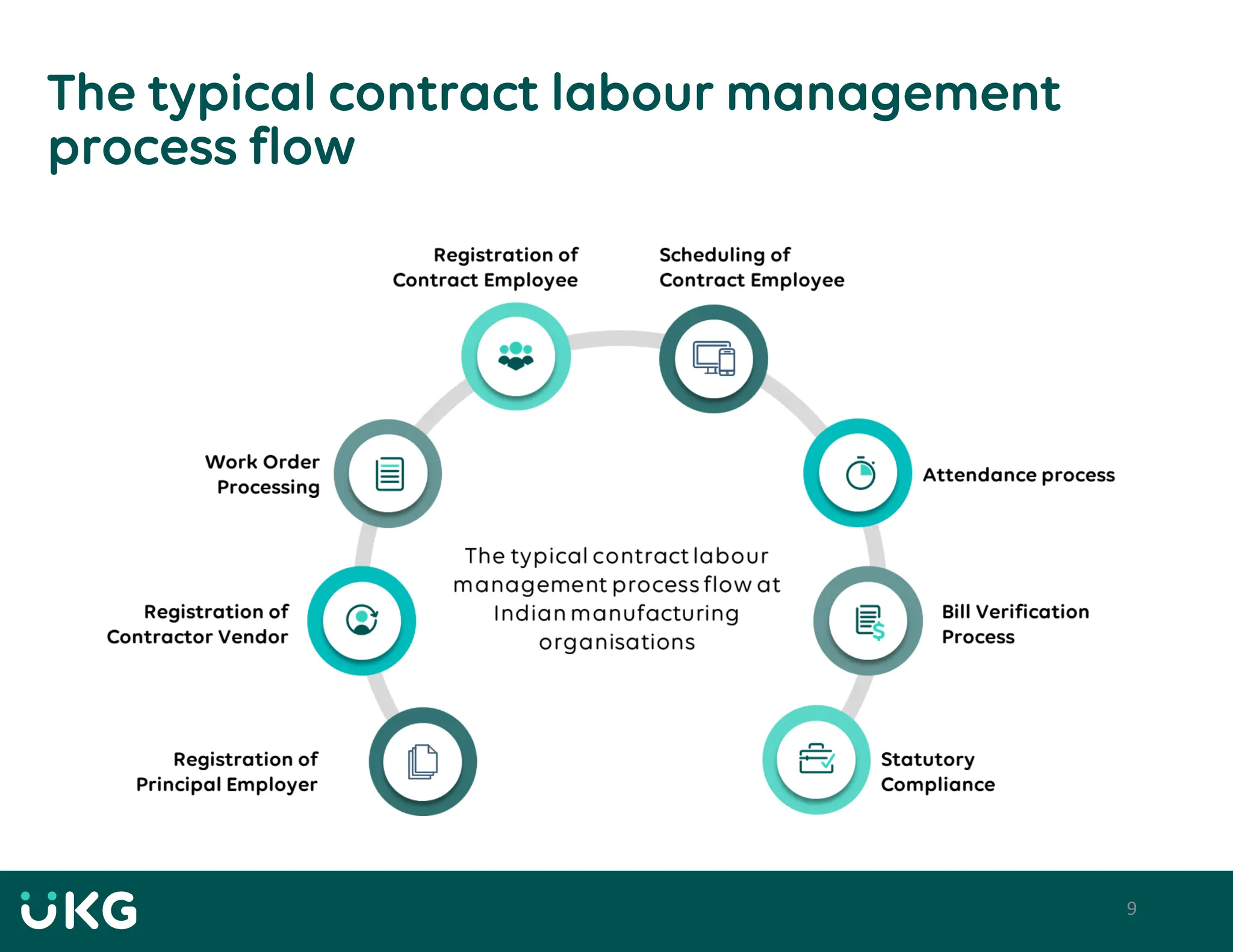
At the manufacturing unit level, the typical process flow for managing
contract labour includes the following nine steps — all of which must be
addressed by the system in a seamless and integrated manner:
▪ Registration of Principal Employer: Information such as Employer
Name, Address, PF Code, ESI/WC code are recorded in the system.
▪ Registration of Contractor Vendor: Information such as Contractor
Name, License Number, Max Contract Workmen, PF Code, and ESI/WC
validity period are recorded in the system.
▪ Work Order Processing: Work order details are imported from the
ERP system into the contract workforce management system and the
requirement is issued to the contractor vendor.
▪ Registration of Contract Employee: Information such as Name,
Unique Identification Number, Address, Skill, Trade, and Certifications
is recorded in the system.
▪ Scheduling of Contract Employee: The Contractor Vendor schedules
contract employees based on organizational requirements and the
skill criteria that is specified.
▪ Time and Attendance Tracking: Contract employees mark
attendance (clock in and out) using time clocks or biometric
terminals.
▪ Bill Verification: At the end of each month, the manufacturing
organisation validates the contractor vendor’s invoice using bill
verification reports.
▪ Statutory Compliance: The organisation generates statutory reports
to demonstrate compliance with the Contract Labour Regulation &
Abolition (CLRA) Act.
9
The typical contract labour management
process flow
10
UKG® workforce management solutions meet the complex requirements of today’s large
manufacturing organisations in India. These proven solutions provide complete automation of
contract labour management processes using a two-pronged approach:
UKG InTouch® data collection terminals enable contract employees to record and track their
hours easily and efficiently by simply swiping a card or badge. Optional biometric identification
allows employees to clock in via finger scan for added protection against fraudulent punching.
Once the InTouch verifies the employee’s identity, it records the time and attendance data and
reports it to UKG Workforce Central®. The InTouch’s ability to automatically capture accurate
timekeeping data for contract employees helps eliminate any scope of error — inadvertent or
otherwise — in contractor billing to help control labour costs. In addition, the InTouch’s modern
user interface provides a fast, self-service view into contract employees’ work-related
information.
The UKG Workforce Central suite provides integrated software to automate the complete
contract labour management process and delivers real-time access to workforce-related
information for better control and improved decision-making. Workforce Central aggregates
contract labour data and manages complex work rules. The software requires little or no
customisation and can be configured by non-technical staff. Workforce Central can generate
time and labour reports or it can feed data into an ERP business intelligence system for
reporting and analysis. The system can also transfer data into financial systems at the end of
each month, if desired, for cost tracking, budgeting, and reporting purposes.
The powerful combination of these two complementary solutions — UKG InTouch terminals and
Workforce Central — helps manufacturers boost productivity and increase compliance while
reducing contract labour costs.
How can the UKG Solutions Help The UKG solution
automates the
complete contract
workforce
management
process to help
Indian
manufacturers
control labour costs,
improve
productivity, and
minimise
compliance risk.
11
Contract Workforce
Management Process
Comprehensive Management and Statutory
Reporting
The UKG solution provides a comprehensive set of a
reports classified as “management” or “statutory.”
Sample statutory reports for CLRA compliance
include:
Form XII Register of Contractors
Form XIII Register of Workmen
Employed by Contractor
Form XVI Muster Roll
Form XVII Register of Wages
Form XVIII Register of Wages cum Muster
Roll
Form XIX Wage Slip
Form XXIII Register of Overtime
Form XXV Annual Return of Principal
Employer (to be sent to the
Registering Officer
Form XXIV Half Yearly Return
of the organizations
engage contract
staff comprising at
least 10% of its
workforce3
85%
Source 3: Future of Work: Trends at Work and Workplace 2019
Did You Know?
12
The UKG Solution
• Automation of contract labour
management processes
• Real-time visibility using UKG InTouch
terminals
• Centralized architecture for easy system
management
• Interface to existing ERP systems for
work order integration
• Holistic view of labour budget and cost
expectations with bill verification
• Accurate contract workforce-related
data such as continuous worked days,
overtime, licenses, and views of on-
premise employees
• Comprehensive reports showing detail at
every stage of the process
• Reduce contract labour costs through complete automation and
enhanced visibility
• Leverage the contract workforce as a strategic resource to improve
operational efficiencies
• Reduce contractor over-billing by accurately tracking workers’ time
and attendance
• Increase productivity by giving frontline managers access to real-
time data for better decision making
• Balance productivity and costs by flexing the contract workforce
based on current demand
• Drive positive change with detailed insights into labour processes
• Minimise compliance risk with accurate interpretation of internal
work policies and government labour laws
Benefits
Features
© 2020 UKG Inc. All rights reserved. For a full list of UKG trademarks, please visit www.ukg.com/trademarks. All other trademarks, if any, are property of their respective owners. All specifications are subject to change.
Connect with us online @UKG.com
About UKG
At UKG (Ultimate Kronos Group), our purpose
is people™. Built from a merger that created
one of the largest cloud companies in the
world, UKG believes organizations succeed
when they focus on their people. As a leading
global provider of HCM, payroll, HR service
delivery, and workforce management
solutions, UKG delivers award-winning Pro,
Dimensions, and Ready solutions to help tens
of thousands of organizations across
geographies and in every industry drive better
business outcomes, improve HR effectiveness,
streamline the payroll process, and help make
work a better, more connected experience for
everyone. UKG has more than 12,000
employees around the globe and is known for
an inclusive workplace culture. The company
has earned numerous awards for culture,
products, and services, including consecutive
years on Fortune’s 100 Best Companies to
Work For list. To learn more, visit ukg.com.
Conclusion
Manufacturers in India continue to rely heavily on contract employees
as a flexible, cost-effective way to align labour to demand. This trend
has created a largely untapped opportunity to reduce costs and
increase operational efficiencies by optimizing contract labour
management effectiveness. Manual and semi-automated workflows
simply cannot address the growing complexity of contract labour
management in the manufacturing sector. At the same time, using
disparate point solutions at various manufacturing units does not
provide the enterprisewide visibility and control Indian
manufacturers need to achieve operational excellence.
Today’s manufacturers need a single, centralised solution that
automates the entire contract labour management process and
integrates seamlessly with ERP and finance systems to help them
control costs, improve productivity, and minimise compliance risk for
bottom-line results.

Sa*ple

  • 1.
    A single, centralizedcontract workforce management system can help Indian manufacturers achieve cost savings and operational efficiencies The Evolving Role of Automation in Managing Contract Labour
  • 2.
    2 Manufacturers in Indiaare increasingly turning to contract labour as a flexible, cost-effective resource that can help them achieve key business goals. Today, manufacturing companies have employed 15 million workers, which amounts to a quarter of all manufacturing workers1. Enterprises originally started deploying contract or “badli” labour in an effort to cut costs. But as reliance on contract employees continues to grow, there is an opportunity to drive both cost savings and operational efficiencies by managing the contract workforce more effectively. To realize these benefits, however, manufacturers must recognize contract labour management as key driver of operational success and put systems in place to automate processes, provide visibility, and enable better control over contract workforce utilization. This paper outlines the challenges involved in contract labour management and the potential consequences of failing to optimise existing processes through automation. It also discusses why manual, semi- automated, and point solutions are no longer sufficient, and how a single, centralized solution that automates the entire contract workforce management process can help manufacturers drive cost savings and operational efficiencies for true competitive advantage. Introduction Source: 1: https://frontline.thehindu.com/economy/article30911557.ece#:~:text=According%20to%20data%20from%20the,the%20country%20in%2 0that%20year.
  • 3.
    3 Direct financial losses dueto: • Over-invoicing by contractors • Contractor deployment of the same resource for multiple labour supply contracts or job-based contracts • Contractor labour payment “leakages” Indirect financial losses due to: • Need for additional employees to manage contract labour • Lack of central visibility into the workforce — from the manufacturing unit level to the Chief Human Resource Officer • Use of multiple, disparate methods and tools for managing contract labour processes across the organisation Increased compliance and legal risk due to: • Inaccurate salary payments • Nonadherence to work rules such as overtime limits or consecutive shift policies • Deployment of contract labour lacking the proper skills and certifications to perform a specified job Damage to an organisation's reputation due to: • Contract workforce dissatisfaction • Unfavorable media or third-party attention As India’s legislation changes and work hours fall under increased scrutiny, organisations that choose to ignore contract labour issues are likely to face serious consequences. Failure to optimise contract labour management may result in: Ignoring Contract Labour Issues Comes at a Cost Source 2 : Future of Work: Trends at Work and Workplace 2019
  • 4.
    1 2 3 4 5 4 Why Current Solutions Are NoLonger Enough In India, the systems used by manufacturers to manage contract labour are typically individual software modules that address specific workforce management functions rather than the entire process. These point solutions were developed for the basic purpose of keeping track of contractors, and as the contractor ecosystem continues to flourish, they have failed to scale to meet evolving requirements. Reasons for these failures include: Contractor reluctance: In many cases, contractors may be hesitant to deploy an automated system that provides labour tracking and a detailed audit trail because it eliminates any chance of manipulating data and gaming the system for monetary gain. Paper-based processes: Because manufacturers’ contract labour-related processes are essentially paper trails, it is difficult to automate these manual workflows using existing systems due to the dynamic nature of managing a contract workforce. Contract workforce churn: Many contract labour jobs require minimal skill levels, and as a result, employees are easily replaceable. This leads to greater churn amongst contract employees, which in turn creates challenges in setting up an automated process for effective tracking. Geographic challenges: Because many manufacturers in India operate units across multiple locations and maintain relationships with multiple contractor vendors, it is challenging to build a single system that meets all enterprise requirements. Most manufacturers have chosen to build local contract labour management systems to address the specific requirements of individual units. Compliance issues: Since contract labour is not considered to be part of the organisation's workforce, many manufacturers maintain manual systems for contract employees and automated systems for direct employees — an approach that results in additional complexities and compliance challenges.
  • 5.
    5 A Better Approachto Contract Workforce Management When it comes to managing the growing contract workforce, disparate point solutions will no longer suffice. Today’s Indian manufacturing organisations require a complete contract labour management system that provides an integrated suite of automated tools and real-time visibility into high-quality labour information to help them control costs, improve productivity, and minimise compliance risk enterprise wide. Key characteristics of an effective contract labour management system include: Complete process automation: A solution that simply captures contract employee attendance data leaves HR and Finance with time-consuming manual reconciliation tasks to help ensure accurate billing and payment. Automated enforcement of work-related policies: Because manufacturing organisations carry liability for contract employees, it is critical that the system accurately implements and consistently applies work-related policies across the contract workforce. Real-time visibility: Manufacturing organisations need visibility into the contract workforce — from the unit and plant level rolling up to the enterprise level — in order to gain unified and cross-functional insights and drive better decision making. Compliance support: Manufacturers require an automated system that accurately enforces internal policies and local government rules to help facilitate compliance. Process standardisation across multiple locations: By using a single contract labour management system across multiple locations and units, manufacturers are better able to enforce local policies while maintaining enterprise-level governance and validation control.
  • 6.
    6 Secure, automated datacollection: A solution that automatically captures accurate time and attendance data for contract employees at work sites helps manufacturing organisations prevent contractors from manipulating data and over-invoicing. Labour budget and cost tracking: By accurately capturing and automatically tracking contract employee time and costs, a contract labour management system helps manufacturers to take corrective action to minimise labour budget overspend for more profitable operations. Workforce productivity monitoring: An automated contract labour management system enables manufacturers to establish uniform performance standards for all contractors and to monitor contract employee productivity to help ensure ongoing adherence. Interfaces with ERP system: To drive data consistency and avoid duplicate data entry, it is important that an organisation’s contract labour management system can automatically transfer data to and from its ERP system. Manufacturers need the ability to send master data updates for contractors, contract workers and work orders from the ERP system to the contract labour management system and validation for contractor invoices from the contract labour management system to the ERP system. Source 2: Future of Work: Trends at Work and Workplace 2019 People feel increased AUTOMATION in workforce management will POSITIVELY impact employee perception on FAIRNESS & EQUALITY 2 82% Did You Know?
  • 7.
    7 Addressing Growing Contract Labour Management Complexity Inorder to control costs and improve operational efficiencies, manufacturers need a centralized system that automates the entire contract workforce management workflow — from contractor registration and work order processing to bill verification and statutory reporting. In addition, they require a system capable of supporting the work order type under which contract labour is engaged at their manufacturing units: • Labour Supply Work Orders: The contractor deploys workers per the requirements specified by the manufacturing unit and is paid for the time that those workers are used by that unit within a given billing period. • Job Basis/Schedule Rate Work Orders: The contractor is paid for the amount of work carried out at a rate specified for a unit of measurement, such as items processed or pieces assembled, rather than the amount of time workers are utilized. The contractor deploys workers according to the amount of work that needs to be performed.
  • 8.
    8 At the manufacturingunit level, the typical process flow for managing contract labour includes the following nine steps — all of which must be addressed by the system in a seamless and integrated manner: ▪ Registration of Principal Employer: Information such as Employer Name, Address, PF Code, ESI/WC code are recorded in the system. ▪ Registration of Contractor Vendor: Information such as Contractor Name, License Number, Max Contract Workmen, PF Code, and ESI/WC validity period are recorded in the system. ▪ Work Order Processing: Work order details are imported from the ERP system into the contract workforce management system and the requirement is issued to the contractor vendor. ▪ Registration of Contract Employee: Information such as Name, Unique Identification Number, Address, Skill, Trade, and Certifications is recorded in the system. ▪ Scheduling of Contract Employee: The Contractor Vendor schedules contract employees based on organizational requirements and the skill criteria that is specified. ▪ Time and Attendance Tracking: Contract employees mark attendance (clock in and out) using time clocks or biometric terminals. ▪ Bill Verification: At the end of each month, the manufacturing organisation validates the contractor vendor’s invoice using bill verification reports. ▪ Statutory Compliance: The organisation generates statutory reports to demonstrate compliance with the Contract Labour Regulation & Abolition (CLRA) Act.
  • 9.
    9 The typical contractlabour management process flow
  • 10.
    10 UKG® workforce managementsolutions meet the complex requirements of today’s large manufacturing organisations in India. These proven solutions provide complete automation of contract labour management processes using a two-pronged approach: UKG InTouch® data collection terminals enable contract employees to record and track their hours easily and efficiently by simply swiping a card or badge. Optional biometric identification allows employees to clock in via finger scan for added protection against fraudulent punching. Once the InTouch verifies the employee’s identity, it records the time and attendance data and reports it to UKG Workforce Central®. The InTouch’s ability to automatically capture accurate timekeeping data for contract employees helps eliminate any scope of error — inadvertent or otherwise — in contractor billing to help control labour costs. In addition, the InTouch’s modern user interface provides a fast, self-service view into contract employees’ work-related information. The UKG Workforce Central suite provides integrated software to automate the complete contract labour management process and delivers real-time access to workforce-related information for better control and improved decision-making. Workforce Central aggregates contract labour data and manages complex work rules. The software requires little or no customisation and can be configured by non-technical staff. Workforce Central can generate time and labour reports or it can feed data into an ERP business intelligence system for reporting and analysis. The system can also transfer data into financial systems at the end of each month, if desired, for cost tracking, budgeting, and reporting purposes. The powerful combination of these two complementary solutions — UKG InTouch terminals and Workforce Central — helps manufacturers boost productivity and increase compliance while reducing contract labour costs. How can the UKG Solutions Help The UKG solution automates the complete contract workforce management process to help Indian manufacturers control labour costs, improve productivity, and minimise compliance risk.
  • 11.
    11 Contract Workforce Management Process ComprehensiveManagement and Statutory Reporting The UKG solution provides a comprehensive set of a reports classified as “management” or “statutory.” Sample statutory reports for CLRA compliance include: Form XII Register of Contractors Form XIII Register of Workmen Employed by Contractor Form XVI Muster Roll Form XVII Register of Wages Form XVIII Register of Wages cum Muster Roll Form XIX Wage Slip Form XXIII Register of Overtime Form XXV Annual Return of Principal Employer (to be sent to the Registering Officer Form XXIV Half Yearly Return of the organizations engage contract staff comprising at least 10% of its workforce3 85% Source 3: Future of Work: Trends at Work and Workplace 2019 Did You Know?
  • 12.
    12 The UKG Solution •Automation of contract labour management processes • Real-time visibility using UKG InTouch terminals • Centralized architecture for easy system management • Interface to existing ERP systems for work order integration • Holistic view of labour budget and cost expectations with bill verification • Accurate contract workforce-related data such as continuous worked days, overtime, licenses, and views of on- premise employees • Comprehensive reports showing detail at every stage of the process • Reduce contract labour costs through complete automation and enhanced visibility • Leverage the contract workforce as a strategic resource to improve operational efficiencies • Reduce contractor over-billing by accurately tracking workers’ time and attendance • Increase productivity by giving frontline managers access to real- time data for better decision making • Balance productivity and costs by flexing the contract workforce based on current demand • Drive positive change with detailed insights into labour processes • Minimise compliance risk with accurate interpretation of internal work policies and government labour laws Benefits Features
  • 13.
    © 2020 UKGInc. All rights reserved. For a full list of UKG trademarks, please visit www.ukg.com/trademarks. All other trademarks, if any, are property of their respective owners. All specifications are subject to change. Connect with us online @UKG.com About UKG At UKG (Ultimate Kronos Group), our purpose is people™. Built from a merger that created one of the largest cloud companies in the world, UKG believes organizations succeed when they focus on their people. As a leading global provider of HCM, payroll, HR service delivery, and workforce management solutions, UKG delivers award-winning Pro, Dimensions, and Ready solutions to help tens of thousands of organizations across geographies and in every industry drive better business outcomes, improve HR effectiveness, streamline the payroll process, and help make work a better, more connected experience for everyone. UKG has more than 12,000 employees around the globe and is known for an inclusive workplace culture. The company has earned numerous awards for culture, products, and services, including consecutive years on Fortune’s 100 Best Companies to Work For list. To learn more, visit ukg.com. Conclusion Manufacturers in India continue to rely heavily on contract employees as a flexible, cost-effective way to align labour to demand. This trend has created a largely untapped opportunity to reduce costs and increase operational efficiencies by optimizing contract labour management effectiveness. Manual and semi-automated workflows simply cannot address the growing complexity of contract labour management in the manufacturing sector. At the same time, using disparate point solutions at various manufacturing units does not provide the enterprisewide visibility and control Indian manufacturers need to achieve operational excellence. Today’s manufacturers need a single, centralised solution that automates the entire contract labour management process and integrates seamlessly with ERP and finance systems to help them control costs, improve productivity, and minimise compliance risk for bottom-line results.