Transforming
The Contingent
Workforce
Ecosystem Into
A Competitive
Advantage
Flight Deck @
Graybar Building
*
July 13, 2016
*
#PrideOne
Speakers
Kate
Goss
Bryan
Peña
Noah
Gold
Kelly
Shea
Jim
Lanzalotto
Bryan Peña
Senior Vice President, Contingent Workforce Strategies
Staffing Industry Analysts
bpena@staffingindustry.com
#PrideOne
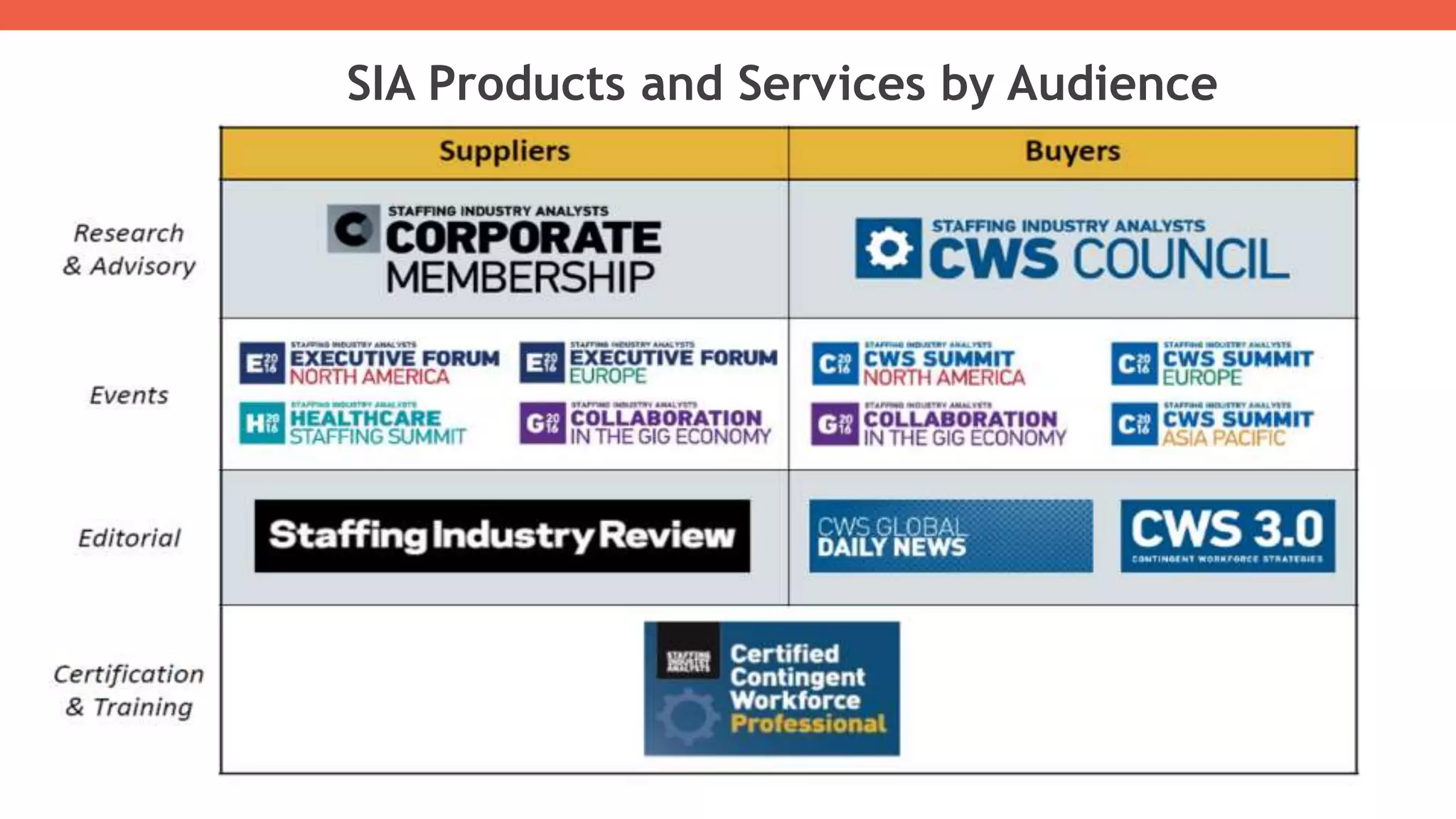
SIA Products and Services by Audience
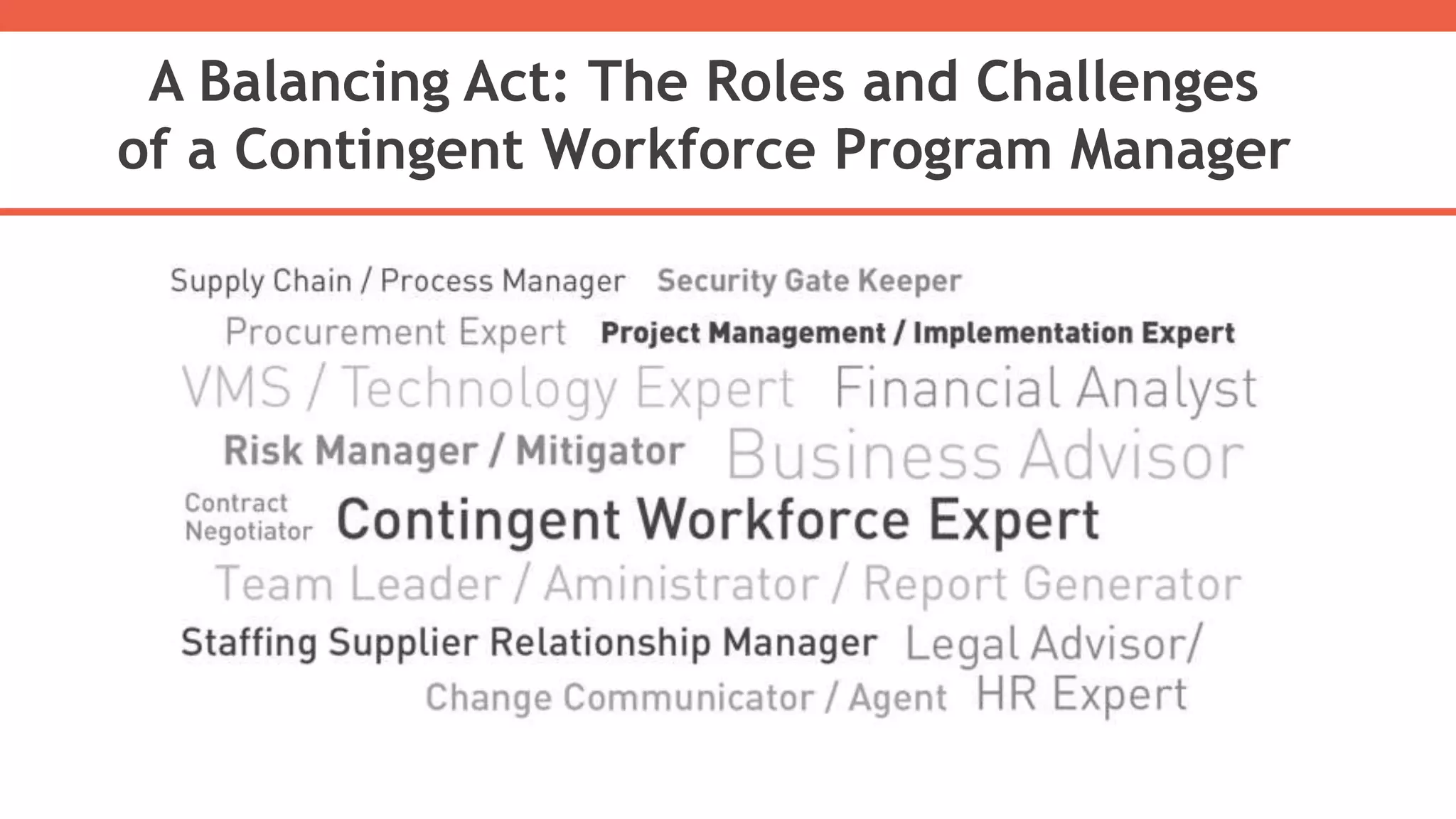
A Balancing Act: The Roles and Challenges
of a Contingent Workforce Program Manager
CCWP
CWS Council Members (partial public list)
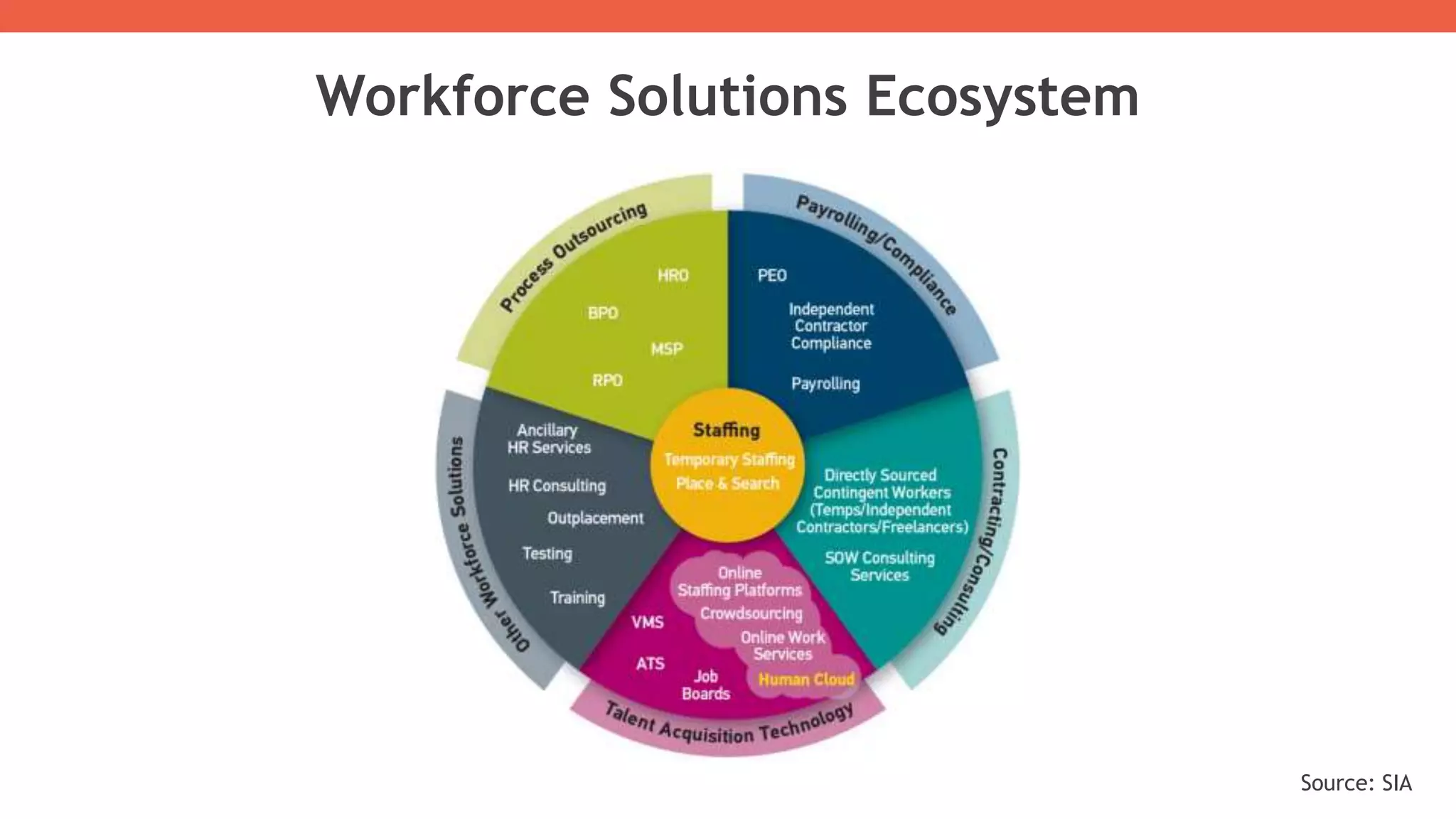
Workforce Solutions Ecosystem
Source: SIA
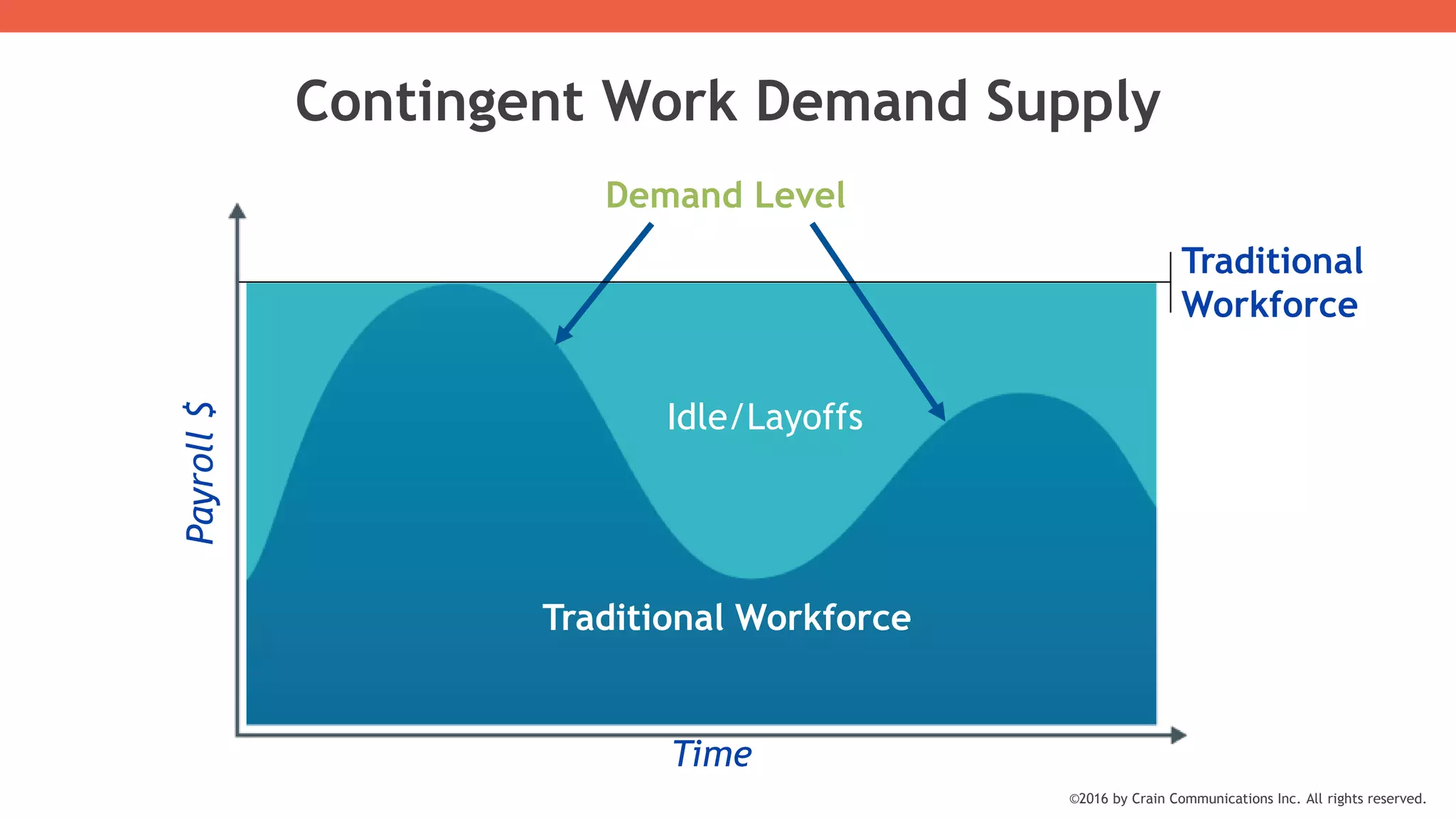
Contingent Work Demand Supply
Payroll$ Demand Level
Traditional
Workforce
Idle/Layoffs
Traditional Workforce
Time
©2016 by Crain Communications Inc. All rights reserved.
 Employees
– Full time or part time
– Apprentices, trainees, and paid interns
 Non-Employees
– Temporary workers
– Independent contractors or consultants/freelancers
– Online workers (e.g. micro tasks, crowdsourced, etc.)
– Professional services (e.g. management consultants, lawyers)
– Outsourced services (e.g. security guards, maintenance)
– Partners (e.g. supply chain, partnerships, joint ventures)
– Formal and informal volunteers (e.g. self-service customers)
– Franchisees/affiliates/associates (e.g. marketing, sales activities, etc.)
– Robots/drones/cognitive computing applications
Future of Workforce Management
©2015 by Crain Communications Inc. All rights reserved.
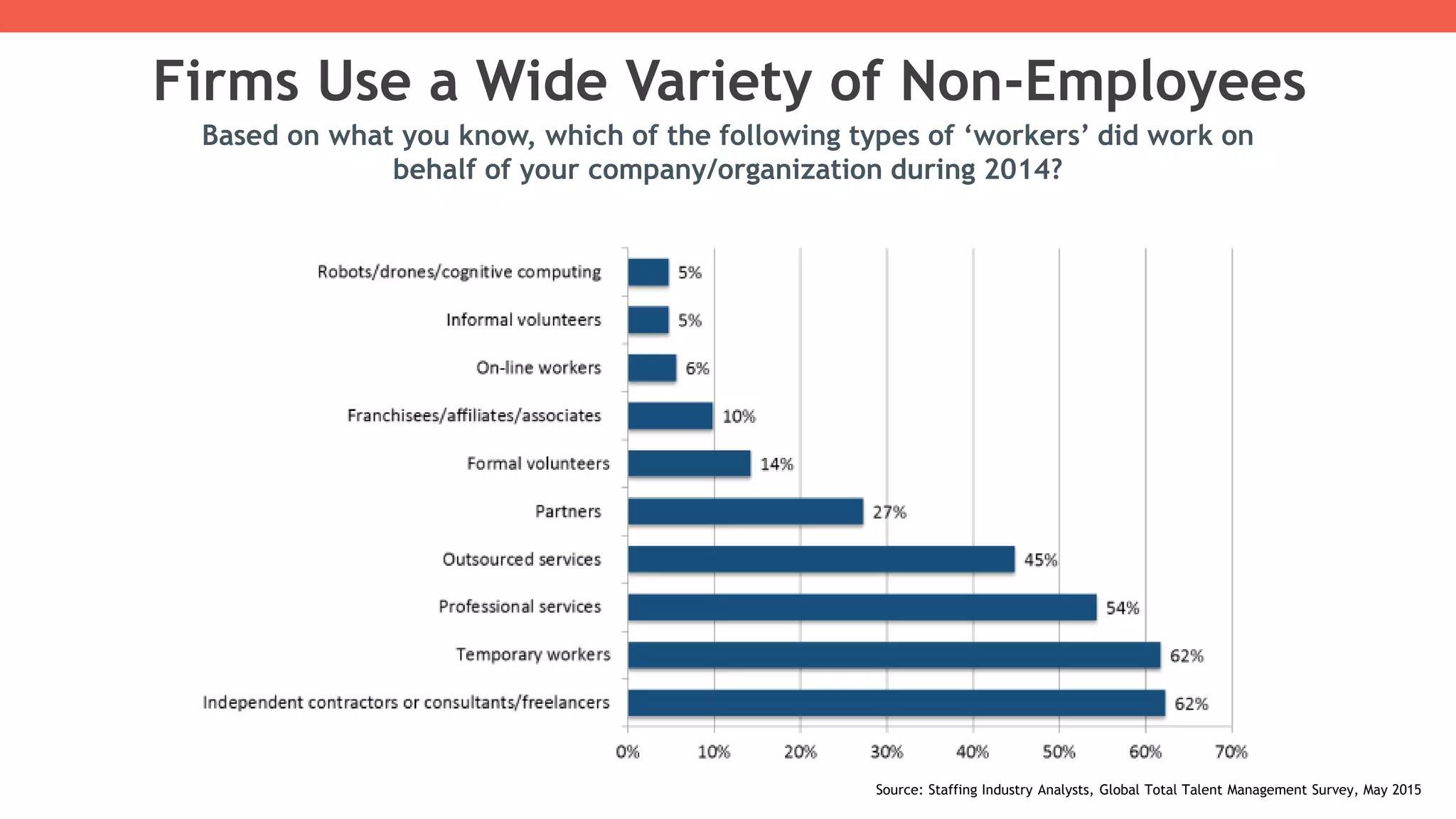
Firms Use a Wide Variety of Non-Employees
Based on what you know, which of the following types of ‘workers’ did work on
behalf of your company/organization during 2014?
Source: Staffing Industry Analysts, Global Total Talent Management Survey, May 2015
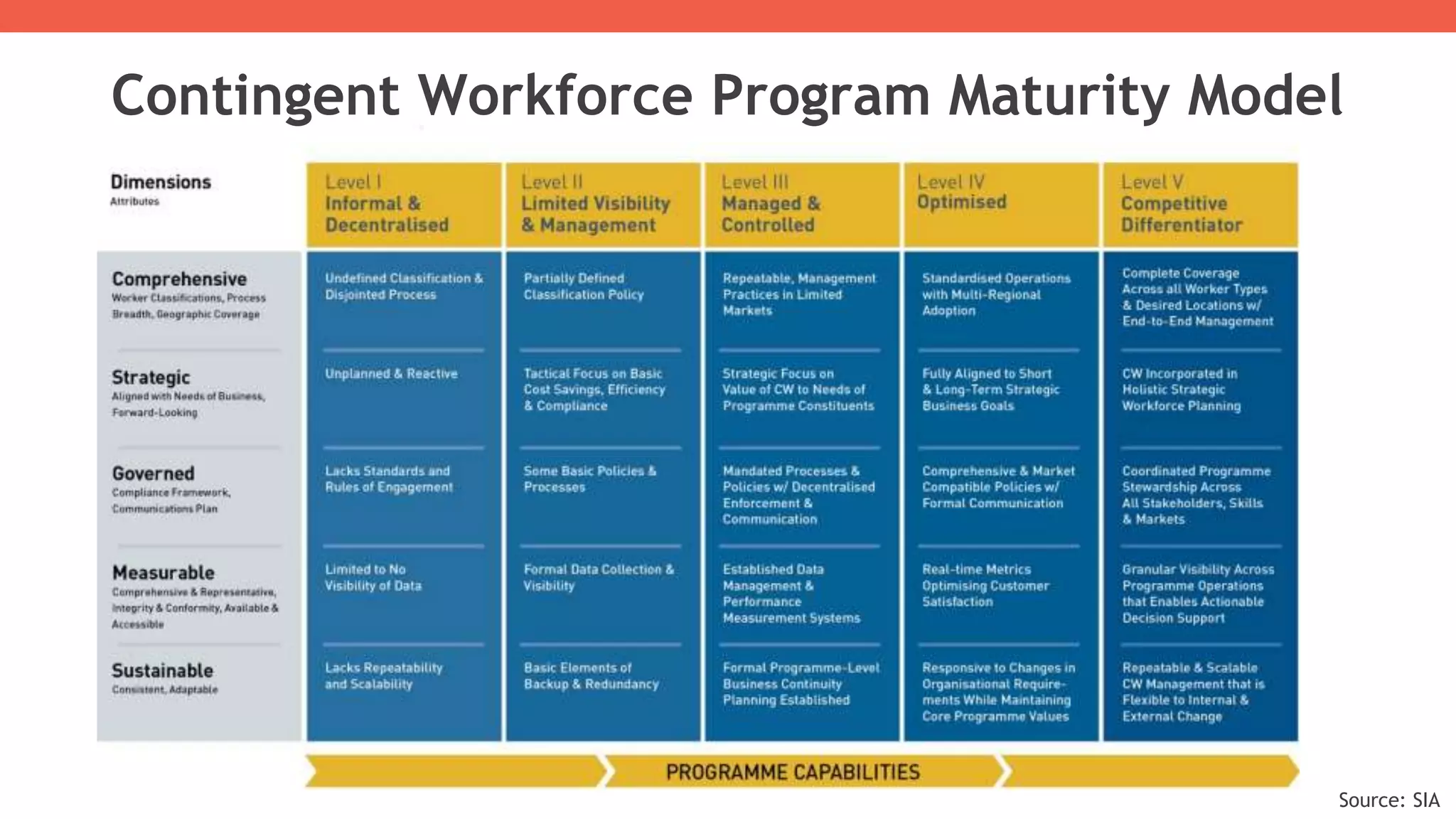
Contingent Workforce Program Maturity Model
Source: SIA
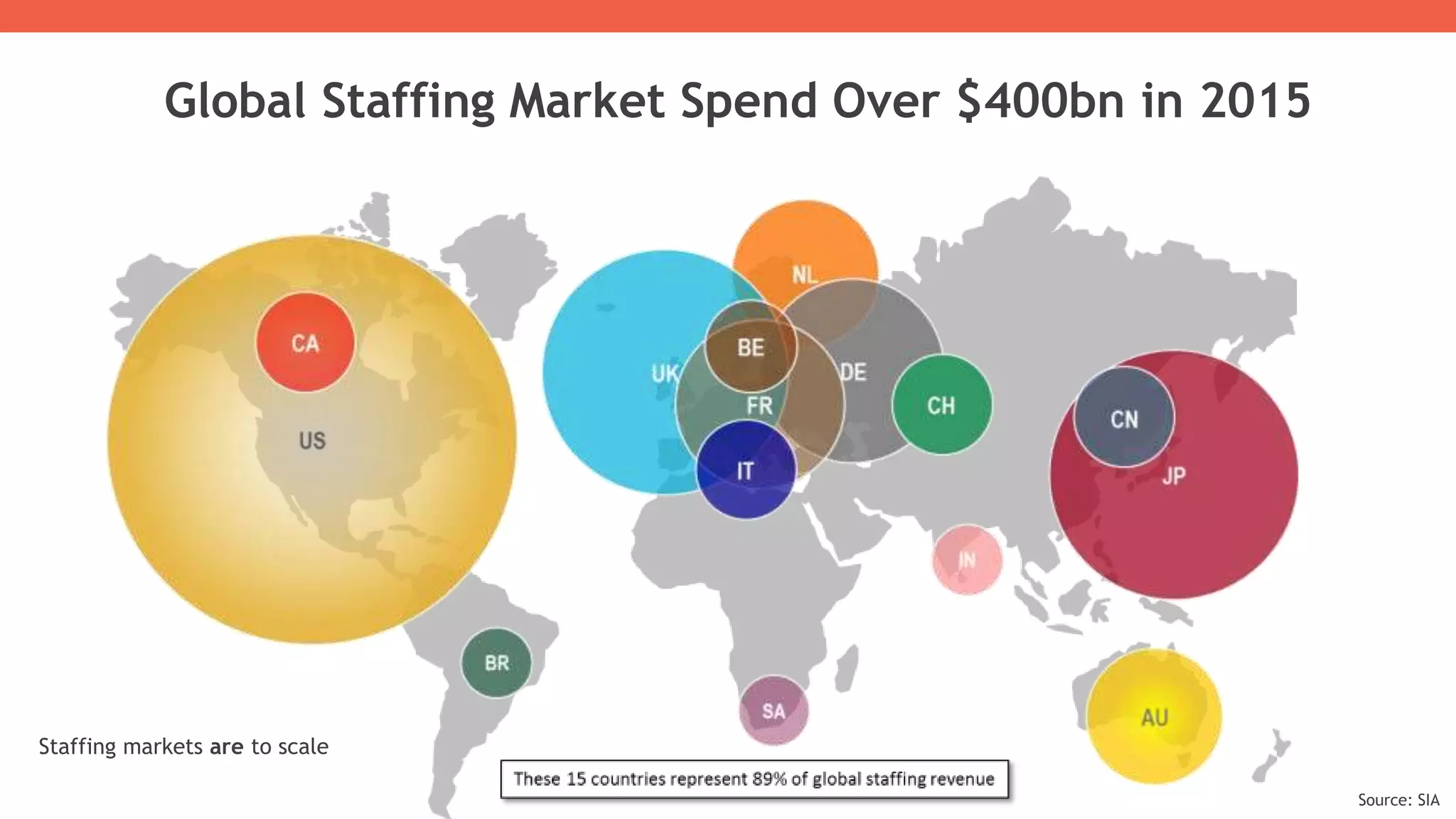
Global Staffing Market Spend Over $400bn in 2015
Source: SIA
Staffing markets are to scale
Source: SIA
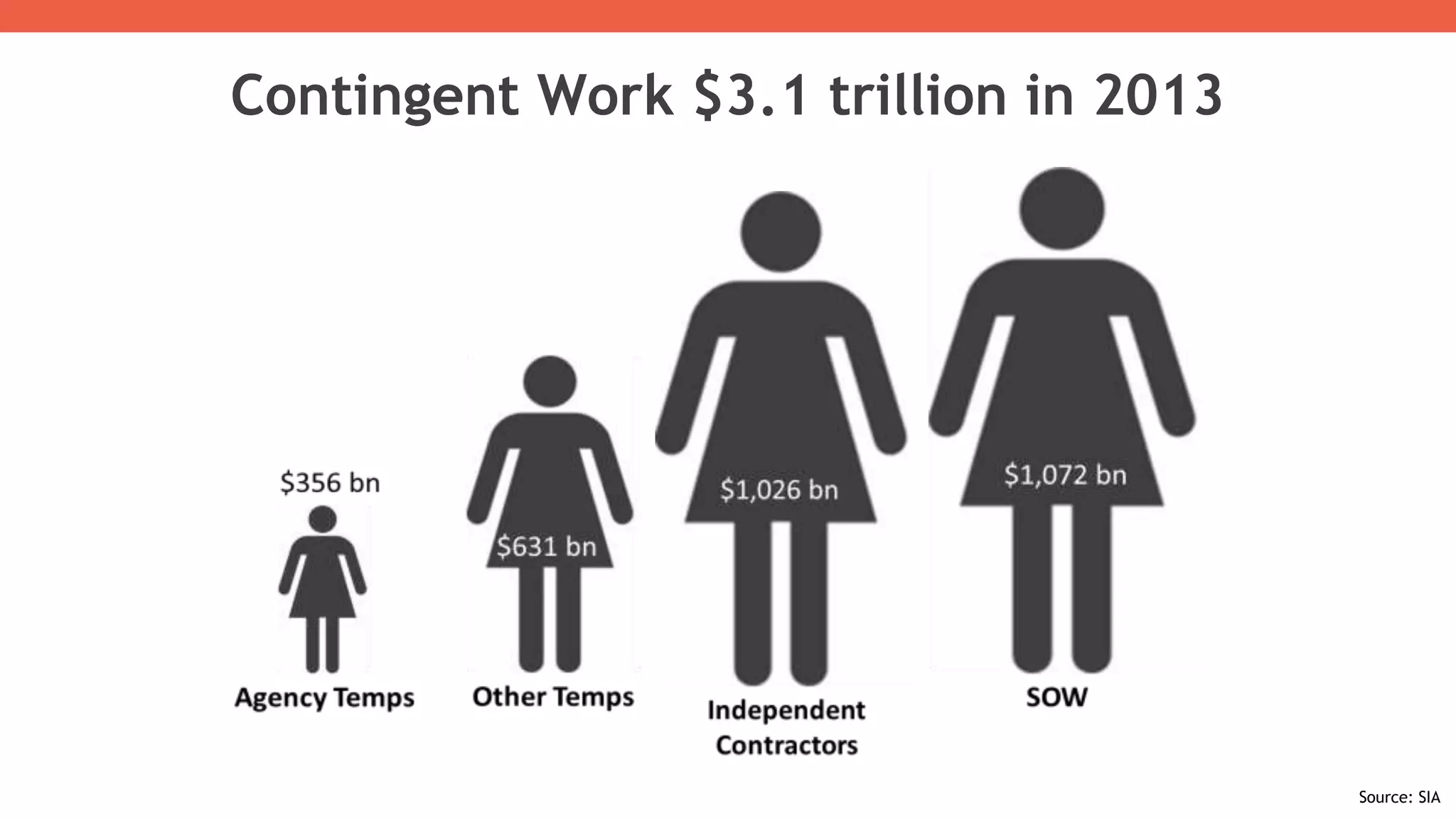
Contingent Work $3.1 trillion in 2013
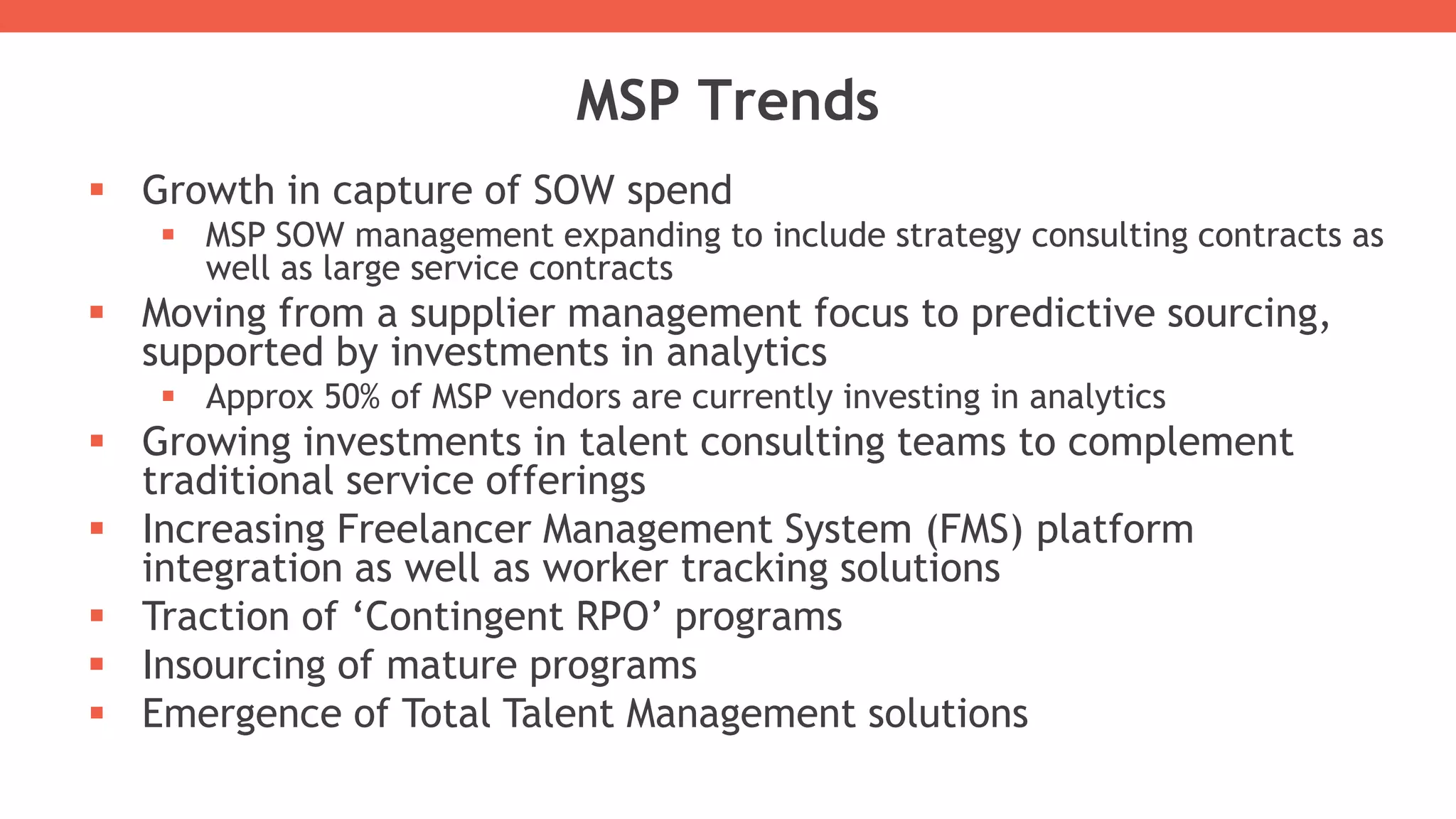
 Growth in capture of SOW spend
 MSP SOW management expanding to include strategy consulting contracts as
well as large service contracts
 Moving from a supplier management focus to predictive sourcing,
supported by investments in analytics
 Approx 50% of MSP vendors are currently investing in analytics
 Growing investments in talent consulting teams to complement
traditional service offerings
 Increasing Freelancer Management System (FMS) platform
integration as well as worker tracking solutions
 Traction of ‘Contingent RPO’ programs
 Insourcing of mature programs
 Emergence of Total Talent Management solutions
MSP Trends
MSP by Region
Source: SIA 2015 VMS and MSP Supplier Competitive Landscape
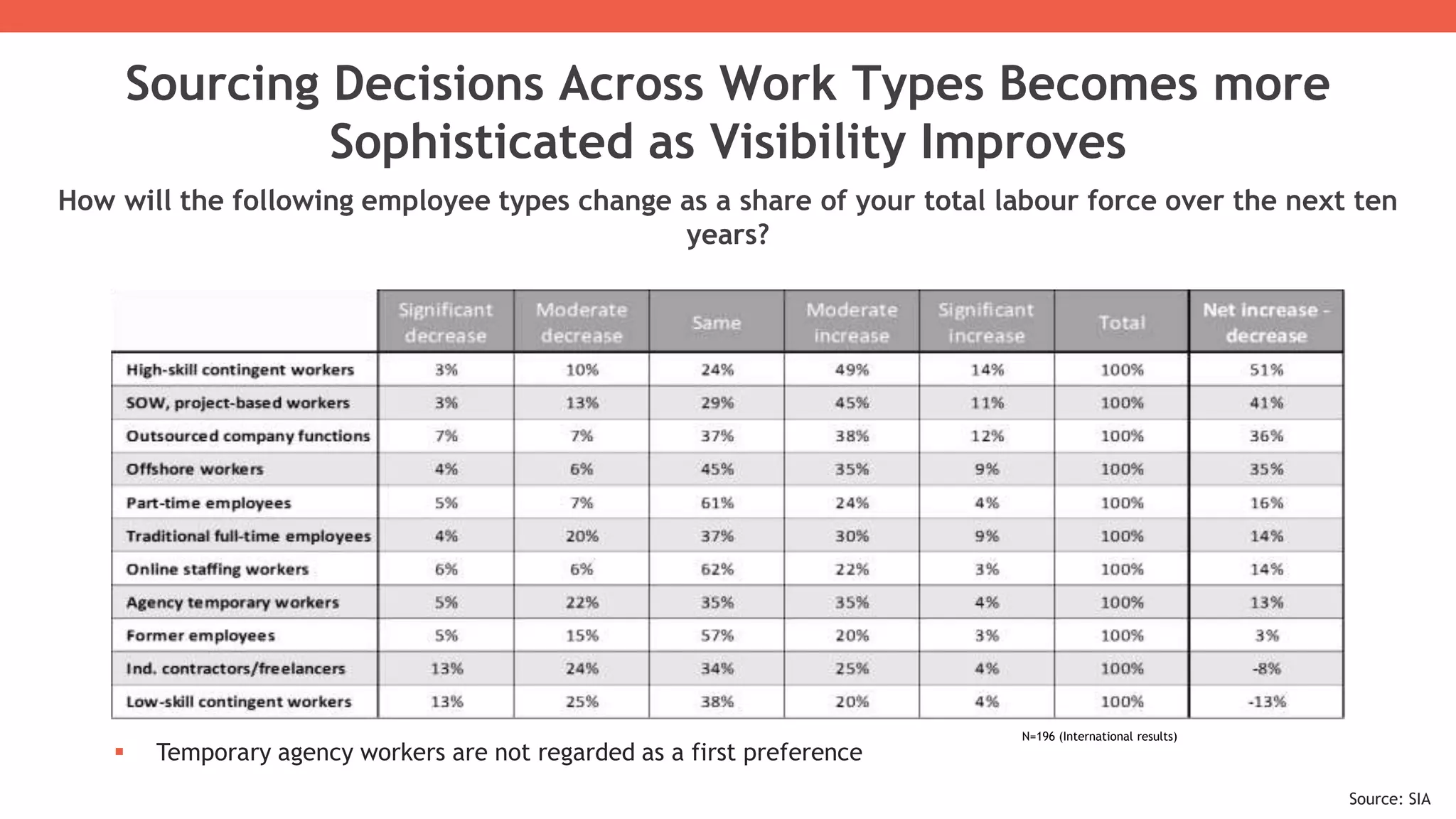
Sourcing Decisions Across Work Types Becomes more
Sophisticated as Visibility Improves
How will the following employee types change as a share of your total labour force over the next ten
years?
 Temporary agency workers are not regarded as a first preference
N=196 (International results)
Source: SIA
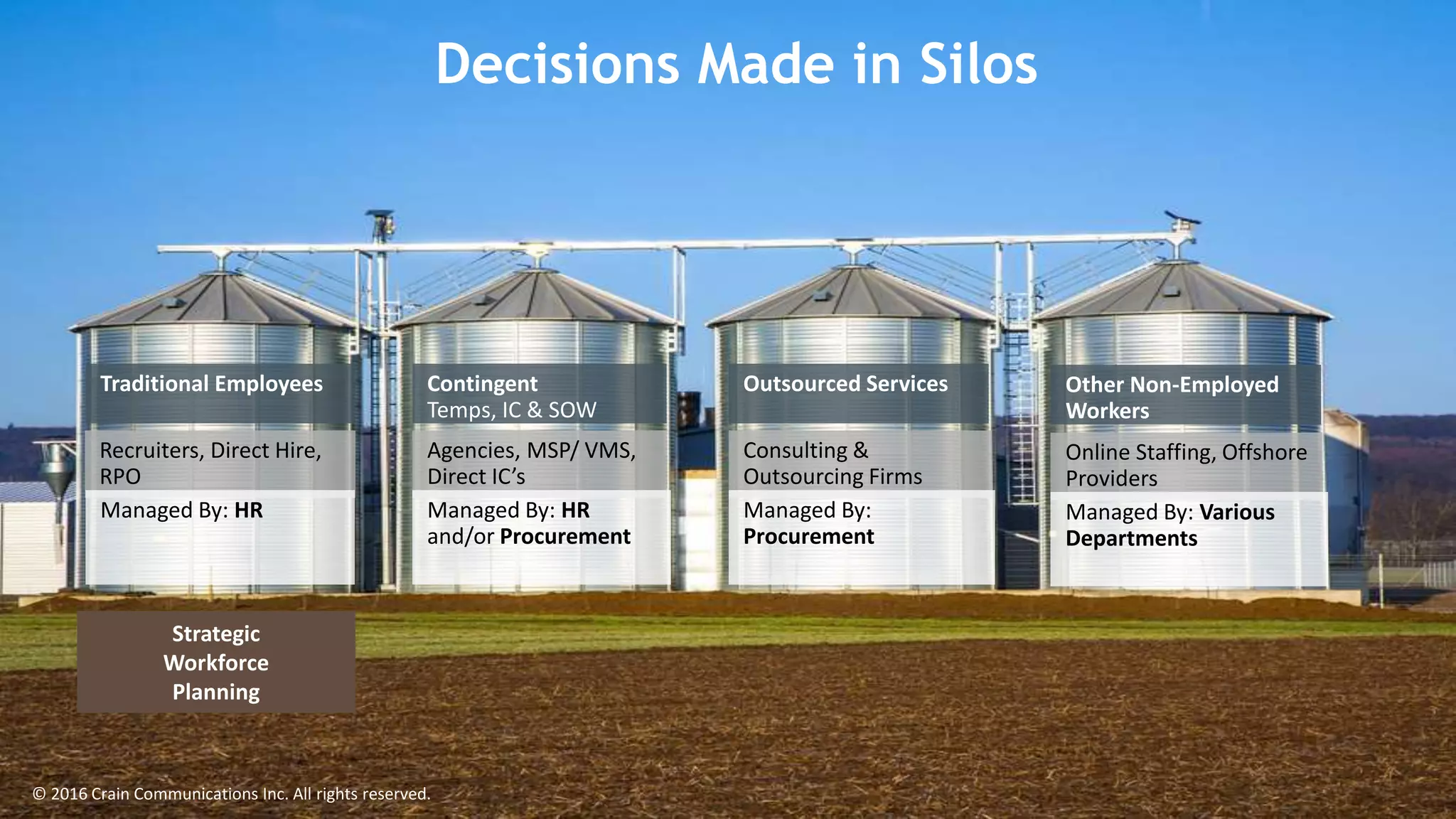
Strategic
Workforce
Planning
Traditional Employees
Recruiters, Direct Hire,
RPO
Managed By: HR
Outsourced ServicesContingent
Temps, IC & SOW
Agencies, MSP/ VMS,
Direct IC’s
Consulting &
Outsourcing Firms
Managed By: HR
and/or Procurement
Managed By:
Procurement
Other Non-Employed
Workers
Online Staffing, Offshore
Providers
Managed By: Various
Departments
© 2016 Crain Communications Inc. All rights reserved.
Decisions Made in Silos
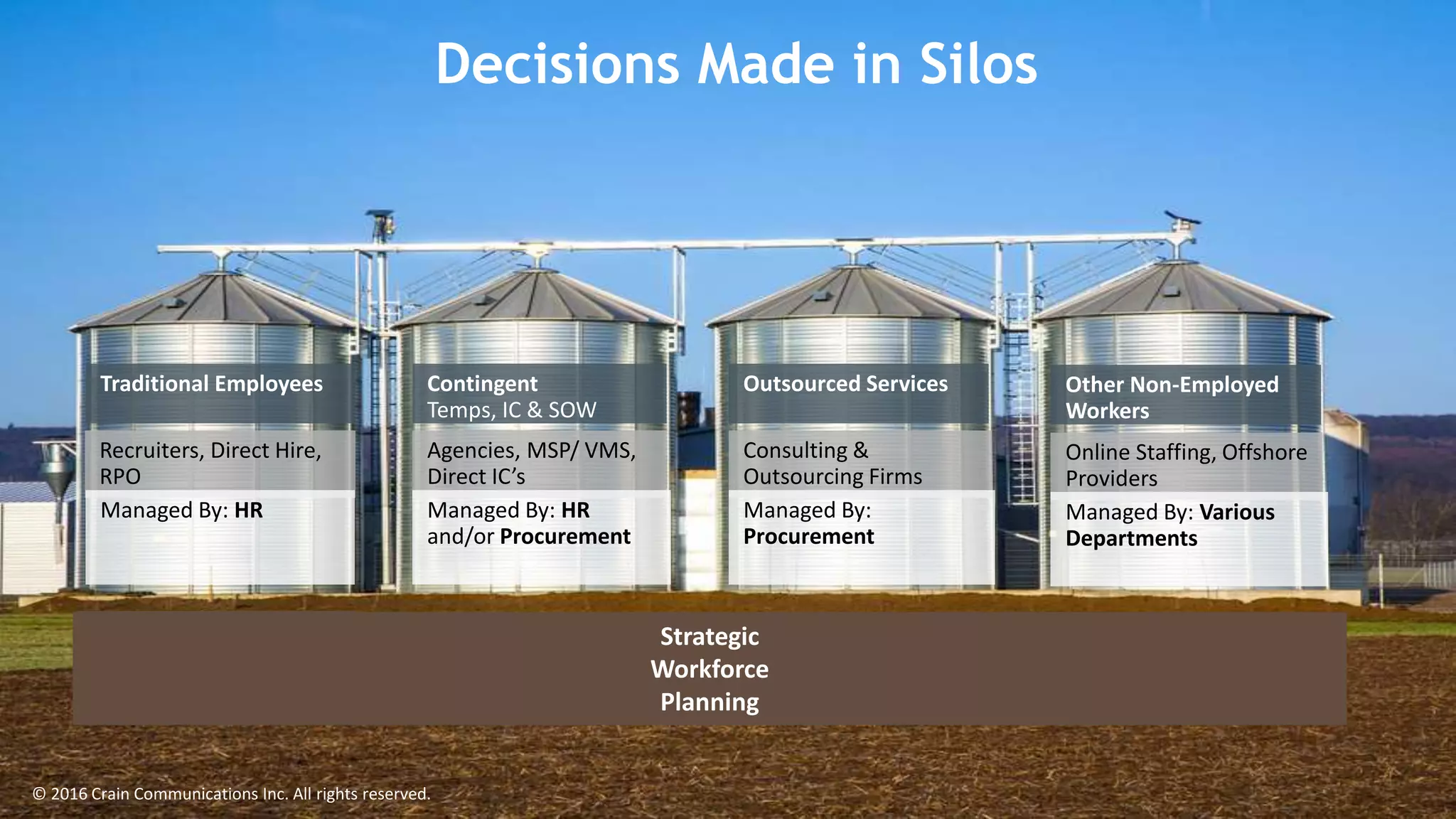
Strategic
Workforce
Planning
Traditional Employees
Recruiters, Direct Hire,
RPO
Managed By: HR
Outsourced ServicesContingent
Temps, IC & SOW
Agencies, MSP/ VMS,
Direct IC’s
Consulting &
Outsourcing Firms
Managed By: HR
and/or Procurement
Managed By:
Procurement
Other Non-Employed
Workers
Online Staffing, Offshore
Providers
Managed By: Various
Departments
© 2016 Crain Communications Inc. All rights reserved.
Strategic
Workforce
Planning
Decisions Made in Silos
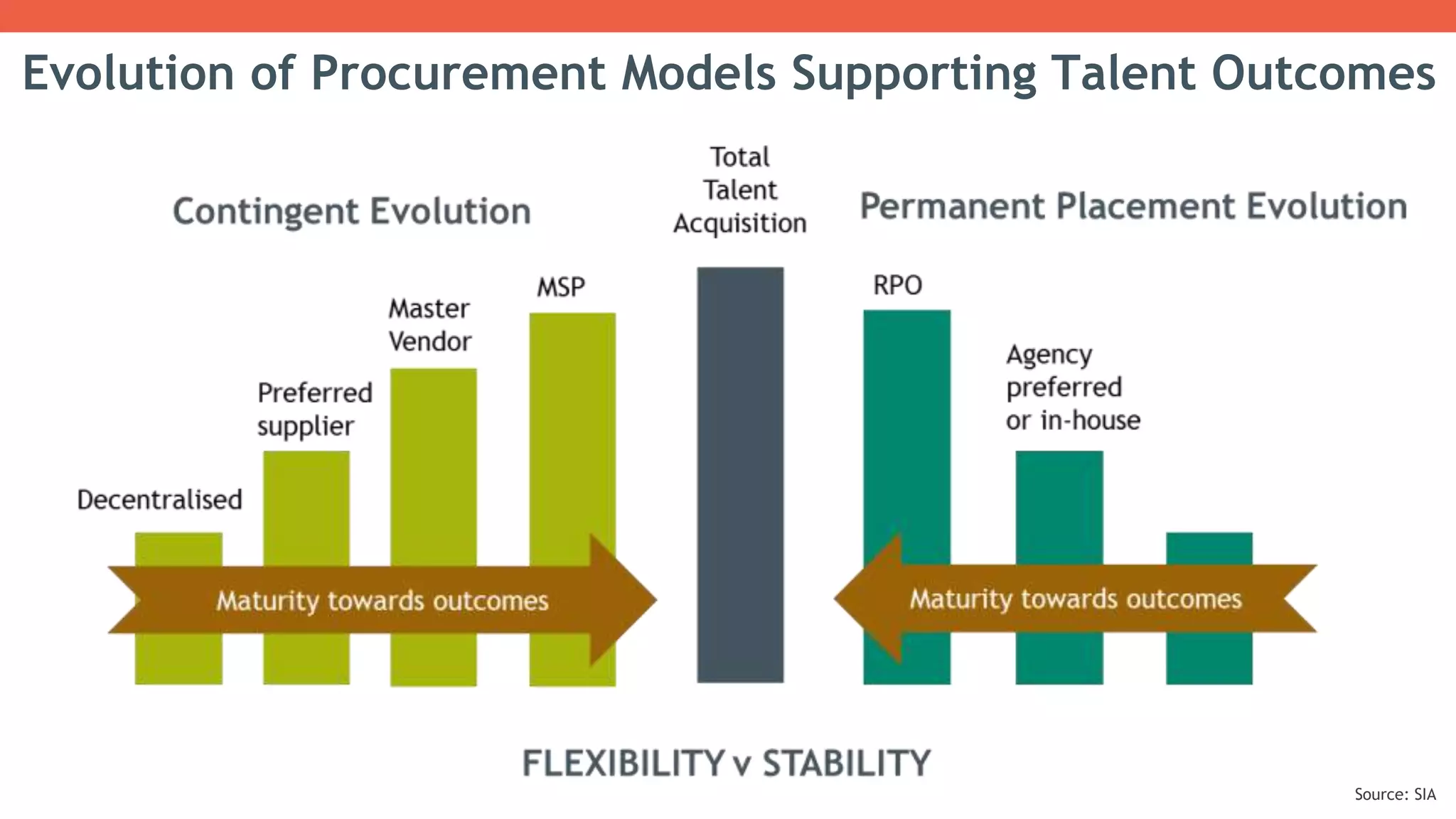
Evolution of Procurement Models Supporting Talent Outcomes
Source: SIA
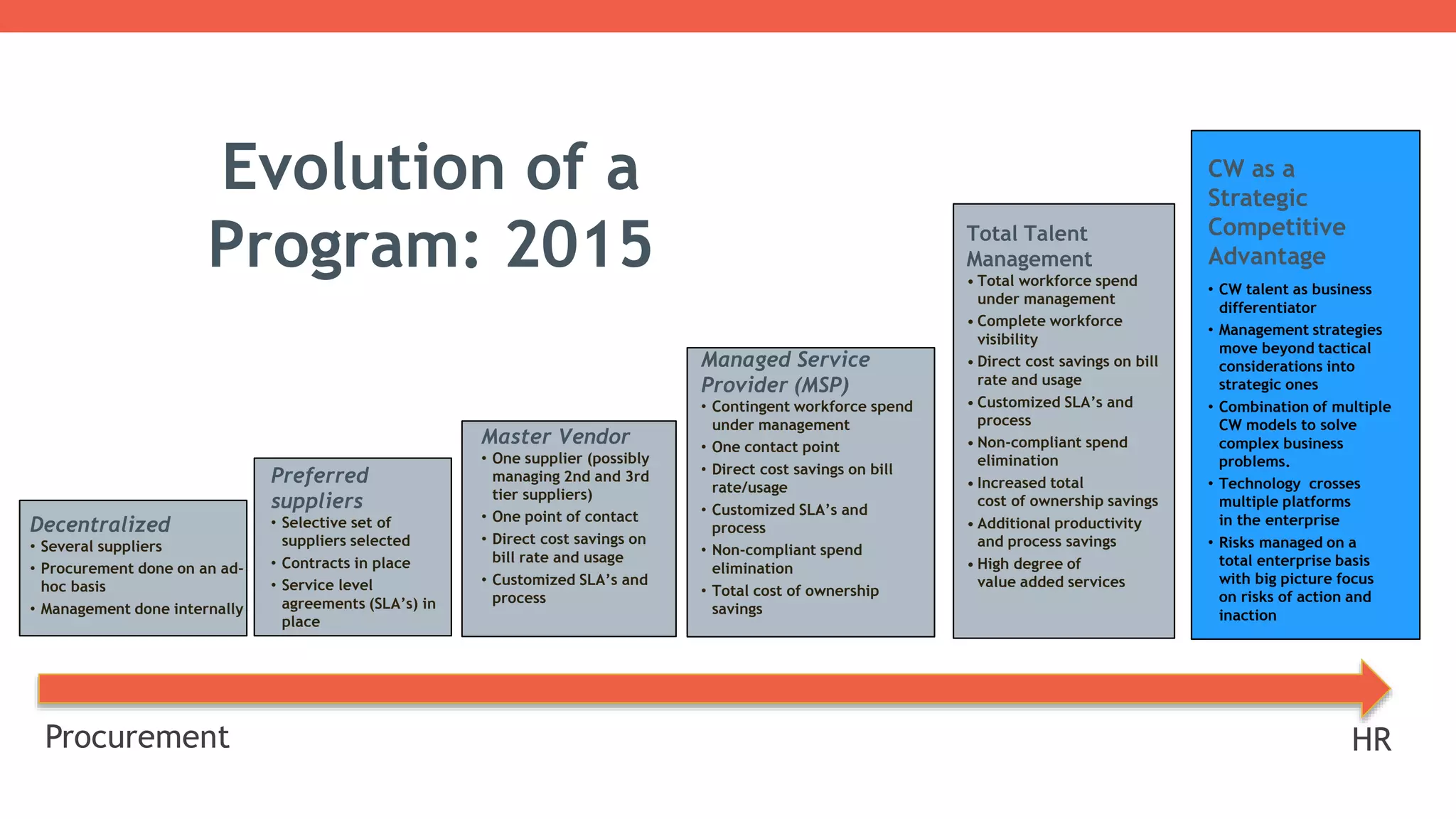
Evolution of a
Program: 2015
Decentralized
• Several suppliers
• Procurement done on an ad-
hoc basis
• Management done internally
Master Vendor
• One supplier (possibly
managing 2nd and 3rd
tier suppliers)
• One point of contact
• Direct cost savings on
bill rate and usage
• Customized SLA’s and
process
Managed Service
Provider (MSP)
• Contingent workforce spend
under management
• One contact point
• Direct cost savings on bill
rate/usage
• Customized SLA’s and
process
• Non-compliant spend
elimination
• Total cost of ownership
savings
Total Talent
Management
• Total workforce spend
under management
• Complete workforce
visibility
• Direct cost savings on bill
rate and usage
• Customized SLA’s and
process
• Non-compliant spend
elimination
• Increased total
cost of ownership savings
• Additional productivity
and process savings
• High degree of
value added services
CW as a
Strategic
Competitive
Advantage
• CW talent as business
differentiator
• Management strategies
move beyond tactical
considerations into
strategic ones
• Combination of multiple
CW models to solve
complex business
problems.
• Technology crosses
multiple platforms
in the enterprise
• Risks managed on a
total enterprise basis
with big picture focus
on risks of action and
inaction
Preferred
suppliers
• Selective set of
suppliers selected
• Contracts in place
• Service level
agreements (SLA’s) in
place
Procurement HR
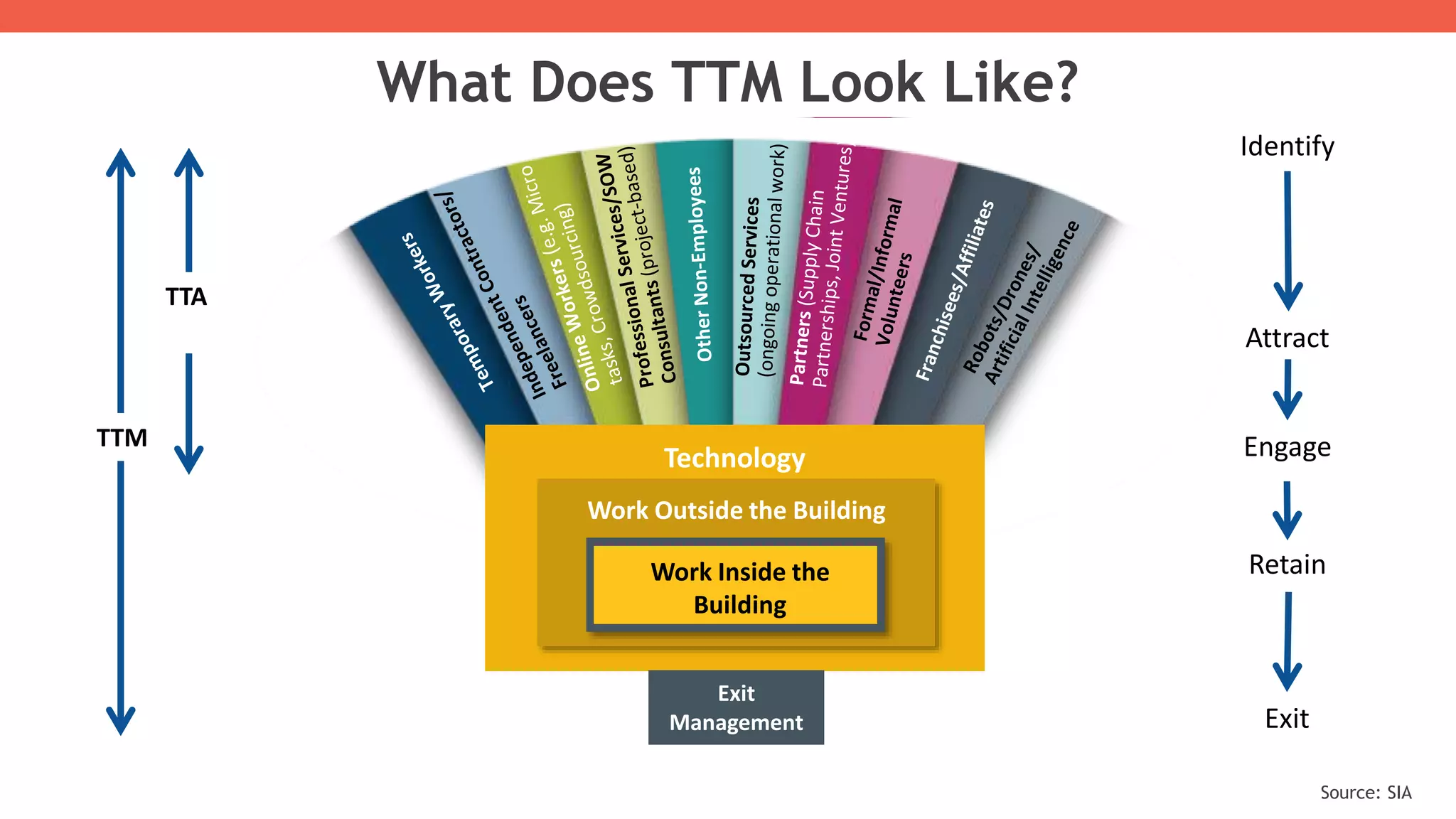
What Does TTM Look Like?
Technology
Work Outside the Building
Work Inside the
Building
Exit
Management
Identify
Attract
Engage
Retain
Exit
TTA
TTM
Source: SIA
Decentralized
• Several suppliers
• Procurement done on an ad-
hoc basis
• Management done internally
Master Vendor
• One supplier (possibly
managing 2nd and 3rd
tier suppliers)
• One point of contact
• Direct cost savings on bill
rate and usage
• Customized SLA’s and
process
Managed Service
Provider (MSP)
• Contingent workforce spend
under management
• One contact point
• Direct cost savings on bill
rate/usage
• Customized SLA’s and process
• Non-compliant spend
elimination
• Total cost of ownership savings
Total Talent
Management
• Total workforce spend
under management
• Complete workforce
visibility
• Direct cost savings on bill
rate and usage
• Customized SLA’s and
process
• Non-compliant spend
elimination
• Increased total
cost of ownership savings
• Additional productivity and
process savings
• High degree of
value added services
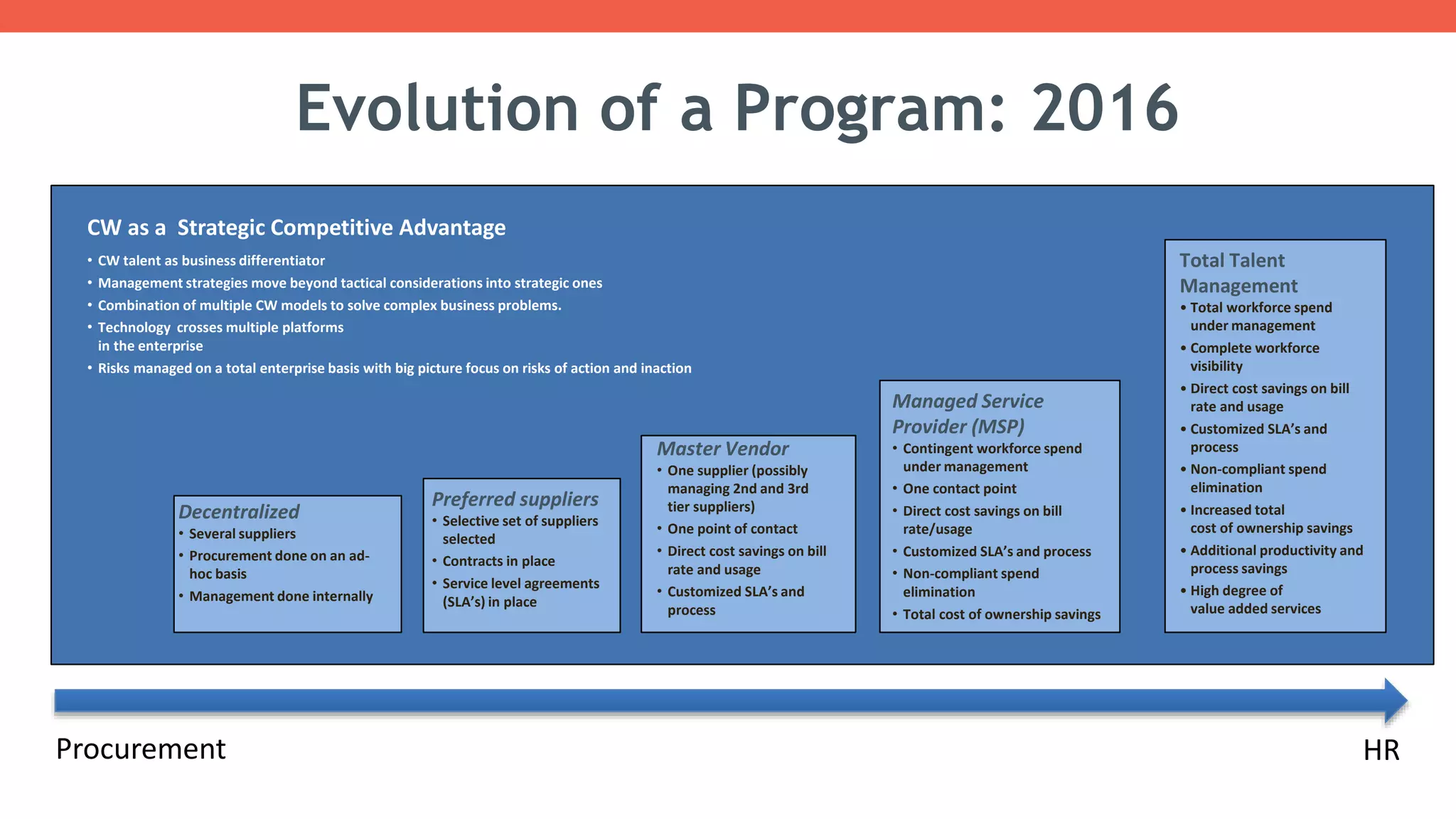
CW as a Strategic Competitive Advantage
• CW talent as business differentiator
• Management strategies move beyond tactical considerations into strategic ones
• Combination of multiple CW models to solve complex business problems.
• Technology crosses multiple platforms
in the enterprise
• Risks managed on a total enterprise basis with big picture focus on risks of action and inaction
Preferred suppliers
• Selective set of suppliers
selected
• Contracts in place
• Service level agreements
(SLA’s) in place
Evolution of a Program: 2016
Procurement HR
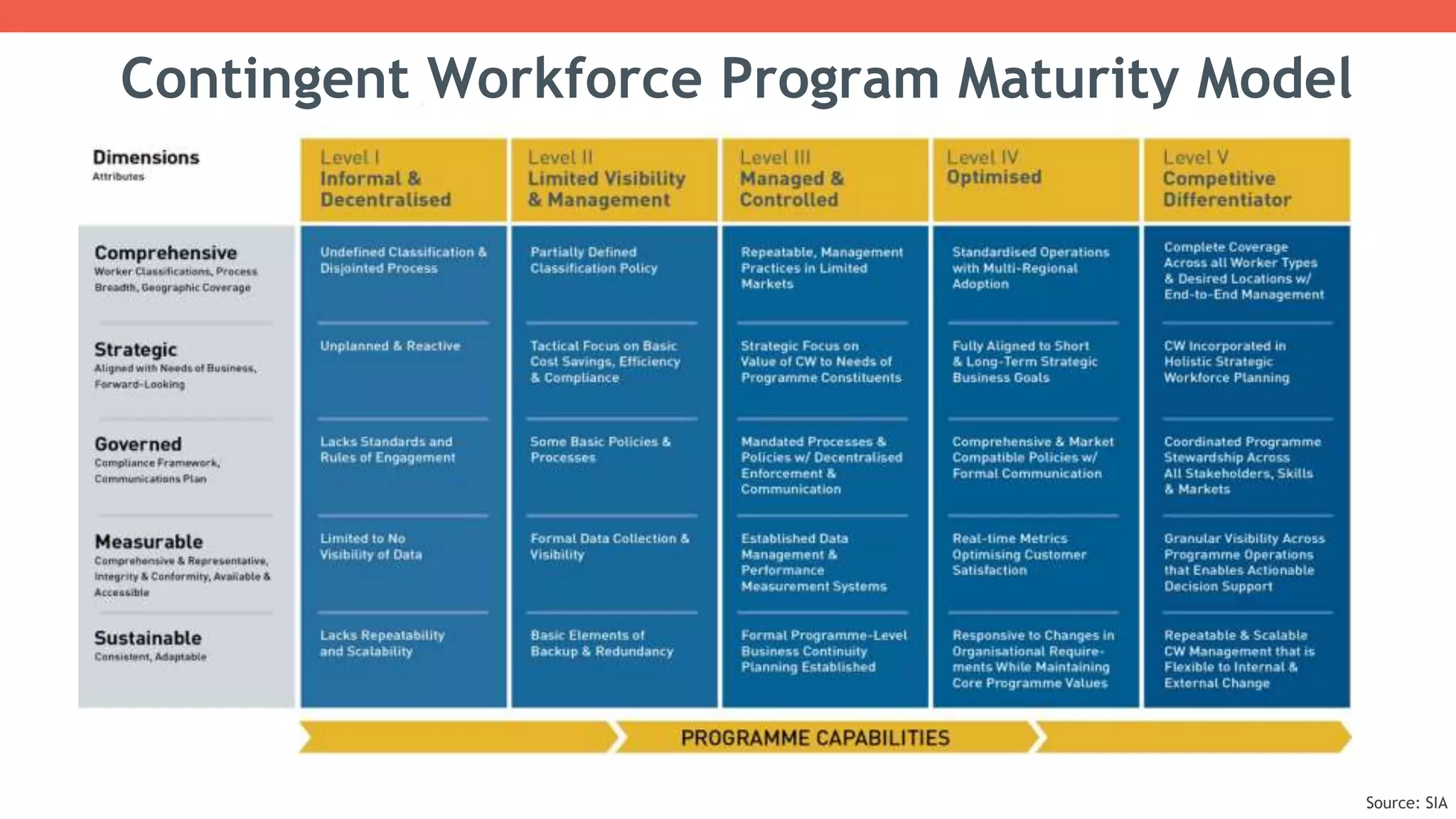
Contingent Workforce Program Maturity Model
Source: SIA
Kelly Shea
Director
Russell Tobin
kelly.shea@russelltobin.com
#PrideOne
About Russell Tobin
 Direct hire & contract staffing
firm
 We focus on a variety of
verticals
 9 offices throughout the U.S.
The Supplier Perspective
 Structured program which allows flexibility
 Clear metrics and SLA’s
 Consistency in communication
 Aligned with best practices
Value of working with an MSP
 Enterprise clients
 Specialization
 Leverage technology
 “Recession proof”
Noah Gold
General Counsel
Pride Global
noah.gold@prideglobal.com
#PrideOne
Legal Issues
Involving
Contingent Labor
Assessing the Legal Landscape
and How to Best Mitigate Risk
Employee v. Independent
Contractor Classification
The DOL’s Crusade Against Misclassification
Employee v. Independent Contractor
 In September 2015, David Weil, Administrator of the Wage and
Hour Division of the United Stated Department of Labor, issued
an “Administrator Interpretation,” wherein he stated bluntly:
“[M]ost workers are employees under the FLSA’s broad
definitions.”
Summary of the AI’s Views
 The AI represents an effort to dramatically expand the “economic
realities” test.
 Any business that uses independent contractors exclusively or to
receive services that are important to its success should review the
AI and consider carefully how the Wage and Hour Division and Courts
applying the “Economic Realities” test would view independent
contractor relationships.
Risks of Misclassification
 Liability for any failure to pay at least the minimum wage for all
time worked,
 Liability for any failure to pay overtime for work in excess of 40
hours per week,
 Reimbursement of employee expenses,
 Provision of various employee benefits,
 Withholding of income taxes and FICA,
 Payment of unemployment insurance contributions, and
 Provision of workers compensation insurance coverage.
Looking Ahead
 The DOL has made it clear of its stated intent to aggressively
challenge independent contractor classifications.
 In light of the policy changes and a promised ramp-up in
investigations/enforcement, it has become riskier for any individual
worker to be classified as an independent contractor.
 Recent cases: Uber, Lyft, GrubHub, FedEx.
Exempt v. Non-Exempt
Another Classification Question
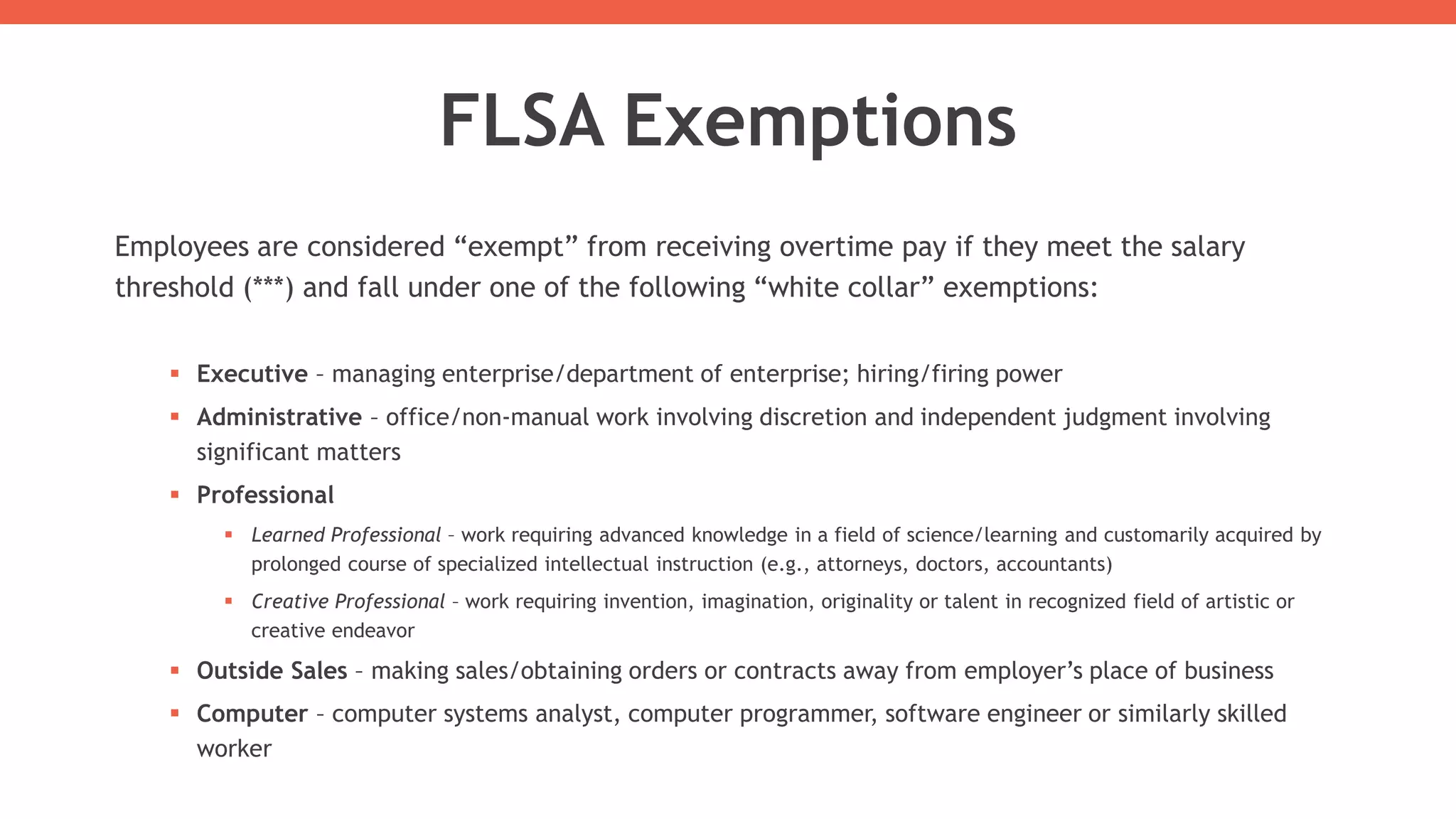
FLSA Exemptions
Employees are considered “exempt” from receiving overtime pay if they meet the salary
threshold (***) and fall under one of the following “white collar” exemptions:
 Executive – managing enterprise/department of enterprise; hiring/firing power
 Administrative – office/non-manual work involving discretion and independent judgment involving
significant matters
 Professional
 Learned Professional – work requiring advanced knowledge in a field of science/learning and customarily acquired by
prolonged course of specialized intellectual instruction (e.g., attorneys, doctors, accountants)
 Creative Professional – work requiring invention, imagination, originality or talent in recognized field of artistic or
creative endeavor
 Outside Sales – making sales/obtaining orders or contracts away from employer’s place of business
 Computer – computer systems analyst, computer programmer, software engineer or similarly skilled
worker
*** New FLSA Salary Threshold
 The current salary threshold to be exempt from the FLSA overtime
regulations is $455/week ($23,360/year).
 In May 2016, the DOL announced that, effective December 1, 2016,
the threshold will become $913/week ($47,476/year).
 This threshold will also now be increased every three years to keep
up with inflation, beginning on January 1, 2020.
 Non-discretionary bonuses and incentive payments (including
commissions) can satisfy up to 10% of the new threshold.
Joint Employment
The Browning-Ferris Decision and the New Joint Employer Standard
The NLRB’s Browning-Ferris Decision
 In August 2015, the National Labor Relations Board (the “NLRB”)
overruled 30 years of joint employer precedent in its decision it
published in the Browning-Ferris Industries of California, Inc. matter.
 In summary, the NLRB announced that it will no longer require direct
and immediate control over terms and conditions of employment to
establish a joint employer relationship.
The New Joint Employer Test
 In analyzing whether a joint employer relationship exists, the NLRB
stated that a case-by-case, fact-intensive evaluation of the allocation
and exercise of control in the workplace must be performed.
 In finding that Browning-Ferris Industries (“BFI”) was a joint employer
with its subcontractor, Leadpoint, the NLRB relied on the following
factors:
 Hiring
 Wages
 Discipline
 Supervision
What’s Next?
 In January 2016, BFI appealed the NLRB’s decision to the U.S. Court of
Appeals in Washington, D.C.
 Several organizations joined BFI’s appeal with supporting briefs of their
own.
 Per the Court’s Order entered on June 22, 2016, final briefs will not be
filed until October 19, 2016.
Mitigating Joint Employment Issues
Parties should work with each other at the contract stage to carefully
spell out the allocation of responsibility and risk.
 Indemnification – allocates obligations when third party claims arise
 Equal Employment Opportunity – both parties’ responsibility
 ADA compliance – both parties’ responsibility
 Wage and Hour/Benefits – agency’s responsibility; though agency should
ensure that clients: (1) understand applicable overtime requirements; (2) do
not allow “off the clock” work; and (3) sign off on worker time sheets.
 Background/Credit Checks/Immigration/I-9 Compliance – agency’s
responsibility
The Affordable Care Act
And Its Implications on Contingent Labor
What the Law Says
The Affordable Care Act (the “ACA”) requires
companies to offer affordable minimum
essential healthcare coverage to 95% of their
employees.
Mitigating Risk
 Again, clients/agencies/MSPs should ensure proper risk allocation at
the contract stage so that proper protections are given to clients.
 Suppliers should undertake responsibility of offering affordable,
minimum value healthcare to all its employees and to provide notice
about the insurance marketplaces.
 Agreements can also provide that both parties view the staffing
agency as the common law employer and provide appropriate
protections to clients even if they are found to be an employer in a
legal proceeding.
Best Practices
Simple Tips in Handling Contingent Labor
Best Practices
 Clients should work with high quality staffing firms that are well-
versed in the industry and have demonstrated superior management
of a contingent workforce.
 Create clear and articulate contracts that define the relationship
and responsibilities of the parties.
 Periodic communication between the client, staffing firm and
workers.
 Review information on temporary workers on the EEOC and ADA
websites.
Jim Lanzalotto
Senior Vice President
Monster
jim.lanzalotto@monster.com
#PrideOne
Q&A
#PrideOne
Networking
#PrideOne

PrideOne Events | Transforming The Contingent Workforce Ecosystem Into A Competitive Advantage

  • 1.
    Transforming The Contingent Workforce Ecosystem Into ACompetitive Advantage Flight Deck @ Graybar Building * July 13, 2016 * #PrideOne
  • 2.
  • 3.
    Bryan Peña Senior VicePresident, Contingent Workforce Strategies Staffing Industry Analysts bpena@staffingindustry.com #PrideOne
  • 4.
    SIA Products andServices by Audience
  • 7.
    A Balancing Act:The Roles and Challenges of a Contingent Workforce Program Manager
  • 8.
  • 9.
    CWS Council Members(partial public list)
  • 10.
  • 11.
    Contingent Work DemandSupply Payroll$ Demand Level Traditional Workforce Idle/Layoffs Traditional Workforce Time ©2016 by Crain Communications Inc. All rights reserved.
  • 12.
     Employees – Fulltime or part time – Apprentices, trainees, and paid interns  Non-Employees – Temporary workers – Independent contractors or consultants/freelancers – Online workers (e.g. micro tasks, crowdsourced, etc.) – Professional services (e.g. management consultants, lawyers) – Outsourced services (e.g. security guards, maintenance) – Partners (e.g. supply chain, partnerships, joint ventures) – Formal and informal volunteers (e.g. self-service customers) – Franchisees/affiliates/associates (e.g. marketing, sales activities, etc.) – Robots/drones/cognitive computing applications Future of Workforce Management ©2015 by Crain Communications Inc. All rights reserved.
  • 13.
    Firms Use aWide Variety of Non-Employees Based on what you know, which of the following types of ‘workers’ did work on behalf of your company/organization during 2014? Source: Staffing Industry Analysts, Global Total Talent Management Survey, May 2015
  • 14.
    Contingent Workforce ProgramMaturity Model Source: SIA
  • 15.
    Global Staffing MarketSpend Over $400bn in 2015 Source: SIA Staffing markets are to scale
  • 16.
    Source: SIA Contingent Work$3.1 trillion in 2013
  • 17.
     Growth incapture of SOW spend  MSP SOW management expanding to include strategy consulting contracts as well as large service contracts  Moving from a supplier management focus to predictive sourcing, supported by investments in analytics  Approx 50% of MSP vendors are currently investing in analytics  Growing investments in talent consulting teams to complement traditional service offerings  Increasing Freelancer Management System (FMS) platform integration as well as worker tracking solutions  Traction of ‘Contingent RPO’ programs  Insourcing of mature programs  Emergence of Total Talent Management solutions MSP Trends
  • 18.
    MSP by Region Source:SIA 2015 VMS and MSP Supplier Competitive Landscape
  • 20.
    Sourcing Decisions AcrossWork Types Becomes more Sophisticated as Visibility Improves How will the following employee types change as a share of your total labour force over the next ten years?  Temporary agency workers are not regarded as a first preference N=196 (International results) Source: SIA
  • 21.
    Strategic Workforce Planning Traditional Employees Recruiters, DirectHire, RPO Managed By: HR Outsourced ServicesContingent Temps, IC & SOW Agencies, MSP/ VMS, Direct IC’s Consulting & Outsourcing Firms Managed By: HR and/or Procurement Managed By: Procurement Other Non-Employed Workers Online Staffing, Offshore Providers Managed By: Various Departments © 2016 Crain Communications Inc. All rights reserved. Decisions Made in Silos
  • 22.
    Strategic Workforce Planning Traditional Employees Recruiters, DirectHire, RPO Managed By: HR Outsourced ServicesContingent Temps, IC & SOW Agencies, MSP/ VMS, Direct IC’s Consulting & Outsourcing Firms Managed By: HR and/or Procurement Managed By: Procurement Other Non-Employed Workers Online Staffing, Offshore Providers Managed By: Various Departments © 2016 Crain Communications Inc. All rights reserved. Strategic Workforce Planning Decisions Made in Silos
  • 23.
    Evolution of ProcurementModels Supporting Talent Outcomes Source: SIA
  • 24.
    Evolution of a Program:2015 Decentralized • Several suppliers • Procurement done on an ad- hoc basis • Management done internally Master Vendor • One supplier (possibly managing 2nd and 3rd tier suppliers) • One point of contact • Direct cost savings on bill rate and usage • Customized SLA’s and process Managed Service Provider (MSP) • Contingent workforce spend under management • One contact point • Direct cost savings on bill rate/usage • Customized SLA’s and process • Non-compliant spend elimination • Total cost of ownership savings Total Talent Management • Total workforce spend under management • Complete workforce visibility • Direct cost savings on bill rate and usage • Customized SLA’s and process • Non-compliant spend elimination • Increased total cost of ownership savings • Additional productivity and process savings • High degree of value added services CW as a Strategic Competitive Advantage • CW talent as business differentiator • Management strategies move beyond tactical considerations into strategic ones • Combination of multiple CW models to solve complex business problems. • Technology crosses multiple platforms in the enterprise • Risks managed on a total enterprise basis with big picture focus on risks of action and inaction Preferred suppliers • Selective set of suppliers selected • Contracts in place • Service level agreements (SLA’s) in place Procurement HR
  • 25.
    What Does TTMLook Like? Technology Work Outside the Building Work Inside the Building Exit Management Identify Attract Engage Retain Exit TTA TTM Source: SIA
  • 26.
    Decentralized • Several suppliers •Procurement done on an ad- hoc basis • Management done internally Master Vendor • One supplier (possibly managing 2nd and 3rd tier suppliers) • One point of contact • Direct cost savings on bill rate and usage • Customized SLA’s and process Managed Service Provider (MSP) • Contingent workforce spend under management • One contact point • Direct cost savings on bill rate/usage • Customized SLA’s and process • Non-compliant spend elimination • Total cost of ownership savings Total Talent Management • Total workforce spend under management • Complete workforce visibility • Direct cost savings on bill rate and usage • Customized SLA’s and process • Non-compliant spend elimination • Increased total cost of ownership savings • Additional productivity and process savings • High degree of value added services CW as a Strategic Competitive Advantage • CW talent as business differentiator • Management strategies move beyond tactical considerations into strategic ones • Combination of multiple CW models to solve complex business problems. • Technology crosses multiple platforms in the enterprise • Risks managed on a total enterprise basis with big picture focus on risks of action and inaction Preferred suppliers • Selective set of suppliers selected • Contracts in place • Service level agreements (SLA’s) in place Evolution of a Program: 2016 Procurement HR
  • 27.
    Contingent Workforce ProgramMaturity Model Source: SIA
  • 28.
  • 29.
    About Russell Tobin Direct hire & contract staffing firm  We focus on a variety of verticals  9 offices throughout the U.S.
  • 30.
    The Supplier Perspective Structured program which allows flexibility  Clear metrics and SLA’s  Consistency in communication  Aligned with best practices
  • 31.
    Value of workingwith an MSP  Enterprise clients  Specialization  Leverage technology  “Recession proof”
  • 32.
    Noah Gold General Counsel PrideGlobal noah.gold@prideglobal.com #PrideOne
  • 33.
    Legal Issues Involving Contingent Labor Assessingthe Legal Landscape and How to Best Mitigate Risk
  • 34.
    Employee v. Independent ContractorClassification The DOL’s Crusade Against Misclassification
  • 35.
    Employee v. IndependentContractor  In September 2015, David Weil, Administrator of the Wage and Hour Division of the United Stated Department of Labor, issued an “Administrator Interpretation,” wherein he stated bluntly: “[M]ost workers are employees under the FLSA’s broad definitions.”
  • 36.
    Summary of theAI’s Views  The AI represents an effort to dramatically expand the “economic realities” test.  Any business that uses independent contractors exclusively or to receive services that are important to its success should review the AI and consider carefully how the Wage and Hour Division and Courts applying the “Economic Realities” test would view independent contractor relationships.
  • 37.
    Risks of Misclassification Liability for any failure to pay at least the minimum wage for all time worked,  Liability for any failure to pay overtime for work in excess of 40 hours per week,  Reimbursement of employee expenses,  Provision of various employee benefits,  Withholding of income taxes and FICA,  Payment of unemployment insurance contributions, and  Provision of workers compensation insurance coverage.
  • 38.
    Looking Ahead  TheDOL has made it clear of its stated intent to aggressively challenge independent contractor classifications.  In light of the policy changes and a promised ramp-up in investigations/enforcement, it has become riskier for any individual worker to be classified as an independent contractor.  Recent cases: Uber, Lyft, GrubHub, FedEx.
  • 39.
    Exempt v. Non-Exempt AnotherClassification Question
  • 40.
    FLSA Exemptions Employees areconsidered “exempt” from receiving overtime pay if they meet the salary threshold (***) and fall under one of the following “white collar” exemptions:  Executive – managing enterprise/department of enterprise; hiring/firing power  Administrative – office/non-manual work involving discretion and independent judgment involving significant matters  Professional  Learned Professional – work requiring advanced knowledge in a field of science/learning and customarily acquired by prolonged course of specialized intellectual instruction (e.g., attorneys, doctors, accountants)  Creative Professional – work requiring invention, imagination, originality or talent in recognized field of artistic or creative endeavor  Outside Sales – making sales/obtaining orders or contracts away from employer’s place of business  Computer – computer systems analyst, computer programmer, software engineer or similarly skilled worker
  • 41.
    *** New FLSASalary Threshold  The current salary threshold to be exempt from the FLSA overtime regulations is $455/week ($23,360/year).  In May 2016, the DOL announced that, effective December 1, 2016, the threshold will become $913/week ($47,476/year).  This threshold will also now be increased every three years to keep up with inflation, beginning on January 1, 2020.  Non-discretionary bonuses and incentive payments (including commissions) can satisfy up to 10% of the new threshold.
  • 42.
    Joint Employment The Browning-FerrisDecision and the New Joint Employer Standard
  • 43.
    The NLRB’s Browning-FerrisDecision  In August 2015, the National Labor Relations Board (the “NLRB”) overruled 30 years of joint employer precedent in its decision it published in the Browning-Ferris Industries of California, Inc. matter.  In summary, the NLRB announced that it will no longer require direct and immediate control over terms and conditions of employment to establish a joint employer relationship.
  • 44.
    The New JointEmployer Test  In analyzing whether a joint employer relationship exists, the NLRB stated that a case-by-case, fact-intensive evaluation of the allocation and exercise of control in the workplace must be performed.  In finding that Browning-Ferris Industries (“BFI”) was a joint employer with its subcontractor, Leadpoint, the NLRB relied on the following factors:  Hiring  Wages  Discipline  Supervision
  • 45.
    What’s Next?  InJanuary 2016, BFI appealed the NLRB’s decision to the U.S. Court of Appeals in Washington, D.C.  Several organizations joined BFI’s appeal with supporting briefs of their own.  Per the Court’s Order entered on June 22, 2016, final briefs will not be filed until October 19, 2016.
  • 46.
    Mitigating Joint EmploymentIssues Parties should work with each other at the contract stage to carefully spell out the allocation of responsibility and risk.  Indemnification – allocates obligations when third party claims arise  Equal Employment Opportunity – both parties’ responsibility  ADA compliance – both parties’ responsibility  Wage and Hour/Benefits – agency’s responsibility; though agency should ensure that clients: (1) understand applicable overtime requirements; (2) do not allow “off the clock” work; and (3) sign off on worker time sheets.  Background/Credit Checks/Immigration/I-9 Compliance – agency’s responsibility
  • 47.
    The Affordable CareAct And Its Implications on Contingent Labor
  • 48.
    What the LawSays The Affordable Care Act (the “ACA”) requires companies to offer affordable minimum essential healthcare coverage to 95% of their employees.
  • 49.
    Mitigating Risk  Again,clients/agencies/MSPs should ensure proper risk allocation at the contract stage so that proper protections are given to clients.  Suppliers should undertake responsibility of offering affordable, minimum value healthcare to all its employees and to provide notice about the insurance marketplaces.  Agreements can also provide that both parties view the staffing agency as the common law employer and provide appropriate protections to clients even if they are found to be an employer in a legal proceeding.
  • 50.
    Best Practices Simple Tipsin Handling Contingent Labor
  • 51.
    Best Practices  Clientsshould work with high quality staffing firms that are well- versed in the industry and have demonstrated superior management of a contingent workforce.  Create clear and articulate contracts that define the relationship and responsibilities of the parties.  Periodic communication between the client, staffing firm and workers.  Review information on temporary workers on the EEOC and ADA websites.
  • 52.
    Jim Lanzalotto Senior VicePresident Monster jim.lanzalotto@monster.com #PrideOne
  • 54.
  • 55.