
Evolution of an Emblem: the Arm & Hammer
•
4 likes•10,790 views

July 19 (Sunday) 1:00 PM (Free) Labor Archives and Research Center - SFSU 480 Winston Dr. SF. Presentation by Kim Munson. How did the arm and hammer end up on all those baking soda boxes? Art Historian Kim Munson shares her investigation of the origins of the arm & hammer from Greco-Roman myth and its role as an early union labor icon to its current usage as the Socialist Labor Party emblem and baking soda trademark. Hosted by the Labor Archives and Research Center. Contact: larc@sfsu.edu Phone: 415-564-4010
![Labor builds civilization “Sing of Hephaistos, famed for his skill, clear-voiced muse, of him who with bright-eyed Athene taught glorious crafts to men on earth, who aforetime lived in caves like wild beasts.” – Homer ,[object Object]](data:image/gif;base64,R0lGODlhAQABAIAAAAAAAP///yH5BAEAAAAALAAAAAABAAEAAAIBRAA7)
More Related Content
Similar to Evolution of an Emblem: the Arm & Hammer
Similar to Evolution of an Emblem: the Arm & Hammer (20)
More from Kim A Munson
More from Kim A Munson (13)
Recently uploaded
Recently uploaded (20)
Evolution of an Emblem: the Arm & Hammer
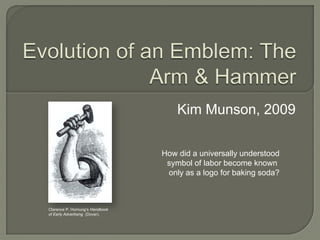
- 1. Evolution of an Emblem: The Arm & Hammer Kim Munson, 2009 How did a universally understood symbol of labor become known only as a logo for baking soda? Clarence P. Hornung’sHandbook of Early Advertising (Dover). Text © Kim Munson, 2009
- 3. Benefits of hard work, skilled craftsmanship.
- 4. Through writing and art, Renaissance interpretations of myths spread through Europe.Piero Di Cosimo, Vulcan and Aeolus c. 1495-1500, oil and tempera on canvas 155.5 x 166.5 cm. National Gallery of Canada, Ottawa
- 5. Other “Hammers” in mythology Other influential “hammers” in Western mythology include Thor the Norse thunder god and the Biblical quotation “Is not My Word like fire, says the Lord, and like a hammer that breaks a rock in pieces” (Jeremiah 23:29). Myths such as these and folk tales like “John Henry” combined with the mystical beliefs attached to natural elements like thunder and fire, reinforce the symbol’s traditional meanings. Hammer = creative/destructive male strength, the sun, thunderbolts, authority, divine skill, industry, protection, fertility, creative intelligence. Fire = purification, revelation, resurrection, transcendence, passion, Divine Energy, the Holy Spirit. A destructive force of nature, yet a domestic comfort. Title page, 1566 2nd edition of Nicolaus Copernicus’ (1473-1543) De revolutionibus orbiumcoelestium (On the Revolutions of the Heavenly Spheres) with colophon of the German printer Heinrich Petri. Joe Madureira. Cover of TheUltimates 3, #4 (2008). Marvel Comics.
- 6. British Trade Guilds Heather Child, The Armorial Bearings of the Guilds of London Although there is evidence of earlier use, The Farriers (left) were officially awarded their arms in 1673 and the Blacksmiths were granted theirs in 1613.
- 7. US Mechanics Societies The General Society of Mechanics & Tradesmen of New York is a benevolent society formed in 1785. Notice the combination of motto and emblem. Other Mechanic’s societies began appearing in US cities like Boston in 1794, and the movement gradually crossed the US, even making it to Gold Rush San Francisco in 1854. General Society of Mechanics and Tradesmen, 1785 Massachusetts Charitable Mechanics Association, 1795 Mechanics’ Institute, 1854
- 8. The Symbol Becomes a Standard By the mid-1800’s, as printing and typesetting became more advanced, versions of the arm & hammer were included in type founder’s specimen books . In this way the symbol became standardized and widely used not only by Mechanic’s societies but also as a general emblem of labor. Page 182 of Clarence Hornung’sHandbook of Early Advertising (Dover). Although the Masons use a gavel/hammer as a symbol of the Lodge Master (creative intelligence), symbol #1, seen above is the official seal of the Junior Order of Mechanics (adopted in 1845), and is not a Masonic symbol.
- 9. Flag & Seal of Wisconsin The Wisconsin state flag, rich in symbols of labor and agriculture, chose the arm & hammer as a symbol of manufacturing in 1848. The Marchex world flag database
- 10. 8 Hour Day Proclaimation In 1869, federal employees won the 8 hour day without a reduction in pay, signed into law by President Grant. See the arm & hammer in the bottom center. Collection of the Library of Congress
- 11. Church & Dwight Contemporary box from Church & Dwight web site. 1878 logo from Hal Morgan, Symbols of America Artifact from the Labor Archives & Research Center, SFSU Church & Sons, (later Church and Dwight) started using the arm & hammer emblem in 1878, inspired by an earlier family venture ‘Vulcan Spice Mills,’ which used a similar logo. The “Honest Labor” tin is another example of the Arm & Hammer used as a product label.
- 12. Armand Hammer The man who wanted to be “the baking soda king” VS Church & Dwight Detail of Church & Dwight’s Arm & Hammer trademark. Armand Hammer (1898-1990), Businessman, Founder of Occidental Petroleum. Art Collector, Founder of the Hammer Museum at UCLA. Church & Dwight had already been using the arm & hammer symbol 31 years before industrialist Armand Hammer was born. He was NOT involved in the company, although he made several take-over attempts. In 1985 Oxy entered into a joint venture with C&D and was he was finally awarded a seat on their board. As a joke he painted the logo on the side of his yacht.
- 13. Socialist Labor Party The Socialist Labor Party of America formally adopted the “uplifted Arm & Hammer” as their emblem and ratified it into their constitution at the eleventh national convention in New York, 1904. It is still prominently featured in all related publications. Graphics from http://www.slp.org
- 14. The Co-Operative Common Wealth, 1898 Collection of the Library of Congress
- 16. Worcester Polytechnic Institute, 1865.
- 17. One work from a series by Warhol and Basquiat, 1984.
- 18. Vulcan Tools logo, 1999.
- 19. photo by Rakka, 2008.
Editor's Notes
- This paper is a draft by Kim Munson not to be reproduced in any form without the author’s permission. Text © 2009 Kim Munson, all rights reserved. Graphics used in this presentation are for academic purposes only, all rights belong to their respective holders.************************The arm & hammer, a dynamic symbol comprised of a muscularmale arm grasping a hammer, implying the action of striking an anvil, has been a recognized emblem of labor, skill and the benefits that come from honest hard work for centuries. Yet this symbol, which was such a ubiquitous emblem of manufacturing that it was incorporated into the Wisconsin state flag in 1848, fell out of use in US union labels, and is now best known as a commercial logo for baking soda.This sign, the Arm & Hammer, has a long and complex history, with roots in Greco-Roman mythology which was further defined in Renaissance Italy, spreading over the centuries to the heraldry of the trade guilds of London (1600’s), and from them to the labor organizations of the “new colonies” of America in the 1700’s and 1800’s. The story of this emblem includes Mechanics Societies,the Masons, the Socialist Labor Party, and the use we see most commonly today, Arm & Hammer baking soda. This is the trail I will follow, as I attempt to trace the meanings and origin of this symbol, and the political connotations that ultimately have inhibited its use by US labor organizations.
- The story of the arm & hammer emblem begins with the Greco-Roman myth of Hephaestus HEF-FES-TUS (Greek, meaning fire) or Vulcan (Roman, meaning volcano), the god of the forge and skilled crafts. As is true of most of these myths, there are many variations to the story, but the gist of it is fairly consistent. Vulcan, an ugly and lame child (for a god) is cast out of Olympus by his mother, the Goddess Hera. He crash lands on the island of Lemnos, where the nymphs raised him as their own. As he matures, his creative vigor helps humans to tame fire (much like Prometheus), teaches them skilled crafts like smithing and carpentry, to domesticate animals, and to develop language. In this painting he is working at the anvil in the right corner, inventing horseshoes. Vulcan is often assisted by Aeolus, god of the 4 winds (the man with the bellows helping Vulcan). Essentially, this myth describes the dawn of civilization, built on the foundation of skilled labor and hard work.Art historian Edwin Panovsky, in his 1937/8 article The Early History of Man in a Series of Paintings by PierodiCosimoexplores both the source material available to the artist in that period and various interpretations of the painting shown here, Vulcan and Aeolus or Vulcan as Teacher of Mankind. Panovsky studied a cycle of 6 paintings telling the story of the discovery of fire, and of the Vulcan myth. According to Panovsky, the paintings are based primarily on the story of the discovery of fire as told by the Greek architect Vitruvius, who visualized society, language and the building of shelters as skills that grew from that event. The myth of Vulcan, god of fire, became the personification of the discovery of fire. Let’s look closer at this painting. Compositionally, the viewer’s eye is drawn diagonally across the painting from Vulcan’s arm with the hammer in the lower left hand corner, past the youth on horseback curious about the horseshoes (domestication of animals) to a builder with a hammer in the upper right, whose gesture echoes that of Vulcan’s. This establishes a direct, if unconscious, link between Vulcan, the master, and the builder in the background, a follower. In the myth, Vulcan is described as a obsessive worker, beginning his labor before dawn and finishing late in the evening. The sleeping man in the foreground of the painting could be a reference to this; Vulcan is already at work while others sleep, as well as the family group who are already awake and interacting. The group could symbolize socialization and the family in general, as the family was the most important social unit in Renaissance society. They are dressed in contemporary fabrics, and they are repeated in front of a small house in the background of the painting, a sign of peace and safety in the home (it could be the finished version of the house under construction on the left). The giraffe appeared in several paintings of this period; it arrived at the Florence Zoo in 1487 and was a source of fascination for many Florentine artists. The inclusion of all the animals and birds, both untamed and domesticated, could be meant to show that this is an early, Eden-like era, when the animals have not yet learned to fear humans. According to the National Gallery of Canada’s web site, the profile of Vulcan may have been a portrait of the patron, Francesco del Pugliese, a wealthy wool merchant. Aside from the obvious interpretation that the fruits of Vulcan’s labor brought about the many benefits of civilization, the more personal meaning may have been that Pugliese’s hard work building his business would nurture and support his own family for generations to come. Renaissance writings and copies of paintings were widely disseminated throughout Europe. It is my belief that while much of the Vulcan story may have been forgotten in the present day, the underlying theme of the benefits of skill and hard work became embedded in the arm and hammer symbol and on some level people still subconsciously understand this connotation.
- There are other Western “hammer” myths that add to the connotations of the arm & hammer & the Vulcan myth, although their symbolic representations are generally different. Hammer wielding characters like Thor and John Henry and stories from the Bible combine with mystical beliefs attached to natural phenomena like thunder and fire to reinforce the symbol’s traditional meanings.A brief synopsis of the meanings of “hammer” and “fire” listed in Jack Tressider’sDictionary of Symbols is: Over time the hammer has come to mean: creative/destructive male strength, the sun, thunderbolts, authority, divine skill, industry, protection, fertility, creative intelligence.Some of the many meanings of fire include: purification, revelation, resurrection, transcendence, passion, Divine Energy, the Holy Spirit. Has a duel role as both a destructive force of nature, yet a domestic comfort.
- Originally designed as symbols of royalty, by the 1600’s British trade guilds began to be awarded their own crests and coats of arms. In the master/journeyman/apprentice guild system, there was great pride in the trade and the group’s self image is often reflected in the tools and symbols chosen to represent them. The terminology of the period is somewhat confusing, as the Farriers were the craftsmen we would consider “blacksmiths,” and the members of the Blacksmith’s Guild were gunsmiths and clockmakers who worked with iron.The arm rising from the middle of the crest holding a tool was a common motif, of the 56 coats of arms reproduced in Bromley & Child’s The Armorial Bearings of the Guilds of London, 22 use this device. The Blacksmiths motto “By Hammer and Hand All Arts Do Stand,” seems to incorporate the essence of the Vulcan myth of skilled labor as a foundation of civilization. There is no confirmed origin for this motto. Anecdotally, I’ve read or been told that this a quote from the old testament or a proverb, although a through search of Biblical quotations and other sources were fruitless. On the web site of the Choke Cherry Forge, an artisan blacksmith’s shop in Canada, I found a folk tale telling of a king (unspecified) who notices various craftsmen throughout his day and asks them where they got their tools. “Oh, we just get them from the blacksmith,” they all say. Finally the King visits the blacksmith and asks him who makes his tools. The blacksmith, surprised by the question says, “I made them all myself, sire.” The King observes that all “arts” are dependant on the blacksmith’s hammer, calling blacksmiths “The Kings of Craftsmen,” hence the motto.While the idea that the arm and hammer in the Farriers arms are meant to embody the myth of Vulcan creating civilization with his labor has a satisfying emotional resonance, but it’s probable that this was a common convention and was simply the easiest way for the guild to identify their craft. On the other hand, we can’t ignore the visual similarity. These guilds, recognized by the crown, did feel that their trades were the lifeblood of London and the backbone of civil society.
- The General Society of Mechanics and Tradesmen of the City of New York was formed in 1784, as a response to the disastrous business climate caused by the end of the British occupation two years earlier. The members wanted to revive business, protect their own interests, provide support to the widows and orphans of their members and help each other in times of sickness or distress. Over time they not only advocated for fairer laws but they also established a public library and a trade school, including classes for women as early as 1887. The Society had several headquarters in New York City, in 1899 moved to their current location at 20 W. 44th Street (near 5th Avenue), where there is an arm and hammer emblem over the front entrance and on a large plaque above the library’s main reading room. They also established the Mechanics Bank on Wall Street, the 4th chartered bank in the city; it went through many changes and became part of Chase National Bank. The arm and hammer is also featured on a bronze plaque on the gates of the society’s cemetery. The societies symbol meshed the raised hammer of the British Farriers with the motto of the Blacksmiths and the member’s pride and ambitions for their new county. In many ways, the General Society embodies the connotations of the Vulcan myth of skilled labor building civilization. Other Mechanics Societies were organized, particularly The Massachusetts Charitable Mechanics Association, which began in Boston in 1795, with Paul Revere as its first President. Eventually the Mechanics movement made it across the country to gold rush SF, with the Mechanics Institute and Library opening in 1884.Harry Rubinstein of the National Museum of American History writes: “Much of the symbolism used by these early organizations is relatively conservative, reflecting their general outlook. For the most part the societies did not mean to change the existing system, but to preserve it against the challenges of a developing capitalist economy which promised to transform masters and journeymen into employers and employees… the societies adopted symbols of nationalism, industry and commerce to suggest their goals and principles. The raised arm holding a hammer, an image which conveys the power and importance of productive labor, became the most identifiable single symbol to represent the artisan class, and eventually the entire working class.”
- This wide spread use was aided by the inclusion of many different versions of the arm & hammer included in type founders specimen books commonly used by printers throughout the country. These examples, reproduced in Clarence P. Horning’s Handbook of Early Advertising, show five different versions of the arm & hammer which were collected together with the emblems of other organizations like the Elks, Masons and the Knights of Columbus. The specimen books were essentially the “clip art” of the 19th century; catalogs of typefaces, decorative borders and wood engravings on every theme imaginable. These woodcuts would be processed by a stereotype who would cast them in type metal so they could be reproduced in quantity. These were sold to printers for everyday use in city directories, advertising and private orders. I don’t know exactly when the arm & hammer made its first appearance in the specimen books, but using the plates ordered through these books was common practice for printers by 1820. It is likely that this widespread use of stock plates by printers contributed to the prevalent use of the arm & hammer as icon of labor in general, and to a visual standardization of the different versions of the emblem.On this sample page are: #1) The Junior Order United Mechanics, #2 resembles the version used by the Massachusetts Charitable Mechanics, #3 resembles the emblem used by “The People” and other Socialist publications, and #4 resembles the logo of the General Society of Mechanics (NY).The Junior Order of United Mechanics, which adopted their emblem in 1868, was an organization based on the ideals of the Mechanics Society with a nationalist agenda. They were NOT related to the Masons, although the emblems do have a visual similarity.