MEDIEVAL
THEATER
How The Plays Worked
• English mystery plays incorporate a combination
of high seriousness and low comedy:
– High seriousness: the Biblical stories of the Old
Testament and Jesus’ life and mission
– Low comedy: the plays incorporate almost slapstick
sketches of contemporary medieval daily life.
• The plays are set in contemporary settings with
recognizable contemporary characters: the truth
of the Biblical stories is timeless -- the divine
truths revealed in the Bible are still true “today.”
How the Plays Were Performed
• Pageant wagons would
• travel a set route and perform at several locations: like
a parade or
• would be set up around a town square and the
audience would travel from one wagon to the next to
see the performances
Mansions or a series of stages would be set up around
the town square
Anchored at either end by Heaven and Hell
Elaborate special effects such as floods, flying and fiery pits
were very popular
How the Plays Were Performed
• Theatre was performed in found spaces: town
squares, taverns, churches, banquet halls -- no
specifically designated theatres
• Theatre was intimate -- audience interacted
with performers
• Elaborate special effects
• Characterization was often dependent upon
costume and makeup
MORALITY PLAYS
• Theme: how to live a Christian life and be saved.
• Allegory:
– A story told on two levels: the literal and the the
symbolic
– Plot: a journey through life or to death
• Emphasis switches from Biblical and saintly
protagonists to the common man: Everyman,
Mankind
• Focus on free will
• First major use of professional acting companies
Miracle Plays
• Miracle plays were similar to mystery plays in
dramatic techniques
• Dramatized the lives of Roman Catholic saints
( in order to become a saint, a person had to
perform 3 documented miracles)
• The most popular subjects were the Virgin
Mary (plays usually written in Latin), St.
George (dragon slayer and patron saint of
England) and St. Nicholas ( associated with
Christmas festivities)
Interludes and Farces
• Combined elements of allegory, classical myth,
and courtly entertainment: music, dance,
spectacle
• Interludes were short plays performed between
courses at court banquets
• Farces were longer plays ridiculing such human
follies as greed and dishonesty
• As the mysteries, miracle and moralities were
censored by Protestant authorities, secular
drama became more important to all levels of
society
Folk Plays
• Often performed at such holidays as Christmas,
New Year and May Day
• Incorporated remnants of pagan rituals
• Mummers, Morris Dancers, etc.
• Robin Hood
• Feast of Fools: Fool companies consisted of .
young men, whose chief business was to play
gross comedies and to execute nonsensical and
often ribald travesties on the Mass. These
boisterous "Feasts" antedate most of the
mysteries, and may have been reverent in their
origin
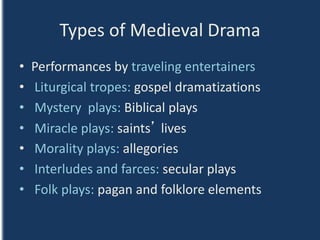
Types of Medieval Drama
• Performances by traveling entertainers
• Liturgical tropes: gospel dramatizations
• Mystery plays: Biblical plays
• Miracle plays: saints’ lives
• Morality plays: allegories
• Interludes and farces: secular plays
• Folk plays: pagan and folklore elements

Medeivaltheaterpowerpoint

  • 1.
  • 2.
    How The PlaysWorked • English mystery plays incorporate a combination of high seriousness and low comedy: – High seriousness: the Biblical stories of the Old Testament and Jesus’ life and mission – Low comedy: the plays incorporate almost slapstick sketches of contemporary medieval daily life. • The plays are set in contemporary settings with recognizable contemporary characters: the truth of the Biblical stories is timeless -- the divine truths revealed in the Bible are still true “today.”
  • 3.
    How the PlaysWere Performed • Pageant wagons would • travel a set route and perform at several locations: like a parade or • would be set up around a town square and the audience would travel from one wagon to the next to see the performances Mansions or a series of stages would be set up around the town square Anchored at either end by Heaven and Hell Elaborate special effects such as floods, flying and fiery pits were very popular
  • 4.
    How the PlaysWere Performed • Theatre was performed in found spaces: town squares, taverns, churches, banquet halls -- no specifically designated theatres • Theatre was intimate -- audience interacted with performers • Elaborate special effects • Characterization was often dependent upon costume and makeup
  • 5.
    MORALITY PLAYS • Theme:how to live a Christian life and be saved. • Allegory: – A story told on two levels: the literal and the the symbolic – Plot: a journey through life or to death • Emphasis switches from Biblical and saintly protagonists to the common man: Everyman, Mankind • Focus on free will • First major use of professional acting companies
  • 6.
    Miracle Plays • Miracleplays were similar to mystery plays in dramatic techniques • Dramatized the lives of Roman Catholic saints ( in order to become a saint, a person had to perform 3 documented miracles) • The most popular subjects were the Virgin Mary (plays usually written in Latin), St. George (dragon slayer and patron saint of England) and St. Nicholas ( associated with Christmas festivities)
  • 7.
    Interludes and Farces •Combined elements of allegory, classical myth, and courtly entertainment: music, dance, spectacle • Interludes were short plays performed between courses at court banquets • Farces were longer plays ridiculing such human follies as greed and dishonesty • As the mysteries, miracle and moralities were censored by Protestant authorities, secular drama became more important to all levels of society
  • 8.
    Folk Plays • Oftenperformed at such holidays as Christmas, New Year and May Day • Incorporated remnants of pagan rituals • Mummers, Morris Dancers, etc. • Robin Hood • Feast of Fools: Fool companies consisted of . young men, whose chief business was to play gross comedies and to execute nonsensical and often ribald travesties on the Mass. These boisterous "Feasts" antedate most of the mysteries, and may have been reverent in their origin
  • 9.
    Types of MedievalDrama • Performances by traveling entertainers • Liturgical tropes: gospel dramatizations • Mystery plays: Biblical plays • Miracle plays: saints’ lives • Morality plays: allegories • Interludes and farces: secular plays • Folk plays: pagan and folklore elements