Comenius Multilateral School Partnership Project
”EuropeanşMultiguide”
2012 - 2014
Every Child Likes to Play
March 2014
This product is made with the collaboration
of all partner schools of the project “European multiguide”ş
2012 - 2014
The brochure is made and produced by
Sredno Obshtoobrazovatelno Uchilishte “Vasil Levski”
Haskovo, Bulgaria
This project has been funded with support from the European Commission. This publication reflects the
views only of the author, and the Commission cannot be held responsible for any use which may be
made of the information contained therein.
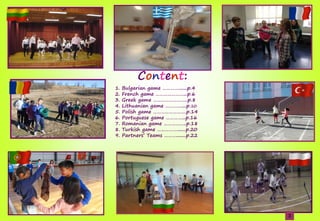
Content:
1.şBulgarianşgameş………….......p.4
2.şFrenchşgameş…………………...p.6
3.şGreekşgameş……………………..p.8
4.şLithuanianşgameş…………....p.10
5.şPolishşgameş…………………….p.14şşşşşşşşşşşş
6.şPortugueseşgameş…………...p.16şşşş
7.şRomanianşgameş……………..p.18şşşşşş
8.şTurkishşgameş…………….......p.20şşşşşşşş
9.şPartners’şTeamsş………........p.22şşşşşş
3
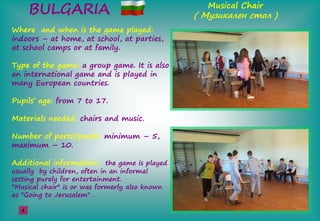
BULGARIA Musical Chair
( М а е ş )
Where and when is the game played:
indoors – at home, at school, at parties,
at school camps or at family.
Type of the game: a group game. It is also
an international game and is played in
many European countries.
Pupils’şage: from 7 to 17.
Materials needed: chairs and music.
Number of participants: minimum – 5,
maximum – 10.
Additional information: the game is played
usually by children, often in an informal
setting purely for entertainment.
"Musical chair" is or was formerly also known
as "Going to Jerusalem" .
4
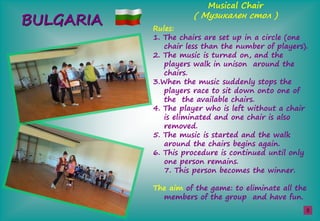
BULGARIA Rules:
1. The chairs are set up in a circle (one
chair less than the number of players).
2. The music is turned on, and the
players walk in unison around the
chairs.
3.When the music suddenly stops the
players race to sit down onto one of
the the available chairs.
4. The player who is left without a chair
is eliminated and one chair is also
removed.
5. The music is started and the walk
around the chairs begins again.
6. This procedure is continued until only
one person remains.
7. This person becomes the winner.
The aim of the game: to eliminate all the
members of the group and have fun.
Musical Chair
( М а е ş )
5
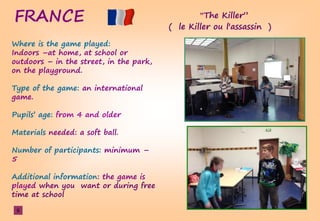
FRANCE ”TheşKiller”
( le Killer ou l'assassin )
Where is the game played:
Indoors –at home, at school or
outdoors – in the street, in the park,
on the playground.
Type of the game: an international
game.
Pupils’şage:şfrom 4 and older
Materials needed: a soft ball.
Number of participants: minimum –
5
Additional information: the game is
played when you want or during free
time at school
6
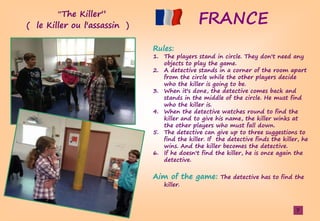
FRANCE”TheşKiller”
( le Killer ou l'assassin )
Rules:
1. The players stand in circle. They don't need any
objects to play the game.
2. A detective stands in a corner of the room apart
from the circle while the other players decide
who the killer is going to be.
3. When it's done, the detective comes back and
stands in the middle of the circle. He must find
who the killer is.
4. When the detective watches round to find the
killer and to give his name, the killer winks at
the other players who must fall down.
5. The detective can give up to three suggestions to
find the killer. If the detective finds the killer, he
wins. And the killer becomes the detective.
6. If he doesn't find the killer, he is once again the
detective.
Aim of the game: The detective has to find the
killer.
7
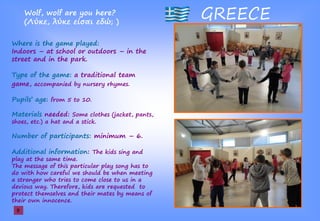
GREECEWolf, wolf are you here?
(Λ ,ş ş ίσα ş ; )
Where is the game played:
Indoors – at school or outdoors – in the
street and in the park.
Type of the game: a traditional team
game, accompanied by nursery rhymes.
Pupils’şage: from 5 to 10.
Materials needed: Some clothes (jacket, pants,
shoes, etc.) a hat and a stick.
Number of participants: minimum – 6.
Additional information: The kids sing and
play at the same time.
The message of this particular play song has to
do with how careful we should be when meeting
a stranger who tries to come close to us in a
devious way. Therefore, kids are requested to
protect themselves and their mates by means of
their own innocence.
8
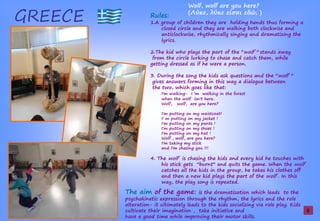
GREECE Rules:
1.A group of children they are holding hands thus forming a
closed circle and they are walking both clockwise and
anticlockwise, rhythmically singing and dramatizing the
lyrics.
2.The kid who plays the part of the ''wolf '' stands away
from the circle lurking to chase and catch them, while
getting dressed as if he were a person.
3. During the song the kids ask questions and the ''wolf ''
gives answers forming in this way a dialogue between
the two, which goes like that:
I'm walking- I 'm walking in the forest
when the wolf isn't here.
Wolf, wolf, are you here?
I'm putting on my waistcoat!
I' m putting on my jacket !
I'm putting on my pants !
I'm putting on my shoes !
I'm putting on my hat !
Wolf , wolf, are you here?
I'm taking my stick
and I'm chasing you !!!
4. The wolf is chasing the kids and every kid he touches with
his stick gets ''burnt'' and quits the game. When the wolf
catches all the kids in the group, he takes his clothes off
and then a new kid plays the part of the wolf . In this
way, the play song is repeated.
The aim of the game: is the dramatization which leads to the
psychokinetic expression through the rhythm, the lyrics and the role
alteration- it ultimately leads to the kids socializing via role play. Kids
cultivate their imagination , take initiative and
have a good time while improving their motor skills.
Wolf, wolf are you here?
(Λ ,ş ş ίσα ş ; )
9
LITHUANIA
Where is the game played:
indoors or outdoors.
Type of the game: a traditional game played
in pairs, during festivals, celebrations or just
to entertain.
Pupils’şage: pupils of different ages can play
this game.
Materials needed: none.
Number of participants: minimum – 6,
maximum – 16. The number must be even.
Rules:
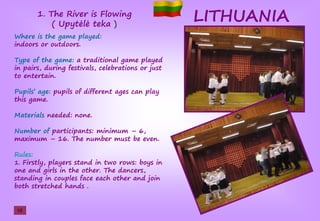
1. Firstly, players stand in two rows: boys in
one and girls in the other. The dancers,
standing in couples face each other and join
both stretched hands .
1. The River is Flowing
(şUpŢtėlėştekaş)
10
LITHUANIA1.The River is Flowing
(UpŢtėlėşteka)
Rules:
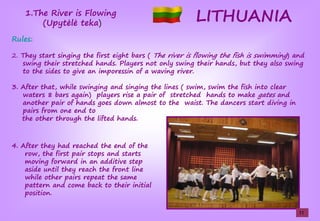
2. They start singing the first eight bars ( The river is flowing the fish is swimming) and
swing their stretched hands. Players not only swing their hands, but they also swing
to the sides to give an imporessin of a waving river.
3. After that, while swinging and singing the lines ( swim, swim the fish into clear
waters 8 bars again) players rise a pair of stretched hands to make gates and
another pair of hands goes down almost to the waist. The dancers start diving in
pairs from one end to
the other through the lifted hands.
4. After they had reached the end of the
row, the first pair stops and starts
moving forward in an additive step
aside until they reach the front line
while other pairs repeat the same
pattern and come back to their initial
position.
11
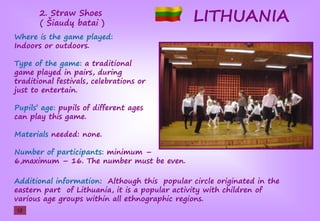
LITHUANIA2. Straw Shoes
(şŠiaudųşbatai )
Where is the game played:
Indoors or outdoors.
Type of the game: a traditional
game played in pairs, during
traditional festivals, celebrations or
just to entertain.
Pupils’şage: pupils of different ages
can play this game.
Materials needed: none.
Number of participants: minimum –
6,maximum – 16. The number must be even.
Additional information: Although this popular circle originated in the
eastern part of Lithuania, it is a popular activity with children of
various age groups within all ethnographic regions.
12
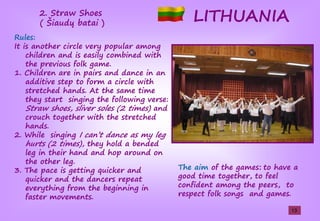
LITHUANIA
Rules:
It is another circle very popular among
children and is easily combined with
the previous folk game.
1. Children are in pairs and dance in an
additive step to form a circle with
stretched hands. At the same time
they start singing the following verse:
Straw shoes, sliver soles (2 times) and
crouch together with the stretched
hands.
2. While singing Işcan’tşdanceşasşmŢşlegş
hurts (2 times), they hold a bended
leg in their hand and hop around on
the other leg.
3. The pace is getting quicker and
quicker and the dancers repeat
everything from the beginning in
faster movements.
The aim of the games: to have a
good time together, to feel
confident among the peers, to
respect folk songs and games.
2. Straw Shoes
(şŠiaudųşbatai )
13
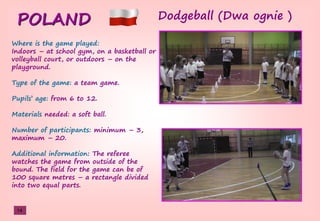
POLAND Dodgeball (Dwa ognie )
Where is the game played:
Indoors – at school gym, on a basketball or
volleyball court, or outdoors – on the
playground.
Type of the game: a team game.
Pupils’şage: from 6 to 12.
Materials needed: a soft ball.
Number of participants: minimum – 3,
maximum – 20.
Additional information: The referee
watches the game from outside of the
bound. The field for the game can be of
100 square metres – a rectangle divided
into two equal parts.
14
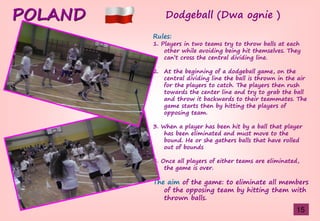
POLAND
Rules:
1. Players in two teams try to throw balls at each
other while avoiding being hit themselves. They
can’tşcrossştheşcentralşdividingşline.
2. At the beginning of a dodgeball game, on the
central dividing line the ball is thrown in the air
for the players to catch. The players then rush
towards the center line and try to grab the ball
and throw it backwards to their teammates. The
game starts then by hitting the players of
opposing team.
3. When a player has been hit by a ball that player
has been eliminated and must move to the
bound. He or she gathers balls that have rolled
out of bounds
4. Once all players of either teams are eliminated,
the game is over.
The aim of the game: to eliminate all members
of the opposing team by hitting them with
thrown balls.
Dodgeball (Dwa ognie )
15
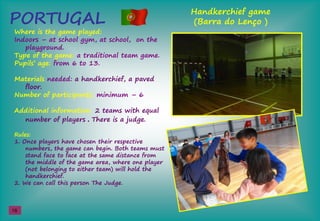
PORTUGAL
Handkerchief game
(Barra do Lenço )
Where is the game played:
Indoors – at school gym, at school, on the
playground.
Type of the game: a traditional team game.
Pupils’şage: from 6 to 13.
Materials needed: a handkerchief, a paved
floor.
Number of participants: minimum – 6
Additional information: 2 teams with equal
number of players . There is a judge.
Rules:
1. Once players have chosen their respective
numbers, the game can begin. Both teams must
stand face to face at the same distance from
the middle of the game area, where one player
(not belonging to either team) will hold the
handkerchief.
2. We can call this person The Judge.
16
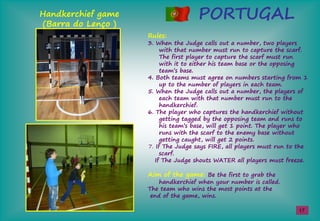
PORTUGALHandkerchief game
(Barra do Lenço )
Rules:
3. When the Judge calls out a number, two players
with that number must run to capture the scarf.
The first player to capture the scarf must run
with it to either his team base or the opposing
team’sşbase.
4. Both teams must agree on numbers starting from 1
up to the number of players in each team.
5. When the Judge calls out a number, the players of
each team with that number must run to the
handkerchief.
6. The player who captures the handkerchief without
getting tagged by the opposing team and runs to
hisşteam’sşbase,şwillşgetş1şpoint.şTheşplaŢerşwhoş
runs with the scarf to the enemy base without
getting caught, will get 2 points.
7. If The Judge says FIRE, all players must run to the
scarf.
If The Judge shouts WATER all players must freeze.
Aim of the game: Be the first to grab the
handkerchief when your number is called.
The team who wins the most points at the
end of the game, wins.
17
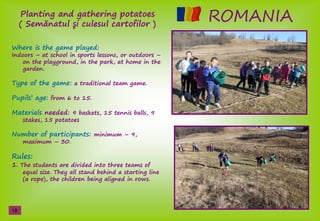
ROMANIAPlanting and gathering potatoes
( Semănatulş işculesulşcartofilor )
Where is the game played:
Indoors – at school in sports lessons, or outdoors –
on the playground, in the park, at home in the
garden.
Type of the game: a traditional team game.
Pupils’şage: from 6 to 15.
Materials needed: 9 baskets, 15 tennis balls, 9
stakes, 15 potatoes
Number of participants: minimum – 9,
maximum – 30.
Rules:
1. The students are divided into three teams of
equal size. They all stand behind a starting line
(a rope), the children being aligned in rows.
18
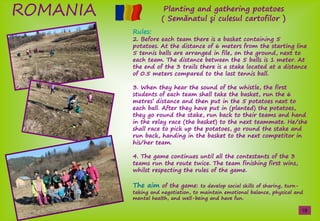
ROMANIA Planting and gathering potatoes
( Semănatulş işculesulşcartofilor )
Rules:
2. Before each team there is a basket containing 5
potatoes. At the distance of 6 meters from the starting line
5 tennis balls are arranged in file, on the ground, next to
each team. The distance between the 5 balls is 1 meter. At
the end of the 3 trails there is a stake located at a distance
of 0.5 meters compared to the last tennis ball.
3. When they hear the sound of the whistle, the first
students of each team shall take the basket, run the 6
metres’şdistanceşandşthenşputşinştheş5şpotatoesşnextştoş
each ball. After they have put in (planted) the potatoes,
they go round the stake, run back to their teams and hand
in the relay race (the basket) to the next teammate. He/she
shall race to pick up the potatoes, go round the stake and
run back, handing in the basket to the next competitor in
his/her team.
4. The game continues until all the contestants of the 3
teams run the route twice. The team finishing first wins,
whilst respecting the rules of the game.
The aim of the game: to develop social skills of sharing, turn-
taking and negotiation, to maintain emotional balance, physical and
mental health, and well-being and have fun.
19
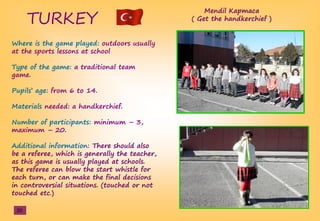
TURKEY
Mendil Kapmaca
( Get the handkerchief )
Where is the game played: outdoors usually
at the sports lessons at school
Type of the game: a traditional team
game.
Pupils’şage: from 6 to 14.
Materials needed: a handkerchief.
Number of participants: minimum – 3,
maximum – 20.
Additional information: There should also
be a referee, which is generally the teacher,
as this game is usually played at schools.
The referee can blow the start whistle for
each turn, or can make the final decisions
in controversial situations. (touched or not
touched etc.)
20
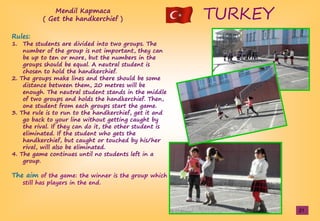
TURKEY
Rules:
1. The students are divided into two groups. The
number of the group is not important, they can
be up to ten or more, but the numbers in the
groups should be equal. A neutral student is
chosen to hold the handkerchief.
2. The groups make lines and there should be some
distance between them, 20 metres will be
enough. The neutral student stands in the middle
of two groups and holds the handkerchief. Then,
one student from each groups start the game.
3. The rule is to run to the handkerchief, get it and
go back to your line without getting caught by
the rival. If they can do it, the other student is
eliminated. If the student who gets the
handkerchief, but caught or touched by his/her
rival, will also be eliminated.
4. The game continues until no students left in a
group.
The aim of the game: the winner is the group which
still has players in the end.
Mendil Kapmaca
( Get the handkerchief )
21
BULGARIA:
Teachers:
Iliyana Panayotova – project
coordinator, English teacher,
brochure and video editor
Dimitar Erfandov – teacher,
cameraman and brochure editor
Nevena Toneva – teacher of PE
Pupils:
from 7th A grade
POLAND:
Teachers:
Malgorzata Gremplewska – teacher
Aleksander Pulaczewski – referee
Dorota Wiankowska-Przekwas – camera
operator
Pupils:
from class 1
Teams:
LITHUANIA:
Teachers:
RasaşMatulevičienėş- a teacher of primary classes
SigutėşValentaitėş– Rugienėş-a music teacher
GiedrėşGuţavičienėş- project coordinator,
English teacher
Cameraman – LukasşMarcinkevičius
Photographer – SidonaşLastauskaitė
Film maker – EivileşRugieniūtė
Pupils:
from class 2 b and Ib
(dancers aged 9-16 years old)
PORTUGAL:
Teachers:
Comenius team from EB 1 Alvor
Cameraman - Ana Duarte, teacher
Pupils: from 4th class D
22
ROMANIA
Teachers:
BăcanuşLăcrămioara
GînscăşCătălinşLucian
Stanciu Daniela
Pupils:
from 4th grade:
Sergiu Alboi, Ana Casian,
Ilie-George Marian, Alexandru Micliuc,
AlexandraşNisioi,ş tefanşNisioi,
ValentinşPorcu an,ş tefanşSmadici,ş
Maria Talida Sfarghiu, Denisa Stanciuc,
Teodora împău,şAnamariaşZaharia
TURKEY
Teachers:
Rıfat Özdamar
Teacher and Cameraman:
Serdar Özbey
Pupils:
from class 2-D
FRANCE
Pupils:
Raquel
Coralie Celia
Clement Jeanne
Dayanna Audrey
Dylan ( as the killer )
Mayrine ( as the detective )
GREECE
Teachers:
Theofani Stratigi – Language teacher
Kontogianopoulou Efthalia – P.E. teacher
Terzis Antonios – School’sşHeadmaster
Pupils:
from 2 grade: Penny, Orestis, Lisidora-Isidora,
Athanasia, George,Bill, Anastasios, Maria
Ivanova-Myrto, Peter, Nicole, Aggeliki, Froso,
Georgia, Triantalili, Christina,
23
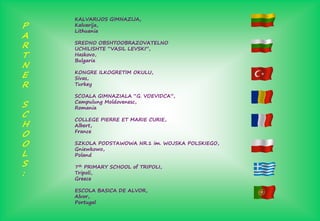
P
A
R
T
N
E
R
S
C
H
O
O
L
S
:
KALVARIJOS GIMNAZIJA,
Kalvarija,
Lithuania
SREDNO OBSHTOOBRAZOVATELNO
UCHILISHTE “VASIL LEVSKI”,
Haskovo,
Bulgaria
KONGRE ILKOGRETIM OKULU,
Sivas,
Turkey
SCOALA GIMNAZIALA “G. VOEVIDCA”,
Campulung Moldovenesc,
Romania
COLLEGE PIERRE ET MARIE CURIE,
Albert,
France
SZKOLA PODSTAWOWA NR.1 im. WOJSKA POLSKIEGO,
Gniewkowo,
Poland
7th PRIMARY SCHOOL of TRIPOLI,
Tripoli,
Greece
ESCOLA BASICA DE ALVOR,
Alvor,
Portugal

Every child like to play

  • 1.
    Comenius Multilateral SchoolPartnership Project ”EuropeanşMultiguide” 2012 - 2014 Every Child Likes to Play March 2014
  • 2.
    This product ismade with the collaboration of all partner schools of the project “European multiguide”ş 2012 - 2014 The brochure is made and produced by Sredno Obshtoobrazovatelno Uchilishte “Vasil Levski” Haskovo, Bulgaria This project has been funded with support from the European Commission. This publication reflects the views only of the author, and the Commission cannot be held responsible for any use which may be made of the information contained therein.
  • 3.
  • 4.
    BULGARIA Musical Chair (М а е ş ) Where and when is the game played: indoors – at home, at school, at parties, at school camps or at family. Type of the game: a group game. It is also an international game and is played in many European countries. Pupils’şage: from 7 to 17. Materials needed: chairs and music. Number of participants: minimum – 5, maximum – 10. Additional information: the game is played usually by children, often in an informal setting purely for entertainment. "Musical chair" is or was formerly also known as "Going to Jerusalem" . 4
  • 5.
    BULGARIA Rules: 1. Thechairs are set up in a circle (one chair less than the number of players). 2. The music is turned on, and the players walk in unison around the chairs. 3.When the music suddenly stops the players race to sit down onto one of the the available chairs. 4. The player who is left without a chair is eliminated and one chair is also removed. 5. The music is started and the walk around the chairs begins again. 6. This procedure is continued until only one person remains. 7. This person becomes the winner. The aim of the game: to eliminate all the members of the group and have fun. Musical Chair ( М а е ş ) 5
  • 6.
    FRANCE ”TheşKiller” ( leKiller ou l'assassin ) Where is the game played: Indoors –at home, at school or outdoors – in the street, in the park, on the playground. Type of the game: an international game. Pupils’şage:şfrom 4 and older Materials needed: a soft ball. Number of participants: minimum – 5 Additional information: the game is played when you want or during free time at school 6
  • 7.
    FRANCE”TheşKiller” ( le Killerou l'assassin ) Rules: 1. The players stand in circle. They don't need any objects to play the game. 2. A detective stands in a corner of the room apart from the circle while the other players decide who the killer is going to be. 3. When it's done, the detective comes back and stands in the middle of the circle. He must find who the killer is. 4. When the detective watches round to find the killer and to give his name, the killer winks at the other players who must fall down. 5. The detective can give up to three suggestions to find the killer. If the detective finds the killer, he wins. And the killer becomes the detective. 6. If he doesn't find the killer, he is once again the detective. Aim of the game: The detective has to find the killer. 7
  • 8.
    GREECEWolf, wolf areyou here? (Λ ,ş ş ίσα ş ; ) Where is the game played: Indoors – at school or outdoors – in the street and in the park. Type of the game: a traditional team game, accompanied by nursery rhymes. Pupils’şage: from 5 to 10. Materials needed: Some clothes (jacket, pants, shoes, etc.) a hat and a stick. Number of participants: minimum – 6. Additional information: The kids sing and play at the same time. The message of this particular play song has to do with how careful we should be when meeting a stranger who tries to come close to us in a devious way. Therefore, kids are requested to protect themselves and their mates by means of their own innocence. 8
  • 9.
    GREECE Rules: 1.A groupof children they are holding hands thus forming a closed circle and they are walking both clockwise and anticlockwise, rhythmically singing and dramatizing the lyrics. 2.The kid who plays the part of the ''wolf '' stands away from the circle lurking to chase and catch them, while getting dressed as if he were a person. 3. During the song the kids ask questions and the ''wolf '' gives answers forming in this way a dialogue between the two, which goes like that: I'm walking- I 'm walking in the forest when the wolf isn't here. Wolf, wolf, are you here? I'm putting on my waistcoat! I' m putting on my jacket ! I'm putting on my pants ! I'm putting on my shoes ! I'm putting on my hat ! Wolf , wolf, are you here? I'm taking my stick and I'm chasing you !!! 4. The wolf is chasing the kids and every kid he touches with his stick gets ''burnt'' and quits the game. When the wolf catches all the kids in the group, he takes his clothes off and then a new kid plays the part of the wolf . In this way, the play song is repeated. The aim of the game: is the dramatization which leads to the psychokinetic expression through the rhythm, the lyrics and the role alteration- it ultimately leads to the kids socializing via role play. Kids cultivate their imagination , take initiative and have a good time while improving their motor skills. Wolf, wolf are you here? (Λ ,ş ş ίσα ş ; ) 9
  • 10.
    LITHUANIA Where is thegame played: indoors or outdoors. Type of the game: a traditional game played in pairs, during festivals, celebrations or just to entertain. Pupils’şage: pupils of different ages can play this game. Materials needed: none. Number of participants: minimum – 6, maximum – 16. The number must be even. Rules: 1. Firstly, players stand in two rows: boys in one and girls in the other. The dancers, standing in couples face each other and join both stretched hands . 1. The River is Flowing (şUpŢtėlėştekaş) 10
  • 11.
    LITHUANIA1.The River isFlowing (UpŢtėlėşteka) Rules: 2. They start singing the first eight bars ( The river is flowing the fish is swimming) and swing their stretched hands. Players not only swing their hands, but they also swing to the sides to give an imporessin of a waving river. 3. After that, while swinging and singing the lines ( swim, swim the fish into clear waters 8 bars again) players rise a pair of stretched hands to make gates and another pair of hands goes down almost to the waist. The dancers start diving in pairs from one end to the other through the lifted hands. 4. After they had reached the end of the row, the first pair stops and starts moving forward in an additive step aside until they reach the front line while other pairs repeat the same pattern and come back to their initial position. 11
  • 12.
    LITHUANIA2. Straw Shoes (şŠiaudųşbatai) Where is the game played: Indoors or outdoors. Type of the game: a traditional game played in pairs, during traditional festivals, celebrations or just to entertain. Pupils’şage: pupils of different ages can play this game. Materials needed: none. Number of participants: minimum – 6,maximum – 16. The number must be even. Additional information: Although this popular circle originated in the eastern part of Lithuania, it is a popular activity with children of various age groups within all ethnographic regions. 12
  • 13.
    LITHUANIA Rules: It is anothercircle very popular among children and is easily combined with the previous folk game. 1. Children are in pairs and dance in an additive step to form a circle with stretched hands. At the same time they start singing the following verse: Straw shoes, sliver soles (2 times) and crouch together with the stretched hands. 2. While singing Işcan’tşdanceşasşmŢşlegş hurts (2 times), they hold a bended leg in their hand and hop around on the other leg. 3. The pace is getting quicker and quicker and the dancers repeat everything from the beginning in faster movements. The aim of the games: to have a good time together, to feel confident among the peers, to respect folk songs and games. 2. Straw Shoes (şŠiaudųşbatai ) 13
  • 14.
    POLAND Dodgeball (Dwaognie ) Where is the game played: Indoors – at school gym, on a basketball or volleyball court, or outdoors – on the playground. Type of the game: a team game. Pupils’şage: from 6 to 12. Materials needed: a soft ball. Number of participants: minimum – 3, maximum – 20. Additional information: The referee watches the game from outside of the bound. The field for the game can be of 100 square metres – a rectangle divided into two equal parts. 14
  • 15.
    POLAND Rules: 1. Players intwo teams try to throw balls at each other while avoiding being hit themselves. They can’tşcrossştheşcentralşdividingşline. 2. At the beginning of a dodgeball game, on the central dividing line the ball is thrown in the air for the players to catch. The players then rush towards the center line and try to grab the ball and throw it backwards to their teammates. The game starts then by hitting the players of opposing team. 3. When a player has been hit by a ball that player has been eliminated and must move to the bound. He or she gathers balls that have rolled out of bounds 4. Once all players of either teams are eliminated, the game is over. The aim of the game: to eliminate all members of the opposing team by hitting them with thrown balls. Dodgeball (Dwa ognie ) 15
  • 16.
    PORTUGAL Handkerchief game (Barra doLenço ) Where is the game played: Indoors – at school gym, at school, on the playground. Type of the game: a traditional team game. Pupils’şage: from 6 to 13. Materials needed: a handkerchief, a paved floor. Number of participants: minimum – 6 Additional information: 2 teams with equal number of players . There is a judge. Rules: 1. Once players have chosen their respective numbers, the game can begin. Both teams must stand face to face at the same distance from the middle of the game area, where one player (not belonging to either team) will hold the handkerchief. 2. We can call this person The Judge. 16
  • 17.
    PORTUGALHandkerchief game (Barra doLenço ) Rules: 3. When the Judge calls out a number, two players with that number must run to capture the scarf. The first player to capture the scarf must run with it to either his team base or the opposing team’sşbase. 4. Both teams must agree on numbers starting from 1 up to the number of players in each team. 5. When the Judge calls out a number, the players of each team with that number must run to the handkerchief. 6. The player who captures the handkerchief without getting tagged by the opposing team and runs to hisşteam’sşbase,şwillşgetş1şpoint.şTheşplaŢerşwhoş runs with the scarf to the enemy base without getting caught, will get 2 points. 7. If The Judge says FIRE, all players must run to the scarf. If The Judge shouts WATER all players must freeze. Aim of the game: Be the first to grab the handkerchief when your number is called. The team who wins the most points at the end of the game, wins. 17
  • 18.
    ROMANIAPlanting and gatheringpotatoes ( Semănatulş işculesulşcartofilor ) Where is the game played: Indoors – at school in sports lessons, or outdoors – on the playground, in the park, at home in the garden. Type of the game: a traditional team game. Pupils’şage: from 6 to 15. Materials needed: 9 baskets, 15 tennis balls, 9 stakes, 15 potatoes Number of participants: minimum – 9, maximum – 30. Rules: 1. The students are divided into three teams of equal size. They all stand behind a starting line (a rope), the children being aligned in rows. 18
  • 19.
    ROMANIA Planting andgathering potatoes ( Semănatulş işculesulşcartofilor ) Rules: 2. Before each team there is a basket containing 5 potatoes. At the distance of 6 meters from the starting line 5 tennis balls are arranged in file, on the ground, next to each team. The distance between the 5 balls is 1 meter. At the end of the 3 trails there is a stake located at a distance of 0.5 meters compared to the last tennis ball. 3. When they hear the sound of the whistle, the first students of each team shall take the basket, run the 6 metres’şdistanceşandşthenşputşinştheş5şpotatoesşnextştoş each ball. After they have put in (planted) the potatoes, they go round the stake, run back to their teams and hand in the relay race (the basket) to the next teammate. He/she shall race to pick up the potatoes, go round the stake and run back, handing in the basket to the next competitor in his/her team. 4. The game continues until all the contestants of the 3 teams run the route twice. The team finishing first wins, whilst respecting the rules of the game. The aim of the game: to develop social skills of sharing, turn- taking and negotiation, to maintain emotional balance, physical and mental health, and well-being and have fun. 19
  • 20.
    TURKEY Mendil Kapmaca ( Getthe handkerchief ) Where is the game played: outdoors usually at the sports lessons at school Type of the game: a traditional team game. Pupils’şage: from 6 to 14. Materials needed: a handkerchief. Number of participants: minimum – 3, maximum – 20. Additional information: There should also be a referee, which is generally the teacher, as this game is usually played at schools. The referee can blow the start whistle for each turn, or can make the final decisions in controversial situations. (touched or not touched etc.) 20
  • 21.
    TURKEY Rules: 1. The studentsare divided into two groups. The number of the group is not important, they can be up to ten or more, but the numbers in the groups should be equal. A neutral student is chosen to hold the handkerchief. 2. The groups make lines and there should be some distance between them, 20 metres will be enough. The neutral student stands in the middle of two groups and holds the handkerchief. Then, one student from each groups start the game. 3. The rule is to run to the handkerchief, get it and go back to your line without getting caught by the rival. If they can do it, the other student is eliminated. If the student who gets the handkerchief, but caught or touched by his/her rival, will also be eliminated. 4. The game continues until no students left in a group. The aim of the game: the winner is the group which still has players in the end. Mendil Kapmaca ( Get the handkerchief ) 21
  • 22.
    BULGARIA: Teachers: Iliyana Panayotova –project coordinator, English teacher, brochure and video editor Dimitar Erfandov – teacher, cameraman and brochure editor Nevena Toneva – teacher of PE Pupils: from 7th A grade POLAND: Teachers: Malgorzata Gremplewska – teacher Aleksander Pulaczewski – referee Dorota Wiankowska-Przekwas – camera operator Pupils: from class 1 Teams: LITHUANIA: Teachers: RasaşMatulevičienėş- a teacher of primary classes SigutėşValentaitėş– Rugienėş-a music teacher GiedrėşGuţavičienėş- project coordinator, English teacher Cameraman – LukasşMarcinkevičius Photographer – SidonaşLastauskaitė Film maker – EivileşRugieniūtė Pupils: from class 2 b and Ib (dancers aged 9-16 years old) PORTUGAL: Teachers: Comenius team from EB 1 Alvor Cameraman - Ana Duarte, teacher Pupils: from 4th class D 22
  • 23.
    ROMANIA Teachers: BăcanuşLăcrămioara GînscăşCătălinşLucian Stanciu Daniela Pupils: from 4thgrade: Sergiu Alboi, Ana Casian, Ilie-George Marian, Alexandru Micliuc, AlexandraşNisioi,ş tefanşNisioi, ValentinşPorcu an,ş tefanşSmadici,ş Maria Talida Sfarghiu, Denisa Stanciuc, Teodora împău,şAnamariaşZaharia TURKEY Teachers: Rıfat Özdamar Teacher and Cameraman: Serdar Özbey Pupils: from class 2-D FRANCE Pupils: Raquel Coralie Celia Clement Jeanne Dayanna Audrey Dylan ( as the killer ) Mayrine ( as the detective ) GREECE Teachers: Theofani Stratigi – Language teacher Kontogianopoulou Efthalia – P.E. teacher Terzis Antonios – School’sşHeadmaster Pupils: from 2 grade: Penny, Orestis, Lisidora-Isidora, Athanasia, George,Bill, Anastasios, Maria Ivanova-Myrto, Peter, Nicole, Aggeliki, Froso, Georgia, Triantalili, Christina, 23
  • 24.
    P A R T N E R S C H O O L S : KALVARIJOS GIMNAZIJA, Kalvarija, Lithuania SREDNO OBSHTOOBRAZOVATELNO UCHILISHTE“VASIL LEVSKI”, Haskovo, Bulgaria KONGRE ILKOGRETIM OKULU, Sivas, Turkey SCOALA GIMNAZIALA “G. VOEVIDCA”, Campulung Moldovenesc, Romania COLLEGE PIERRE ET MARIE CURIE, Albert, France SZKOLA PODSTAWOWA NR.1 im. WOJSKA POLSKIEGO, Gniewkowo, Poland 7th PRIMARY SCHOOL of TRIPOLI, Tripoli, Greece ESCOLA BASICA DE ALVOR, Alvor, Portugal