Advertising Medical Devices to Consumers 
Complying with the legislation 
Mick O’Connor 
Director 
Recalls & Advertising Section 
Office of Product Review 
Monitoring and Compliance Group 
ARCS – Training – 26 November 2014
Outline of presentation 
 
Overview of the therapeutic goods consumer advertising requirements 
TGA’s approach to advertising compliance 
1
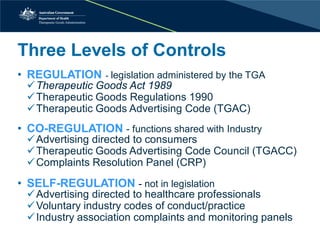
Three Levels of Controls 
• 
REGULATION - legislation administered by the TGA 
 
Therapeutic Goods Act 1989 
 
Therapeutic Goods Regulations 1990 
 
Therapeutic Goods Advertising Code (TGAC) 
•CO-REGULATION - functions shared with Industry 
Advertising directed to consumers 
Therapeutic Goods Advertising Code Council (TGACC) 
Complaints Resolution Panel (CRP) 
•SELF-REGULATION - not in legislation 
Advertising directed to healthcare professionals 
Voluntary industry codes of conduct/practice 
Industry association complaints and monitoring panels
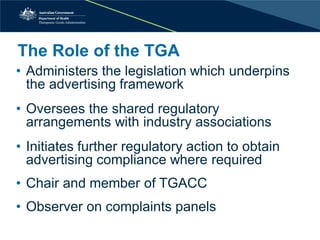
The Role of the TGA 
• 
Administers the legislation which underpins the advertising framework 
• 
Oversees the shared regulatory arrangements with industry associations 
• 
Initiates further regulatory action to obtain advertising compliance where required 
• 
Chair and member of TGACC 
• 
Observer on complaints panels
Therapeutic Goods Advertising Requirements 
• 
The advertising requirements are set out in the 
 
Therapeutic Goods Act 
 
Therapeutic Goods Regulations 
 
Therapeutic Goods Advertising Code 
 
Price Information Code of Practice 
•Advertising requirements are also set out in the Competition and Consumer Act
Therapeutic Goods Act 1989 Chapter 1- Preliminary 
• 
Important definitions listed in Section 3 - Interpretation: 
 
Therapeutic Goods 
 
Therapeutic Use 
 
Medical Device (defined in Chapter 4)
Therapeutic Goods Act 1989 
Chapter 1- Preliminary 
• 
Advertisement is defined in Section 3 - Interpretation: 
– 
“...any statement, pictorial representation or design, however made, that is intended, whether directly or indirectly, to promote the use or supply of the goods”
Therapeutic Goods Act 1989 
Chapter 4 – Medical Devices 
• 
Subsection 41ML: Offence for Medical Devices 
– 
Advertising an intended purpose not accepted in relation to the inclusion of the device in ARTG 
– 
Applies to ads for HCPs and consumers 
• 
s41FN(5) – Conditions applying automatically - Advertising material 
– 
The inclusion of a kind of medical device in the Register is subject to a condition that advertising material relating to medical devices of that kind is consistent with the intended purpose as certified under section 41FD.
Therapeutic Goods Act 1989 
Chapter 5; Part 5-1 – Advertising 
• 
Provides for: 
– 
exemption for advertisements directed exclusively to health professionals 
– 
advertising definitions 
– 
establishes the Advertising Code 
– 
prohibited and restricted representations 
– 
offences
Therapeutic Goods Regulations 1990 
• 
Part 2 
‒establishes approval scheme for certain “specified media” advertisements 
‒provides for the TGA to issue orders 
•Part 6, Divisions 2 & 3 
‒establishes TGACC & CRP and their procedures 
‒provides for the complaints register
Therapeutic Goods Advertising Code 
Object 
• 
To ensure that the marketing and advertising of therapeutic goods to consumers is conducted in a manner that promotes the quality use of therapeutic goods, is socially responsible and does not mislead or deceive the consumer 
Application 
• 
The conformity of an advertisement with the Code is assessed in terms of its probable impact upon the reasonable person to whom the advertisement is directed
Therapeutic Goods Advertising Code 
General Principles 
• 
Section 4 sets out the key requirements including that therapeutic good advertisements “must not”: 
– 
Mislead or be likely to mislead 
– 
Arouse unrealistic expectations of product effectiveness 
– 
Lead consumers to self-diagnosing, inappropriately treating or believing they have a serious disease 
– 
Abuse consumers’ trust or exploit their lack of knowledge 
– 
Encourage inappropriate or excessive use 
– 
Claim that a good is guaranteed, certain, sure cure or that the goods are completely safe or harmless 
– 
Be directed to minors (subject to exceptions).
Prohibited Representations 
Section 5(1) and Appendix 6, Part 1 of the Code 
• 
An advertisement must not contain, expressly or by implication, certain representations. Includes representations regarding abortifacient action or the treatment, cure or prevention of the following diseases: 
– 
Neoplastic disease 
– 
Sexually Transmitted Diseases (STD) 
– 
HIV AIDS and/or HCV 
– 
Mental illness 
• 
Note there are some exceptions which become restricted representations.
Restricted Representation 
Section 5(2) and Appendix 6, Part 2 of the Code 
• 
A Restricted representation in an advertisement for therapeutic goods is a reference (whether expressly or by implication) to a serious form of disease, condition, ailment or defect specified in Table 1 of the Code 
• 
An advertisement that refers to a restricted representation requires approval for the reference before the advertisement is published or broadcast
• 
Legislative requirements: 
‒ 
Set out in Chapter 5, Part 5-1, Division 3 of the Therapeutic Goods Act 1989 
‒ 
Specifically, section 42DD through to s.42DK 
Applying for approval to make a Restricted Representation
Advertising Complaints 
• 
Complaints about medical device advertisements directed to the public that do not comply with the advertising requirements can be made to the: 
 
Complaints Resolution Panel – TV, radio, newspapers, magazines, cinemas, posters 
 
Medical Technology Association of Australia – in-store material, brochures 
 
Therapeutic Goods Administration
Advertising Compliance 
• 
Complaints considered by the Complaints Resolution Panel may result in the advertiser being requested to take certain actions 
• 
The Panel may make a recommendation to the Secretary of the Department of Health (TGA) 
– 
where the Advertiser fails to respond, or fails to indicate an intention to comply fully with Panel’s requests
Recommendations to Secretary 
• 
The Panel may recommend that Secretary orders the Advertiser to 
– 
withdraw an advertisement 
– 
withdraw claim or representation 
– 
publish a retraction or correction 
• 
May also recommend that the Secretary take other regulatory actions
The Secretary’s Order 
• 
Secretary’s delegate in TGA reviews afresh the complaint and the Panel’s findings 
• 
Based on this review the delegate may decide to order the Advertiser under regulation 9 to 
‒withdraw an advertisement 
‒withdraw claim or representation 
‒publish a retraction or correction 
•Consequences of non-compliance with order and rights for ‘review’ advised
Advertising Tips 
1. 
Hold the appropriate level of evidence 
2. 
Claims must be consistent with intended purpose 
3. 
No references to prohibited or unapproved restricted representations, “TGA approved” or to the product being safe 
4. 
Endorsements and testimonials must comply fully with the Code 
5. 
Include mandatory warning statements
Advertising Medical Devices to Consumers: Complying with the legislation

Advertising Medical Devices to Consumers: Complying with the legislation

  • 1.
    Advertising Medical Devicesto Consumers Complying with the legislation Mick O’Connor Director Recalls & Advertising Section Office of Product Review Monitoring and Compliance Group ARCS – Training – 26 November 2014
  • 2.
    Outline of presentation  Overview of the therapeutic goods consumer advertising requirements TGA’s approach to advertising compliance 1
  • 3.
    Three Levels ofControls • REGULATION - legislation administered by the TGA  Therapeutic Goods Act 1989  Therapeutic Goods Regulations 1990  Therapeutic Goods Advertising Code (TGAC) •CO-REGULATION - functions shared with Industry Advertising directed to consumers Therapeutic Goods Advertising Code Council (TGACC) Complaints Resolution Panel (CRP) •SELF-REGULATION - not in legislation Advertising directed to healthcare professionals Voluntary industry codes of conduct/practice Industry association complaints and monitoring panels
  • 4.
    The Role ofthe TGA • Administers the legislation which underpins the advertising framework • Oversees the shared regulatory arrangements with industry associations • Initiates further regulatory action to obtain advertising compliance where required • Chair and member of TGACC • Observer on complaints panels
  • 5.
    Therapeutic Goods AdvertisingRequirements • The advertising requirements are set out in the  Therapeutic Goods Act  Therapeutic Goods Regulations  Therapeutic Goods Advertising Code  Price Information Code of Practice •Advertising requirements are also set out in the Competition and Consumer Act
  • 6.
    Therapeutic Goods Act1989 Chapter 1- Preliminary • Important definitions listed in Section 3 - Interpretation:  Therapeutic Goods  Therapeutic Use  Medical Device (defined in Chapter 4)
  • 7.
    Therapeutic Goods Act1989 Chapter 1- Preliminary • Advertisement is defined in Section 3 - Interpretation: – “...any statement, pictorial representation or design, however made, that is intended, whether directly or indirectly, to promote the use or supply of the goods”
  • 8.
    Therapeutic Goods Act1989 Chapter 4 – Medical Devices • Subsection 41ML: Offence for Medical Devices – Advertising an intended purpose not accepted in relation to the inclusion of the device in ARTG – Applies to ads for HCPs and consumers • s41FN(5) – Conditions applying automatically - Advertising material – The inclusion of a kind of medical device in the Register is subject to a condition that advertising material relating to medical devices of that kind is consistent with the intended purpose as certified under section 41FD.
  • 9.
    Therapeutic Goods Act1989 Chapter 5; Part 5-1 – Advertising • Provides for: – exemption for advertisements directed exclusively to health professionals – advertising definitions – establishes the Advertising Code – prohibited and restricted representations – offences
  • 10.
    Therapeutic Goods Regulations1990 • Part 2 ‒establishes approval scheme for certain “specified media” advertisements ‒provides for the TGA to issue orders •Part 6, Divisions 2 & 3 ‒establishes TGACC & CRP and their procedures ‒provides for the complaints register
  • 11.
    Therapeutic Goods AdvertisingCode Object • To ensure that the marketing and advertising of therapeutic goods to consumers is conducted in a manner that promotes the quality use of therapeutic goods, is socially responsible and does not mislead or deceive the consumer Application • The conformity of an advertisement with the Code is assessed in terms of its probable impact upon the reasonable person to whom the advertisement is directed
  • 12.
    Therapeutic Goods AdvertisingCode General Principles • Section 4 sets out the key requirements including that therapeutic good advertisements “must not”: – Mislead or be likely to mislead – Arouse unrealistic expectations of product effectiveness – Lead consumers to self-diagnosing, inappropriately treating or believing they have a serious disease – Abuse consumers’ trust or exploit their lack of knowledge – Encourage inappropriate or excessive use – Claim that a good is guaranteed, certain, sure cure or that the goods are completely safe or harmless – Be directed to minors (subject to exceptions).
  • 13.
    Prohibited Representations Section5(1) and Appendix 6, Part 1 of the Code • An advertisement must not contain, expressly or by implication, certain representations. Includes representations regarding abortifacient action or the treatment, cure or prevention of the following diseases: – Neoplastic disease – Sexually Transmitted Diseases (STD) – HIV AIDS and/or HCV – Mental illness • Note there are some exceptions which become restricted representations.
  • 14.
    Restricted Representation Section5(2) and Appendix 6, Part 2 of the Code • A Restricted representation in an advertisement for therapeutic goods is a reference (whether expressly or by implication) to a serious form of disease, condition, ailment or defect specified in Table 1 of the Code • An advertisement that refers to a restricted representation requires approval for the reference before the advertisement is published or broadcast
  • 15.
    • Legislative requirements: ‒ Set out in Chapter 5, Part 5-1, Division 3 of the Therapeutic Goods Act 1989 ‒ Specifically, section 42DD through to s.42DK Applying for approval to make a Restricted Representation
  • 16.
    Advertising Complaints • Complaints about medical device advertisements directed to the public that do not comply with the advertising requirements can be made to the:  Complaints Resolution Panel – TV, radio, newspapers, magazines, cinemas, posters  Medical Technology Association of Australia – in-store material, brochures  Therapeutic Goods Administration
  • 17.
    Advertising Compliance • Complaints considered by the Complaints Resolution Panel may result in the advertiser being requested to take certain actions • The Panel may make a recommendation to the Secretary of the Department of Health (TGA) – where the Advertiser fails to respond, or fails to indicate an intention to comply fully with Panel’s requests
  • 18.
    Recommendations to Secretary • The Panel may recommend that Secretary orders the Advertiser to – withdraw an advertisement – withdraw claim or representation – publish a retraction or correction • May also recommend that the Secretary take other regulatory actions
  • 19.
    The Secretary’s Order • Secretary’s delegate in TGA reviews afresh the complaint and the Panel’s findings • Based on this review the delegate may decide to order the Advertiser under regulation 9 to ‒withdraw an advertisement ‒withdraw claim or representation ‒publish a retraction or correction •Consequences of non-compliance with order and rights for ‘review’ advised
  • 20.
    Advertising Tips 1. Hold the appropriate level of evidence 2. Claims must be consistent with intended purpose 3. No references to prohibited or unapproved restricted representations, “TGA approved” or to the product being safe 4. Endorsements and testimonials must comply fully with the Code 5. Include mandatory warning statements