Advertising Compliance
Ensuring you are code compliant
Nicole McLay
Assistant Secretary
Regulatory Education and Compliance Branch
Regulatory Practice and Support Division, TGA
ARCS Annual Conference
21 August 2018
About the Advertising Code
• The cornerstone of the advertising framework - advertising to the public
for therapeutic goods MUST comply with the Code
‒ Therapeutic Goods Act 1989 – s.42DM (criminal offence) and
s.42DMA (civil penalties)
• Advertising must support appropriate use of therapeutic goods and
must not mislead or deceive the consumer
• New Code (2018) takes effect on 1 January 2019
‒ Six month transition period allows for education
2015 v 2018 Code
Key differences
2018 Code guidance
• 2018 Code will be supported by specific guidance
• Guidance provides more information on the application of Code
provisions, using examples where possible
• Initial version of guidance consulted on with Code in April
• A consultation on updated version is now open
• Will be finalised before 2018 Code takes effect
• Intended to be a ‘living’ document with updates as needed
Key general differences: 2015 v 2018 Codes
• Objective requirements for ‘prominently displayed or
communicated’ (s.4)
• Clearer requirements for what information must be included in
advertising (s.11, 12, 13, 14)
• Amended endorsement and testimonial requirements (s.16, 17)
• Explicit requirement to identify traditional evidence and paradigm
where used as basis for advertising (s.23)
Key specific differences: 2015 v 2018 Codes
• Advertising must not be inconsistent with current public health
campaigns (s.21)
• New mandatory statement for S3 medicines advertising (s.14)
• Explicit sunscreen requirements to reinforce public health messages
(s.27)
• New criteria for restricted representations (s.28)
• Incorporation of the Price Information Code of Practice for providing
prescription medicine prices to consumers (Schedule 1)
Representations that include
comparisons
Comparative representations – competitor complaints
• Comparison style advertisements raise complex issues
• We triage complaints and prioritise cases according to our model:
– We assess complaints on the merits of the case
– We are not the arbiters of commercial disputes
• Comparisons are permitted, where the science supports the
comparison but advertisers must take care in making such claims
• Even where well evidenced if the statements are likely to confuse a
reasonable consumer, we may find them in breach
Complaints handling
arrangements
Complaints handling processes from 1 July 2018
• Consultation on proposed complaints handling model closed 4 June
• The consultation model set out:
– How complaints will be handled
– Prioritisation by nature of breach and likely public health impact
– Possible consequences of non-compliance based on priority
(including the use of sanctions and penalties)
– KPIs & approach to publication of complaint outcomes
• We are continuing to refine how we triage, prioritise and handle
complaints
Approach to complaints handling
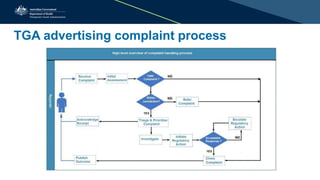
• Initial assessment of complaints
– trivial or vexatious complaints not considered
– complaints outside TGA jurisdiction referred to correct body
– following initial assessment, complaint is triaged & prioritised
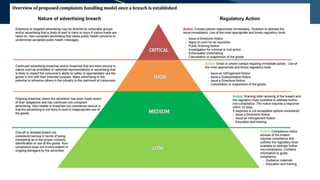
• Action taken will depend on priority
• More serious actions (e.g. direction, infringement notice or
court action) won’t happen without prior contact from the TGA
TGA advertising complaint process
Triage and prioritisation
• Key considerations impacting on prioritisation:
– whether the claims made or reliance on the claims made in the
advertisement likely to cause public harm
– impact on the ability of consumers to safely and appropriately use
goods for their intended purpose
– frequency and likely impact of the non-compliant advertising and its
influence on other advertisers to the detriment of consumers
– Advertiser’s previous conduct & awareness of their obligations
• Other factors may be taken into account on a case by case basis
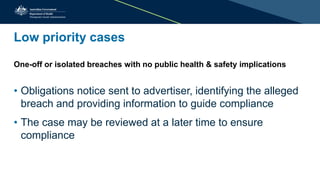
Low priority cases
One-off or isolated breaches with no public health & safety implications
• Obligations notice sent to advertiser, identifying the alleged
breach and providing information to guide compliance
• The case may be reviewed at a later time to ensure
compliance
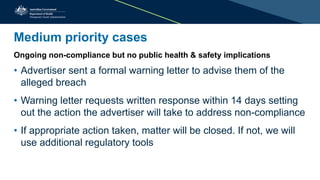
Medium priority cases
Ongoing non-compliance but no public health & safety implications
• Advertiser sent a formal warning letter to advise them of the
alleged breach
• Warning letter requests written response within 14 days setting
out the action the advertiser will take to address non-compliance
• If appropriate action taken, matter will be closed. If not, we will
use additional regulatory tools
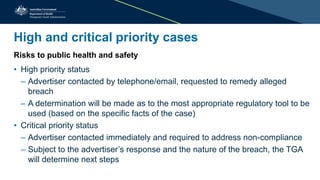
High and critical priority cases
Risks to public health and safety
• High priority status
– Advertiser contacted by telephone/email, requested to remedy alleged
breach
– A determination will be made as to the most appropriate regulatory tool to be
used (based on the specific facts of the case)
• Critical priority status
– Advertiser contacted immediately and required to address non-compliance
– Subject to the advertiser’s response and the nature of the breach, the TGA
will determine next steps
Publication of actions
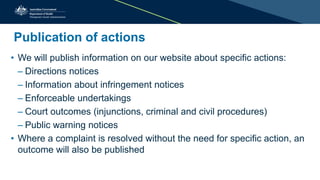
• We will publish information on our website about specific actions:
– Directions notices
– Information about infringement notices
– Enforceable undertakings
– Court outcomes (injunctions, criminal and civil procedures)
– Public warning notices
• Where a complaint is resolved without the need for specific action, an
outcome will also be published
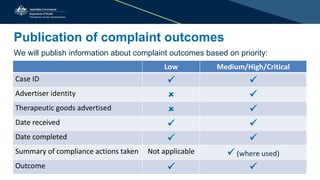
Publication of complaint outcomes
We will publish information about complaint outcomes based on priority:
Low Medium/High/Critical
Case ID  
Advertiser identity  
Therapeutic goods advertised  
Date received  
Date completed  
Summary of compliance actions taken Not applicable  (where used)
Outcome  
Meeting your obligations
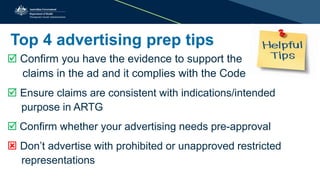
Top 4 advertising prep tips
 Confirm you have the evidence to support the
claims in the ad and it complies with the Code
 Ensure claims are consistent with indications/intended
purpose in ARTG
 Confirm whether your advertising needs pre-approval
 Don’t advertise with prohibited or unapproved restricted
representations
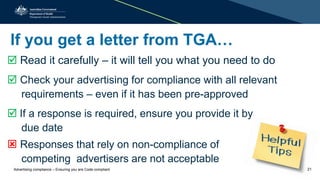
If you get a letter from TGA…
 Read it carefully – it will tell you what you need to do
 Check your advertising for compliance with all relevant
requirements – even if it has been pre-approved
 If a response is required, ensure you provide it by
due date
 Responses that rely on non-compliance of
competing advertisers are not acceptable
Advertising compliance – Ensuring you are Code compliant 21
Where can I find out more?
• The onus is on the advertisers of therapeutic goods to ensure that they are
aware of and are compliant with their obligations.
• We provide a range of tools to assist advertisers in managing their
compliance, including:
– E-learning modules
– Webinars/roadshows
– Advertising hub:
https://www.tga.gov.au/advertising-hub
– Contact: TGA.Advertising@tga.gov.au
Advertising compliance – Ensuring you are Code compliant 22
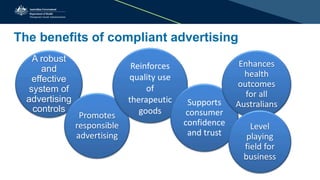
The benefits of compliant advertising
A robust
and
effective
system of
advertising
controls
Promotes
responsible
advertising
Reinforces
quality use
of
therapeutic
goods
Supports
consumer
confidence
and trust
Enhances
health
outcomes
for all
Australians
Level
playing
field for
business
Presentation: Advertising compliance - Ensuring you are code compliant

Presentation: Advertising compliance - Ensuring you are code compliant

  • 1.
    Advertising Compliance Ensuring youare code compliant Nicole McLay Assistant Secretary Regulatory Education and Compliance Branch Regulatory Practice and Support Division, TGA ARCS Annual Conference 21 August 2018
  • 2.
    About the AdvertisingCode • The cornerstone of the advertising framework - advertising to the public for therapeutic goods MUST comply with the Code ‒ Therapeutic Goods Act 1989 – s.42DM (criminal offence) and s.42DMA (civil penalties) • Advertising must support appropriate use of therapeutic goods and must not mislead or deceive the consumer • New Code (2018) takes effect on 1 January 2019 ‒ Six month transition period allows for education
  • 3.
    2015 v 2018Code Key differences
  • 4.
    2018 Code guidance •2018 Code will be supported by specific guidance • Guidance provides more information on the application of Code provisions, using examples where possible • Initial version of guidance consulted on with Code in April • A consultation on updated version is now open • Will be finalised before 2018 Code takes effect • Intended to be a ‘living’ document with updates as needed
  • 5.
    Key general differences:2015 v 2018 Codes • Objective requirements for ‘prominently displayed or communicated’ (s.4) • Clearer requirements for what information must be included in advertising (s.11, 12, 13, 14) • Amended endorsement and testimonial requirements (s.16, 17) • Explicit requirement to identify traditional evidence and paradigm where used as basis for advertising (s.23)
  • 6.
    Key specific differences:2015 v 2018 Codes • Advertising must not be inconsistent with current public health campaigns (s.21) • New mandatory statement for S3 medicines advertising (s.14) • Explicit sunscreen requirements to reinforce public health messages (s.27) • New criteria for restricted representations (s.28) • Incorporation of the Price Information Code of Practice for providing prescription medicine prices to consumers (Schedule 1)
  • 7.
  • 8.
    Comparative representations –competitor complaints • Comparison style advertisements raise complex issues • We triage complaints and prioritise cases according to our model: – We assess complaints on the merits of the case – We are not the arbiters of commercial disputes • Comparisons are permitted, where the science supports the comparison but advertisers must take care in making such claims • Even where well evidenced if the statements are likely to confuse a reasonable consumer, we may find them in breach
  • 9.
  • 10.
    Complaints handling processesfrom 1 July 2018 • Consultation on proposed complaints handling model closed 4 June • The consultation model set out: – How complaints will be handled – Prioritisation by nature of breach and likely public health impact – Possible consequences of non-compliance based on priority (including the use of sanctions and penalties) – KPIs & approach to publication of complaint outcomes • We are continuing to refine how we triage, prioritise and handle complaints
  • 11.
    Approach to complaintshandling • Initial assessment of complaints – trivial or vexatious complaints not considered – complaints outside TGA jurisdiction referred to correct body – following initial assessment, complaint is triaged & prioritised • Action taken will depend on priority • More serious actions (e.g. direction, infringement notice or court action) won’t happen without prior contact from the TGA
  • 12.
  • 13.
    Triage and prioritisation •Key considerations impacting on prioritisation: – whether the claims made or reliance on the claims made in the advertisement likely to cause public harm – impact on the ability of consumers to safely and appropriately use goods for their intended purpose – frequency and likely impact of the non-compliant advertising and its influence on other advertisers to the detriment of consumers – Advertiser’s previous conduct & awareness of their obligations • Other factors may be taken into account on a case by case basis
  • 14.
    Low priority cases One-offor isolated breaches with no public health & safety implications • Obligations notice sent to advertiser, identifying the alleged breach and providing information to guide compliance • The case may be reviewed at a later time to ensure compliance
  • 15.
    Medium priority cases Ongoingnon-compliance but no public health & safety implications • Advertiser sent a formal warning letter to advise them of the alleged breach • Warning letter requests written response within 14 days setting out the action the advertiser will take to address non-compliance • If appropriate action taken, matter will be closed. If not, we will use additional regulatory tools
  • 16.
    High and criticalpriority cases Risks to public health and safety • High priority status – Advertiser contacted by telephone/email, requested to remedy alleged breach – A determination will be made as to the most appropriate regulatory tool to be used (based on the specific facts of the case) • Critical priority status – Advertiser contacted immediately and required to address non-compliance – Subject to the advertiser’s response and the nature of the breach, the TGA will determine next steps
  • 18.
    Publication of actions •We will publish information on our website about specific actions: – Directions notices – Information about infringement notices – Enforceable undertakings – Court outcomes (injunctions, criminal and civil procedures) – Public warning notices • Where a complaint is resolved without the need for specific action, an outcome will also be published
  • 19.
    Publication of complaintoutcomes We will publish information about complaint outcomes based on priority: Low Medium/High/Critical Case ID   Advertiser identity   Therapeutic goods advertised   Date received   Date completed   Summary of compliance actions taken Not applicable  (where used) Outcome  
  • 20.
  • 21.
    Top 4 advertisingprep tips  Confirm you have the evidence to support the claims in the ad and it complies with the Code  Ensure claims are consistent with indications/intended purpose in ARTG  Confirm whether your advertising needs pre-approval  Don’t advertise with prohibited or unapproved restricted representations
  • 22.
    If you geta letter from TGA…  Read it carefully – it will tell you what you need to do  Check your advertising for compliance with all relevant requirements – even if it has been pre-approved  If a response is required, ensure you provide it by due date  Responses that rely on non-compliance of competing advertisers are not acceptable Advertising compliance – Ensuring you are Code compliant 21
  • 23.
    Where can Ifind out more? • The onus is on the advertisers of therapeutic goods to ensure that they are aware of and are compliant with their obligations. • We provide a range of tools to assist advertisers in managing their compliance, including: – E-learning modules – Webinars/roadshows – Advertising hub: https://www.tga.gov.au/advertising-hub – Contact: TGA.Advertising@tga.gov.au Advertising compliance – Ensuring you are Code compliant 22
  • 24.
    The benefits ofcompliant advertising A robust and effective system of advertising controls Promotes responsible advertising Reinforces quality use of therapeutic goods Supports consumer confidence and trust Enhances health outcomes for all Australians Level playing field for business

Editor's Notes

  • #3 Advertising is regulated to protect the health and safety of Australian consumers of therapeutic goods The current version of the Code is the 2015 version, which is essentially the same in requirements as the 2007 version. So it’s been a long time since there were any substantive changes to the Code There may be a need for some minor refinements to the 2018 Code prior to 1 January 2019 (e.g. if we identify any issues arising from the guidance consultation)
  • #5 For the 2018 Code, TGA is producing specific and comprehensive guidance to assist advertisers in navigating and understanding the Code. We haven’t produced such guidance for previous versions of the Code so this is new territory. You might be aware that we consulted on the draft 2018 Code and preliminary guidance in April 2018. The guidance has been updated to include feedback from that consultation and reflect the 2018 Code as made The Code guidance will also need to be updated to capture the changes to the Code arising from the consultation. Amended Code guidance is the subject of a further public consultation that’s now open. We are expecting the guidance to be a ‘living document’ that evolves as we identify particular issues that need clarification or further guidance
  • #6  S23 – Explicit requirement to identify traditional evidence and paradigm where used as basis for advertising If an advertisement for a complementary medicine includes a claim based on evidence of a history of traditional use and paradigm, the reliance on this traditional use must be disclosed in the advertisement and disclosure must be displayed or communicated in the advertisement. Where the advertiser is relying on traditional evidence to support an indication referenced in an advertisement, the advertiser must clearly disclose to the viewer that this is the case and identify the paradigm of the traditional use. This information must be clearly disclosed in the advertisement. Paradigms include, but are not limited to: Traditional Chinese Medicine Ayurvedic medicine Western herbal medicine. Where evidence from multiple paradigms is relied upon, the advertisement needs to clearly disclose this and link the appropriate paradigm to the appropriate indication, and if needed, the ingredient.
  • #7 21 – Advertising must not be inconsistent with current public health campaigns This is a new provision for the Advertising Code. The department of health is currently running campaigns associated with a Bowel Screening Campaign. An example of an advertisement that may offend this provision would be where a good was advertised as providing home testing kits only requiring use every 5 years. This would offend a number of the provisions of the code, but is contrary to the current campaign messaging that encourages those over 50 to use a government supplied testing kit, for use every two years. S16,17 – amended endorsement and testimonial requirements Provisions of the 2015 Code have been updated, but still address endorsement by government bodies. These sorts of endorsements are prohibited. Testimonials are now addressed in a separate section (s17). This section is similar to the previous s4(7), but now has improved clarity. Testimonials are used by advertisers to verify and normalise the use of a product and provide what appears to be ‘objective’ statements of the effiacy of a product. We do examine these for compliance. It is critical that the provision of a testimonial is independent and not subject to any type of inducement.
  • #9 One of the most challenging areas for sponsors, and us are advertisements that include comparative representations. When advertisers use comparators in their advertising we tend to receive a flurry of competitor complaints. Today is an opportunity to thoroughly explain how the provisions relating to comparisons work, our role in assessing complaints relating to these advertisements and how to avoid falling foul of the Code: Clause 4(1)(b) – an advertisement of therapeutic goods must contain correct and balanced statements only and claims which the sponsor has already verified. Clause 4(2)(c) - an advertisement of therapeutic goods must not mislead, or be likely to mislead, directly or by implication or through emphasis, comparisons, contrasts or omissions; and Clause 4(5) - comparative advertisements must be balanced and must not be misleading or likely to be misleading, either about the therapeutic goods advertised or the therapeutic goods, or classes of therapeutic goods, with which it is compared. Points of comparison should be factual and reflect the body of scientific evidence. Comparisons should not imply that the therapeutic goods, or classes of therapeutic goods, with which comparison is made, are harmful or ineffectual. Evidence, depending on the nature of the therapeutic use claim and the good/s being advertised may comprise: Clinical study reports on the actual therapeutic good being advertised If clinical data is not available on the actual therapeutic good, a justification and reference to ingredients (for medicines) or to similar devices (for medical devices) Literature reviews Objective critical review of all data presented by a clinical expert It should be noted that even when a claim can be substantiated by evidence, it may nevertheless be deemed to be misleading and/or unbalanced or, in the case of goods included in the ARTG, may not be consistent with the entry for the good in relation to that inclusion. While it may be acceptable for an advertisement to make a comparison between therapeutic goods or classes of therapeutic goods the advertiser must ensure that comparative claims do not expressly or by implication lead the audience to a view that the comparator goods are harmful or ineffectual. This applies to therapeutic comparative claims and non-therapeutic comparative claims.
  • #11 Mention new IT system being built to support process and improved reporting We will publish statistical information twice per year (as part of the TGA’s existing external reporting commitment). Some case outcomes will be published on the TGA website (covered later in this presentation).
  • #14 Strong triage process weighing a range of considerations will inform how we progress complaints. Considerations may include: The degree of contravention of the advertisement Public health considerations, such as vulnerability of target market Proliferation of a product Prior conduct of the advertiser, including whether they have previously breached the advertising code and been made aware of their obligations Sector behavior Responsiveness of an advertiser to notification about their obligations
  • #23 If you receive a letter from the TGA about your advertising, here is what you should do.
  • #25 These are the key outcomes of a well developed advertising system – read the bubbles Such a system minimises the impact on consumers and public health from exposure to any misleading or inaccurate advertising