Even Swaps Method
Pairwise comparison charts
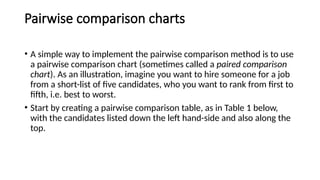
• A simple way to implement the pairwise comparison method is to use
a pairwise comparison chart (sometimes called a paired comparison
chart). As an illustration, imagine you want to hire someone for a job
from a short-list of five candidates, who you want to rank from first to
fifth, i.e. best to worst.
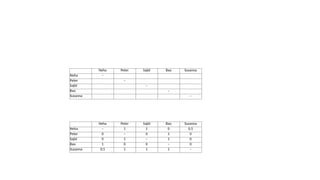
• Start by creating a pairwise comparison table, as in Table 1 below,
with the candidates listed down the left hand-side and also along the
top.
Neha Peter Sajid Bao Susanna
Neha –
Peter –
Sajid –
Bao –
Susanna –
Neha Peter Sajid Bao Susanna
Neha – 1 1 0 0,5
Peter 0 – 0 1 0
Sajid 0 1 – 1 0
Bao 1 0 0 – 0
Susanna 0,5 1 1 1 –
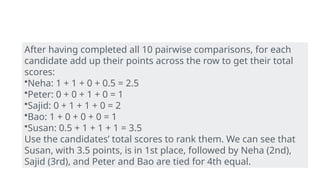
After having completed all 10 pairwise comparisons, for each
candidate add up their points across the row to get their total
scores:
•Neha: 1 + 1 + 0 + 0.5 = 2.5
•Peter: 0 + 0 + 1 + 0 = 1
•Sajid: 0 + 1 + 1 + 0 = 2
•Bao: 1 + 0 + 0 + 0 = 1
•Susan: 0.5 + 1 + 1 + 1 = 3.5
Use the candidates’ total scores to rank them. We can see that
Susan, with 3.5 points, is in 1st place, followed by Neha (2nd),
Sajid (3rd), and Peter and Bao are tied for 4th equal.
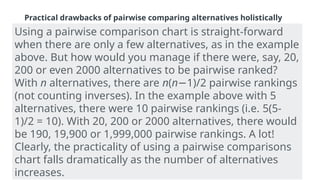
Practical drawbacks of pairwise comparing alternatives holistically
Using a pairwise comparison chart is straight-forward
when there are only a few alternatives, as in the example
above. But how would you manage if there were, say, 20,
200 or even 2000 alternatives to be pairwise ranked?
With n alternatives, there are n(n 1)/2
− pairwise rankings
(not counting inverses). In the example above with 5
alternatives, there were 10 pairwise rankings (i.e. 5(5-
1)/2 = 10). With 20, 200 or 2000 alternatives, there would
be 190, 19,900 or 1,999,000 pairwise rankings. A lot!
Clearly, the practicality of using a pairwise comparisons
chart falls dramatically as the number of alternatives
increases.
The concept
• Firstly, a fundamental principle of decision making: if all alternatives are
rated equally for a given objective, then you can ignore that objective in
making your decision [1].
• “The even swap method provides a way to adjust the consequences of
different alternatives in order to render them equivalent in terms of a given
objective. Thus this objective becomes irrelevant. As its name implies, an
even swap increases the value of an alternative in terms of one objective
while decreasing its value by an equivalent amount in terms of another
objective. In essence, the even swap method is a form of bartering – it forces
you to think about the value of one objective in terms of another” [2].
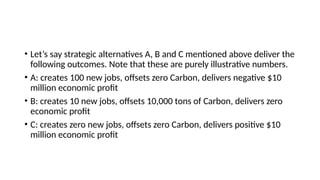
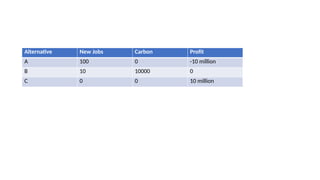
• Let’s say strategic alternatives A, B and C mentioned above deliver the
following outcomes. Note that these are purely illustrative numbers.
• A: creates 100 new jobs, offsets zero Carbon, delivers negative $10
million economic profit
• B: creates 10 new jobs, offsets 10,000 tons of Carbon, delivers zero
economic profit
• C: creates zero new jobs, offsets zero Carbon, delivers positive $10
million economic profit
Alternative New Jobs Carbon Profit
A 100 0 -10 million
B 10 10000 0
C 0 0 10 million
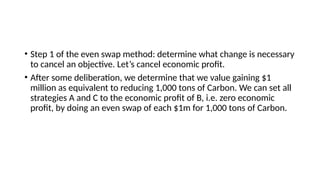
• Step 1 of the even swap method: determine what change is necessary
to cancel an objective. Let’s cancel economic profit.
• After some deliberation, we determine that we value gaining $1
million as equivalent to reducing 1,000 tons of Carbon. We can set all
strategies A and C to the economic profit of B, i.e. zero economic
profit, by doing an even swap of each $1m for 1,000 tons of Carbon.
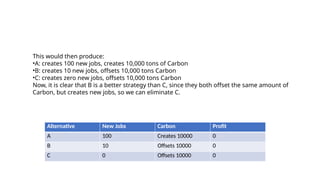
Alternative New Jobs Carbon Profit
A 100 Creates 10000 0
B 10 Offsets 10000 0
C 0 Offsets 10000 0
This would then produce:
•A: creates 100 new jobs, creates 10,000 tons of Carbon
•B: creates 10 new jobs, offsets 10,000 tons Carbon
•C: creates zero new jobs, offsets 10,000 tons Carbon
Now, it is clear that B is a better strategy than C, since they both offset the same amount of
Carbon, but creates new jobs, so we can eliminate C.
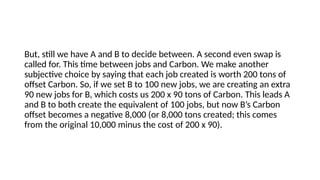
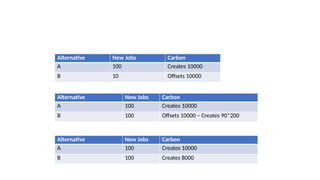
But, still we have A and B to decide between. A second even swap is
called for. This time between jobs and Carbon. We make another
subjective choice by saying that each job created is worth 200 tons of
offset Carbon. So, if we set B to 100 new jobs, we are creating an extra
90 new jobs for B, which costs us 200 x 90 tons of Carbon. This leads A
and B to both create the equivalent of 100 jobs, but now B’s Carbon
offset becomes a negative 8,000 (or 8,000 tons created; this comes
from the original 10,000 minus the cost of 200 x 90).
Alternative New Jobs Carbon
A 100 Creates 10000
B 10 Offsets 10000
Alternative New Jobs Carbon
A 100 Creates 10000
B 100 Offsets 10000 – Creates 90*200
Alternative New Jobs Carbon
A 100 Creates 10000
B 100 Creates 8000
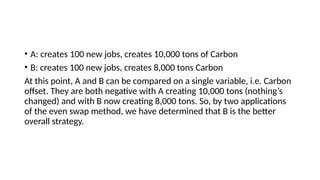
• A: creates 100 new jobs, creates 10,000 tons of Carbon
• B: creates 100 new jobs, creates 8,000 tons Carbon
At this point, A and B can be compared on a single variable, i.e. Carbon
offset. They are both negative with A creating 10,000 tons (nothing’s
changed) and with B now creating 8,000 tons. So, by two applications
of the even swap method, we have determined that B is the better
overall strategy.
• In closing, “The even swap method will not make complex decisions
easy; you’ll still have to make hard choices about the values you set
and the trades you make. What it does provide is a reliable
mechanism for making trades and a coherent framework in which to
make them” [1].
• Postscript 1: if this technique reminds you of the Benjamin Franklin
technique, you’re quite right as the even swap method was informed by this.
• Postscript 2: if you’re wondering why not just use weightings for each of the
objectives, then I should remind you of a great quote by
Kahneman: “Hypothesis testing can be completely contaminated if the
organization knows the answer that the leader wants to get” [3].
• Weighting the objectives is a sure-fire way of manipulating the process to
achieve the outcome you want – I’ve seen this more than once at my
clients. The even swap method also has some vulnerability to this form of
manipulation, sigh, but it is better in it that forces swaps to be explicitly
defined and hence justified.
References:
• [1] “Even Swaps: A Rational Method for Making Trade-offs”,
Hammond, Keeney and Raiffa
• [2] “Smart Choices”, Hammond, Keeney and Raiffa
• [3] “Strategic decisions: When can you trust your gut?”, McKinsey
Quarterly
• [4] Pairwise comparison method & pairwise ranking | 1000minds
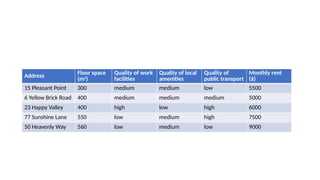
Address Floor space
(m2
)
Quality of work
facilities
Quality of local
amenities
Quality of
public transport
Monthly rent
($)
15 Pleasant Point 300 medium medium low 5500
6 Yellow Brick Road 400 medium medium medium 5000
23 Happy Valley 400 high low high 6000
77 Sunshine Lane 550 low medium high 7500
50 Heavenly Way 560 low medium low 9000
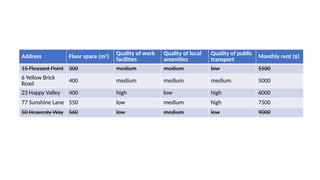
Address Floor space (m2
) Quality of work
facilities
Quality of local
amenities
Quality of public
transport
Monthly rent ($)
15 Pleasant Point 300 medium medium low 5500
6 Yellow Brick
Road 400 medium medium medium 5000
23 Happy Valley 400 high low high 6000
77 Sunshine Lane 550 low medium high 7500
50 Heavenly Way 560 low medium low 9000
Address
Floor space
(m2
)
Quality of
work facilities
Quality of
local
amenities
Quality of
public
transport
Monthly rent
($)
6 Yellow Brick
Road
400 medium medium medium [high] 5000 [6000]
23 Happy
Valley
400 high low high 6000
77 Sunshine
Lane 550 [400] low medium high 7500 [6000]
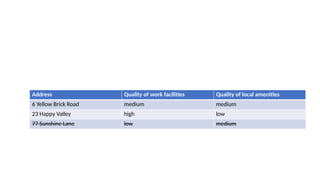
Address Quality of work facilities Quality of local amenities
6 Yellow Brick Road medium medium
23 Happy Valley high low
77 Sunshine Lane low medium

Even Swaps Method in Multicriteria Decison Making

  • 1.
  • 2.
    Pairwise comparison charts •A simple way to implement the pairwise comparison method is to use a pairwise comparison chart (sometimes called a paired comparison chart). As an illustration, imagine you want to hire someone for a job from a short-list of five candidates, who you want to rank from first to fifth, i.e. best to worst. • Start by creating a pairwise comparison table, as in Table 1 below, with the candidates listed down the left hand-side and also along the top.
  • 3.
    Neha Peter SajidBao Susanna Neha – Peter – Sajid – Bao – Susanna – Neha Peter Sajid Bao Susanna Neha – 1 1 0 0,5 Peter 0 – 0 1 0 Sajid 0 1 – 1 0 Bao 1 0 0 – 0 Susanna 0,5 1 1 1 –
  • 4.
    After having completedall 10 pairwise comparisons, for each candidate add up their points across the row to get their total scores: •Neha: 1 + 1 + 0 + 0.5 = 2.5 •Peter: 0 + 0 + 1 + 0 = 1 •Sajid: 0 + 1 + 1 + 0 = 2 •Bao: 1 + 0 + 0 + 0 = 1 •Susan: 0.5 + 1 + 1 + 1 = 3.5 Use the candidates’ total scores to rank them. We can see that Susan, with 3.5 points, is in 1st place, followed by Neha (2nd), Sajid (3rd), and Peter and Bao are tied for 4th equal.
  • 5.
    Practical drawbacks ofpairwise comparing alternatives holistically Using a pairwise comparison chart is straight-forward when there are only a few alternatives, as in the example above. But how would you manage if there were, say, 20, 200 or even 2000 alternatives to be pairwise ranked? With n alternatives, there are n(n 1)/2 − pairwise rankings (not counting inverses). In the example above with 5 alternatives, there were 10 pairwise rankings (i.e. 5(5- 1)/2 = 10). With 20, 200 or 2000 alternatives, there would be 190, 19,900 or 1,999,000 pairwise rankings. A lot! Clearly, the practicality of using a pairwise comparisons chart falls dramatically as the number of alternatives increases.
  • 6.
    The concept • Firstly,a fundamental principle of decision making: if all alternatives are rated equally for a given objective, then you can ignore that objective in making your decision [1]. • “The even swap method provides a way to adjust the consequences of different alternatives in order to render them equivalent in terms of a given objective. Thus this objective becomes irrelevant. As its name implies, an even swap increases the value of an alternative in terms of one objective while decreasing its value by an equivalent amount in terms of another objective. In essence, the even swap method is a form of bartering – it forces you to think about the value of one objective in terms of another” [2].
  • 7.
    • Let’s saystrategic alternatives A, B and C mentioned above deliver the following outcomes. Note that these are purely illustrative numbers. • A: creates 100 new jobs, offsets zero Carbon, delivers negative $10 million economic profit • B: creates 10 new jobs, offsets 10,000 tons of Carbon, delivers zero economic profit • C: creates zero new jobs, offsets zero Carbon, delivers positive $10 million economic profit
  • 8.
    Alternative New JobsCarbon Profit A 100 0 -10 million B 10 10000 0 C 0 0 10 million
  • 9.
    • Step 1of the even swap method: determine what change is necessary to cancel an objective. Let’s cancel economic profit. • After some deliberation, we determine that we value gaining $1 million as equivalent to reducing 1,000 tons of Carbon. We can set all strategies A and C to the economic profit of B, i.e. zero economic profit, by doing an even swap of each $1m for 1,000 tons of Carbon.
  • 10.
    Alternative New JobsCarbon Profit A 100 Creates 10000 0 B 10 Offsets 10000 0 C 0 Offsets 10000 0 This would then produce: •A: creates 100 new jobs, creates 10,000 tons of Carbon •B: creates 10 new jobs, offsets 10,000 tons Carbon •C: creates zero new jobs, offsets 10,000 tons Carbon Now, it is clear that B is a better strategy than C, since they both offset the same amount of Carbon, but creates new jobs, so we can eliminate C.
  • 11.
    But, still wehave A and B to decide between. A second even swap is called for. This time between jobs and Carbon. We make another subjective choice by saying that each job created is worth 200 tons of offset Carbon. So, if we set B to 100 new jobs, we are creating an extra 90 new jobs for B, which costs us 200 x 90 tons of Carbon. This leads A and B to both create the equivalent of 100 jobs, but now B’s Carbon offset becomes a negative 8,000 (or 8,000 tons created; this comes from the original 10,000 minus the cost of 200 x 90).
  • 12.
    Alternative New JobsCarbon A 100 Creates 10000 B 10 Offsets 10000 Alternative New Jobs Carbon A 100 Creates 10000 B 100 Offsets 10000 – Creates 90*200 Alternative New Jobs Carbon A 100 Creates 10000 B 100 Creates 8000
  • 13.
    • A: creates100 new jobs, creates 10,000 tons of Carbon • B: creates 100 new jobs, creates 8,000 tons Carbon At this point, A and B can be compared on a single variable, i.e. Carbon offset. They are both negative with A creating 10,000 tons (nothing’s changed) and with B now creating 8,000 tons. So, by two applications of the even swap method, we have determined that B is the better overall strategy.
  • 14.
    • In closing,“The even swap method will not make complex decisions easy; you’ll still have to make hard choices about the values you set and the trades you make. What it does provide is a reliable mechanism for making trades and a coherent framework in which to make them” [1].
  • 15.
    • Postscript 1:if this technique reminds you of the Benjamin Franklin technique, you’re quite right as the even swap method was informed by this. • Postscript 2: if you’re wondering why not just use weightings for each of the objectives, then I should remind you of a great quote by Kahneman: “Hypothesis testing can be completely contaminated if the organization knows the answer that the leader wants to get” [3]. • Weighting the objectives is a sure-fire way of manipulating the process to achieve the outcome you want – I’ve seen this more than once at my clients. The even swap method also has some vulnerability to this form of manipulation, sigh, but it is better in it that forces swaps to be explicitly defined and hence justified.
  • 16.
    References: • [1] “EvenSwaps: A Rational Method for Making Trade-offs”, Hammond, Keeney and Raiffa • [2] “Smart Choices”, Hammond, Keeney and Raiffa • [3] “Strategic decisions: When can you trust your gut?”, McKinsey Quarterly • [4] Pairwise comparison method & pairwise ranking | 1000minds
  • 17.
    Address Floor space (m2 ) Qualityof work facilities Quality of local amenities Quality of public transport Monthly rent ($) 15 Pleasant Point 300 medium medium low 5500 6 Yellow Brick Road 400 medium medium medium 5000 23 Happy Valley 400 high low high 6000 77 Sunshine Lane 550 low medium high 7500 50 Heavenly Way 560 low medium low 9000
  • 18.
    Address Floor space(m2 ) Quality of work facilities Quality of local amenities Quality of public transport Monthly rent ($) 15 Pleasant Point 300 medium medium low 5500 6 Yellow Brick Road 400 medium medium medium 5000 23 Happy Valley 400 high low high 6000 77 Sunshine Lane 550 low medium high 7500 50 Heavenly Way 560 low medium low 9000
  • 19.
    Address Floor space (m2 ) Quality of workfacilities Quality of local amenities Quality of public transport Monthly rent ($) 6 Yellow Brick Road 400 medium medium medium [high] 5000 [6000] 23 Happy Valley 400 high low high 6000 77 Sunshine Lane 550 [400] low medium high 7500 [6000]
  • 20.
    Address Quality ofwork facilities Quality of local amenities 6 Yellow Brick Road medium medium 23 Happy Valley high low 77 Sunshine Lane low medium