Pairwise comparison
• Pairwisecomparison is a tool to rank a set of decision-making criteria
and rate the criteria on a relative scale of importance,
• Making decisions requires comparing alternatives with respect to a
set of criteria. If there are more than two criteria, determining which
criteria are more important can itself be a serious problem. One
would like to be able to rank the criteria in order of importance, and
to assign to the criteria some relative ranking indicating the degree of
importance of each criterion with respect to the other criteria.
• Pairwise comparison is one way to determine how to evaluate
alternatives by providing an easy and reliable means to rate and rank
decision-making criteria. It is often used to assign weights to design
criteria in concept evaluation.
https://deseng.ryerson.ca/dokuwiki/design:pairwise_comparison#:~:text=Pairwise%20comparison%20is%20one%20way,design%20criteria%20in%20concept%20evaluation
3.
Pairwise comparison stages
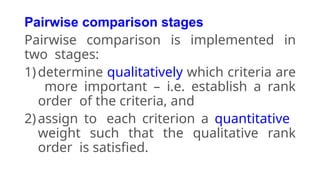
Pairwisecomparison is implemented in
two stages:
1)determine qualitatively which criteria are
more important – i.e. establish a rank
order of the criteria, and
2)assign to each criterion a quantitative
weight such that the qualitative rank
order is satisfied.
4.
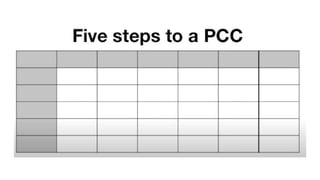
The pairwise comparison
method
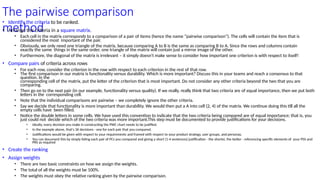
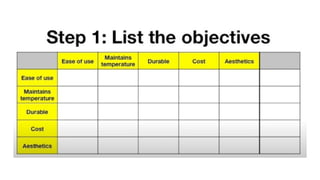
•Identify the criteria to be ranked.
• Arrange the criteria in a square matrix.
• Each cell in the matrix corresponds to a comparison of a pair of items (hence the name “pairwise comparison”). The cells will contain the item that is
considered the most important of the pair.
• Obviously, we only need one triangle of the matrix, because comparing A to B is the same as comparing B to A. Since the rows and columns contain
exactly the same things in the same order, one triangle of the matrix will contain just a mirror image of the other.
• Furthermore, the diagonal of the matrix is irrelevant – it simply doesn't make sense to consider how important one criterion is with respect to itself!
• Compare pairs of criteria across rows
• For each row, consider the criterion in the row with respect to each criterion in the rest of that row.
• The first comparison in our matrix is functionality versus durability. Which is more important? Discuss this in your teams and reach a consensus to that
question. In the
corresponding cell of the matrix, put the letter of the criterion that is most important. Do not consider any other criteria beyond the two that you are
comparing.
• Then go on to the next pair (in our example, functionality versus quality). If we really, really think that two criteria are of equal importance, then we put both
letters in the corresponding cell.
• Note that the individual comparisons are pairwise – we completely ignore the other criteria.
• Say we decide that functionality is more important than durability. We would then put a A into cell (2, 4) of the matrix. We continue doing this till all the
empty cells have been filled.
• Notice the double letters in some cells. We have used this convention to indicate that the two criteria being compared are of equal importance; that is, you
just could not decide which of the two criteria was more important.This step must be documented to provide justifications for your decisions.
• Ideally, every decision you make in constructing the PWC chart needs to be justified.
• In the example above, that's 36 decisions - one for each pair that you compared.
• Justifications would be given with respect to your requirements and framed with respect to your product strategy, user groups, and personas.
• You can document this by simply listing each pair of PCs you compared and giving a short (1-4 sentences) justification - the shorter, the better - referencing specific elements of your PSS and
PRS as required
• Create the ranking
• Assign weights
• There are two basic constraints on how we assign the weights.
• The total of all the weights must be 100%.
• The weights must obey the relative ranking given by the pairwise comparison.
5.
Pairwise Comparison Charts
(PCC):Setting Up and Running
Them for a water bottle example
https://www.youtube.com/watch?v=orrQFHKlocs
Is a tool used to rank design objectives
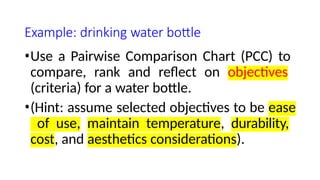
6.
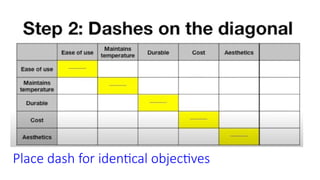
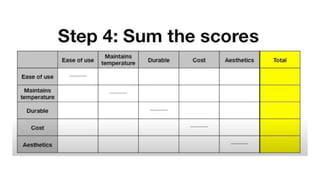
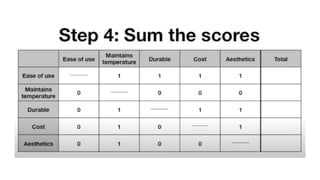
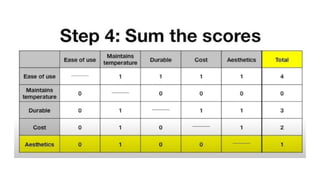
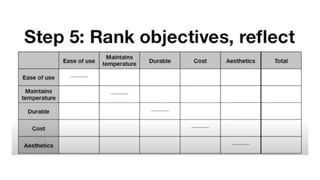
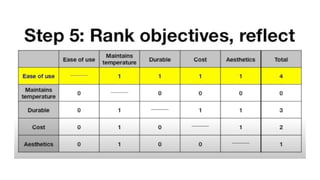
Example: drinking waterbottle
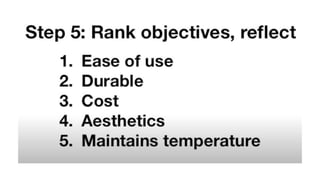
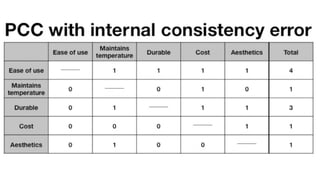
•Use a Pairwise Comparison Chart (PCC) to
compare, rank and reflect on objectives
(criteria) for a water bottle.
•(Hint: assume selected objectives to be ease
of use, maintain temperature, durability,
cost, and aesthetics considerations).
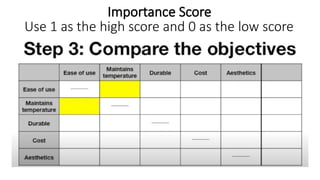
Use 1 asthe high score and 0 as the low score
Importance Score
11.
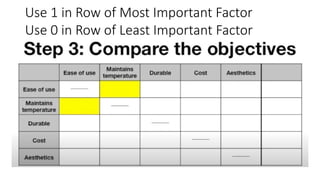
Use 1 inRow of Most Important Factor
Use 0 in Row of Least Important Factor
18.
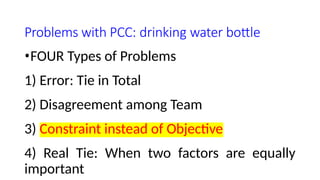
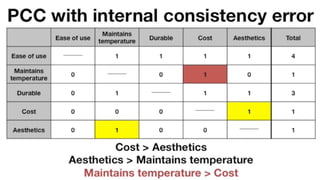
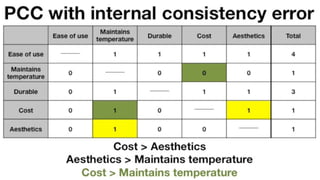
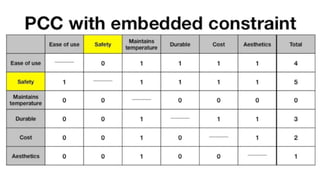
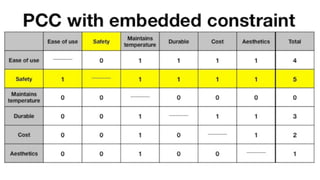
Problems with PCC:drinking water bottle
•FOUR Types of Problems
1) Error: Tie in Total
2) Disagreement among Team
3) Constraint instead of Objective
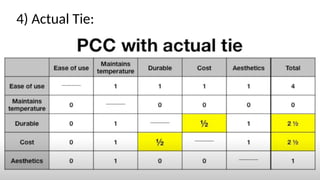
4) Real Tie: When two factors are equally
important
22.
2) Disagreement amongTeam
In order to solve such problems, you must
conduct in-depth survey to understand the
design demand of the client or public while
making the policy decision.
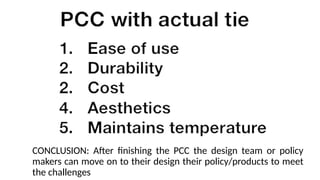
CONCLUSION: After finishingthe PCC the design team or policy
makers can move on to their design their policy/products to meet
the challenges
27.
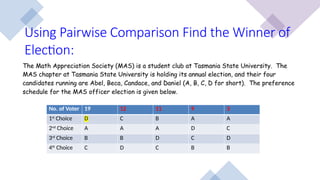
Using Pairwise ComparisonFind the Winner of
Election:
No. of Voter 19 12 11 9 3
1st
Choice D C B A A
2nd
Choice A A A D C
3rd
Choice B B D C D
4th
Choice C D C B B
28.
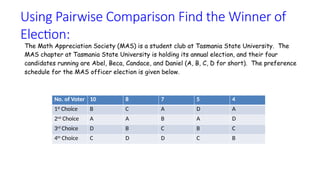
Using Pairwise ComparisonFind the Winner of
Election:
No. of Voter 10 8 7 5 4
1st
Choice B C A D A
2nd
Choice A A B A D
3rd
Choice D B C B C
4th
Choice C D D C B
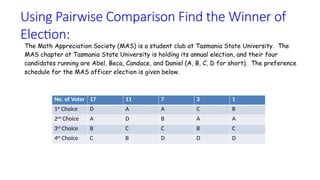
29.
Using Pairwise ComparisonFind the Winner of
Election:
No. of Voter 17 11 7 3 1
1st
Choice D A A C B
2nd
Choice A D B A A
3rd
Choice B C C B C
4th
Choice C B D D D
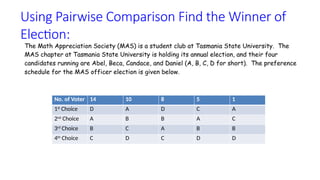
30.
Using Pairwise ComparisonFind the Winner of
Election:
No. of Voter 14 10 8 5 1
1st
Choice D A D C A
2nd
Choice A B B A C
3rd
Choice B C A B B
4th
Choice C D C D D
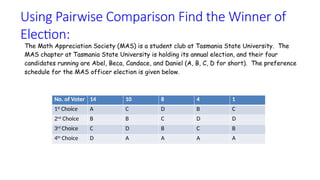
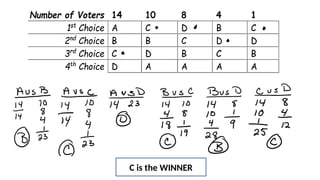
31.
Using Pairwise ComparisonFind the Winner of
Election:
No. of Voter 14 10 8 4 1
1st
Choice A C D B C
2nd
Choice B B C D D
3rd
Choice C D B C B
4th
Choice D A A A A
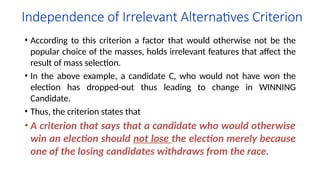
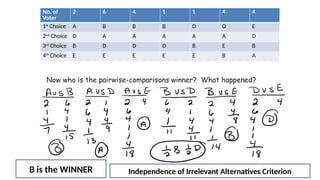
Independence of IrrelevantAlternatives Criterion
• According to this criterion a factor that would otherwise not be the
popular choice of the masses, holds irrelevant features that affect the
result of mass selection.
• In the above example, a candidate C, who would not have won the
election has dropped-out thus leading to change in WINNING
Candidate.
• Thus, the criterion states that
• A criterion that says that a candidate who would otherwise
win an election should not lose the election merely because
one of the losing candidates withdraws from the race.
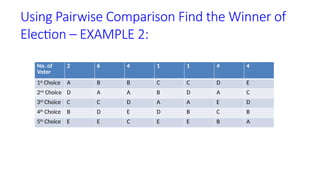
34.
Using Pairwise ComparisonFind the Winner of
Election – EXAMPLE 2:
No. of
Voter
2 6 4 1 1 4 4
1st
Choice A B B C C D E
2nd
Choice D A A B D A C
3rd
Choice C C D A A E D
4th
Choice B D E D B C B
5th
Choice E E C E E B A
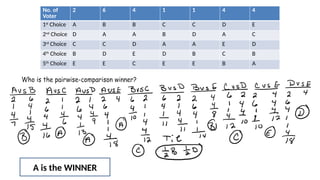
35.
No. of
Voter
2 64 1 1 4 4
1st
Choice A B B C C D E
2nd
Choice D A A B D A C
3rd
Choice C C D A A E D
4th
Choice B D E D B C B
5th
Choice E E C E E B A
A is the WINNER
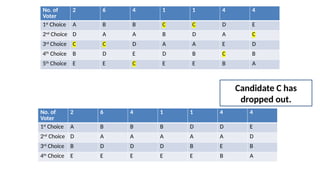
36.
No. of
Voter
2 64 1 1 4 4
1st
Choice A B B C C D E
2nd
Choice D A A B D A C
3rd
Choice C C D A A E D
4th
Choice B D E D B C B
5th
Choice E E C E E B A
Candidate C has
dropped out.
No. of
Voter
2 6 4 1 1 4 4
1st
Choice A B B B D D E
2nd
Choice D A A A A A D
3rd
Choice B D D D B E B
4th
Choice E E E E E B A
37.
No. of
Voter
2 64 1 1 4 4
1st
Choice A B B B D D E
2nd
Choice D A A A A A D
3rd
Choice B D D D B E B
4th
Choice E E E E E B A
B is the WINNER Independence of Irrelevant Alternatives Criterion


![The analytic hierarchy process
AHP Priority Calculator
https://bpmsg.com/ahp/ahp-
calc.php?n=5&t=AHP+priorities&c[0]=ease+of+use&c[1]=maintain+tem
perature&c[2]=durability&c[3]=cost&c[4]=aesthetics+](https://image.slidesharecdn.com/02a-pairwisecomparison-250305100201-30d56ee5/85/Pairwise-comparison-of-items-and-environment-39-320.jpg)


![573 ahp[1] note](https://cdn.slidesharecdn.com/ss_thumbnails/573-ahp1note-130203214242-phpapp01-thumbnail.jpg?width=640&height=640&fit=bounds)


