Technology Today • Winter 201416
T
hunder roared in the distance,
and dark clouds cloaked the sky
as if under a wicked wizard’s
spell. Pikes Peak towered over a
fleet of five medium-duty electric trucks
with their batteries charging at a rate of
50 kilowatts. Nearby, a team of South-
west Research Institute (SwRI) engineers
watched an array of monitors and gauges
beneath a makeshift rain shelter. The
SwRI-built aggregation system confirmed
that the five-vehicle fleet was pulling a
total load of 250 kilowatts from the
power grid.
Suddenly, the grid made a request of
the energy aggregator: Become an energy
generator and provide the grid with 250
kW of power. The aggregator processed
the request and commanded the charg-
ing stations to reverse energy flows on
the vehicles. A second later, the five
vehicles were pushing energy from their
storage batteries back into the grid.
As the storm neared, a second re-
quest came in: Become a load resource
and absorb 100 kW from the grid. The
aggregator analyzed the vehicles’ charge
schedules and issued commands to
stop sending energy into the grid and
start absorbing it, while also
prioritizing the battery charg-
ing according to anticipated
vehicle use. As commands
kept coming in, the wicked
wizard finally had his way and
rain poured as the soaked
SwRI engineers tried to read
one more number from the
chargers.
That was one of many
testing operations carried
out in September at Fort
Carson Army Base, Colo.,
successfully demonstrating
vehicle-to-grid technology in
military operations thanks to
an SwRI-developed electric
vehicle aggregation system.
As the smart grid continues to evolve,
the desire and need for new energy
storage systems to support it contin-
ues to grow. Integrating renewable
energy, such as wind and solar, into
the grid means those energy sources’
varying output must be balanced with
the energy load across the grid. Energy
storage systems can help; the problem
is, they are neither cheap nor simple to
build and integrate. Additionally, many
technologies, such as flow batteries
or large-scale lithium-ion systems,
have yet to be proven viable and cost-
effective. This has led toward develop-
ment of an alternative to centralized
large-scale storage — distributed
energy storage solutions using electric
vehicles. The SwRI team is pushing
electric vehicle technology forward
for grid energy storage through two
research programs: one for the U.S.
Department of Defense and another
for a commercial vehicle fleet.
Using vehicles during their idle
times (which can account for up to 90
percent of the time) to support the
electrical grid using the vehicles’ battery
storage capability is called vehicle-to-grid
(V2G) technology. Many chargers only
allow power to flow into the vehicle.
Such unidirectional systems can provide
demand/response services, where the
demand (load) imposed by charging the
vehicles’ batteries is curtailed during
peak demand periods. Unidirectional
systems also can provide frequency regu-
lation services where the chargers can be
turned on or off to help maintain overall
grid frequency. Bidirectional charging
SwRI engineers expand electric
vehicles’ role in managing the
power grid
A Driving Force
By Sean Mitchem and Yaxi Liu
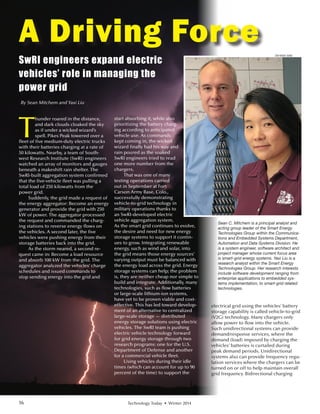
Sean C. Mitchem is a principal analyst and
acting group leader of the Smart Energy
Technologies Group within the Communica-
tions and Embedded Systems Department,
Automation and Data Systems Division. He
is a system engineer, software architect and
project manager whose current focus area
is smart-grid energy systems. Yaxi Liu is a
research analyst within the Smart Energy
Technologies Group. Her research interests
include software development ranging from
enterprise applications to embedded sys-
tems implementation, to smart-grid related
technologies.
D019355-3262
Technology Today • Winter 2014 17
systems can act in a
true V2G manner by al-
lowing energy to flow
back from the vehicle
into the grid, thus
acting as a short-term
generation resource.
Bidirectional systems
also can manage and
move power during
times when they are
not taking load from
the grid. In the military
aggregator developed
by SwRI, the chargers
and vehicles are able to
support an emergency
“island” microgrid by
supplementing the
typical diesel genera-
tors used for backup power.
Electric vehicle (EV) aggregation is
the concept of managing a collection of
electric vehicles or charging stations for
power management purposes. The aggre-
gator is a control system that sits between
an energy command system and the
vehicle chargers to dispatch power flow
requests to the EV fleet. It collects status
information from each fleet unit, such as
connection status, state of charge, real
and reactive power levels and flow direc-
tions, and maximum available charge
and discharge power. It aggregates this
data into a fleet perspective to define
the fleet’s energy status and presents the
fleet perspective to a supervisory control
system. When the control system sends a
power request to the aggregator, the ag-
gregator evaluates the request against the
fleet situation and dispatches individual
requests to each EV fleet member to
change its power usage. Factors such as
vehicle-use schedules and EV maximum
power flows can be used to make the
best decisions for the fleet while imple-
menting the power request.
SwRI became involved in EV ag-
gregation as a member of the team that
designed and implemented the Smart
Power Infrastructure Demonstration for
Energy Reliability and Security (SPIDERS)
program. SPIDERS involved creating a se-
cure microgrid on Fort Carson to provide
energy certainty to critical infrastructure
when grid power is unavailable. The
base’s energy generation capabilities in-
clude a 2-megawatt solar array and a fleet
of five medium-duty electric vehicles that
use direct current (DC) for high-power,
bi-directional transfers. SwRI team mem-
bers developed an aggregation system
that manages the electric vehicle supply
equipment (EVSE) to charge and dis-
charge the vehicles. The SwRI system also
proved capable of providing significant
on-demand reactive power services to
the grid, giving the army base even more
economic reward for running the system.
The entire system — vehicles, EVSEs
and aggregator — was the first to imple-
ment Society of Automotive Engineers
(SAE) standards for bi-directional, DC fast
charging. SwRI was the lead EVSE engi-
neering team for the project, responsible
for coordinating all development work
required to implement and deploy to SAE
standards. SwRI staff worked with two
EV manufacturers to refit their vehicles
to the SAE Combo Connector for DC
fast charging. Additionally, SwRI brought
vehicle and EVSE manufacturers together
to develop an interface control docu-
ment that clearly defined the messaging
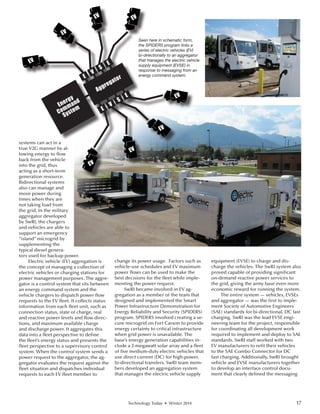
Seen here in schematic form,
the SPIDERS program links a
series of electric vehicles (EV)
bi-directionally to an aggregator
that manages the electric vehicle
supply equipment (EVSE) in
response to messaging from an
energy command system.
Aggregator
Energy
Command
System
EV
E
V
S
E
E
V
S
E
EV
EV
EV
EV
EV
EVEV
18 Technology Today • Winter 2014
between EVs and chargers to the
SAE standards. The SwRI-developed
distributed software system is secure,
self-recoverable and adaptable for
various operation modes.
The SwRI team is working on a
second program involving the use
of a commercial EV delivery fleet to
provide very fast responses in frequency
regulation on the grid. Grid power fre-
quency in the United States is maintained
at 60Hz. When loads exceed the energy
being generated, the grid’s frequency
drops. Conversely, frequency increases
when generation exceeds load. To ef-
fectively manage frequency changes, the
energy market incurs millions of dollars
in costs annually to have idle capacity
available to quickly add or remove energy
from the grid. As part of a pilot program
for the Energy Reliability Council of Texas
(ERCOT), the state’s regional independent
system operator, the vehicle fleet will
provide frequency regulation services
in what is known as the “regulation-up”
market, removing charge loads from the
grid in less than one second — signifi-
cantly faster than the ramp capabilities
of coal, oil or natural gas fueled power
plants. The SwRI-built hardware/software
solution monitors grid frequency and
EV power usage at 40 times per second.
The software aggregator manages the
EV fleet, turning chargers on or off as
needed to meet grid power requirements
in response to frequency changes. The
technology proves electric vehicles are
able to generate revenue for fleet owners
while also lending extra support for the
grid and increase the ability to use variable
renewable generation through enhanced
frequency regulation. Recently the SwRI
aggregation system became the first sys-
tem qualified to bid electric vehicle energy
into the ERCOT Fast Response Regulation
Services market.
The work also pushes the boundaries
of electric vehicle capabilities. Potential rev-
enue opportunities for vehicle owners when
their vehicles are idle may spur interest in
electric vehicle ownership, which in turn
could bring a widespread electric vehicle-
supported grid a step closer to reality.
While research has indicated poten-
tial benefits of using electric vehicles for
V2G services through analysis and simula-
tion, few examples have been available
to evaluate real results. By successfully
deploying two V2G systems within true
operational environments and demon-
strating the value of V2G on a daily basis
with vehicle fleet owners, the SwRI team
has tossed the first rocks down the
mountain of electric vehicle energy that
may someday become a landslide change
to both transportation technology and
electrical grid management.
Questions about this article? Contact
Mitchem at (210) 522-2698 or sean.
mitchem@swri.org, or Liu at (210) 522-3513
or yaxi.liu@swri.org.
Acknowledgments
The authors acknowledge the significant
technical contributions of Research Engineers
Marisa Ramon and Gerardo Trevino, both of
the Automation and Data Systems Division,
as well as Joe Redfield of Redfield Consult-
ing Services. Portions of the described work
are funded under DOE Award Number
DE-OE0000193 through the Austin, Texas-
based Center for the Commercialization of
Electric Technology (CCET).The authors wish
to acknowledge Michael Dittmer of SwRI and
Milton Holloway, Ph.D., CEO of CCET.
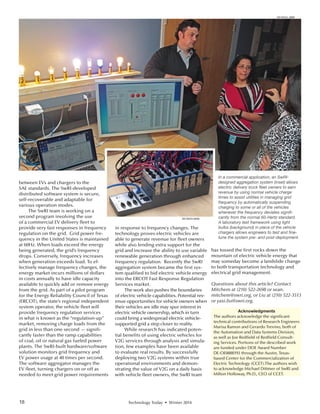
In a commercial application, an SwRI-
designed aggregation system (inset) allows
electric delivery truck fleet owners to earn
revenue by using normal vehicle charge
times to assist utilities in managing grid
frequency by automatically suspending
charging to some or all of the vehicles
whenever the frequency deviates signifi-
cantly from the normal 60-Hertz standard.
A laboratory test framework using light
bulbs (background) in place of the vehicle
chargers allows engineers to test and fine-
tune the system pre- and post-deployment.
D019343-0836
D019343_0885

drivingforce

  • 1.
    Technology Today •Winter 201416 T hunder roared in the distance, and dark clouds cloaked the sky as if under a wicked wizard’s spell. Pikes Peak towered over a fleet of five medium-duty electric trucks with their batteries charging at a rate of 50 kilowatts. Nearby, a team of South- west Research Institute (SwRI) engineers watched an array of monitors and gauges beneath a makeshift rain shelter. The SwRI-built aggregation system confirmed that the five-vehicle fleet was pulling a total load of 250 kilowatts from the power grid. Suddenly, the grid made a request of the energy aggregator: Become an energy generator and provide the grid with 250 kW of power. The aggregator processed the request and commanded the charg- ing stations to reverse energy flows on the vehicles. A second later, the five vehicles were pushing energy from their storage batteries back into the grid. As the storm neared, a second re- quest came in: Become a load resource and absorb 100 kW from the grid. The aggregator analyzed the vehicles’ charge schedules and issued commands to stop sending energy into the grid and start absorbing it, while also prioritizing the battery charg- ing according to anticipated vehicle use. As commands kept coming in, the wicked wizard finally had his way and rain poured as the soaked SwRI engineers tried to read one more number from the chargers. That was one of many testing operations carried out in September at Fort Carson Army Base, Colo., successfully demonstrating vehicle-to-grid technology in military operations thanks to an SwRI-developed electric vehicle aggregation system. As the smart grid continues to evolve, the desire and need for new energy storage systems to support it contin- ues to grow. Integrating renewable energy, such as wind and solar, into the grid means those energy sources’ varying output must be balanced with the energy load across the grid. Energy storage systems can help; the problem is, they are neither cheap nor simple to build and integrate. Additionally, many technologies, such as flow batteries or large-scale lithium-ion systems, have yet to be proven viable and cost- effective. This has led toward develop- ment of an alternative to centralized large-scale storage — distributed energy storage solutions using electric vehicles. The SwRI team is pushing electric vehicle technology forward for grid energy storage through two research programs: one for the U.S. Department of Defense and another for a commercial vehicle fleet. Using vehicles during their idle times (which can account for up to 90 percent of the time) to support the electrical grid using the vehicles’ battery storage capability is called vehicle-to-grid (V2G) technology. Many chargers only allow power to flow into the vehicle. Such unidirectional systems can provide demand/response services, where the demand (load) imposed by charging the vehicles’ batteries is curtailed during peak demand periods. Unidirectional systems also can provide frequency regu- lation services where the chargers can be turned on or off to help maintain overall grid frequency. Bidirectional charging SwRI engineers expand electric vehicles’ role in managing the power grid A Driving Force By Sean Mitchem and Yaxi Liu Sean C. Mitchem is a principal analyst and acting group leader of the Smart Energy Technologies Group within the Communica- tions and Embedded Systems Department, Automation and Data Systems Division. He is a system engineer, software architect and project manager whose current focus area is smart-grid energy systems. Yaxi Liu is a research analyst within the Smart Energy Technologies Group. Her research interests include software development ranging from enterprise applications to embedded sys- tems implementation, to smart-grid related technologies. D019355-3262
  • 2.
    Technology Today •Winter 2014 17 systems can act in a true V2G manner by al- lowing energy to flow back from the vehicle into the grid, thus acting as a short-term generation resource. Bidirectional systems also can manage and move power during times when they are not taking load from the grid. In the military aggregator developed by SwRI, the chargers and vehicles are able to support an emergency “island” microgrid by supplementing the typical diesel genera- tors used for backup power. Electric vehicle (EV) aggregation is the concept of managing a collection of electric vehicles or charging stations for power management purposes. The aggre- gator is a control system that sits between an energy command system and the vehicle chargers to dispatch power flow requests to the EV fleet. It collects status information from each fleet unit, such as connection status, state of charge, real and reactive power levels and flow direc- tions, and maximum available charge and discharge power. It aggregates this data into a fleet perspective to define the fleet’s energy status and presents the fleet perspective to a supervisory control system. When the control system sends a power request to the aggregator, the ag- gregator evaluates the request against the fleet situation and dispatches individual requests to each EV fleet member to change its power usage. Factors such as vehicle-use schedules and EV maximum power flows can be used to make the best decisions for the fleet while imple- menting the power request. SwRI became involved in EV ag- gregation as a member of the team that designed and implemented the Smart Power Infrastructure Demonstration for Energy Reliability and Security (SPIDERS) program. SPIDERS involved creating a se- cure microgrid on Fort Carson to provide energy certainty to critical infrastructure when grid power is unavailable. The base’s energy generation capabilities in- clude a 2-megawatt solar array and a fleet of five medium-duty electric vehicles that use direct current (DC) for high-power, bi-directional transfers. SwRI team mem- bers developed an aggregation system that manages the electric vehicle supply equipment (EVSE) to charge and dis- charge the vehicles. The SwRI system also proved capable of providing significant on-demand reactive power services to the grid, giving the army base even more economic reward for running the system. The entire system — vehicles, EVSEs and aggregator — was the first to imple- ment Society of Automotive Engineers (SAE) standards for bi-directional, DC fast charging. SwRI was the lead EVSE engi- neering team for the project, responsible for coordinating all development work required to implement and deploy to SAE standards. SwRI staff worked with two EV manufacturers to refit their vehicles to the SAE Combo Connector for DC fast charging. Additionally, SwRI brought vehicle and EVSE manufacturers together to develop an interface control docu- ment that clearly defined the messaging Seen here in schematic form, the SPIDERS program links a series of electric vehicles (EV) bi-directionally to an aggregator that manages the electric vehicle supply equipment (EVSE) in response to messaging from an energy command system. Aggregator Energy Command System EV E V S E E V S E EV EV EV EV EV EVEV
  • 3.
    18 Technology Today• Winter 2014 between EVs and chargers to the SAE standards. The SwRI-developed distributed software system is secure, self-recoverable and adaptable for various operation modes. The SwRI team is working on a second program involving the use of a commercial EV delivery fleet to provide very fast responses in frequency regulation on the grid. Grid power fre- quency in the United States is maintained at 60Hz. When loads exceed the energy being generated, the grid’s frequency drops. Conversely, frequency increases when generation exceeds load. To ef- fectively manage frequency changes, the energy market incurs millions of dollars in costs annually to have idle capacity available to quickly add or remove energy from the grid. As part of a pilot program for the Energy Reliability Council of Texas (ERCOT), the state’s regional independent system operator, the vehicle fleet will provide frequency regulation services in what is known as the “regulation-up” market, removing charge loads from the grid in less than one second — signifi- cantly faster than the ramp capabilities of coal, oil or natural gas fueled power plants. The SwRI-built hardware/software solution monitors grid frequency and EV power usage at 40 times per second. The software aggregator manages the EV fleet, turning chargers on or off as needed to meet grid power requirements in response to frequency changes. The technology proves electric vehicles are able to generate revenue for fleet owners while also lending extra support for the grid and increase the ability to use variable renewable generation through enhanced frequency regulation. Recently the SwRI aggregation system became the first sys- tem qualified to bid electric vehicle energy into the ERCOT Fast Response Regulation Services market. The work also pushes the boundaries of electric vehicle capabilities. Potential rev- enue opportunities for vehicle owners when their vehicles are idle may spur interest in electric vehicle ownership, which in turn could bring a widespread electric vehicle- supported grid a step closer to reality. While research has indicated poten- tial benefits of using electric vehicles for V2G services through analysis and simula- tion, few examples have been available to evaluate real results. By successfully deploying two V2G systems within true operational environments and demon- strating the value of V2G on a daily basis with vehicle fleet owners, the SwRI team has tossed the first rocks down the mountain of electric vehicle energy that may someday become a landslide change to both transportation technology and electrical grid management. Questions about this article? Contact Mitchem at (210) 522-2698 or sean. mitchem@swri.org, or Liu at (210) 522-3513 or yaxi.liu@swri.org. Acknowledgments The authors acknowledge the significant technical contributions of Research Engineers Marisa Ramon and Gerardo Trevino, both of the Automation and Data Systems Division, as well as Joe Redfield of Redfield Consult- ing Services. Portions of the described work are funded under DOE Award Number DE-OE0000193 through the Austin, Texas- based Center for the Commercialization of Electric Technology (CCET).The authors wish to acknowledge Michael Dittmer of SwRI and Milton Holloway, Ph.D., CEO of CCET. In a commercial application, an SwRI- designed aggregation system (inset) allows electric delivery truck fleet owners to earn revenue by using normal vehicle charge times to assist utilities in managing grid frequency by automatically suspending charging to some or all of the vehicles whenever the frequency deviates signifi- cantly from the normal 60-Hertz standard. A laboratory test framework using light bulbs (background) in place of the vehicle chargers allows engineers to test and fine- tune the system pre- and post-deployment. D019343-0836 D019343_0885