Seven Secrets to Learn    English Elena Varzari, Senior Lecturer, Balti “Alecu Russo” State University, US Embassy Alumni Resource Center Coordinator/ Balti branch, administered by IREX- International Researches & Exchange Board
Contents Secret # 1:  Learn about  Word Stress   Secret # 2:  Sentence Stress Secret # 3:  Listen! Listen! Listen!   Secret # 4:  Don ’ t  Listen!
Contents:   Secret # 5:  Improve Your Vocabulary  with 5  Words a Day Secret # 6:  30 Minutes a Day Better than  3.5 Hours a Week Secret # 7: Revise! Revise! Revise!
Learn about  Word Stress   Word Stress is: golden key number one for speaking and understanding English   very important   one of the best ways for you to understand spoken English - especially English spoken fast.
Learn about  Word Stress   Native speakers of English use word stress naturally. Word stress is so natural for them that they don't even know they use it.  Non-native speakers who speak English to native speakers without using word stress, encounter two problems:
Problems: They find it difficult to understand native speakers, especially those speaking fast.  2.  The native speakers may find it difficult to understand them.
Learn about  Word Stress   In English, we do not say each syllable with the same force or strength.  In one word, we accentuate ONE syllable. We say  one  syllable very loudly (big, strong, important) and  all the other syllables  very quietly.
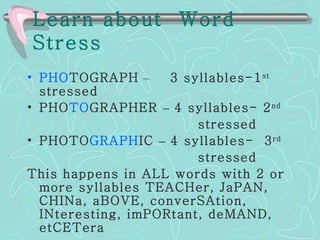
Learn about  Word Stress   Let's take 3 words: photograph, photographer and photographic.  Do they sound the same when spoken? No. Because we accentuate (stress) ONE syllable in each word. And it is not always the same syllable. So the shape of each word is different.
Learn about  Word Stress   PHO TOGRAPH   –   3 syllables-1 st  stressed PHO TO GRAPHER   –  4 syllables- 2 nd   stressed PHOTO GRAPH IC   –  4 syllables-  3 rd   stressed This happens in ALL words with 2 or more syllables   TEACHer, JaPAN, CHINa, aBOVE, converSAtion, INteresting, imPORtant, deMAND, etCETera
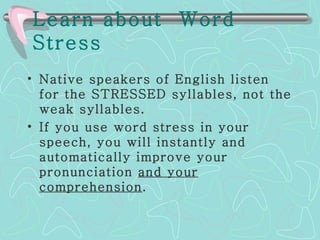
Learn about  Word Stress   Native speakers of English listen for the STRESSED syllables, not the weak syllables.  If you use word stress in your speech, you will instantly and automatically improve your pronunciation  and your comprehension .
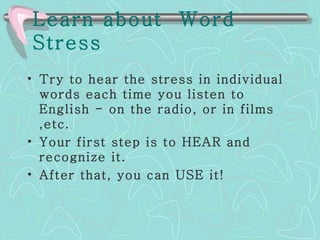
Learn about  Word Stress   Try to hear the stress in individual words each time you listen to English - on the radio, or in films ,etc.  Your first step is to HEAR and recognize it.  After that, you can USE it!
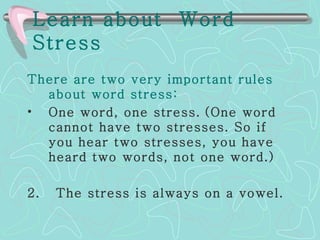
Learn about  Word Stress   There are two very important rules about word stress: One word, one stress.   (One word cannot have two stresses. So if you hear two stresses, you have heard two words, not one word.)  2.  The stress is always on a vowel.
SENTENCE STRESS Sentence Stress is golden key number two for speaking and understanding English.  With Sentence Stress, some *words* in a sentence are "stressed" (loud) and other words are weak (quiet).
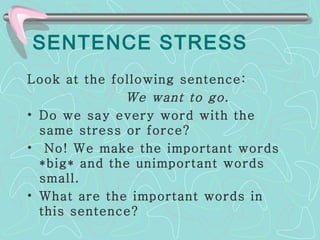
SENTENCE STRESS Look at the following sentence:  We want to go. Do we say every word with the same stress or force? No! We make the important words *big* and the unimportant words small.  What are the important words in this sentence?
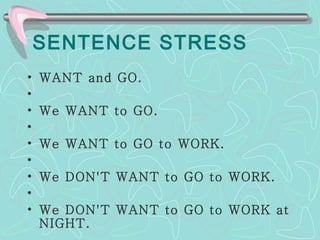
SENTENCE STRESS WANT and GO.   We WANT to GO.   We WANT to GO to WORK.   We DON'T WANT to GO to WORK.   We DON'T WANT to GO to WORK at NIGHT.
LISTEN! LISTEN! LISTEN! When the speech is too fast for you, when you can't understand it, that is exactly when you NEED to listen to it!!! How can you improve if you don't listen and you don ’ t practise?
LISTEN! LISTEN! LISTEN! When you were a baby, did you understand your own language?  You *learned* to understand by *listening* 24 hours a day, 7 days a week  After that, you learned to speak.  Then you learned to read.  And then you learned to write.  *But listening came first!*
  DON'T LISTEN!   In Secret # 3 it was said  -  LISTEN!  LISTEN! LISTEN!  Now it is said  DON'T LISTEN!  What is it meant?
DON'T LISTEN! Sometimes you can LISTEN too hard.  Sometimes you can TRY too. Which is the difference between the verbs TO LISTEN and TO HEAR?
DON'T LISTEN! TO LISTEN is active. TO HEAR is passive.  Sometimes it is better only to HEAR. Let the radio and the cassette play. But DON'T listen. Just HEAR. Your subconscious will listen for you.  And you will still learn.
DON'T LISTEN! If you listen and try to understand, you may block on one word and get frustrated. Don't worry! Just HEAR!  Y ou will still be learning.  The important thing is to let the radio or cassette or television or record PLAY.
DON'T LISTEN! And you - you do nothing.  Your brain will HEAR, your subconscious will  LISTEN and you will  LEARN!
Improve Your Vocabulary    with 5 Words a Day  Vocabulary is easy!  How many days in a year are there?  If you learn only 5 new words a day, you will learn 5 x  365 = 1,825  new words in a year.
Improve Your Vocabulary    with 5 Words a Day  Buy a notebook and write in 5 new words EACH day, EVERY day.  Learn them! You will soon have an excellent  vocabulary.
30 MINUTES A DAY BETTER THAN 3.5 HOURS A WEEK   Study regularly. Study often. LITTLE + OFTEN is better than LOT + SOMETIMES
30 MINUTES A DAY BETTER THAN 3.5 HOURS A WEEK How can you easily find 30 minutes each  day?  You can get up 30 minutes earlier Or have a shorter lunch break. Fix a particular time every day - and keep it!
REVISE! REVISE! REVISE!   If you revise, you'll improve your learning by 100%. You should be systematic about this. When you learn something, you should note it.  Then you should *look at it again*, 3 times: - after 1 day - after 1 week - after 1 month
REVISE! REVISE! REVISE! Each time you revise, test yourself.   Learn, revise, test. Revise, test. Revise, test, etc.
Materials were borrowed from http://www.englishclub.net
Results Guaranteed SUCCESS !!!

Evarzari

  • 1.
    Seven Secrets toLearn English Elena Varzari, Senior Lecturer, Balti “Alecu Russo” State University, US Embassy Alumni Resource Center Coordinator/ Balti branch, administered by IREX- International Researches & Exchange Board
  • 2.
    Contents Secret #1: Learn about Word Stress Secret # 2: Sentence Stress Secret # 3: Listen! Listen! Listen! Secret # 4: Don ’ t Listen!
  • 3.
    Contents:   Secret# 5: Improve Your Vocabulary with 5 Words a Day Secret # 6: 30 Minutes a Day Better than 3.5 Hours a Week Secret # 7: Revise! Revise! Revise!
  • 4.
    Learn about Word Stress Word Stress is: golden key number one for speaking and understanding English very important one of the best ways for you to understand spoken English - especially English spoken fast.
  • 5.
    Learn about Word Stress Native speakers of English use word stress naturally. Word stress is so natural for them that they don't even know they use it. Non-native speakers who speak English to native speakers without using word stress, encounter two problems:
  • 6.
    Problems: They findit difficult to understand native speakers, especially those speaking fast. 2. The native speakers may find it difficult to understand them.
  • 7.
    Learn about Word Stress In English, we do not say each syllable with the same force or strength. In one word, we accentuate ONE syllable. We say one syllable very loudly (big, strong, important) and all the other syllables very quietly.
  • 8.
    Learn about Word Stress Let's take 3 words: photograph, photographer and photographic. Do they sound the same when spoken? No. Because we accentuate (stress) ONE syllable in each word. And it is not always the same syllable. So the shape of each word is different.
  • 9.
    Learn about Word Stress PHO TOGRAPH – 3 syllables-1 st stressed PHO TO GRAPHER – 4 syllables- 2 nd stressed PHOTO GRAPH IC – 4 syllables- 3 rd stressed This happens in ALL words with 2 or more syllables TEACHer, JaPAN, CHINa, aBOVE, converSAtion, INteresting, imPORtant, deMAND, etCETera
  • 10.
    Learn about Word Stress Native speakers of English listen for the STRESSED syllables, not the weak syllables. If you use word stress in your speech, you will instantly and automatically improve your pronunciation and your comprehension .
  • 11.
    Learn about Word Stress Try to hear the stress in individual words each time you listen to English - on the radio, or in films ,etc. Your first step is to HEAR and recognize it. After that, you can USE it!
  • 12.
    Learn about Word Stress There are two very important rules about word stress: One word, one stress. (One word cannot have two stresses. So if you hear two stresses, you have heard two words, not one word.) 2. The stress is always on a vowel.
  • 13.
    SENTENCE STRESS SentenceStress is golden key number two for speaking and understanding English. With Sentence Stress, some *words* in a sentence are "stressed" (loud) and other words are weak (quiet).
  • 14.
    SENTENCE STRESS Lookat the following sentence: We want to go. Do we say every word with the same stress or force? No! We make the important words *big* and the unimportant words small. What are the important words in this sentence?
  • 15.
    SENTENCE STRESS WANTand GO.   We WANT to GO.   We WANT to GO to WORK.   We DON'T WANT to GO to WORK.   We DON'T WANT to GO to WORK at NIGHT.
  • 16.
    LISTEN! LISTEN! LISTEN!When the speech is too fast for you, when you can't understand it, that is exactly when you NEED to listen to it!!! How can you improve if you don't listen and you don ’ t practise?
  • 17.
    LISTEN! LISTEN! LISTEN!When you were a baby, did you understand your own language? You *learned* to understand by *listening* 24 hours a day, 7 days a week After that, you learned to speak. Then you learned to read. And then you learned to write. *But listening came first!*
  • 18.
    DON'TLISTEN!   In Secret # 3 it was said - LISTEN! LISTEN! LISTEN! Now it is said DON'T LISTEN! What is it meant?
  • 19.
    DON'T LISTEN! Sometimesyou can LISTEN too hard. Sometimes you can TRY too. Which is the difference between the verbs TO LISTEN and TO HEAR?
  • 20.
    DON'T LISTEN! TOLISTEN is active. TO HEAR is passive. Sometimes it is better only to HEAR. Let the radio and the cassette play. But DON'T listen. Just HEAR. Your subconscious will listen for you. And you will still learn.
  • 21.
    DON'T LISTEN! Ifyou listen and try to understand, you may block on one word and get frustrated. Don't worry! Just HEAR! Y ou will still be learning. The important thing is to let the radio or cassette or television or record PLAY.
  • 22.
    DON'T LISTEN! Andyou - you do nothing. Your brain will HEAR, your subconscious will LISTEN and you will LEARN!
  • 23.
    Improve Your Vocabulary with 5 Words a Day  Vocabulary is easy! How many days in a year are there? If you learn only 5 new words a day, you will learn 5 x 365 = 1,825 new words in a year.
  • 24.
    Improve Your Vocabulary with 5 Words a Day  Buy a notebook and write in 5 new words EACH day, EVERY day. Learn them! You will soon have an excellent vocabulary.
  • 25.
    30 MINUTES ADAY BETTER THAN 3.5 HOURS A WEEK   Study regularly. Study often. LITTLE + OFTEN is better than LOT + SOMETIMES
  • 26.
    30 MINUTES ADAY BETTER THAN 3.5 HOURS A WEEK How can you easily find 30 minutes each day? You can get up 30 minutes earlier Or have a shorter lunch break. Fix a particular time every day - and keep it!
  • 27.
    REVISE! REVISE! REVISE!  If you revise, you'll improve your learning by 100%. You should be systematic about this. When you learn something, you should note it. Then you should *look at it again*, 3 times: - after 1 day - after 1 week - after 1 month
  • 28.
    REVISE! REVISE! REVISE!Each time you revise, test yourself.   Learn, revise, test. Revise, test. Revise, test, etc.
  • 29.
    Materials were borrowedfrom http://www.englishclub.net
  • 30.