Part 1
EVALUATIVE COMMENTARY
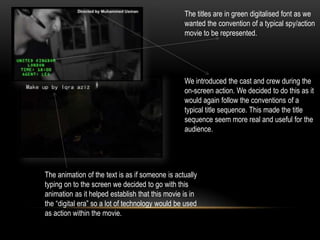
The titles are in green digitalised font as we
wanted the convention of a typical spy/action
movie to be represented.
We introduced the cast and crew during the
on-screen action. We decided to do this as it
would again follow the conventions of a
typical title sequence. This made the title
sequence seem more real and useful for the
audience.
The animation of the text is as if someone is actually
typing on to the screen we decided to go with this
animation as it helped establish that this movie is in
the “digital era” so a lot of technology would be used
as action within the movie.
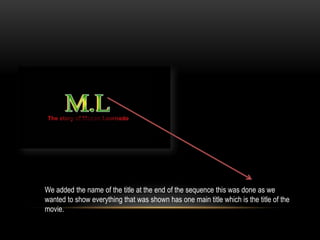
We added the name of the title at the end of the sequence this was done as we
wanted to show everything that was shown has one main title which is the title of the
movie.
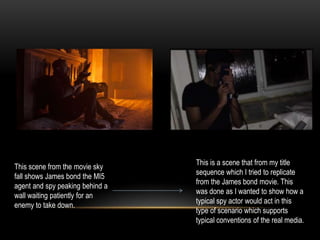
This scene from the movie sky
fall shows James bond the MI5
agent and spy peaking behind a
wall waiting patiently for an
enemy to take down.
This is a scene that from my title
sequence which I tried to replicate
from the James bond movie. This
was done as I wanted to show how a
typical spy actor would act in this
type of scenario which supports
typical conventions of the real media.
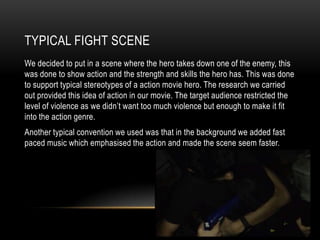
TYPICAL FIGHT SCENE
We decided to put in a scene where the hero takes down one of the enemy, this
was done to show action and the strength and skills the hero has. This was done
to support typical stereotypes of a action movie hero. The research we carried
out provided this idea of action in our movie. The target audience restricted the
level of violence as we didn’t want too much violence but enough to make it fit
into the action genre.
Another typical convention we used was that in the background we added fast
paced music which emphasised the action and made the scene seem faster.
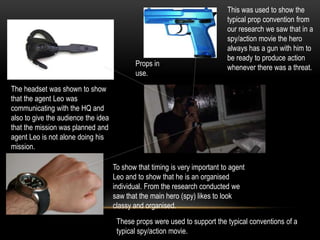
The headset was shown to show
that the agent Leo was
communicating with the HQ and
also to give the audience the idea
that the mission was planned and
agent Leo is not alone doing his
mission.
To show that timing is very important to agent
Leo and to show that he is an organised
individual. From the research conducted we
saw that the main hero (spy) likes to look
classy and organised.
This was used to show the
typical prop convention from
our research we saw that in a
spy/action movie the hero
always has a gun with him to
be ready to produce action
whenever there was a threat.
These props were used to support the typical conventions of a
typical spy/action movie.
Props in
use.
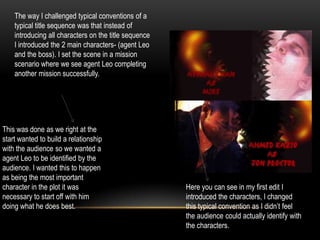
The way I challenged typical conventions of a
typical title sequence was that instead of
introducing all characters on the title sequence
I introduced the 2 main characters- (agent Leo
and the boss). I set the scene in a mission
scenario where we see agent Leo completing
another mission successfully.
This was done as we right at the
start wanted to build a relationship
with the audience so we wanted a
agent Leo to be identified by the
audience. I wanted this to happen
as being the most important
character in the plot it was
necessary to start off with him
doing what he does best.
Here you can see in my first edit I
introduced the characters, I changed
this typical convention as I didn’t feel
the audience could actually identify with
the characters.
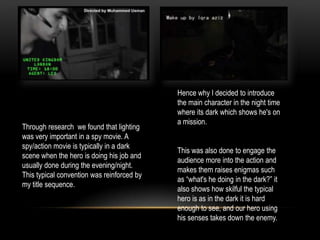
Through research we found that lighting
was very important in a spy movie. A
spy/action movie is typically in a dark
scene when the hero is doing his job and
usually done during the evening/night.
This typical convention was reinforced by
my title sequence.
Hence why I decided to introduce
the main character in the night time
where its dark which shows he's on
a mission.
This was also done to engage the
audience more into the action and
makes them raises enigmas such
as “what's he doing in the dark?” it
also shows how skilful the typical
hero is as in the dark it is hard
enough to see, and our hero using
his senses takes down the enemy.

Evaluative commentary1

  • 1.
  • 2.
    The titles arein green digitalised font as we wanted the convention of a typical spy/action movie to be represented. We introduced the cast and crew during the on-screen action. We decided to do this as it would again follow the conventions of a typical title sequence. This made the title sequence seem more real and useful for the audience. The animation of the text is as if someone is actually typing on to the screen we decided to go with this animation as it helped establish that this movie is in the “digital era” so a lot of technology would be used as action within the movie.
  • 3.
    We added thename of the title at the end of the sequence this was done as we wanted to show everything that was shown has one main title which is the title of the movie.
  • 4.
    This scene fromthe movie sky fall shows James bond the MI5 agent and spy peaking behind a wall waiting patiently for an enemy to take down. This is a scene that from my title sequence which I tried to replicate from the James bond movie. This was done as I wanted to show how a typical spy actor would act in this type of scenario which supports typical conventions of the real media.
  • 5.
    TYPICAL FIGHT SCENE Wedecided to put in a scene where the hero takes down one of the enemy, this was done to show action and the strength and skills the hero has. This was done to support typical stereotypes of a action movie hero. The research we carried out provided this idea of action in our movie. The target audience restricted the level of violence as we didn’t want too much violence but enough to make it fit into the action genre. Another typical convention we used was that in the background we added fast paced music which emphasised the action and made the scene seem faster.
  • 6.
    The headset wasshown to show that the agent Leo was communicating with the HQ and also to give the audience the idea that the mission was planned and agent Leo is not alone doing his mission. To show that timing is very important to agent Leo and to show that he is an organised individual. From the research conducted we saw that the main hero (spy) likes to look classy and organised. This was used to show the typical prop convention from our research we saw that in a spy/action movie the hero always has a gun with him to be ready to produce action whenever there was a threat. These props were used to support the typical conventions of a typical spy/action movie. Props in use.
  • 7.
    The way Ichallenged typical conventions of a typical title sequence was that instead of introducing all characters on the title sequence I introduced the 2 main characters- (agent Leo and the boss). I set the scene in a mission scenario where we see agent Leo completing another mission successfully. This was done as we right at the start wanted to build a relationship with the audience so we wanted a agent Leo to be identified by the audience. I wanted this to happen as being the most important character in the plot it was necessary to start off with him doing what he does best. Here you can see in my first edit I introduced the characters, I changed this typical convention as I didn’t feel the audience could actually identify with the characters.
  • 8.
    Through research wefound that lighting was very important in a spy movie. A spy/action movie is typically in a dark scene when the hero is doing his job and usually done during the evening/night. This typical convention was reinforced by my title sequence. Hence why I decided to introduce the main character in the night time where its dark which shows he's on a mission. This was also done to engage the audience more into the action and makes them raises enigmas such as “what's he doing in the dark?” it also shows how skilful the typical hero is as in the dark it is hard enough to see, and our hero using his senses takes down the enemy.