Evaluation Question 3:
In what ways does your product
use, develop or challenge forms and
conventions of real media products?
Bold text
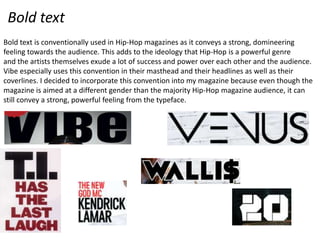
Bold text is conventionally used in Hip-Hop magazines as it conveys a strong, domineering
feeling towards the audience. This adds to the ideology that Hip-Hop is a powerful genre
and the artists themselves exude a lot of success and power over each other and the audience.
Vibe especially uses this convention in their masthead and their headlines as well as their
coverlines. I decided to incorporate this convention into my magazine because even though the
magazine is aimed at a different gender than the majority Hip-Hop magazine audience, it can
still convey a strong, powerful feeling from the typeface.
Colour Scheme
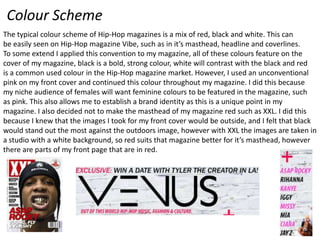
The typical colour scheme of Hip-Hop magazines is a mix of red, black and white. This can
be easily seen on Hip-Hop magazine Vibe, such as in it’s masthead, headline and coverlines.
To some extend I applied this convention to my magazine, all of these colours feature on the
cover of my magazine, black is a bold, strong colour, white will contrast with the black and red
is a common used colour in the Hip-Hop magazine market. However, I used an unconventional
pink on my front cover and continued this colour throughout my magazine. I did this because
my niche audience of females will want feminine colours to be featured in the magazine, such
as pink. This also allows me to establish a brand identity as this is a unique point in my
magazine. I also decided not to make the masthead of my magazine red such as XXL. I did this
because I knew that the images I took for my front cover would be outside, and I felt that black
would stand out the most against the outdoors image, however with XXL the images are taken in
a studio with a white background, so red suits that magazine better for it’s masthead, however
there are parts of my front page that are in red.
Images
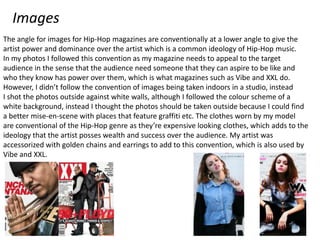
The angle for images for Hip-Hop magazines are conventionally at a lower angle to give the
artist power and dominance over the artist which is a common ideology of Hip-Hop music.
In my photos I followed this convention as my magazine needs to appeal to the target
audience in the sense that the audience need someone that they can aspire to be like and
who they know has power over them, which is what magazines such as Vibe and XXL do.
However, I didn’t follow the convention of images being taken indoors in a studio, instead
I shot the photos outside against white walls, although I followed the colour scheme of a
white background, instead I thought the photos should be taken outside because I could find
a better mise-en-scene with places that feature graffiti etc. The clothes worn by my model
are conventional of the Hip-Hop genre as they’re expensive looking clothes, which adds to the
ideology that the artist posses wealth and success over the audience. My artist was
accessorized with golden chains and earrings to add to this convention, which is also used by
Vibe and XXL.
Poses
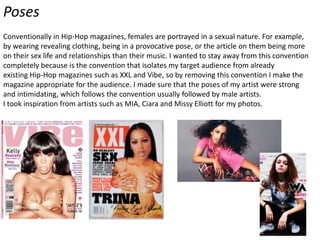
Conventionally in Hip-Hop magazines, females are portrayed in a sexual nature. For example,
by wearing revealing clothing, being in a provocative pose, or the article on them being more
on their sex life and relationships than their music. I wanted to stay away from this convention
completely because is the convention that isolates my target audience from already
existing Hip-Hop magazines such as XXL and Vibe, so by removing this convention I make the
magazine appropriate for the audience. I made sure that the poses of my artist were strong
and intimidating, which follows the convention usually followed by male artists.
I took inspiration from artists such as MIA, Ciara and Missy Elliott for my photos.

EVALUATION QUESTION 3

  • 1.
    Evaluation Question 3: Inwhat ways does your product use, develop or challenge forms and conventions of real media products?
  • 2.
    Bold text Bold textis conventionally used in Hip-Hop magazines as it conveys a strong, domineering feeling towards the audience. This adds to the ideology that Hip-Hop is a powerful genre and the artists themselves exude a lot of success and power over each other and the audience. Vibe especially uses this convention in their masthead and their headlines as well as their coverlines. I decided to incorporate this convention into my magazine because even though the magazine is aimed at a different gender than the majority Hip-Hop magazine audience, it can still convey a strong, powerful feeling from the typeface.
  • 3.
    Colour Scheme The typicalcolour scheme of Hip-Hop magazines is a mix of red, black and white. This can be easily seen on Hip-Hop magazine Vibe, such as in it’s masthead, headline and coverlines. To some extend I applied this convention to my magazine, all of these colours feature on the cover of my magazine, black is a bold, strong colour, white will contrast with the black and red is a common used colour in the Hip-Hop magazine market. However, I used an unconventional pink on my front cover and continued this colour throughout my magazine. I did this because my niche audience of females will want feminine colours to be featured in the magazine, such as pink. This also allows me to establish a brand identity as this is a unique point in my magazine. I also decided not to make the masthead of my magazine red such as XXL. I did this because I knew that the images I took for my front cover would be outside, and I felt that black would stand out the most against the outdoors image, however with XXL the images are taken in a studio with a white background, so red suits that magazine better for it’s masthead, however there are parts of my front page that are in red.
  • 4.
    Images The angle forimages for Hip-Hop magazines are conventionally at a lower angle to give the artist power and dominance over the artist which is a common ideology of Hip-Hop music. In my photos I followed this convention as my magazine needs to appeal to the target audience in the sense that the audience need someone that they can aspire to be like and who they know has power over them, which is what magazines such as Vibe and XXL do. However, I didn’t follow the convention of images being taken indoors in a studio, instead I shot the photos outside against white walls, although I followed the colour scheme of a white background, instead I thought the photos should be taken outside because I could find a better mise-en-scene with places that feature graffiti etc. The clothes worn by my model are conventional of the Hip-Hop genre as they’re expensive looking clothes, which adds to the ideology that the artist posses wealth and success over the audience. My artist was accessorized with golden chains and earrings to add to this convention, which is also used by Vibe and XXL.
  • 5.
    Poses Conventionally in Hip-Hopmagazines, females are portrayed in a sexual nature. For example, by wearing revealing clothing, being in a provocative pose, or the article on them being more on their sex life and relationships than their music. I wanted to stay away from this convention completely because is the convention that isolates my target audience from already existing Hip-Hop magazines such as XXL and Vibe, so by removing this convention I make the magazine appropriate for the audience. I made sure that the poses of my artist were strong and intimidating, which follows the convention usually followed by male artists. I took inspiration from artists such as MIA, Ciara and Missy Elliott for my photos.