In what ways does your
media product use,
develop or challenge
forms and conventions of
real media products?
By Thanarsana Tanikasalam
Task
 This year for my A2 media, I was asked to create a short
five minute film (my choice of genre along with my
group).
 As a group we discussed all the different types of
genres and what stories can be created for each
genre.
 Our end result was romance, as horror and thriller was
commonly produced, and we wanted to try something
different and challenging this year.
 Our production of short film “Raja Rani” used many forms
and conventions of real media texts, as we were only able
to produce such a piece as we had been able to
research existing productions which we then went on to
use, adapt or reject when planning our production.
 As I was the producer for my AS portfolio I felt that it would
be best if I were to take this role again as well as being
responsible for make up and costume. Before looking into
my particular area, I looked at existing short films on
Youtube.
 https://www.youtube.com/watch?v=Nu9d7-zH9v8
 I felt Youtube is most suitable to research and look into
existing short romantic film. This is because once our
production is finished, it will be posted on Youtube.
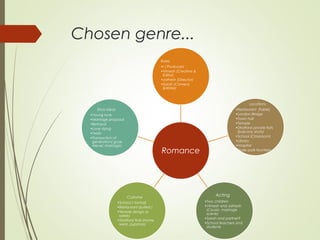
Chosen genre...
Romance
Roles
•I ( Producer)
•Vimesh (Creative &
Editor)
•Jathesh (Director)
•Sarah (Camera
&Writer)
Locations
•Restaurant (Table)
•London Bridge
•Town hall
•Temple
•Stratford private flats
(balcony shots)
•School (Classroom)
•Library
•Hospital
•Hyde park fountain
Acting
•Two children
•Vimesh and Jathesh
(Cousin, marriage
scene)
•Sarah and partner?
•School teachers and
students
Costume
•School ( formal)
•Restaurant (suited )
•Temple (lenga or
saree)
•Stratford flats (home
wear, pyjamas)
Story ideas
•Young love
•Marriage proposal
•Betrayal
•Love dying
•Twists
•Transaction of
generation( gcse,
Alevel, marriage)
Codes and conventions...
 Codes – A system of signs (verbal, aural or visual) used
to convey meaning. Codes can be divided into two
categories. They are TECHNICAL and SYMBOLIC code.
 TECHNICAL CODE - are all the ways in which
equipment is used to tell the story in a media text, for
example the camera work in a film.
 Conventions – A generally accepted custom or an
established rule.
Codes and conventions-
Real Media
 I now will be explaining, how I used codes and conventions in our five
minute short film.
 Locations- I chose popular scenery that normally are used, in other romantic
films. For example: restaurant, school, park etc.
 Costumes- As my film has a traditional Indian scene from the Indian
background, I decided the characters in the film should follow the concept
and wear similar clothing. For example: The women wears a red saree and
the male wears a Sherwani.
 Editing- From the films I looked at, to show flashback, “dream effect” was
often used to show it was the past. Also the effect of “fade out”. However, in
our film, we decided to change the order and convention of showing it in
chronological order. So we edited it in reverse order. We also used the
“dream effect” as it would make it clear to the audience that it is the past,
instead of present or future.
 Camera angles- From the research I carried out, I realised , a lot of extreme
close up and close up have been used to show the characters emotions
and feelings. I have also used this in our film. For example: When our male
character Arjun is about the sign the divorce paper, extreme close-up is
used towards his eyes to show the tension and feeling of this scene.
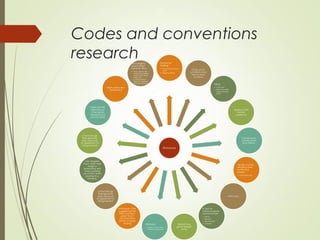
Codes and conventions
research
Romance
Emotional
feelings
• Sad ending (Voice
over)
• Happy ending
Close up for
emotions, long
shot to show
locations
Titling
• Curly font
• Pink and white
colours mostly
used.
Aimed at the
female
audience
Voiceover to
introduce the
love theme.
Usually involves
wedding bells,
hearts and
flowers,
• Symbolise love
Soft music
A typical
romance genre
would include:
• Status
• Gender
• Relationship
• sexualityReveal love
genre straight
away
Dialogue
• Used to show story
behind characters
Hints given ( film
suggesting that
they may be a
good “love”
and that there
will be a happy
ending
Characters go
their separate
ways because
of agreement or
disagreement
Non diegetic
music when they
begin a
relationship with
music building
up conflict arises
leading to a
breakup.
Characters go
their separate
ways because
of agreement or
disagreement
Often the film
directors use
other genre
elements and
put into theirs
Main characters
introduced
Non diegetic
sound within
romantic films
• Music shows the
characters falling
in love and show
when the
complication is
about to happen
and turn the story.
How have we challenged
the codes and conventions?
 Our media product uses, develops and challenges
many of the forms and conventions of real media
products. A key example of how we have challenged
a key convention is that we have edited our film in a
unique method of reverse. This is because we wanted
to create a piece , that will be different from the
traditional convention and to see if our audience like
the twist we have used.
 The majority of other romantic films that I have
analysed, always creates the same type of drama and
it is predictable.
Stereotypes/Costume/Convention
 The costumes that we had chosen for the actors challenged
the code and conventions.
 As our main actor (Vimto) wore casual clothing for scenes at:
park, school ,library and apartment. However we challenged
the convention by him wearing a sherwani for wedding scene.
We challenged the convention as he did not dress up in a
suit. He wore a traditional Indian outfit, which the Indian
audience will be familiar with.
 Our second actor (Thanarsana) also wore casual clothing for
scenes at : park, school, library and apartment. However we
challenged the convention by her wearing a saree for the
wedding scene. We challenged the convention as she did
wear a dress. She wore a traditional Indian saree instead,
which the Indian audience will be familiar with.
Examples
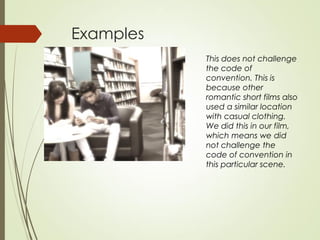
This does not challenge
the code of
convention. This is
because other
romantic short films also
used a similar location
with casual clothing.
We did this in our film,
which means we did
not challenge the
code of convention in
this particular scene.
Examples
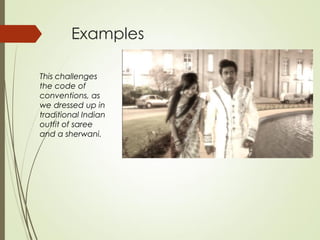
This challenges
the code of
conventions, as
we dressed up in
traditional Indian
outfit of saree
and a sherwani.

Evaluation q1

  • 1.
    In what waysdoes your media product use, develop or challenge forms and conventions of real media products? By Thanarsana Tanikasalam
  • 2.
    Task  This yearfor my A2 media, I was asked to create a short five minute film (my choice of genre along with my group).  As a group we discussed all the different types of genres and what stories can be created for each genre.  Our end result was romance, as horror and thriller was commonly produced, and we wanted to try something different and challenging this year.
  • 3.
     Our productionof short film “Raja Rani” used many forms and conventions of real media texts, as we were only able to produce such a piece as we had been able to research existing productions which we then went on to use, adapt or reject when planning our production.  As I was the producer for my AS portfolio I felt that it would be best if I were to take this role again as well as being responsible for make up and costume. Before looking into my particular area, I looked at existing short films on Youtube.  https://www.youtube.com/watch?v=Nu9d7-zH9v8  I felt Youtube is most suitable to research and look into existing short romantic film. This is because once our production is finished, it will be posted on Youtube.
  • 4.
    Chosen genre... Romance Roles •I (Producer) •Vimesh (Creative & Editor) •Jathesh (Director) •Sarah (Camera &Writer) Locations •Restaurant (Table) •London Bridge •Town hall •Temple •Stratford private flats (balcony shots) •School (Classroom) •Library •Hospital •Hyde park fountain Acting •Two children •Vimesh and Jathesh (Cousin, marriage scene) •Sarah and partner? •School teachers and students Costume •School ( formal) •Restaurant (suited ) •Temple (lenga or saree) •Stratford flats (home wear, pyjamas) Story ideas •Young love •Marriage proposal •Betrayal •Love dying •Twists •Transaction of generation( gcse, Alevel, marriage)
  • 5.
    Codes and conventions... Codes – A system of signs (verbal, aural or visual) used to convey meaning. Codes can be divided into two categories. They are TECHNICAL and SYMBOLIC code.  TECHNICAL CODE - are all the ways in which equipment is used to tell the story in a media text, for example the camera work in a film.  Conventions – A generally accepted custom or an established rule.
  • 6.
    Codes and conventions- RealMedia  I now will be explaining, how I used codes and conventions in our five minute short film.  Locations- I chose popular scenery that normally are used, in other romantic films. For example: restaurant, school, park etc.  Costumes- As my film has a traditional Indian scene from the Indian background, I decided the characters in the film should follow the concept and wear similar clothing. For example: The women wears a red saree and the male wears a Sherwani.  Editing- From the films I looked at, to show flashback, “dream effect” was often used to show it was the past. Also the effect of “fade out”. However, in our film, we decided to change the order and convention of showing it in chronological order. So we edited it in reverse order. We also used the “dream effect” as it would make it clear to the audience that it is the past, instead of present or future.  Camera angles- From the research I carried out, I realised , a lot of extreme close up and close up have been used to show the characters emotions and feelings. I have also used this in our film. For example: When our male character Arjun is about the sign the divorce paper, extreme close-up is used towards his eyes to show the tension and feeling of this scene.
  • 7.
    Codes and conventions research Romance Emotional feelings •Sad ending (Voice over) • Happy ending Close up for emotions, long shot to show locations Titling • Curly font • Pink and white colours mostly used. Aimed at the female audience Voiceover to introduce the love theme. Usually involves wedding bells, hearts and flowers, • Symbolise love Soft music A typical romance genre would include: • Status • Gender • Relationship • sexualityReveal love genre straight away Dialogue • Used to show story behind characters Hints given ( film suggesting that they may be a good “love” and that there will be a happy ending Characters go their separate ways because of agreement or disagreement Non diegetic music when they begin a relationship with music building up conflict arises leading to a breakup. Characters go their separate ways because of agreement or disagreement Often the film directors use other genre elements and put into theirs Main characters introduced Non diegetic sound within romantic films • Music shows the characters falling in love and show when the complication is about to happen and turn the story.
  • 8.
    How have wechallenged the codes and conventions?  Our media product uses, develops and challenges many of the forms and conventions of real media products. A key example of how we have challenged a key convention is that we have edited our film in a unique method of reverse. This is because we wanted to create a piece , that will be different from the traditional convention and to see if our audience like the twist we have used.  The majority of other romantic films that I have analysed, always creates the same type of drama and it is predictable.
  • 9.
    Stereotypes/Costume/Convention  The costumesthat we had chosen for the actors challenged the code and conventions.  As our main actor (Vimto) wore casual clothing for scenes at: park, school ,library and apartment. However we challenged the convention by him wearing a sherwani for wedding scene. We challenged the convention as he did not dress up in a suit. He wore a traditional Indian outfit, which the Indian audience will be familiar with.  Our second actor (Thanarsana) also wore casual clothing for scenes at : park, school, library and apartment. However we challenged the convention by her wearing a saree for the wedding scene. We challenged the convention as she did wear a dress. She wore a traditional Indian saree instead, which the Indian audience will be familiar with.
  • 10.
    Examples This does notchallenge the code of convention. This is because other romantic short films also used a similar location with casual clothing. We did this in our film, which means we did not challenge the code of convention in this particular scene.
  • 11.
    Examples This challenges the codeof conventions, as we dressed up in traditional Indian outfit of saree and a sherwani.