Evaluation P1
Lauren Rosenfeld
Introduction
Vibe Productions project ‘The Rise in Redbridge Crime’ is
a documentary focusing on the crime in the Redbridge
region and why it is happening. It follows a brief given by
the London Borough of Redbridge council, which stated
that we must create a social action project focusing on
one of the issues surrounding the area, specifically for 14
to 19 year olds as a primary audience, but people aged
30 and over as a secondary audience, in order to improve
community cohesion. Before producing a team, as
individuals we thoroughly researched the requirements of
the brief in order to clearly understand every aspect of it.
Another important part of research was job roles involved
in the industry and other information to help during
production of the social action project.
Introduction
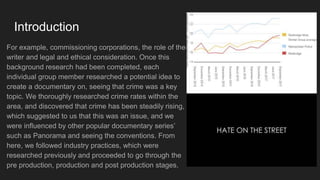
For example, commissioning corporations, the role of the
writer and legal and ethical consideration. Once this
background research had been completed, each
individual group member researched a potential idea to
create a documentary on, seeing that crime was a key
topic. We thoroughly researched crime rates within the
area, and discovered that crime has been steadily rising,
which suggested to us that this was an issue, and we
were influenced by other popular documentary series’
such as Panorama and seeing the conventions. From
here, we followed industry practices, which were
researched previously and proceeded to go through the
pre production, production and post production stages.
Fitness for purpose
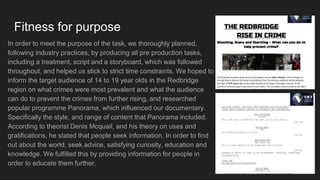
In order to meet the purpose of the task, we thoroughly planned,
following industry practices, by producing all pre production tasks,
including a treatment, script and a storyboard, which was followed
throughout, and helped us stick to strict time constraints. We hoped to
inform the target audience of 14 to 19 year olds in the Redbridge
region on what crimes were most prevalent and what the audience
can do to prevent the crimes from further rising, and researched
popular programme Panorama, which influenced our documentary.
Specifically the style, and range of content that Panorama included.
According to theorist Denis Mcquail, and his theory on uses and
gratifications, he stated that people seek information. In order to find
out about the world, seek advice, satisfying curiosity, education and
knowledge. We fulfilled this by providing information for people in
order to educate them further.
Fitness for purpose
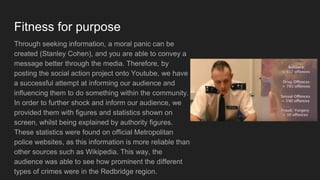
Through seeking information, a moral panic can be
created (Stanley Cohen), and you are able to convey a
message better through the media. Therefore, by
posting the social action project onto Youtube, we have
a successful attempt at informing our audience and
influencing them to do something within the community.
In order to further shock and inform our audience, we
provided them with figures and statistics shown on
screen, whilst being explained by authority figures.
These statistics were found on official Metropolitan
police websites, as this information is more reliable than
other sources such as Wikipedia. This way, the
audience was able to see how prominent the different
types of crimes were in the Redbridge region.
Fitness for purpose
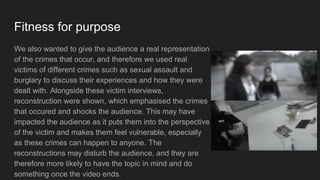
We also wanted to give the audience a real representation
of the crimes that occur, and therefore we used real
victims of different crimes such as sexual assault and
burglary to discuss their experiences and how they were
dealt with. Alongside these victim interviews,
reconstruction were shown, which emphasised the crimes
that occured and shocks the audience. This may have
impacted the audience as it puts them into the perspective
of the victim and makes them feel vulnerable, especially
as these crimes can happen to anyone. The
reconstructions may disturb the audience, and they are
therefore more likely to have the topic in mind and do
something once the video ends.
Fitness for purpose
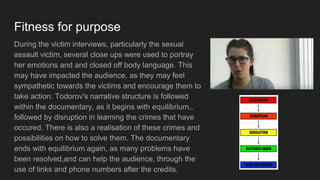
During the victim interviews, particularly the sexual
assault victim, several close ups were used to portray
her emotions and and closed off body language. This
may have impacted the audience, as they may feel
sympathetic towards the victims and encourage them to
take action. Todorov's narrative structure is followed
within the documentary, as it begins with equilibrium,,
followed by disruption in learning the crimes that have
occured. There is also a realisation of these crimes and
possibilities on how to solve them. The documentary
ends with equilibrium again, as many problems have
been resolved,and can help the audience, through the
use of links and phone numbers after the credits.
Fitness for purpose
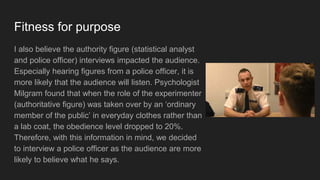
I also believe the authority figure (statistical analyst
and police officer) interviews impacted the audience.
Especially hearing figures from a police officer, it is
more likely that the audience will listen. Psychologist
Milgram found that when the role of the experimenter
(authoritative figure) was taken over by an ‘ordinary
member of the public’ in everyday clothes rather than
a lab coat, the obedience level dropped to 20%.
Therefore, with this information in mind, we decided
to interview a police officer as the audience are more
likely to believe what he says.
Fitness for purpose
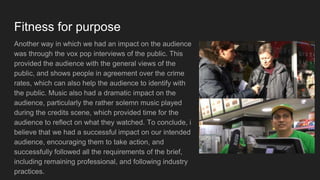
Another way in which we had an impact on the audience
was through the vox pop interviews of the public. This
provided the audience with the general views of the
public, and shows people in agreement over the crime
rates, which can also help the audience to identify with
the public. Music also had a dramatic impact on the
audience, particularly the rather solemn music played
during the credits scene, which provided time for the
audience to reflect on what they watched. To conclude, i
believe that we had a successful impact on our intended
audience, encouraging them to take action, and
successfully followed all the requirements of the brief,
including remaining professional, and following industry
practices.
Technical Qualities - Camerawork
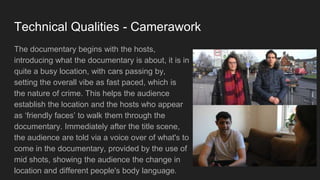
The documentary begins with the hosts,
introducing what the documentary is about, it is in
quite a busy location, with cars passing by,
setting the overall vibe as fast paced, which is
the nature of crime. This helps the audience
establish the location and the hosts who appear
as ‘friendly faces’ to walk them through the
documentary. Immediately after the title scene,
the audience are told via a voice over of what's to
come in the documentary, provided by the use of
mid shots, showing the audience the change in
location and different people's body language.
Technical Qualities - Camerawork
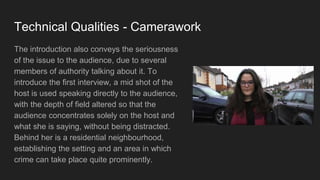
The introduction also conveys the seriousness
of the issue to the audience, due to several
members of authority talking about it. To
introduce the first interview, a mid shot of the
host is used speaking directly to the audience,
with the depth of field altered so that the
audience concentrates solely on the host and
what she is saying, without being distracted.
Behind her is a residential neighbourhood,
establishing the setting and an area in which
crime can take place quite prominently.
Technical Qualities - Camerawork
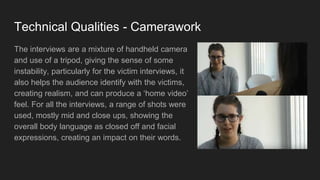
The interviews are a mixture of handheld camera
and use of a tripod, giving the sense of some
instability, particularly for the victim interviews, it
also helps the audience identify with the victims,
creating realism, and can produce a ‘home video’
feel. For all the interviews, a range of shots were
used, mostly mid and close ups, showing the
overall body language as closed off and facial
expressions, creating an impact on their words.
Technical Qualities - Camerawork
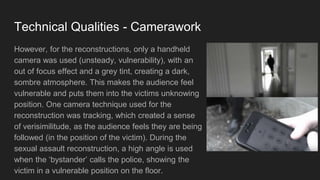
However, for the reconstructions, only a handheld
camera was used (unsteady, vulnerability), with an
out of focus effect and a grey tint, creating a dark,
sombre atmosphere. This makes the audience feel
vulnerable and puts them into the victims unknowing
position. One camera technique used for the
reconstruction was tracking, which created a sense
of verisimilitude, as the audience feels they are being
followed (in the position of the victim). During the
sexual assault reconstruction, a high angle is used
when the ‘bystander’ calls the police, showing the
victim in a vulnerable position on the floor.
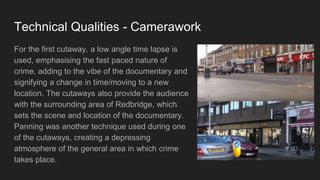
Technical Qualities - Camerawork
For the first cutaway, a low angle time lapse is
used, emphasising the fast paced nature of
crime, adding to the vibe of the documentary and
signifying a change in time/moving to a new
location. The cutaways also provide the audience
with the surrounding area of Redbridge, which
sets the scene and location of the documentary.
Panning was another technique used during one
of the cutaways, creating a depressing
atmosphere of the general area in which crime
takes place.
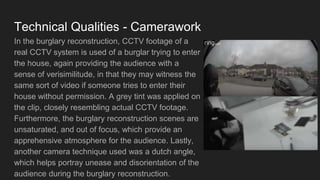
Technical Qualities - Camerawork
In the burglary reconstruction, CCTV footage of a
real CCTV system is used of a burglar trying to enter
the house, again providing the audience with a
sense of verisimilitude, in that they may witness the
same sort of video if someone tries to enter their
house without permission. A grey tint was applied on
the clip, closely resembling actual CCTV footage.
Furthermore, the burglary reconstruction scenes are
unsaturated, and out of focus, which provide an
apprehensive atmosphere for the audience. Lastly,
another camera technique used was a dutch angle,
which helps portray unease and disorientation of the
audience during the burglary reconstruction.
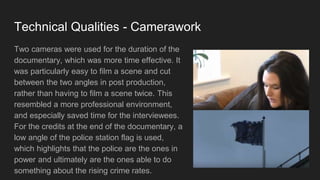
Technical Qualities - Camerawork
Two cameras were used for the duration of the
documentary, which was more time effective. It
was particularly easy to film a scene and cut
between the two angles in post production,
rather than having to film a scene twice. This
resembled a more professional environment,
and especially saved time for the interviewees.
For the credits at the end of the documentary, a
low angle of the police station flag is used,
which highlights that the police are the ones in
power and ultimately are the ones able to do
something about the rising crime rates.
Technical Qualities - Editing
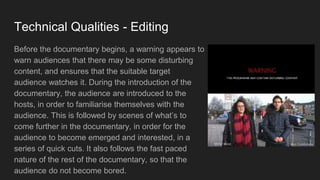
Before the documentary begins, a warning appears to
warn audiences that there may be some disturbing
content, and ensures that the suitable target
audience watches it. During the introduction of the
documentary, the audience are introduced to the
hosts, in order to familiarise themselves with the
audience. This is followed by scenes of what’s to
come further in the documentary, in order for the
audience to become emerged and interested, in a
series of quick cuts. It also follows the fast paced
nature of the rest of the documentary, so that the
audience do not become bored.
Technical Qualities - Editing
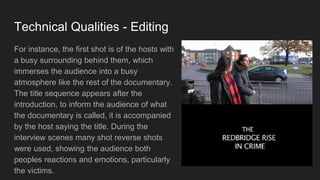
For instance, the first shot is of the hosts with
a busy surrounding behind them, which
immerses the audience into a busy
atmosphere like the rest of the documentary.
The title sequence appears after the
introduction, to inform the audience of what
the documentary is called, it is accompanied
by the host saying the title. During the
interview scenes many shot reverse shots
were used, showing the audience both
peoples reactions and emotions, particularly
the victims.
Technical Qualities - Editing
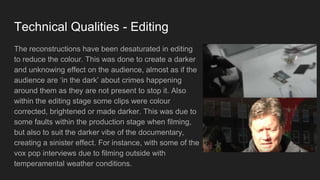
The reconstructions have been desaturated in editing
to reduce the colour. This was done to create a darker
and unknowing effect on the audience, almost as if the
audience are ‘in the dark’ about crimes happening
around them as they are not present to stop it. Also
within the editing stage some clips were colour
corrected, brightened or made darker. This was due to
some faults within the production stage when filming,
but also to suit the darker vibe of the documentary,
creating a sinister effect. For instance, with some of the
vox pop interviews due to filming outside with
temperamental weather conditions.
Technical Qualities - Editing
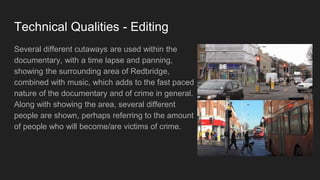
Several different cutaways are used within the
documentary, with a time lapse and panning,
showing the surrounding area of Redbridge,
combined with music, which adds to the fast paced
nature of the documentary and of crime in general.
Along with showing the area, several different
people are shown, perhaps referring to the amount
of people who will become/are victims of crime.
Technical Qualities - Editing
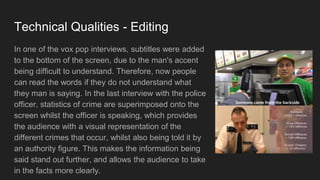
In one of the vox pop interviews, subtitles were added
to the bottom of the screen, due to the man's accent
being difficult to understand. Therefore, now people
can read the words if they do not understand what
they man is saying. In the last interview with the police
officer, statistics of crime are superimposed onto the
screen whilst the officer is speaking, which provides
the audience with a visual representation of the
different crimes that occur, whilst also being told it by
an authority figure. This makes the information being
said stand out further, and allows the audience to take
in the facts more clearly.
Technical Qualities - Mise-en-scene
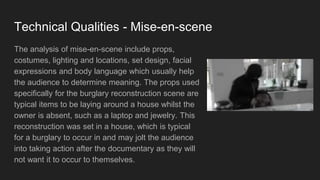
The analysis of mise-en-scene include props,
costumes, lighting and locations, set design, facial
expressions and body language which usually help
the audience to determine meaning. The props used
specifically for the burglary reconstruction scene are
typical items to be laying around a house whilst the
owner is absent, such as a laptop and jewelry. This
reconstruction was set in a house, which is typical
for a burglary to occur in and may jolt the audience
into taking action after the documentary as they will
not want it to occur to themselves.
Technical Qualities - Mise-en-scene
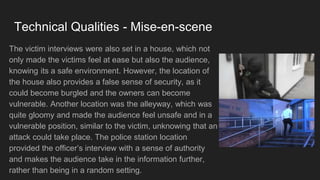
The victim interviews were also set in a house, which not
only made the victims feel at ease but also the audience,
knowing its a safe environment. However, the location of
the house also provides a false sense of security, as it
could become burgled and the owners can become
vulnerable. Another location was the alleyway, which was
quite gloomy and made the audience feel unsafe and in a
vulnerable position, similar to the victim, unknowing that an
attack could take place. The police station location
provided the officer’s interview with a sense of authority
and makes the audience take in the information further,
rather than being in a random setting.
Technical Qualities - Mise-en-scene
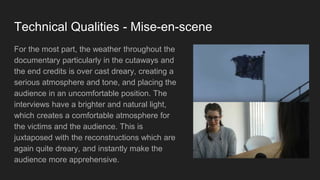
For the most part, the weather throughout the
documentary particularly in the cutaways and
the end credits is over cast dreary, creating a
serious atmosphere and tone, and placing the
audience in an uncomfortable position. The
interviews have a brighter and natural light,
which creates a comfortable atmosphere for
the victims and the audience. This is
juxtaposed with the reconstructions which are
again quite dreary, and instantly make the
audience more apprehensive.
Technical Qualities - Mise-en-scene
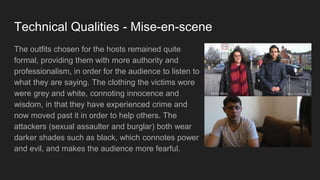
The outfits chosen for the hosts remained quite
formal, providing them with more authority and
professionalism, in order for the audience to listen to
what they are saying. The clothing the victims wore
were grey and white, connoting innocence and
wisdom, in that they have experienced crime and
now moved past it in order to help others. The
attackers (sexual assaulter and burglar) both wear
darker shades such as black, which connotes power
and evil, and makes the audience more fearful.
Technical Qualities - Sound
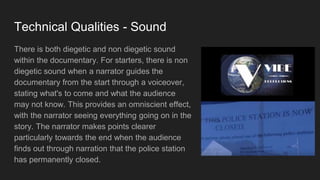
There is both diegetic and non diegetic sound
within the documentary. For starters, there is non
diegetic sound when a narrator guides the
documentary from the start through a voiceover,
stating what's to come and what the audience
may not know. This provides an omniscient effect,
with the narrator seeing everything going on in the
story. The narrator makes points clearer
particularly towards the end when the audience
finds out through narration that the police station
has permanently closed.
Technical Qualities - Sound
As the narrator is female, the tone is softer and less harsh with points being stated.
The softer tone works especially when dealing with a sensitive topic such as crime,
in that there is a juxtaposition between the harshness of what's being shown and
the compassionate female voice walking the audience through. The language use
is quite formal, further highlighting the importance of the topic and adding to the
professionalism. There is use of non diegetic music throughout the introduction of
the documentary, providing a serious effect and adding to a tense ambience. It is
also quite suspenseful, in order for the audience to ponder on what's to come. Non
diegetic sound is also used within the cutaways, it is rather upbeat music, which
contrasts the events shown within the documentary, in order to keep a fast paced
vibe and atmosphere throughout. During the end credits scene, the non diegetic
music is more downbeat, in order to make the audience determined to take action.
Technical Qualities - Sound
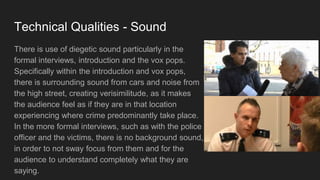
There is use of diegetic sound particularly in the
formal interviews, introduction and the vox pops.
Specifically within the introduction and vox pops,
there is surrounding sound from cars and noise from
the high street, creating verisimilitude, as it makes
the audience feel as if they are in that location
experiencing where crime predominantly take place.
In the more formal interviews, such as with the police
officer and the victims, there is no background sound,
in order to not sway focus from them and for the
audience to understand completely what they are
saying.

Evaluation p1

  • 1.
  • 2.
    Introduction Vibe Productions project‘The Rise in Redbridge Crime’ is a documentary focusing on the crime in the Redbridge region and why it is happening. It follows a brief given by the London Borough of Redbridge council, which stated that we must create a social action project focusing on one of the issues surrounding the area, specifically for 14 to 19 year olds as a primary audience, but people aged 30 and over as a secondary audience, in order to improve community cohesion. Before producing a team, as individuals we thoroughly researched the requirements of the brief in order to clearly understand every aspect of it. Another important part of research was job roles involved in the industry and other information to help during production of the social action project.
  • 3.
    Introduction For example, commissioningcorporations, the role of the writer and legal and ethical consideration. Once this background research had been completed, each individual group member researched a potential idea to create a documentary on, seeing that crime was a key topic. We thoroughly researched crime rates within the area, and discovered that crime has been steadily rising, which suggested to us that this was an issue, and we were influenced by other popular documentary series’ such as Panorama and seeing the conventions. From here, we followed industry practices, which were researched previously and proceeded to go through the pre production, production and post production stages.
  • 4.
    Fitness for purpose Inorder to meet the purpose of the task, we thoroughly planned, following industry practices, by producing all pre production tasks, including a treatment, script and a storyboard, which was followed throughout, and helped us stick to strict time constraints. We hoped to inform the target audience of 14 to 19 year olds in the Redbridge region on what crimes were most prevalent and what the audience can do to prevent the crimes from further rising, and researched popular programme Panorama, which influenced our documentary. Specifically the style, and range of content that Panorama included. According to theorist Denis Mcquail, and his theory on uses and gratifications, he stated that people seek information. In order to find out about the world, seek advice, satisfying curiosity, education and knowledge. We fulfilled this by providing information for people in order to educate them further.
  • 5.
    Fitness for purpose Throughseeking information, a moral panic can be created (Stanley Cohen), and you are able to convey a message better through the media. Therefore, by posting the social action project onto Youtube, we have a successful attempt at informing our audience and influencing them to do something within the community. In order to further shock and inform our audience, we provided them with figures and statistics shown on screen, whilst being explained by authority figures. These statistics were found on official Metropolitan police websites, as this information is more reliable than other sources such as Wikipedia. This way, the audience was able to see how prominent the different types of crimes were in the Redbridge region.
  • 6.
    Fitness for purpose Wealso wanted to give the audience a real representation of the crimes that occur, and therefore we used real victims of different crimes such as sexual assault and burglary to discuss their experiences and how they were dealt with. Alongside these victim interviews, reconstruction were shown, which emphasised the crimes that occured and shocks the audience. This may have impacted the audience as it puts them into the perspective of the victim and makes them feel vulnerable, especially as these crimes can happen to anyone. The reconstructions may disturb the audience, and they are therefore more likely to have the topic in mind and do something once the video ends.
  • 7.
    Fitness for purpose Duringthe victim interviews, particularly the sexual assault victim, several close ups were used to portray her emotions and and closed off body language. This may have impacted the audience, as they may feel sympathetic towards the victims and encourage them to take action. Todorov's narrative structure is followed within the documentary, as it begins with equilibrium,, followed by disruption in learning the crimes that have occured. There is also a realisation of these crimes and possibilities on how to solve them. The documentary ends with equilibrium again, as many problems have been resolved,and can help the audience, through the use of links and phone numbers after the credits.
  • 8.
    Fitness for purpose Ialso believe the authority figure (statistical analyst and police officer) interviews impacted the audience. Especially hearing figures from a police officer, it is more likely that the audience will listen. Psychologist Milgram found that when the role of the experimenter (authoritative figure) was taken over by an ‘ordinary member of the public’ in everyday clothes rather than a lab coat, the obedience level dropped to 20%. Therefore, with this information in mind, we decided to interview a police officer as the audience are more likely to believe what he says.
  • 9.
    Fitness for purpose Anotherway in which we had an impact on the audience was through the vox pop interviews of the public. This provided the audience with the general views of the public, and shows people in agreement over the crime rates, which can also help the audience to identify with the public. Music also had a dramatic impact on the audience, particularly the rather solemn music played during the credits scene, which provided time for the audience to reflect on what they watched. To conclude, i believe that we had a successful impact on our intended audience, encouraging them to take action, and successfully followed all the requirements of the brief, including remaining professional, and following industry practices.
  • 10.
    Technical Qualities -Camerawork The documentary begins with the hosts, introducing what the documentary is about, it is in quite a busy location, with cars passing by, setting the overall vibe as fast paced, which is the nature of crime. This helps the audience establish the location and the hosts who appear as ‘friendly faces’ to walk them through the documentary. Immediately after the title scene, the audience are told via a voice over of what's to come in the documentary, provided by the use of mid shots, showing the audience the change in location and different people's body language.
  • 11.
    Technical Qualities -Camerawork The introduction also conveys the seriousness of the issue to the audience, due to several members of authority talking about it. To introduce the first interview, a mid shot of the host is used speaking directly to the audience, with the depth of field altered so that the audience concentrates solely on the host and what she is saying, without being distracted. Behind her is a residential neighbourhood, establishing the setting and an area in which crime can take place quite prominently.
  • 12.
    Technical Qualities -Camerawork The interviews are a mixture of handheld camera and use of a tripod, giving the sense of some instability, particularly for the victim interviews, it also helps the audience identify with the victims, creating realism, and can produce a ‘home video’ feel. For all the interviews, a range of shots were used, mostly mid and close ups, showing the overall body language as closed off and facial expressions, creating an impact on their words.
  • 13.
    Technical Qualities -Camerawork However, for the reconstructions, only a handheld camera was used (unsteady, vulnerability), with an out of focus effect and a grey tint, creating a dark, sombre atmosphere. This makes the audience feel vulnerable and puts them into the victims unknowing position. One camera technique used for the reconstruction was tracking, which created a sense of verisimilitude, as the audience feels they are being followed (in the position of the victim). During the sexual assault reconstruction, a high angle is used when the ‘bystander’ calls the police, showing the victim in a vulnerable position on the floor.
  • 14.
    Technical Qualities -Camerawork For the first cutaway, a low angle time lapse is used, emphasising the fast paced nature of crime, adding to the vibe of the documentary and signifying a change in time/moving to a new location. The cutaways also provide the audience with the surrounding area of Redbridge, which sets the scene and location of the documentary. Panning was another technique used during one of the cutaways, creating a depressing atmosphere of the general area in which crime takes place.
  • 15.
    Technical Qualities -Camerawork In the burglary reconstruction, CCTV footage of a real CCTV system is used of a burglar trying to enter the house, again providing the audience with a sense of verisimilitude, in that they may witness the same sort of video if someone tries to enter their house without permission. A grey tint was applied on the clip, closely resembling actual CCTV footage. Furthermore, the burglary reconstruction scenes are unsaturated, and out of focus, which provide an apprehensive atmosphere for the audience. Lastly, another camera technique used was a dutch angle, which helps portray unease and disorientation of the audience during the burglary reconstruction.
  • 16.
    Technical Qualities -Camerawork Two cameras were used for the duration of the documentary, which was more time effective. It was particularly easy to film a scene and cut between the two angles in post production, rather than having to film a scene twice. This resembled a more professional environment, and especially saved time for the interviewees. For the credits at the end of the documentary, a low angle of the police station flag is used, which highlights that the police are the ones in power and ultimately are the ones able to do something about the rising crime rates.
  • 17.
    Technical Qualities -Editing Before the documentary begins, a warning appears to warn audiences that there may be some disturbing content, and ensures that the suitable target audience watches it. During the introduction of the documentary, the audience are introduced to the hosts, in order to familiarise themselves with the audience. This is followed by scenes of what’s to come further in the documentary, in order for the audience to become emerged and interested, in a series of quick cuts. It also follows the fast paced nature of the rest of the documentary, so that the audience do not become bored.
  • 18.
    Technical Qualities -Editing For instance, the first shot is of the hosts with a busy surrounding behind them, which immerses the audience into a busy atmosphere like the rest of the documentary. The title sequence appears after the introduction, to inform the audience of what the documentary is called, it is accompanied by the host saying the title. During the interview scenes many shot reverse shots were used, showing the audience both peoples reactions and emotions, particularly the victims.
  • 19.
    Technical Qualities -Editing The reconstructions have been desaturated in editing to reduce the colour. This was done to create a darker and unknowing effect on the audience, almost as if the audience are ‘in the dark’ about crimes happening around them as they are not present to stop it. Also within the editing stage some clips were colour corrected, brightened or made darker. This was due to some faults within the production stage when filming, but also to suit the darker vibe of the documentary, creating a sinister effect. For instance, with some of the vox pop interviews due to filming outside with temperamental weather conditions.
  • 20.
    Technical Qualities -Editing Several different cutaways are used within the documentary, with a time lapse and panning, showing the surrounding area of Redbridge, combined with music, which adds to the fast paced nature of the documentary and of crime in general. Along with showing the area, several different people are shown, perhaps referring to the amount of people who will become/are victims of crime.
  • 21.
    Technical Qualities -Editing In one of the vox pop interviews, subtitles were added to the bottom of the screen, due to the man's accent being difficult to understand. Therefore, now people can read the words if they do not understand what they man is saying. In the last interview with the police officer, statistics of crime are superimposed onto the screen whilst the officer is speaking, which provides the audience with a visual representation of the different crimes that occur, whilst also being told it by an authority figure. This makes the information being said stand out further, and allows the audience to take in the facts more clearly.
  • 22.
    Technical Qualities -Mise-en-scene The analysis of mise-en-scene include props, costumes, lighting and locations, set design, facial expressions and body language which usually help the audience to determine meaning. The props used specifically for the burglary reconstruction scene are typical items to be laying around a house whilst the owner is absent, such as a laptop and jewelry. This reconstruction was set in a house, which is typical for a burglary to occur in and may jolt the audience into taking action after the documentary as they will not want it to occur to themselves.
  • 23.
    Technical Qualities -Mise-en-scene The victim interviews were also set in a house, which not only made the victims feel at ease but also the audience, knowing its a safe environment. However, the location of the house also provides a false sense of security, as it could become burgled and the owners can become vulnerable. Another location was the alleyway, which was quite gloomy and made the audience feel unsafe and in a vulnerable position, similar to the victim, unknowing that an attack could take place. The police station location provided the officer’s interview with a sense of authority and makes the audience take in the information further, rather than being in a random setting.
  • 24.
    Technical Qualities -Mise-en-scene For the most part, the weather throughout the documentary particularly in the cutaways and the end credits is over cast dreary, creating a serious atmosphere and tone, and placing the audience in an uncomfortable position. The interviews have a brighter and natural light, which creates a comfortable atmosphere for the victims and the audience. This is juxtaposed with the reconstructions which are again quite dreary, and instantly make the audience more apprehensive.
  • 25.
    Technical Qualities -Mise-en-scene The outfits chosen for the hosts remained quite formal, providing them with more authority and professionalism, in order for the audience to listen to what they are saying. The clothing the victims wore were grey and white, connoting innocence and wisdom, in that they have experienced crime and now moved past it in order to help others. The attackers (sexual assaulter and burglar) both wear darker shades such as black, which connotes power and evil, and makes the audience more fearful.
  • 26.
    Technical Qualities -Sound There is both diegetic and non diegetic sound within the documentary. For starters, there is non diegetic sound when a narrator guides the documentary from the start through a voiceover, stating what's to come and what the audience may not know. This provides an omniscient effect, with the narrator seeing everything going on in the story. The narrator makes points clearer particularly towards the end when the audience finds out through narration that the police station has permanently closed.
  • 27.
    Technical Qualities -Sound As the narrator is female, the tone is softer and less harsh with points being stated. The softer tone works especially when dealing with a sensitive topic such as crime, in that there is a juxtaposition between the harshness of what's being shown and the compassionate female voice walking the audience through. The language use is quite formal, further highlighting the importance of the topic and adding to the professionalism. There is use of non diegetic music throughout the introduction of the documentary, providing a serious effect and adding to a tense ambience. It is also quite suspenseful, in order for the audience to ponder on what's to come. Non diegetic sound is also used within the cutaways, it is rather upbeat music, which contrasts the events shown within the documentary, in order to keep a fast paced vibe and atmosphere throughout. During the end credits scene, the non diegetic music is more downbeat, in order to make the audience determined to take action.
  • 28.
    Technical Qualities -Sound There is use of diegetic sound particularly in the formal interviews, introduction and the vox pops. Specifically within the introduction and vox pops, there is surrounding sound from cars and noise from the high street, creating verisimilitude, as it makes the audience feel as if they are in that location experiencing where crime predominantly take place. In the more formal interviews, such as with the police officer and the victims, there is no background sound, in order to not sway focus from them and for the audience to understand completely what they are saying.