QUESTION 1.
In what ways does your media
product use, develop or challenge
forms and conventions of real
media products?
At the start of the A2 coursework task we were given a specific brief where
we had to create a 5 minute introduction to a documentary based on a top
that we had chose. To advertise and support the documentary, we had 2
ancillary tasks to complete. One was to create an informative TV listings
article for a specific magazine, and the second was to create a radio trail
which was aimed to encourage people to watch the documentary. A lot of
research and planning went into the documentary genre as a whole ot
ensure it was effective and as professional as possible. We looked into
specific similar documentaries, the target market we aimed the
documentary towards, other similar radio trails, magazine articles and
much more.
At first, we researched into the documentary genre by looking at the typical
conventions. We had to present information on a factual topic for different
reasons including the record of events, convey opinions, inform viewers and
create public interest. To make our documentary effective we had to look
into convention of the genre like actuality, exposition, voiceover, interviews,
archival footage and reconstructions. Having completed the documentary,
we have been able to see what conventions we have used and why.
To ensure we made our documentary as professional as possible, we
watched documentaries such as „Supersize Me‟, „Inside Death Row‟ and
„Panorama‟ and analyzed them, looking at different camera shots and
editing skills. We found out what they all had in common so we were
able to follow them for our documentary. We found that in „Supersize
Me‟ there was a lot of handheld movement of the camera however we
challenged this convention and went against this because it didn‟t fit in
with our documentary style. We used many zooming, tracking and pan
shots which were all present in all of these documentaries.
PANORAMA
“Panorama: jailed for a knife”, aired on BBC
1, is the main programme we followed as
it had many codes and conventions we
wanted to use and adapt to our own
documentary, “Left Wounded”. Left
wounded and Panorama share the same
subject on knife crime, both engage a
teenage audience of an age range
between 14-22 as this is the most
common category of where knife crime is
becoming popular. The purpose of aiming
it at this age is to raise awareness and
show the consequences of what happens
when you carry a knife. The main aim of
the documentary was for it to be
persuasive and informative, just like
Panorama, by including friends and
families of those who have been murdered
to encourage youths to drop a knife to
save a life.
Bill Nicholls's theory
We then researched in Bill Nicholls theory of the various
documentary modes which consisted of expository,
observational, participatory, poetic, reflexive and per
formative.
If we look at Bill Nicholls theory, our documentary Left
Wounded will come under the category of expository
mode as it follows most of these conventions including
using titles and narration . It shows the documentary
from a neutral point of view. However it also follows the
poetic mode due to our interview on Mohammed.
Mohammed had been affected by knife crime because of
his close friend Depzman which showed emotion. We
added backing piano instrumental to make it more
dramatic and for the audience to empathise with
Mohammed.
COMPARING THE INTRODUCTION
Panorama started with an opening screen of
statistics on the screen, about how the sentence
was for knife crime. However we challenged this
convention and went against it by using footage
from different case studies (BBC NEWS) where
people have been stabbed. We thought this would
engage the audience more as it relates more to the
youths in not just Birmingham, but all over the UK.
We were pleased with how this came out as
response from questionnaires showed it intrigued
and captured the audiences attention.

Whilst Panorama starts off with a
mid long shot of a criminal, we
thought an establishing shot
would be necessary to set the
scene about what the
documentary will involve.
However both show what the
documentaries are referring to;
knife crime.
We followed several conventions of
Panorama, in this case it was a mid
shot of the interviewee. We believed
this was a useful way of putting
across emotion and feeling of how the
family and friends felt from those who
have been victims of knife crime. An
extra feature we decided to add was
a caption of who the interviewee was
how he is related to the documentary
so it always relates back to knife
crime. It also shows the rules of third
have been used.

The close up shot of the
people walking was utilised in
Left Wounded as well as it
was a good filler to break up
the interview of Mohammed
and the setting of the Sixth
form we went to. These
screenshots show the
similarity between our
documentary and Panorama.
STOCK FOOTAGE

Panorama use stock footage from the Drop
the Weapons campaign to describe how
serious knife crime is. As it was made by
Metropolitan Police it shows how it is trying
to influence the audience to drop a knife and
save a life. The use of the props such as the
coffin has an impact on the audience,
showing consequences of what stabbings
cause as well as the emotion and hardship
families and friends go through.

Left Wounded utilises stock of a young
upcoming rapper Depzman, who lived in
Birmingham. He was an idol to many
people and was very well known which is
why we thought it was necessary to
include his rap video, to show the impact
and consequences knife crime causes.
Not only was he known in Birmingham
but across the UK which shows Left
Wounded is reaching out to all youths in
all societies. This scene also refers to the
dead, with grave stone of a friend who
had been stabbed which again shows the
hardship families an go through.
INTERVIEWS
Panorama consisted mainly of interviews
from different criminals which have been
jailed due to knife crime. They have tried to
capture information about whether the
people locked up, regret using knifes and
whether they would use it in the future or
not. However we challenged this and got
interviews of those who have been affected
by knife crime i.e. Mohammed the friend of
Depzman and also gained information from
professionals like the Student Support
Officer and the principal of Solihull Sixth
Form. We also considered the mise-en –
scene and background of the interviews to
make sure it was fit for purpose. In
panorama, they used the classic jail cell to
show how hard it is living in a condition with
no freedom which therefore reinforces for
youths to drop knives. With Left Wounded,
we made sure that the professionals
(Principal and Student Support) had a
background which portrayed their job role.
However we could of improved by using
different shots for our interviews like close
ups and long shots to make it look more
interesting.
FILLERS

Fillers is an important part of a documentary, its what helps the documentary to flow. Without
fillers there would be a lot of blank spaces which wouldn‟t look professional. Most of the fillers
included within Panorama were describing the setting which we also adapted to our documentary.
A range of shots, pans, zooms and angles were used to make it look as interesting and eye
catching as possible. Most of the shots were taken of the surrounding to inform the viewer where
the footage was filmed which was also done in Panorama.
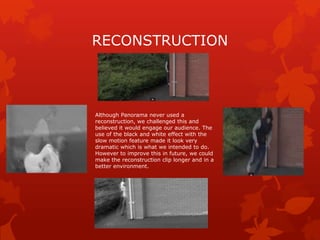
RECONSTRUCTION

Although Panorama never used a
reconstruction, we challenged this and
believed it would engage our audience. The
use of the black and white effect with the
slow motion feature made it look very
dramatic which is what we intended to do.
However to improve this in future, we could
make the reconstruction clip longer and in a
better environment.
SUMMARY
1. I believe our documentary followed many codes and conventions
of a professional documentary including the camera shots,
angles and different editing skills. However challenging the
conventions also worked well and were suitable.
2. The non- diegetic background music was created by the group
and worked well with the filming. The level of this music was
raised when necessary and lowered when we didn‟t need it i.e.
throughout the interviews. The sound levels were decent
throughout however they could have been improved throughout
some of the interviews.
3. The use of fades, dissolves and other effects allowed the
documentary to flow and look as professional as possible.
4. The voiceover we used was effective as it sounded professional.
We thought a female voice should be used as the entirety of the
documentary consisted of males.
5. However in future, I think I would use statistics on screen to
emphasise on the number of people who are victims of knife
crime.
THE WAYS IN WHICH WE
FOLLOWED THE CODES AND
CONVENTIONS OF THE DOUBLE
PAGE SPREAD
We decided „Radio Times‟ would be the magazine to
feature our double page spread as it advertised
various programmes and also was suitable for our
target audience. We looked at the conventions we
had to follow in order to make it look as professional
as possible including the style of writing used. We
wanted the article to be informative but also
persuade people to read it.
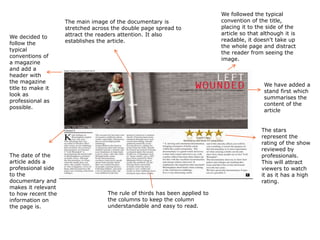
We decided to
follow the
typical
conventions of
a magazine
and add a
header with
the magazine
title to make it
look as
professional as
possible.

The date of the
article adds a
professional side
to the
documentary and
makes it relevant
to how recent the
information on
the page is.

The main image of the documentary is
stretched across the double page spread to
attract the readers attention. It also
establishes the article.

We followed the typical
convention of the title,
placing it to the side of the
article so that although it is
readable, it doesn't take up
the whole page and distract
the reader from seeing the
image.

We have added a
stand first which
summarises the
content of the
article
The stars
represent the
rating of the show
reviewed by
professionals.
This will attract
viewers to watch
it as it has a high
rating.
The rule of thirds has been applied to
the columns to keep the column
understandable and easy to read.
SUMMARY
1. In comparison to the Eric, Ernie and me we followed most
of the conventions by adding a bold title, stand first, page
numbers and the date and time. The white background was
also utilised in our magazine page to make it look as
professional as possible. However we changed the layout by
stretching the image across the two pages so it attracts the
audience more.
2. We chose to use this magazine as a template as it had
many professional programmes advertised on it which were
popular and looked sophisticated.
3. However the changes i would make would be to add an
extra image to inform the audience more about what will be
included in the documentary. I would also change the font
to make it look more professional and suit the magazine
style.
THE WAYS IN WHICH WE
FOLLOWED THE CODES AND
CONVENTIONS OF THE RADIO
TRAILER
TYPICAL RADIO TRAILER
CONVENTIONS
The typical radio trailer conventions consist of:
1. Voiceover
2. Music
3. Facts
4. Channel
5. Date/ time
The radio trailer needs to be catchy and stand out to get the
audience‟s attention. It should be short, informative and
persuasive to engage people to view the documentary.
We heard various radio trailers to get an
understanding of the codes and conventions we
needed to consider to make it effective and
persuasive as possible. We chose radio 1 to
broadcast our radio trailer as it was aimed at
young adults and students and felt this radio
station would allow use to reach this target
audience
LEFT WOUNDED RADIO TRAILER
 Our radio trailer consisted of many conventions as
professionally as possible. This was fulfilled ny hearing radio
one trailers and following all the conventions they had
 The voiceover was recorded in a separate, quiet room so it
was clear and understandable
 We used the same music in our documentary on our radio
trailer so they both linked together
 We utilised small parts of our documentary sound (i.e.
Mohammad's interview) to show an insight of what will be
included within the documentary
 By showing the documentary on channel 4, it will reach to
our aspired target audience of young adults and teenagers

Question 1

  • 1.
    QUESTION 1. In whatways does your media product use, develop or challenge forms and conventions of real media products?
  • 2.
    At the startof the A2 coursework task we were given a specific brief where we had to create a 5 minute introduction to a documentary based on a top that we had chose. To advertise and support the documentary, we had 2 ancillary tasks to complete. One was to create an informative TV listings article for a specific magazine, and the second was to create a radio trail which was aimed to encourage people to watch the documentary. A lot of research and planning went into the documentary genre as a whole ot ensure it was effective and as professional as possible. We looked into specific similar documentaries, the target market we aimed the documentary towards, other similar radio trails, magazine articles and much more. At first, we researched into the documentary genre by looking at the typical conventions. We had to present information on a factual topic for different reasons including the record of events, convey opinions, inform viewers and create public interest. To make our documentary effective we had to look into convention of the genre like actuality, exposition, voiceover, interviews, archival footage and reconstructions. Having completed the documentary, we have been able to see what conventions we have used and why.
  • 3.
    To ensure wemade our documentary as professional as possible, we watched documentaries such as „Supersize Me‟, „Inside Death Row‟ and „Panorama‟ and analyzed them, looking at different camera shots and editing skills. We found out what they all had in common so we were able to follow them for our documentary. We found that in „Supersize Me‟ there was a lot of handheld movement of the camera however we challenged this convention and went against this because it didn‟t fit in with our documentary style. We used many zooming, tracking and pan shots which were all present in all of these documentaries.
  • 4.
    PANORAMA “Panorama: jailed fora knife”, aired on BBC 1, is the main programme we followed as it had many codes and conventions we wanted to use and adapt to our own documentary, “Left Wounded”. Left wounded and Panorama share the same subject on knife crime, both engage a teenage audience of an age range between 14-22 as this is the most common category of where knife crime is becoming popular. The purpose of aiming it at this age is to raise awareness and show the consequences of what happens when you carry a knife. The main aim of the documentary was for it to be persuasive and informative, just like Panorama, by including friends and families of those who have been murdered to encourage youths to drop a knife to save a life.
  • 5.
    Bill Nicholls's theory Wethen researched in Bill Nicholls theory of the various documentary modes which consisted of expository, observational, participatory, poetic, reflexive and per formative. If we look at Bill Nicholls theory, our documentary Left Wounded will come under the category of expository mode as it follows most of these conventions including using titles and narration . It shows the documentary from a neutral point of view. However it also follows the poetic mode due to our interview on Mohammed. Mohammed had been affected by knife crime because of his close friend Depzman which showed emotion. We added backing piano instrumental to make it more dramatic and for the audience to empathise with Mohammed.
  • 6.
    COMPARING THE INTRODUCTION Panoramastarted with an opening screen of statistics on the screen, about how the sentence was for knife crime. However we challenged this convention and went against it by using footage from different case studies (BBC NEWS) where people have been stabbed. We thought this would engage the audience more as it relates more to the youths in not just Birmingham, but all over the UK. We were pleased with how this came out as response from questionnaires showed it intrigued and captured the audiences attention. Whilst Panorama starts off with a mid long shot of a criminal, we thought an establishing shot would be necessary to set the scene about what the documentary will involve. However both show what the documentaries are referring to; knife crime.
  • 7.
    We followed severalconventions of Panorama, in this case it was a mid shot of the interviewee. We believed this was a useful way of putting across emotion and feeling of how the family and friends felt from those who have been victims of knife crime. An extra feature we decided to add was a caption of who the interviewee was how he is related to the documentary so it always relates back to knife crime. It also shows the rules of third have been used. The close up shot of the people walking was utilised in Left Wounded as well as it was a good filler to break up the interview of Mohammed and the setting of the Sixth form we went to. These screenshots show the similarity between our documentary and Panorama.
  • 8.
    STOCK FOOTAGE Panorama usestock footage from the Drop the Weapons campaign to describe how serious knife crime is. As it was made by Metropolitan Police it shows how it is trying to influence the audience to drop a knife and save a life. The use of the props such as the coffin has an impact on the audience, showing consequences of what stabbings cause as well as the emotion and hardship families and friends go through. Left Wounded utilises stock of a young upcoming rapper Depzman, who lived in Birmingham. He was an idol to many people and was very well known which is why we thought it was necessary to include his rap video, to show the impact and consequences knife crime causes. Not only was he known in Birmingham but across the UK which shows Left Wounded is reaching out to all youths in all societies. This scene also refers to the dead, with grave stone of a friend who had been stabbed which again shows the hardship families an go through.
  • 9.
    INTERVIEWS Panorama consisted mainlyof interviews from different criminals which have been jailed due to knife crime. They have tried to capture information about whether the people locked up, regret using knifes and whether they would use it in the future or not. However we challenged this and got interviews of those who have been affected by knife crime i.e. Mohammed the friend of Depzman and also gained information from professionals like the Student Support Officer and the principal of Solihull Sixth Form. We also considered the mise-en – scene and background of the interviews to make sure it was fit for purpose. In panorama, they used the classic jail cell to show how hard it is living in a condition with no freedom which therefore reinforces for youths to drop knives. With Left Wounded, we made sure that the professionals (Principal and Student Support) had a background which portrayed their job role. However we could of improved by using different shots for our interviews like close ups and long shots to make it look more interesting.
  • 10.
    FILLERS Fillers is animportant part of a documentary, its what helps the documentary to flow. Without fillers there would be a lot of blank spaces which wouldn‟t look professional. Most of the fillers included within Panorama were describing the setting which we also adapted to our documentary. A range of shots, pans, zooms and angles were used to make it look as interesting and eye catching as possible. Most of the shots were taken of the surrounding to inform the viewer where the footage was filmed which was also done in Panorama.
  • 11.
    RECONSTRUCTION Although Panorama neverused a reconstruction, we challenged this and believed it would engage our audience. The use of the black and white effect with the slow motion feature made it look very dramatic which is what we intended to do. However to improve this in future, we could make the reconstruction clip longer and in a better environment.
  • 12.
    SUMMARY 1. I believeour documentary followed many codes and conventions of a professional documentary including the camera shots, angles and different editing skills. However challenging the conventions also worked well and were suitable. 2. The non- diegetic background music was created by the group and worked well with the filming. The level of this music was raised when necessary and lowered when we didn‟t need it i.e. throughout the interviews. The sound levels were decent throughout however they could have been improved throughout some of the interviews. 3. The use of fades, dissolves and other effects allowed the documentary to flow and look as professional as possible. 4. The voiceover we used was effective as it sounded professional. We thought a female voice should be used as the entirety of the documentary consisted of males. 5. However in future, I think I would use statistics on screen to emphasise on the number of people who are victims of knife crime.
  • 13.
    THE WAYS INWHICH WE FOLLOWED THE CODES AND CONVENTIONS OF THE DOUBLE PAGE SPREAD
  • 14.
    We decided „RadioTimes‟ would be the magazine to feature our double page spread as it advertised various programmes and also was suitable for our target audience. We looked at the conventions we had to follow in order to make it look as professional as possible including the style of writing used. We wanted the article to be informative but also persuade people to read it.
  • 16.
    We decided to followthe typical conventions of a magazine and add a header with the magazine title to make it look as professional as possible. The date of the article adds a professional side to the documentary and makes it relevant to how recent the information on the page is. The main image of the documentary is stretched across the double page spread to attract the readers attention. It also establishes the article. We followed the typical convention of the title, placing it to the side of the article so that although it is readable, it doesn't take up the whole page and distract the reader from seeing the image. We have added a stand first which summarises the content of the article The stars represent the rating of the show reviewed by professionals. This will attract viewers to watch it as it has a high rating. The rule of thirds has been applied to the columns to keep the column understandable and easy to read.
  • 17.
    SUMMARY 1. In comparisonto the Eric, Ernie and me we followed most of the conventions by adding a bold title, stand first, page numbers and the date and time. The white background was also utilised in our magazine page to make it look as professional as possible. However we changed the layout by stretching the image across the two pages so it attracts the audience more. 2. We chose to use this magazine as a template as it had many professional programmes advertised on it which were popular and looked sophisticated. 3. However the changes i would make would be to add an extra image to inform the audience more about what will be included in the documentary. I would also change the font to make it look more professional and suit the magazine style.
  • 18.
    THE WAYS INWHICH WE FOLLOWED THE CODES AND CONVENTIONS OF THE RADIO TRAILER
  • 19.
    TYPICAL RADIO TRAILER CONVENTIONS Thetypical radio trailer conventions consist of: 1. Voiceover 2. Music 3. Facts 4. Channel 5. Date/ time The radio trailer needs to be catchy and stand out to get the audience‟s attention. It should be short, informative and persuasive to engage people to view the documentary.
  • 20.
    We heard variousradio trailers to get an understanding of the codes and conventions we needed to consider to make it effective and persuasive as possible. We chose radio 1 to broadcast our radio trailer as it was aimed at young adults and students and felt this radio station would allow use to reach this target audience
  • 21.
    LEFT WOUNDED RADIOTRAILER  Our radio trailer consisted of many conventions as professionally as possible. This was fulfilled ny hearing radio one trailers and following all the conventions they had  The voiceover was recorded in a separate, quiet room so it was clear and understandable  We used the same music in our documentary on our radio trailer so they both linked together  We utilised small parts of our documentary sound (i.e. Mohammad's interview) to show an insight of what will be included within the documentary  By showing the documentary on channel 4, it will reach to our aspired target audience of young adults and teenagers