EVALUATION
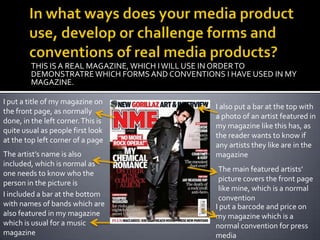
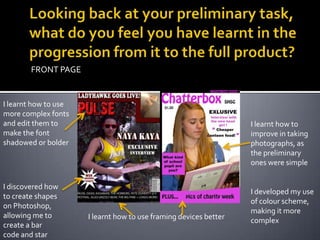
In what ways does your media product use, develop or challenge forms and conventions of real media products?THIS IS A REAL MAGAZINE, WHICH I WILL USE IN ORDER TO DEMONSTRATRE WHICH FORMS AND CONVENTIONS I HAVE USED IN MY MAGAZINE.I put a title of my magazine on the front page, as normally done, in the left corner. This is quite usual as people first look at the top left corner of a pageI also put a bar at the top with a photo of an artist featured in my magazine like this has, as the reader wants to know if any artists they like are in the magazineThe artist’s name is also included, which is normal as one needs to know who the person in the picture isThe main featured artists’ picture covers the front page like mine, which is a normal conventionI included a bar at the bottom with names of bands which are also featured in my magazine which is usual for a music magazineI put a barcode and price on my magazine which is a normal convention for press media
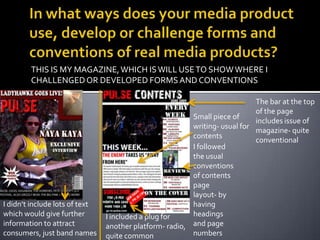
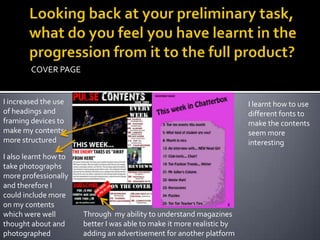
In what ways does your media product use, develop or challenge forms and conventions of real media products?THIS IS MY MAGAZINE, WHICH IS WILL USE TO SHOW WHERE I CHALLENGED OR DEVELOPED FORMS AND CONVENTIONSThe bar at the top of the page includes issue of magazine- quite conventionalSmall piece of writing- usual for contentsI followed the usual conventions of contents page layout- by having headings and page numbersI didn’t include lots of text which would give further information to attract consumers, just band namesI included a plug for another platform- radio, quite common
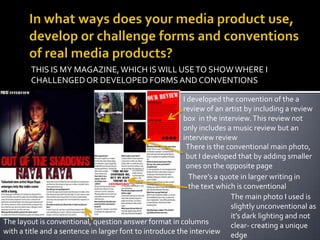
In what ways does your media product use, develop or challenge forms and conventions of real media products?THIS IS MY MAGAZINE, WHICH IS WILL USE TO SHOW WHERE I CHALLENGED OR DEVELOPED FORMS AND CONVENTIONSI developed the convention of the a review of an artist by including a review box  in the interview. This review not only includes a music review but an interview reviewThere is the conventional main photo, but I developed that by adding smaller ones on the opposite pageThere’s a quote in larger writing in the text which is conventionalThe main photo I used is slightly unconventional as it’s dark lighting and not clear- creating a unique edgeThe layout is conventional, question answer format in columns with a title and a sentence in larger font to introduce the interview
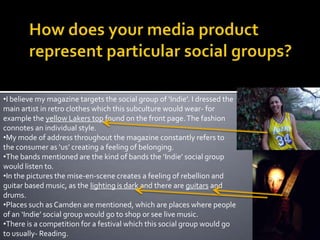
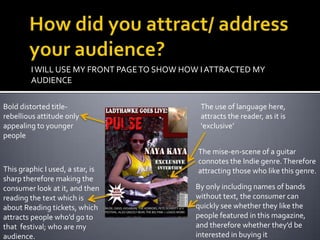
How does your media product represent particular social groups?I believe my magazine targets the social group of ‘Indie’. I dressed the main artist in retro clothes which this subculture would wear- for example the yellow Lakers top found on the front page. The fashion connotes an individual style.
My mode of address throughout the magazine constantly refers to the consumer as ‘us’ creating a feeling of belonging.
The bands mentioned are the kind of bands the ‘Indie’ social group would listen to.
In the pictures the mise-en-scene creates a feeling of rebellion and guitar based music, as the lighting is dark and there are guitars and drums.
Places such as Camden are mentioned, which are places where people of an ‘Indie’ social group would go to shop or see live music.
There is a competition for a festival which this social group would go to usually- Reading.What kind of media institution might distribute your media product and why?I would want my magazine to reach any Indie music fan, therefore I’d want it to be distributed in newsagents and other magazine selling shops all over Britain.I would, therefore, need my magazine to be distributed by a largely successful media institution such as IPC Media who publish NME. IPC Media publishes 850 magazines, with a wide variety from Country Life to Marie Claire. NME is the only music magazine IPC Media publishes, therefore this could be both beneficial or detrimental for my magazine. This could be beneficial as NME is a very successful magazine, and as mine is similar to it, there is a high chance of it becoming equally successful. However, due to NME’s success mine could become too similar to it if it is distributed similarly and therefore not reach it’s maximum potential.
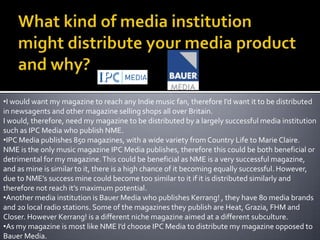
Another media institution is Bauer Media who publishes Kerrang! , they have 80 media brands and 20 local radio stations. Some of the magazines they publish are Heat, Grazia, FHM and Closer. However Kerrang! is a different niche magazine aimed at a different subculture.
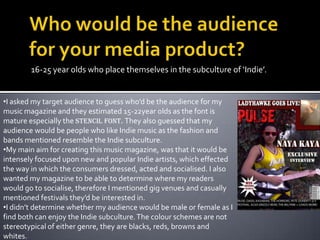
As my magazine is most like NME I’d choose IPC Media to distribute my magazine opposed to Bauer Media. Who would be the audience for your media product?16-25 year olds who place themselves in the subculture of ‘Indie’. I asked my target audience to guess who’d be the audience for my music magazine and they estimated 15-22year olds as the font is mature especially the stencil font. They also guessed that my audience would be people who like Indie music as the fashion and bands mentioned resemble the Indie subculture.
My main aim for creating this music magazine, was that it would be intensely focused upon new and popular Indie artists, which effected the way in which the consumers dressed, acted and socialised. I also wanted my magazine to be able to determine where my readers would go to socialise, therefore I mentioned gig venues and casually mentioned festivals they’d be interested in.

Evaluation

  • 1.
  • 2.
    In what waysdoes your media product use, develop or challenge forms and conventions of real media products?THIS IS A REAL MAGAZINE, WHICH I WILL USE IN ORDER TO DEMONSTRATRE WHICH FORMS AND CONVENTIONS I HAVE USED IN MY MAGAZINE.I put a title of my magazine on the front page, as normally done, in the left corner. This is quite usual as people first look at the top left corner of a pageI also put a bar at the top with a photo of an artist featured in my magazine like this has, as the reader wants to know if any artists they like are in the magazineThe artist’s name is also included, which is normal as one needs to know who the person in the picture isThe main featured artists’ picture covers the front page like mine, which is a normal conventionI included a bar at the bottom with names of bands which are also featured in my magazine which is usual for a music magazineI put a barcode and price on my magazine which is a normal convention for press media
  • 3.
    In what waysdoes your media product use, develop or challenge forms and conventions of real media products?THIS IS MY MAGAZINE, WHICH IS WILL USE TO SHOW WHERE I CHALLENGED OR DEVELOPED FORMS AND CONVENTIONSThe bar at the top of the page includes issue of magazine- quite conventionalSmall piece of writing- usual for contentsI followed the usual conventions of contents page layout- by having headings and page numbersI didn’t include lots of text which would give further information to attract consumers, just band namesI included a plug for another platform- radio, quite common
  • 4.
    In what waysdoes your media product use, develop or challenge forms and conventions of real media products?THIS IS MY MAGAZINE, WHICH IS WILL USE TO SHOW WHERE I CHALLENGED OR DEVELOPED FORMS AND CONVENTIONSI developed the convention of the a review of an artist by including a review box in the interview. This review not only includes a music review but an interview reviewThere is the conventional main photo, but I developed that by adding smaller ones on the opposite pageThere’s a quote in larger writing in the text which is conventionalThe main photo I used is slightly unconventional as it’s dark lighting and not clear- creating a unique edgeThe layout is conventional, question answer format in columns with a title and a sentence in larger font to introduce the interview
  • 5.
    How does yourmedia product represent particular social groups?I believe my magazine targets the social group of ‘Indie’. I dressed the main artist in retro clothes which this subculture would wear- for example the yellow Lakers top found on the front page. The fashion connotes an individual style.
  • 6.
    My mode ofaddress throughout the magazine constantly refers to the consumer as ‘us’ creating a feeling of belonging.
  • 7.
    The bands mentionedare the kind of bands the ‘Indie’ social group would listen to.
  • 8.
    In the picturesthe mise-en-scene creates a feeling of rebellion and guitar based music, as the lighting is dark and there are guitars and drums.
  • 9.
    Places such asCamden are mentioned, which are places where people of an ‘Indie’ social group would go to shop or see live music.
  • 10.
    There is acompetition for a festival which this social group would go to usually- Reading.What kind of media institution might distribute your media product and why?I would want my magazine to reach any Indie music fan, therefore I’d want it to be distributed in newsagents and other magazine selling shops all over Britain.I would, therefore, need my magazine to be distributed by a largely successful media institution such as IPC Media who publish NME. IPC Media publishes 850 magazines, with a wide variety from Country Life to Marie Claire. NME is the only music magazine IPC Media publishes, therefore this could be both beneficial or detrimental for my magazine. This could be beneficial as NME is a very successful magazine, and as mine is similar to it, there is a high chance of it becoming equally successful. However, due to NME’s success mine could become too similar to it if it is distributed similarly and therefore not reach it’s maximum potential.
  • 11.
    Another media institutionis Bauer Media who publishes Kerrang! , they have 80 media brands and 20 local radio stations. Some of the magazines they publish are Heat, Grazia, FHM and Closer. However Kerrang! is a different niche magazine aimed at a different subculture.
  • 12.
    As my magazineis most like NME I’d choose IPC Media to distribute my magazine opposed to Bauer Media. Who would be the audience for your media product?16-25 year olds who place themselves in the subculture of ‘Indie’. I asked my target audience to guess who’d be the audience for my music magazine and they estimated 15-22year olds as the font is mature especially the stencil font. They also guessed that my audience would be people who like Indie music as the fashion and bands mentioned resemble the Indie subculture.
  • 13.
    My main aimfor creating this music magazine, was that it would be intensely focused upon new and popular Indie artists, which effected the way in which the consumers dressed, acted and socialised. I also wanted my magazine to be able to determine where my readers would go to socialise, therefore I mentioned gig venues and casually mentioned festivals they’d be interested in.