Media evaluation
                          hypnosissequence lasting around 2
The brief was to created a genre specific title
minutes long. Our film is called “Hypnosis”. In short, it is a horror film about
a group of teenage friends who venture into the woods on a camping trip. A
mysterious killer who can control minds then starts killing off the teenagers
 one by one. We chose this name for the film because it means 'a state of
consciousness where a person loses the power of voluntary action.' Which
 simply means a person can't control their own actions. We thought this to
be a suitable name for the film as this happens to the characters in the film.
 We also thought that the name gave quite a mysterious and spooky feel,
    which was ideal for the horror genre. In the actual title sequence, the
audience are introduced to a mysterious looking man wearing dark clothing
walking through the woods holding a knife. In between these clips, footage
  is shown of the destruction of five photos of the same group of 5 friends.
 Each one is destroyed differently, representing how each of the teenagers
die in the film. At the end of the title sequence it pans from the man cutting
 a rope, to the characters walking into the shot signalling the beginning of
                                     the film.
In what ways does your media product use,
      develop or challenge forms and
    conventions of real media products?
We did lots of research into title sequences before we even begun to develop
  our idea. We watched loads of existing title sequences to get ideas of what
  makes a good and interesting one. We found that the best types of title
  sequences weren't showing a narrative, instead the better ones conveyed
  different ideas that suggested things about the film and used the footage to
  create enigmas in the audiences mind about what happens later on in the
  film. We found this in the title sequence for 'Halloween 3'. The use of
  editing, footage and colour suggested and symbolised many things that
  may be in the film later on. Such as the use of orange linked with
  halloween. Also, the image of the pumpkin at the end of the title sequence
  is slowly revealed throughout it. This could suggest how the narrative will
  work throughout the film. This creates enigmas in the audiences minds,
  which is also what we wanted to do. We did this by creating a sense of
  mystery as we only saw the body of the man and never his face making us
  wonder who he is.
Another feature that we noticed is that you don't have to have
  long clips in your title sequence to convey the message and
  make it look effective. An example of a title sequence that
  does this is 'se7en' . Throughout the title sequence we are
  shown very short clips that quickly cut to another clip. But from
  these short clips, which also have low lighting, we are able to
  feel the tone and genre of the film. We wanted to do this in our
  title sequence. We used short flashes of the destruction of the
  photos and the mysterious man walking through the woods,
  when watching it though the placement of these short clips
  together allow there to be a link between them and therefore
  allowing the audience to piece together what is happening and
  what will happen further into the film.
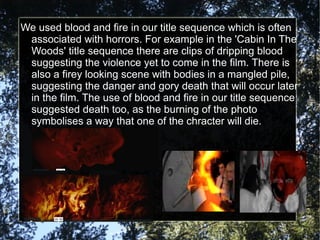
We used blood and fire in our title sequence which is often
 associated with horrors. For example in the 'Cabin In The
 Woods' title sequence there are clips of dripping blood
 suggesting the violence yet to come in the film. There is
 also a firey looking scene with bodies in a mangled pile,
 suggesting the danger and gory death that will occur later
 in the film. The use of blood and fire in our title sequence
 suggested death too, as the burning of the photo
 symbolises a way that one of the chracter will die.
We also noticed that typography and animatics were an
 important feature of title sequences as the right font can
 give the right feel to the title sequence. Also, the right sort
 of animatics can really give a tense feel, especially in
 horror films (distorted, dripping etc). Again, 'se7en' was a
 good example as the typography was very scratchy and
 handwritten and it moved very creepily and distorted
 giving the feeling of unease.
We did want to challenge some of the conventions of
 horror too as we wanted to add something a bit
 different from other horrors to differenciate it. We
 filmed in the daylight on purpose to make the
 audience feel tense from the very beginning.
 Typically, horror films use dark lighting to give a
 sense of mystery not being able to see what is going
 to jump out at you. We wanted to create a sense of
 unease as you don't particularly see a lot of daylight
 in horrors and when you do things don't usually jump
 out and scare you. We wanted to change this, so
 audiences didn't know when something was going to
 jump out.
Who would be your target audience
       for your product?
We decided the target audience would be primarily males aged 15-25. We imagined
  the film would be rated a 15, hence the minimum age being 15. Our secondary
  audience would be females aged 15-25 too, we also thought that couples on a date
  would be a possible audience as there is an element of romance in the film as well
  as the violence. They would fall under the group E, being students as typically they
  have more money to spend leisurely. Their interests would include social
  networking, theme parks for the adrenaline rush, music, going out with friends,
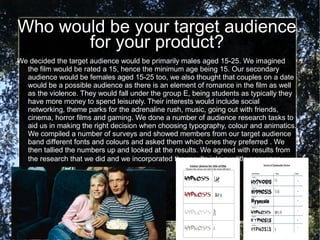
  cinema, horror films and gaming. We done a number of audience research tasks to
  aid us in making the right decision when choosing typography, colour and animatics.
  We compiled a number of surveys and showed members from our target audience
  band different fonts and colours and asked them which ones they preferred . We
  then tallied the numbers up and looked at the results. We agreed with results from
  the research that we did and we incorporated the results into our title sequence.
What kind of media institution
  might distribute your product and
                 why?
When choosing a film studio we researched into what studios had
 previously produced similar and successful films. We wanted one
 that was also notorious for producing horror films. The two that
 stood out the most were Hammer films and Lionsgate film studios.
 We thought that hammer looked like a good studio because they
 produced lots of horror films such as 'The Woman in Black', which
 was quite successful. However, saying this, we thought that
 Hammer seemed like a more unknown company and we may not
 get the budget we needed. We looked at Lionsgate and we
 preferred this studio as it was a more well known company that had
 produced really successful films like 'The Hunger Games'. They also
 produced successful horror films such as 'The Possesion' and 'The
 Last Excorcism'.
The possession
Distribution of The Possession. Lionsgate distributed
  'The Possession', which made a profit of around $64
  million. The film was based around an allegedly
  haunted 'dybbuk box' story, meaning that it may have
  attracted audience this way as it was based on a real
  life thing. To market the film the film was premiered at
  the “Film4 FrightFest”. This created buzz about the
  film and attracted audiences. Trailers and posters
  were used to promote the film too.
The Last exorcism
Lionsgate distributed The Last Exorcism. With its
  budget totalling only $1.8 million, its $65 million profit
  could be said to be a success. With the extreme
  success of thr 1973 film 'The Exorcist' this film
  almost had a pre-sold audience as Lionsgate knew
  that films of this subject in the past have been
  successful. With room for a sequel to this film too,
  Lionsgate knew that the money would be well
  invested.
How does your media product
represent certain social groups
How does your media product represent
        particular social groups?
We were lucky enough to have a choice in what camera we
used to to film our title sequence. Our school,needed,
    used film our title sequence. Our school, if if needed,
provided usus with flip camera to to record our footage on.
    provided with a a flip camera record our footage on.
However, I also had a Fujifilm camera that we could use
    However, I also had a Fujifilm camera that we could use
too. We discussed what camera we wanted to to use and
    too. We discussed what camera we wanted use and we
all we all decided that my camera would probably be the
     decided that my camera would probably be the best
cameracamera as use as it has aquality image for our titleour
    best to use to it has a better better quality image for
sequence, which we wanted. This isThis is because we it
    title sequence, which we wanted. because we wanted
to wanted it to look as professional as possible. We did look
    look as professional as possible. We did look into using
the flipusing theto record foley sound on, however,on,
    into camera flip camera to record foley sound after
filming we realised that we didn't need to we didn't in as we
    however, after filming we realised that add any need to
had all any in as we had all of the sound that we wanted.
    add of the sound that we wanted.
We used some online websites to choose our font and to
 choose our music. Dafont.com was very useful as the
 tabs at the top of the web page allow you to choose what
 type/genre of font we wanted. We went on the 'horror'
 theme and searched through to find the one we
 eventually chose. We also used audionetwork.lgfl.org.uk
 to choose our music. This website is available for schools
 to use copyright free music on what they choose. This
 website also had themes such as horror/dark/creepy. We
 went through lots of the soundtracks until we narrowed it
 down to a few.
Some problems that we faced was that we didn't get
  enough location shots the first time around therefore we
  had to go back. We had to use a flip camera this time
  though as I'd forgotten my own camera. In the future I
  think we would plan better and get as many shots as
  possible.
Another problem we faced was the stiffness of the tripod
  that we used. It gave it an unprofessional look to it
  therefore in future we will check equipment before
  leaving.
How did you attract/address your
           audience?
I think we have successfully reached our target audience as we have
    used all of the main codes and conventions of successful horror
    films.we have used them to the best of our ability to produce
    something that is different, tense yet conforms to the main
    conventions of horror films. From the audience feedback we
    received we received mostly positive feedback with most people
    saying we used the build up of tension really well and it was well
    edited. We did receive some constructive critisism though, which
    was only welcomed, as we wanted to get the most out of our title
    sequence. The comment that mostly came up was about the pace
    not being consistent or some of the clips being too long. This was
    easily solved by removing or cutting down clips.
Looking back at your preliminary task, what do
you feel you have learnt in the progression from
              it to the full product?
The preliminary task was to create a fight sequence with lots of different camera
   angles. I feel like we made a successful fight sequence due to the many camera
   angle used and the use of foley sound. I felt like we made quite a professional
   looking fight sequence in a fairly short amount of time. We didn't do much planning
   to our fight sequence either, so I think that with that taken into account, we did a fair
   job.
We also learnt a lot about foley sound when doing this task. We learnt what objects we
  could use to make effective sound effects for example, slapping raw meat for the
  slapping effect and breaking celery for breaking bones. We learnt how to record
  these sounds and then transfer them into final cut pro too. So in doing this task we
  learnt lots of important skills we could impliment into our final product.
However, saying this, the fact that we didn't plan made the filming slightly more difficult
  as we had to think of different things to do on the spot. Whereas if we had made a
  plan/storyboard of the shots and performances we were going to do it would have
  made it a lot easier and quicker to film. Also, as we all had different ideas about how
  to edit the fight sequence, it was difficult to encoorporate all of our ideas into it.Iwe
  had taken it in turns instead of doing it all at once, we would have been able to get
  more of our ideas into it.

Evaluation

  • 1.
    Media evaluation hypnosissequence lasting around 2 The brief was to created a genre specific title minutes long. Our film is called “Hypnosis”. In short, it is a horror film about a group of teenage friends who venture into the woods on a camping trip. A mysterious killer who can control minds then starts killing off the teenagers one by one. We chose this name for the film because it means 'a state of consciousness where a person loses the power of voluntary action.' Which simply means a person can't control their own actions. We thought this to be a suitable name for the film as this happens to the characters in the film. We also thought that the name gave quite a mysterious and spooky feel, which was ideal for the horror genre. In the actual title sequence, the audience are introduced to a mysterious looking man wearing dark clothing walking through the woods holding a knife. In between these clips, footage is shown of the destruction of five photos of the same group of 5 friends. Each one is destroyed differently, representing how each of the teenagers die in the film. At the end of the title sequence it pans from the man cutting a rope, to the characters walking into the shot signalling the beginning of the film.
  • 2.
    In what waysdoes your media product use, develop or challenge forms and conventions of real media products? We did lots of research into title sequences before we even begun to develop our idea. We watched loads of existing title sequences to get ideas of what makes a good and interesting one. We found that the best types of title sequences weren't showing a narrative, instead the better ones conveyed different ideas that suggested things about the film and used the footage to create enigmas in the audiences mind about what happens later on in the film. We found this in the title sequence for 'Halloween 3'. The use of editing, footage and colour suggested and symbolised many things that may be in the film later on. Such as the use of orange linked with halloween. Also, the image of the pumpkin at the end of the title sequence is slowly revealed throughout it. This could suggest how the narrative will work throughout the film. This creates enigmas in the audiences minds, which is also what we wanted to do. We did this by creating a sense of mystery as we only saw the body of the man and never his face making us wonder who he is.
  • 3.
    Another feature thatwe noticed is that you don't have to have long clips in your title sequence to convey the message and make it look effective. An example of a title sequence that does this is 'se7en' . Throughout the title sequence we are shown very short clips that quickly cut to another clip. But from these short clips, which also have low lighting, we are able to feel the tone and genre of the film. We wanted to do this in our title sequence. We used short flashes of the destruction of the photos and the mysterious man walking through the woods, when watching it though the placement of these short clips together allow there to be a link between them and therefore allowing the audience to piece together what is happening and what will happen further into the film.
  • 4.
    We used bloodand fire in our title sequence which is often associated with horrors. For example in the 'Cabin In The Woods' title sequence there are clips of dripping blood suggesting the violence yet to come in the film. There is also a firey looking scene with bodies in a mangled pile, suggesting the danger and gory death that will occur later in the film. The use of blood and fire in our title sequence suggested death too, as the burning of the photo symbolises a way that one of the chracter will die.
  • 5.
    We also noticedthat typography and animatics were an important feature of title sequences as the right font can give the right feel to the title sequence. Also, the right sort of animatics can really give a tense feel, especially in horror films (distorted, dripping etc). Again, 'se7en' was a good example as the typography was very scratchy and handwritten and it moved very creepily and distorted giving the feeling of unease.
  • 6.
    We did wantto challenge some of the conventions of horror too as we wanted to add something a bit different from other horrors to differenciate it. We filmed in the daylight on purpose to make the audience feel tense from the very beginning. Typically, horror films use dark lighting to give a sense of mystery not being able to see what is going to jump out at you. We wanted to create a sense of unease as you don't particularly see a lot of daylight in horrors and when you do things don't usually jump out and scare you. We wanted to change this, so audiences didn't know when something was going to jump out.
  • 7.
    Who would beyour target audience for your product? We decided the target audience would be primarily males aged 15-25. We imagined the film would be rated a 15, hence the minimum age being 15. Our secondary audience would be females aged 15-25 too, we also thought that couples on a date would be a possible audience as there is an element of romance in the film as well as the violence. They would fall under the group E, being students as typically they have more money to spend leisurely. Their interests would include social networking, theme parks for the adrenaline rush, music, going out with friends, cinema, horror films and gaming. We done a number of audience research tasks to aid us in making the right decision when choosing typography, colour and animatics. We compiled a number of surveys and showed members from our target audience band different fonts and colours and asked them which ones they preferred . We then tallied the numbers up and looked at the results. We agreed with results from the research that we did and we incorporated the results into our title sequence.
  • 8.
    What kind ofmedia institution might distribute your product and why? When choosing a film studio we researched into what studios had previously produced similar and successful films. We wanted one that was also notorious for producing horror films. The two that stood out the most were Hammer films and Lionsgate film studios. We thought that hammer looked like a good studio because they produced lots of horror films such as 'The Woman in Black', which was quite successful. However, saying this, we thought that Hammer seemed like a more unknown company and we may not get the budget we needed. We looked at Lionsgate and we preferred this studio as it was a more well known company that had produced really successful films like 'The Hunger Games'. They also produced successful horror films such as 'The Possesion' and 'The Last Excorcism'.
  • 9.
    The possession Distribution ofThe Possession. Lionsgate distributed 'The Possession', which made a profit of around $64 million. The film was based around an allegedly haunted 'dybbuk box' story, meaning that it may have attracted audience this way as it was based on a real life thing. To market the film the film was premiered at the “Film4 FrightFest”. This created buzz about the film and attracted audiences. Trailers and posters were used to promote the film too.
  • 10.
    The Last exorcism Lionsgatedistributed The Last Exorcism. With its budget totalling only $1.8 million, its $65 million profit could be said to be a success. With the extreme success of thr 1973 film 'The Exorcist' this film almost had a pre-sold audience as Lionsgate knew that films of this subject in the past have been successful. With room for a sequel to this film too, Lionsgate knew that the money would be well invested.
  • 11.
    How does yourmedia product represent certain social groups
  • 12.
    How does yourmedia product represent particular social groups? We were lucky enough to have a choice in what camera we used to to film our title sequence. Our school,needed, used film our title sequence. Our school, if if needed, provided usus with flip camera to to record our footage on. provided with a a flip camera record our footage on. However, I also had a Fujifilm camera that we could use However, I also had a Fujifilm camera that we could use too. We discussed what camera we wanted to to use and too. We discussed what camera we wanted use and we all we all decided that my camera would probably be the decided that my camera would probably be the best cameracamera as use as it has aquality image for our titleour best to use to it has a better better quality image for sequence, which we wanted. This isThis is because we it title sequence, which we wanted. because we wanted to wanted it to look as professional as possible. We did look look as professional as possible. We did look into using the flipusing theto record foley sound on, however,on, into camera flip camera to record foley sound after filming we realised that we didn't need to we didn't in as we however, after filming we realised that add any need to had all any in as we had all of the sound that we wanted. add of the sound that we wanted.
  • 13.
    We used someonline websites to choose our font and to choose our music. Dafont.com was very useful as the tabs at the top of the web page allow you to choose what type/genre of font we wanted. We went on the 'horror' theme and searched through to find the one we eventually chose. We also used audionetwork.lgfl.org.uk to choose our music. This website is available for schools to use copyright free music on what they choose. This website also had themes such as horror/dark/creepy. We went through lots of the soundtracks until we narrowed it down to a few.
  • 14.
    Some problems thatwe faced was that we didn't get enough location shots the first time around therefore we had to go back. We had to use a flip camera this time though as I'd forgotten my own camera. In the future I think we would plan better and get as many shots as possible. Another problem we faced was the stiffness of the tripod that we used. It gave it an unprofessional look to it therefore in future we will check equipment before leaving.
  • 15.
    How did youattract/address your audience? I think we have successfully reached our target audience as we have used all of the main codes and conventions of successful horror films.we have used them to the best of our ability to produce something that is different, tense yet conforms to the main conventions of horror films. From the audience feedback we received we received mostly positive feedback with most people saying we used the build up of tension really well and it was well edited. We did receive some constructive critisism though, which was only welcomed, as we wanted to get the most out of our title sequence. The comment that mostly came up was about the pace not being consistent or some of the clips being too long. This was easily solved by removing or cutting down clips.
  • 16.
    Looking back atyour preliminary task, what do you feel you have learnt in the progression from it to the full product? The preliminary task was to create a fight sequence with lots of different camera angles. I feel like we made a successful fight sequence due to the many camera angle used and the use of foley sound. I felt like we made quite a professional looking fight sequence in a fairly short amount of time. We didn't do much planning to our fight sequence either, so I think that with that taken into account, we did a fair job. We also learnt a lot about foley sound when doing this task. We learnt what objects we could use to make effective sound effects for example, slapping raw meat for the slapping effect and breaking celery for breaking bones. We learnt how to record these sounds and then transfer them into final cut pro too. So in doing this task we learnt lots of important skills we could impliment into our final product. However, saying this, the fact that we didn't plan made the filming slightly more difficult as we had to think of different things to do on the spot. Whereas if we had made a plan/storyboard of the shots and performances we were going to do it would have made it a lot easier and quicker to film. Also, as we all had different ideas about how to edit the fight sequence, it was difficult to encoorporate all of our ideas into it.Iwe had taken it in turns instead of doing it all at once, we would have been able to get more of our ideas into it.