Integrating Value-Based Benefit Design eValue8 User Meeting July 15, 2009
About Journal Communications 4,000 employees, 1,200 pre-Medicare and Medicare-eligible participants nationally. Our strategic plan focuses on providing quality benefits while maintaining shareholder value. Like other employers, we struggle with managing: Affordable coverage (employer and retiree) The impact of medical inflation on our budget; The health status of medical plan participants.
5 years ago… 4 benefit plans  Copays for doctor appointments and pharmacy Low deductibles Cost per employee per year –  30%   above  the Midwest average! Attitude of entitlement.  Very passive, little engagement
2004:  Our Concerns Employer concerns: How to afford exponential increases year over year. Participants did not understand how their benefits worked or how much procedures cost. Many had chronic disease driving frequent hospitalizations, ER visits and prescription drug use. High utilizers often non-compliant and driving up medical costs. Member concerns: Participants did not know how expensive their care was; no money saved. Patients did not understand benefits and relied on physician to steer.  Patients with medication management needed more “touch” than plan would allow.
Question What can we can do today, to improve the health status of our participants today  AND  tomorrow?
Strategy for all – Actives and retirees Improve the health status of the participants Provide access to qualified providers; Offer medical plans that require engagement of participants; Reduce the barriers to preventive care; Give participants with chronic diseases tools and support to manage their condition; Increase compliance for disease-specific medications; Introduce wellness program that provides feedback and Communicate, communicate, communicate…
Step 1:  Promote the right provider Implemented a Narrow PPO Network in SE Wisconsin  Online Transparency Tools Compare providers  Quality and Safety – following safety practices developed by the Leapfrog group. Promote and provide incentives for patients to use cost-efficient providers within the network MRIs, CT Scans, Colonoscopies Commodity rebate of $100 Use plan design to steer participants
Step 2:  Reduce Barriers to Care Integrated EAP (5 visits) Updated Mental Health Benefits (Parity) Implemented Transparency Tools, Nurse Line, Personal Nurse Preventive Care and Wellness: Provide 100% coverage  (deductible waived)  for all preventive care  HSA Plans - Waive the medical deductible for “preventive” prescription drugs Send wellness reminders to medical plan participants Offer free flu shots at all locations for employees, participants and spouses
Step 3:  Manage Chronic Disease and Increase Prescription Compliance Traditional Disease Management in 2004 Pharmacy compliance in 2008  ( Based on Asheville Project )   Members with a personal health coach (from a network of local pharmacists);  Coordination with the patient’s physician or other healthcare providers to help effectively manage their Condition: Diabetes High Blood Pressure Cholesterol Medication and supplies at no cost / reduced cost Partners:  Mirixa and Piedmont Pharmaceutical Network
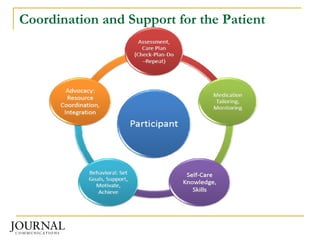
Coordination and Support for the Patient
Patient Incentives – Diabetes & Cardiovascular Face-to-face coaching Improved reliability via direct observation Interpersonal connection Strengthens the patient-physician relationship HSA Medical plan deductible waived for preventive RX 100% coverage diabetes medication, test strips and supplies  Reduce copays by 50% for medication Cholesterol Blood Pressure Free Glucometers & Insulin Pumps
A word about incentives Incentives are used in the beginning to get participants to  engage Participants don’t stay in the program because of the incentives…they stay because: More knowledge about their disease Improved Health Improved sense of well-being
Testimonial I signed up for HealthMapRx for Diabetes because the medications were free.  I had no idea how much this decision would impact my life. I have lost 70 pounds…I am eating better, I am walking and my A1C shows my diabetes is in control!  I  feel  better, I have more energy and now I can keep up with my grandchildren! Brenda (my coach) is great!  I’ve learned so much from her!  Thank you so much for offering this program.
Better Outcomes – Participant With weight management, exercise and better diet and medication compliance: Control blood sugar Control blood pressure Control of blood lipids (“good” and “bad” cholesterols) Care of feet, eyes, kidneys Live a healthy, active lifestyle
Better Outcomes –Plan Reduced costs to employer for health care: Lowers hospital admissions, length of stay as well as ER visits Reduced risk of serious disease events (prevent complications) Participants are more knowledgeable about self-care  Increased medication expense (compliance) Collaboration with patient’s physician
Step 4:  Integrate Wellness Partnered with Quality Health Solutions Health Risk Assessment that measures: health status,  readiness to change (Prochaska model) personal health history and  health care utilization data  Coaching On-site health screenings  (glucose, triglycerides, blood pressure and BMI) On-line wellness tools (includes biometrics)
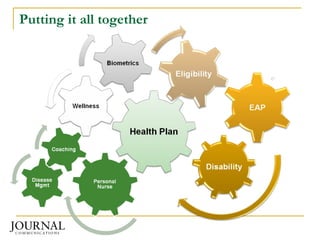
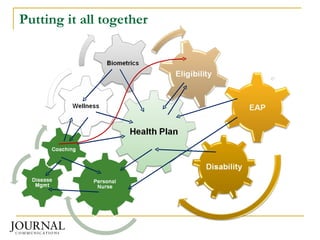
Putting it all together
Keys to success??? Partner with a TPA that can/will support your initiatives. Find a trusted resource to assist with managing eligibility of plans to maintain HIPAA compliance. Integrate the data from all of your resources: Sick time/LOA/FMLA Disability Wellness Medical Take the time to create links between processes. Make sure the communication is relevant.
Partner with your TPA Spend time to determine what your TPA can do for you.  Find out what they are doing for other customers.  (Products, initiatives, plan design) Share your plan initiatives with your TPA so they can support you. Analyze your experience.  Ask what will make the biggest impact. Leverage economies of scale when it makes sense. Don’t be afraid to ask for assistance. Don’t be intimidated by the answer “no.”
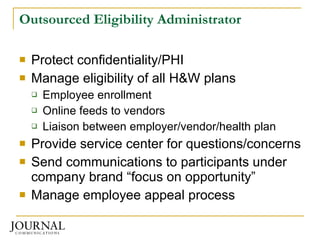
Outsourced Eligibility Administrator Protect confidentiality/PHI Manage eligibility of all H&W plans Employee enrollment Online feeds to vendors Liaison between employer/vendor/health plan Provide service center for questions/concerns Send communications to participants under company brand “focus on opportunity” Manage employee appeal process
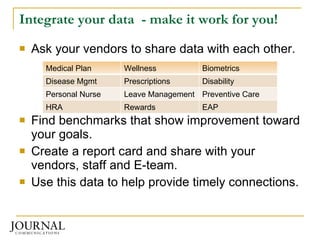
Integrate your data  - make it work for you! Ask your vendors to share data with each other. Find benchmarks that show improvement toward your goals.  Create a report card and share with your vendors, staff and E-team. Use this data to help provide timely connections. Medical Plan Wellness Biometrics Disease Mgmt Prescriptions Disability Personal Nurse Leave Management Preventive Care HRA Rewards EAP
Getting to the right place at the right time Educate your vendors so that they understand all of the resources you offer to employees.  Make sure they refer patients to the best resource. Patients should feel helped, not threatened. Help them learn so they can stay engaged.
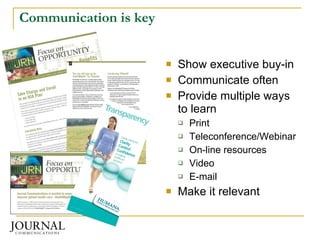
Communication is key Show executive buy-in Communicate often Provide multiple ways to learn Print Teleconference/Webinar On-line resources Video E-mail Make it relevant
Still more to do… Expand beyond HealthMapRx TM   for Diabetes and CV Health : Depression Asthma Develop more value-based purchasing opportunities Continue to create incentives for patients to use efficient providers
Our Goal – Improving Health Encourage patient to  work with MD  to tailor and monitor medication regimen, promote adherence. Use HRA  to help the patient assess, identify key issues.  Guide them to the correct resource so they may develop working plan of care. Provide coaching  to motivate, inspire toward better behaviors: develop mutually agreeable goals, provide support in meeting them, rewards for achievement Provide tools and advocates  – guide, provide assistance with coordination, navigation, integration of overall care of key resources.
Resources - Connections Center for Health Value Innovation Cyndy Nayer  314-422-4385,  [email_address] Mirixa (HealthMapRx)  Cindy Schaller, 703.865.2035,  [email_address]   www.HealthMapRx.com   Piedmont Pharmaceutical Care Network Larry S. Long RPh, 336-202-7146,  [email_address] Quality Health Solutions Brian J. Thomas, 888-747-0708 ext 102,  [email_address]
Questions? Christine Reichardt [email_address] 414-224-2069

Evalu8 72009

  • 1.
    Integrating Value-Based BenefitDesign eValue8 User Meeting July 15, 2009
  • 2.
    About Journal Communications4,000 employees, 1,200 pre-Medicare and Medicare-eligible participants nationally. Our strategic plan focuses on providing quality benefits while maintaining shareholder value. Like other employers, we struggle with managing: Affordable coverage (employer and retiree) The impact of medical inflation on our budget; The health status of medical plan participants.
  • 3.
    5 years ago…4 benefit plans Copays for doctor appointments and pharmacy Low deductibles Cost per employee per year – 30% above the Midwest average! Attitude of entitlement. Very passive, little engagement
  • 4.
    2004: OurConcerns Employer concerns: How to afford exponential increases year over year. Participants did not understand how their benefits worked or how much procedures cost. Many had chronic disease driving frequent hospitalizations, ER visits and prescription drug use. High utilizers often non-compliant and driving up medical costs. Member concerns: Participants did not know how expensive their care was; no money saved. Patients did not understand benefits and relied on physician to steer. Patients with medication management needed more “touch” than plan would allow.
  • 5.
    Question What canwe can do today, to improve the health status of our participants today AND tomorrow?
  • 6.
    Strategy for all– Actives and retirees Improve the health status of the participants Provide access to qualified providers; Offer medical plans that require engagement of participants; Reduce the barriers to preventive care; Give participants with chronic diseases tools and support to manage their condition; Increase compliance for disease-specific medications; Introduce wellness program that provides feedback and Communicate, communicate, communicate…
  • 7.
    Step 1: Promote the right provider Implemented a Narrow PPO Network in SE Wisconsin Online Transparency Tools Compare providers Quality and Safety – following safety practices developed by the Leapfrog group. Promote and provide incentives for patients to use cost-efficient providers within the network MRIs, CT Scans, Colonoscopies Commodity rebate of $100 Use plan design to steer participants
  • 8.
    Step 2: Reduce Barriers to Care Integrated EAP (5 visits) Updated Mental Health Benefits (Parity) Implemented Transparency Tools, Nurse Line, Personal Nurse Preventive Care and Wellness: Provide 100% coverage (deductible waived) for all preventive care HSA Plans - Waive the medical deductible for “preventive” prescription drugs Send wellness reminders to medical plan participants Offer free flu shots at all locations for employees, participants and spouses
  • 9.
    Step 3: Manage Chronic Disease and Increase Prescription Compliance Traditional Disease Management in 2004 Pharmacy compliance in 2008 ( Based on Asheville Project ) Members with a personal health coach (from a network of local pharmacists); Coordination with the patient’s physician or other healthcare providers to help effectively manage their Condition: Diabetes High Blood Pressure Cholesterol Medication and supplies at no cost / reduced cost Partners: Mirixa and Piedmont Pharmaceutical Network
  • 10.
    Coordination and Supportfor the Patient
  • 11.
    Patient Incentives –Diabetes & Cardiovascular Face-to-face coaching Improved reliability via direct observation Interpersonal connection Strengthens the patient-physician relationship HSA Medical plan deductible waived for preventive RX 100% coverage diabetes medication, test strips and supplies Reduce copays by 50% for medication Cholesterol Blood Pressure Free Glucometers & Insulin Pumps
  • 12.
    A word aboutincentives Incentives are used in the beginning to get participants to engage Participants don’t stay in the program because of the incentives…they stay because: More knowledge about their disease Improved Health Improved sense of well-being
  • 13.
    Testimonial I signedup for HealthMapRx for Diabetes because the medications were free. I had no idea how much this decision would impact my life. I have lost 70 pounds…I am eating better, I am walking and my A1C shows my diabetes is in control! I feel better, I have more energy and now I can keep up with my grandchildren! Brenda (my coach) is great! I’ve learned so much from her! Thank you so much for offering this program.
  • 14.
    Better Outcomes –Participant With weight management, exercise and better diet and medication compliance: Control blood sugar Control blood pressure Control of blood lipids (“good” and “bad” cholesterols) Care of feet, eyes, kidneys Live a healthy, active lifestyle
  • 15.
    Better Outcomes –PlanReduced costs to employer for health care: Lowers hospital admissions, length of stay as well as ER visits Reduced risk of serious disease events (prevent complications) Participants are more knowledgeable about self-care Increased medication expense (compliance) Collaboration with patient’s physician
  • 16.
    Step 4: Integrate Wellness Partnered with Quality Health Solutions Health Risk Assessment that measures: health status, readiness to change (Prochaska model) personal health history and health care utilization data Coaching On-site health screenings (glucose, triglycerides, blood pressure and BMI) On-line wellness tools (includes biometrics)
  • 17.
  • 18.
  • 19.
    Keys to success???Partner with a TPA that can/will support your initiatives. Find a trusted resource to assist with managing eligibility of plans to maintain HIPAA compliance. Integrate the data from all of your resources: Sick time/LOA/FMLA Disability Wellness Medical Take the time to create links between processes. Make sure the communication is relevant.
  • 20.
    Partner with yourTPA Spend time to determine what your TPA can do for you. Find out what they are doing for other customers. (Products, initiatives, plan design) Share your plan initiatives with your TPA so they can support you. Analyze your experience. Ask what will make the biggest impact. Leverage economies of scale when it makes sense. Don’t be afraid to ask for assistance. Don’t be intimidated by the answer “no.”
  • 21.
    Outsourced Eligibility AdministratorProtect confidentiality/PHI Manage eligibility of all H&W plans Employee enrollment Online feeds to vendors Liaison between employer/vendor/health plan Provide service center for questions/concerns Send communications to participants under company brand “focus on opportunity” Manage employee appeal process
  • 22.
    Integrate your data - make it work for you! Ask your vendors to share data with each other. Find benchmarks that show improvement toward your goals. Create a report card and share with your vendors, staff and E-team. Use this data to help provide timely connections. Medical Plan Wellness Biometrics Disease Mgmt Prescriptions Disability Personal Nurse Leave Management Preventive Care HRA Rewards EAP
  • 23.
    Getting to theright place at the right time Educate your vendors so that they understand all of the resources you offer to employees. Make sure they refer patients to the best resource. Patients should feel helped, not threatened. Help them learn so they can stay engaged.
  • 24.
    Communication is keyShow executive buy-in Communicate often Provide multiple ways to learn Print Teleconference/Webinar On-line resources Video E-mail Make it relevant
  • 25.
    Still more todo… Expand beyond HealthMapRx TM for Diabetes and CV Health : Depression Asthma Develop more value-based purchasing opportunities Continue to create incentives for patients to use efficient providers
  • 26.
    Our Goal –Improving Health Encourage patient to work with MD to tailor and monitor medication regimen, promote adherence. Use HRA to help the patient assess, identify key issues. Guide them to the correct resource so they may develop working plan of care. Provide coaching to motivate, inspire toward better behaviors: develop mutually agreeable goals, provide support in meeting them, rewards for achievement Provide tools and advocates – guide, provide assistance with coordination, navigation, integration of overall care of key resources.
  • 27.
    Resources - ConnectionsCenter for Health Value Innovation Cyndy Nayer 314-422-4385, [email_address] Mirixa (HealthMapRx) Cindy Schaller, 703.865.2035, [email_address] www.HealthMapRx.com Piedmont Pharmaceutical Care Network Larry S. Long RPh, 336-202-7146, [email_address] Quality Health Solutions Brian J. Thomas, 888-747-0708 ext 102, [email_address]
  • 28.
    Questions? Christine Reichardt[email_address] 414-224-2069

Editor's Notes

  • #8 Journal Communications – in combination with BHCG reviewed claims history and results – noticed there were some providers that were more effective than others.
  • #10 Asheville project principle Requires partnership of Employer, Pharmacist and participant!