Communicating Change and Complex Benefit Design Hays Companies July 24, 2009
About Journal Communications 4,000 employees, 1,200 pre-Medicare and Medicare-eligible participants nationally. Our strategic plan focuses on providing quality benefits while maintaining shareholder value. Like other employers, we struggle with managing: Affordable coverage (employer and retiree) The impact of medical inflation on our budget; The health status of medical plan participants.
5 years ago… Rich benefits going away… Copays for doctor appointments and pharmacy Low deductibles Complex Benefit Plans 15 PPO networks, 4 fully-insured plans, 2 claim administrators Each company had different rules, plan design variations Attitude of entitlement.  Very passive, little engagement Lots of change
Our Challenge  To communicate: Benefit plan changes  Company expectations & accountability Navigation through self-service service model How their benefits work Customer Service Center and other advocates To connect with: Employees who don’t have access to a PC Spouses, children and other participants Employees who have transient workplaces (reporters) 70 locations in 13 + states To get employees engaged Increase employee satisfaction
Helping employees navigate through complex benefits
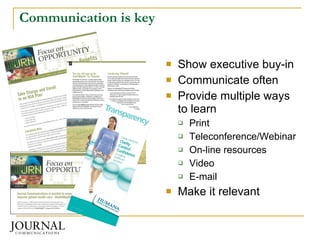
Communication is key Show executive buy-in Communicate often Provide multiple ways to learn Print Teleconference/Webinar On-line resources Video E-mail Make it relevant
Start with the basics Explain the basics of your benefit program in the most simple terms. Don’t underestimate the impact of white space. Create communications which will apply to the majority of the audience (common ground). Supplement with targeted messages/inserts which describe the details if different. Archive communications for future reference.
Say it, re-say it and say it again Use a variety of resources to reach your audience: E-mail Mail to homes / postcards Links to inter/intra net Posters Voice mail blasts Don’t just recycle – say it a different way. Strengthen their knowledge base a little at a time.
Show executive buy-in & leadership support Inform leaders of changes in advance. Communication pieces Webinars/training sessions  Huddle - Give them information to support your communication – let them say it too. Provide Frequently Asked Questions (FAQs)  Use testimonials when appropriate Provide advocates, resources for the tough questions
Change - Tell them the truth & what to expect. Put benefit communications in a business context: Benefits – especially health care benefits – remain one of our biggest operating expenses.  In fact, the biggest after payroll and newsprint.  That’s been the case for several years now. Journal Communications is committed to offering competitive benefits, so that we can attract and retain talented employees. At the same time, we need to be diligent in managing expenses. That’s a tough challenge, as health care costs continue to rise dramatically, faster than inflation. Remind them of the good stuff. Explain the employer’s objective. We’re in this together…
Handle the objections before they are asked. Don’t let them put up the wall… Why  must I take HRA in order to participate in the health plan? Why  did you eliminate the “best” plan? Why  do I have to pay a spousal surcharge? Why  do I have to pay so much? Why  doesn’t my company spend more on benefits Because, because, because…..
Use scenarios to help explain tough concepts/decisions
Use testimonials when you can I signed up for HealthMapRx for Diabetes because the medications were free.  I had no idea how much this decision would impact my life. I have lost 70 pounds…I am eating better, I am walking and my A1C shows my diabetes is in control!  I  feel  better, I have more energy and now I can keep up with my grandchildren! Brenda (my coach) is great!  I’ve learned so much from her!  Thank you so much for offering this program.
Get them engaged Tell them where they can get information Provide easy access to tools, resources and advocates. Offer medical plans that require engagement of participants – namely HSA Plans Take away the crutches. Provide timely feedback from multiple resources: Focus on Opportunity – Benefits Health Plan  (including disease management, personal nurse) Active Health Management Coaches Wellness program Use integration of data to make it timely.
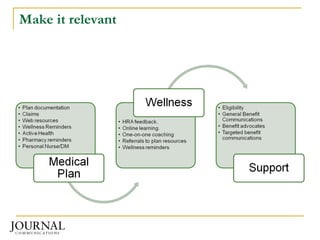
Make it relevant
Put them in control. You can log in and view your claims any time. You can view your paycheck before pay day. You should “know your numbers” so you can stay healthy. You can manage your HSA account. You can call. You can read historical communications.
Increase your connectivity Collect:  Cell phone numbers Spouse contact info Home e-mail Preferred method of communications
Still more to do… Face Book – new age media Text messages, links to cell phones Benefit alerts Automated web communications
Control your meetings Start on time. Slides should be clear and easy.  Use speaker notes for staff who are not intimate with topic. Don’t read your slides. Look people in the eye and speak with authority and smile.  Remember you are the authority. Don’t let a rebel interrupt, distract or derail Be nice and interested. Show southern charm. Don’t let them see you sweat Ask them to take some time after the meeting to discuss Don’t rush, leave enough time for questions.
Questions? Christine A. Reichardt Journal Communications [email_address] 414-224-2069

Employee Communication in times of change

  • 1.
    Communicating Change andComplex Benefit Design Hays Companies July 24, 2009
  • 2.
    About Journal Communications4,000 employees, 1,200 pre-Medicare and Medicare-eligible participants nationally. Our strategic plan focuses on providing quality benefits while maintaining shareholder value. Like other employers, we struggle with managing: Affordable coverage (employer and retiree) The impact of medical inflation on our budget; The health status of medical plan participants.
  • 3.
    5 years ago…Rich benefits going away… Copays for doctor appointments and pharmacy Low deductibles Complex Benefit Plans 15 PPO networks, 4 fully-insured plans, 2 claim administrators Each company had different rules, plan design variations Attitude of entitlement. Very passive, little engagement Lots of change
  • 4.
    Our Challenge To communicate: Benefit plan changes Company expectations & accountability Navigation through self-service service model How their benefits work Customer Service Center and other advocates To connect with: Employees who don’t have access to a PC Spouses, children and other participants Employees who have transient workplaces (reporters) 70 locations in 13 + states To get employees engaged Increase employee satisfaction
  • 5.
    Helping employees navigatethrough complex benefits
  • 6.
    Communication is keyShow executive buy-in Communicate often Provide multiple ways to learn Print Teleconference/Webinar On-line resources Video E-mail Make it relevant
  • 7.
    Start with thebasics Explain the basics of your benefit program in the most simple terms. Don’t underestimate the impact of white space. Create communications which will apply to the majority of the audience (common ground). Supplement with targeted messages/inserts which describe the details if different. Archive communications for future reference.
  • 8.
    Say it, re-sayit and say it again Use a variety of resources to reach your audience: E-mail Mail to homes / postcards Links to inter/intra net Posters Voice mail blasts Don’t just recycle – say it a different way. Strengthen their knowledge base a little at a time.
  • 9.
    Show executive buy-in& leadership support Inform leaders of changes in advance. Communication pieces Webinars/training sessions Huddle - Give them information to support your communication – let them say it too. Provide Frequently Asked Questions (FAQs) Use testimonials when appropriate Provide advocates, resources for the tough questions
  • 10.
    Change - Tellthem the truth & what to expect. Put benefit communications in a business context: Benefits – especially health care benefits – remain one of our biggest operating expenses. In fact, the biggest after payroll and newsprint. That’s been the case for several years now. Journal Communications is committed to offering competitive benefits, so that we can attract and retain talented employees. At the same time, we need to be diligent in managing expenses. That’s a tough challenge, as health care costs continue to rise dramatically, faster than inflation. Remind them of the good stuff. Explain the employer’s objective. We’re in this together…
  • 11.
    Handle the objectionsbefore they are asked. Don’t let them put up the wall… Why must I take HRA in order to participate in the health plan? Why did you eliminate the “best” plan? Why do I have to pay a spousal surcharge? Why do I have to pay so much? Why doesn’t my company spend more on benefits Because, because, because…..
  • 12.
    Use scenarios tohelp explain tough concepts/decisions
  • 13.
    Use testimonials whenyou can I signed up for HealthMapRx for Diabetes because the medications were free. I had no idea how much this decision would impact my life. I have lost 70 pounds…I am eating better, I am walking and my A1C shows my diabetes is in control! I feel better, I have more energy and now I can keep up with my grandchildren! Brenda (my coach) is great! I’ve learned so much from her! Thank you so much for offering this program.
  • 14.
    Get them engagedTell them where they can get information Provide easy access to tools, resources and advocates. Offer medical plans that require engagement of participants – namely HSA Plans Take away the crutches. Provide timely feedback from multiple resources: Focus on Opportunity – Benefits Health Plan (including disease management, personal nurse) Active Health Management Coaches Wellness program Use integration of data to make it timely.
  • 15.
  • 16.
    Put them incontrol. You can log in and view your claims any time. You can view your paycheck before pay day. You should “know your numbers” so you can stay healthy. You can manage your HSA account. You can call. You can read historical communications.
  • 17.
    Increase your connectivityCollect: Cell phone numbers Spouse contact info Home e-mail Preferred method of communications
  • 18.
    Still more todo… Face Book – new age media Text messages, links to cell phones Benefit alerts Automated web communications
  • 19.
    Control your meetingsStart on time. Slides should be clear and easy. Use speaker notes for staff who are not intimate with topic. Don’t read your slides. Look people in the eye and speak with authority and smile. Remember you are the authority. Don’t let a rebel interrupt, distract or derail Be nice and interested. Show southern charm. Don’t let them see you sweat Ask them to take some time after the meeting to discuss Don’t rush, leave enough time for questions.
  • 20.
    Questions? Christine A.Reichardt Journal Communications [email_address] 414-224-2069