Less meat, less heat
sustainability and our steak
Content
1. The problem: high meat consumption
- environmental crisis
- food crisis
- health crisis
2. Our solution
- challenges
- content
- approach
EVA’s aim is to maximally replace animal food by
plant based food, thus helping to create a more
people, animal and environmentally friendly society
We inform, organize, lobby and campaign
Our staff of 6 operates from our office in Ghent
We were founded in 2000
1. The problem
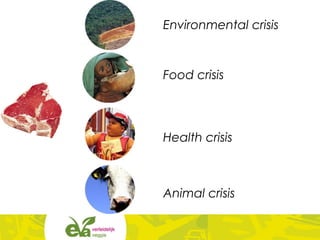
Animal crisis
Environmental crisis
Health crisis
Food crisis
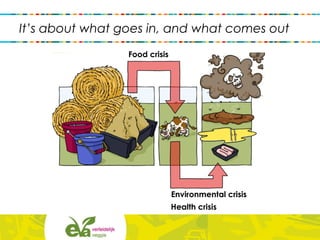
It’s about what goes in, and what comes out
Food crisis
Environmental crisis
Health crisis
« The livestock sector emerges as one of the top
two or three most significant contributors to the
most serious environmental problems, at every
scale from local to global.
The findings of this report suggest that it should
be a major policy focus when dealing with
problems of land degradation, climate change
and air pollution, water shortage and water
pollution and loss of biodiversity.»
Livestock’s Long Shadow, FAO 2006
1. Environmental crisis
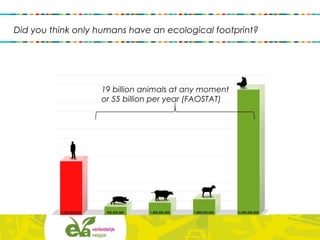
19 billion animals at any moment
or 55 billion per year (FAOSTAT)
Did you think only humans have an ecological footprint?
<
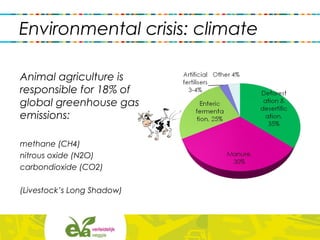
Animal agriculture is
responsible for 18% of
global greenhouse gas
emissions:
methane (CH4)
nitrous oxide (N2O)
carbondioxide (CO2)
(Livestock’s Long Shadow)
Environmental crisis: climate
Focus on methane?
GWP values and
lifetimes from
2007 IPCC AR4 [3]
Lifetime
(years)
GWP time horizon
20 years 100 years 500 years
Methane 12 72 25 7.6 (7)
Nitrous oxide 114 289 298 153 (156)
GWP (global warming potential) of methane increases when a time horizon
of 20 years is used instead of one of 100.
Mitigation?
« Available technologies for reduction of emissions
from livestock production, applied universally at
realistic costs, would reduce non-carbon dioxide
emissions by less than 20%. »
(McMichael et al, 2007)
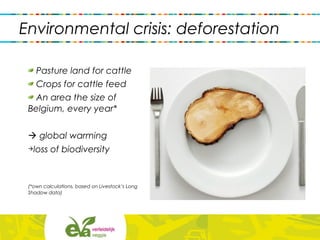
Pasture land for cattle
Crops for cattle feed
An area the size of
Belgium, every year*
 global warming
loss of biodiversity
(*own calculations, based on Livestock’s Long
Shadow data)
Environmental crisis: deforestation
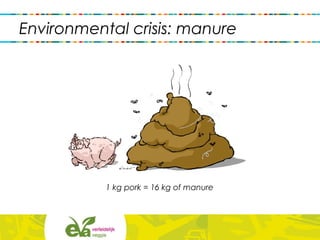
1 kg pork = 16 kg of manure
Environmental crisis: manure
2. Food crisis
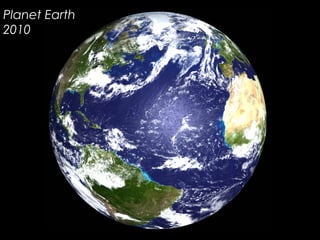
Planet Earth
2010
Out of almost 7.000.000.000 people on this
planet
1.000.000.000 suffer from hunger, of which 200.000.000 are
children
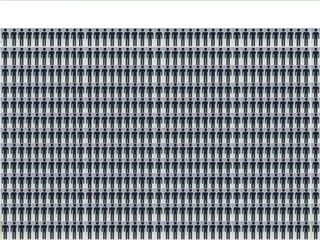
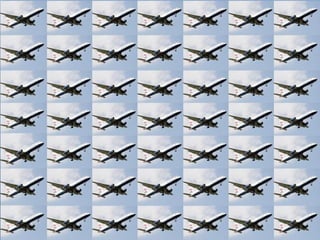
25.000 people die of hunger or malnutrition every day
Now how many is that, really?
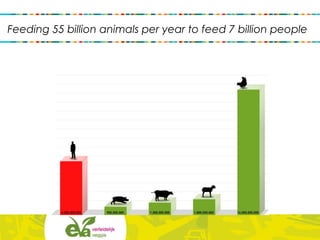
Feeding 55 billion animals per year to feed 7 billion people
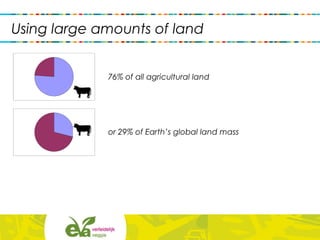
Using large amounts of land
76% of all agricultural land
or 29% of Earth’s global land mass
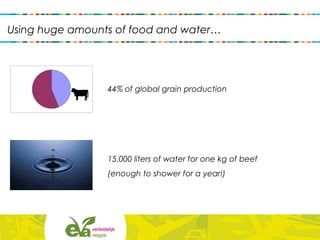
44% of global grain production
Using huge amounts of food and water…
15.000 liters of water for one kg of beef
(enough to shower for a year!)
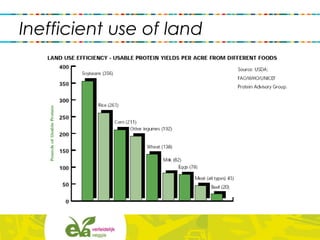
Inefficient use of land
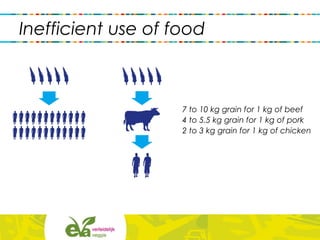
Inefficient use of food
7 to 10 kg grain for 1 kg of beef
4 to 5.5 kg grain for 1 kg of pork
2 to 3 kg grain for 1 kg of chicken
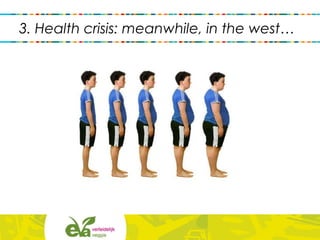
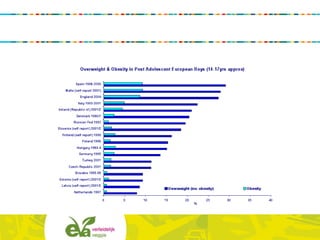
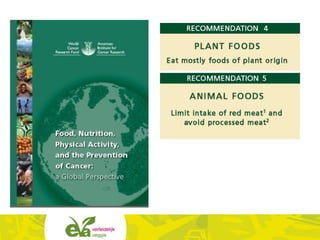
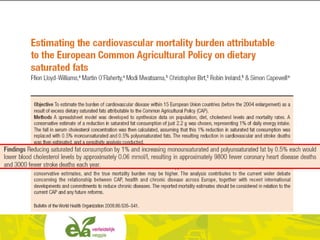
3. Health crisis: meanwhile, in the west…
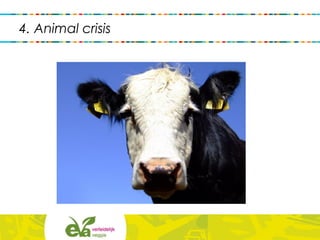
4. Animal crisis
"The greatness of a nation and it's moral progress
can be judged by the way it's animals are treated.”
Gandhi
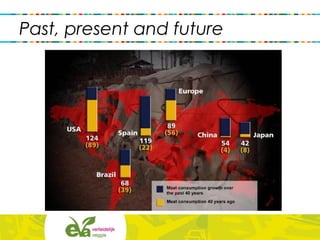
Past, present and future
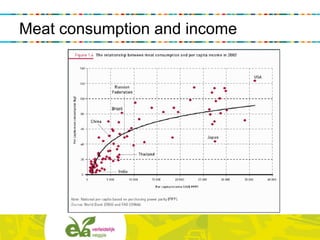
Meat consumption and income
« The current global average meat consumption is
100 g per person per day, with about a ten-fold
variation between high-consuming and low-
consuming populations. 90 g per day is
proposed as a working global target, shared
more evenly, with not more than 50 g per day
coming from red meat from ruminants.»
(McMichael et al, Food, livestock production, energy, climate change, and health, The Lancet, Oct 2007.)
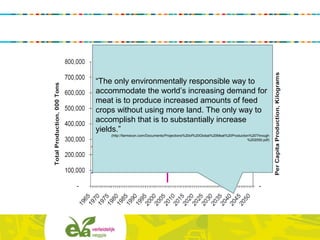
“The only environmentally responsible way to
accommodate the world’s increasing demand for
meat is to produce increased amounts of feed
crops without using more land. The only way to
accomplish that is to substantially increase
yields.”
(http://farmecon.com/Documents/Projections%20of%20Global%20Meat%20Production%20Through
%202050.pdf)
“Hence, some affected countries now face the double burden of
under-nutrition due to nutritional deficits in parts of their populations
and an increase in obesity-related chronic diseases due to
increased availability of foods of animal origin, high in saturated fat,
and energy-dense processed foods rich in fats and sugar. (…)
Economic development and associated urbanism could lead to diets
that are less protective against chronic diseases than are traditional
diets. »
McMichael et al.
Heavy stress on the meat production system
because of:
- Scarce land
- scarce water
- scarce fertilizer
- climate change
- rising consumer awareness
- health costs
The future
70% increase in food production by 2050?
Less people
More land
A new green revolution
A significant dietary shift
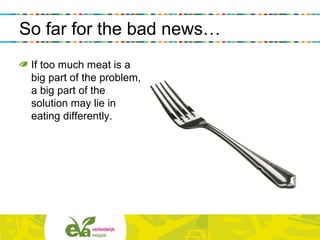
So far for the bad news…
If too much meat is a
big part of the problem,
a big part of the
solution may lie in
eating differently.
2. Our solution
Challenges
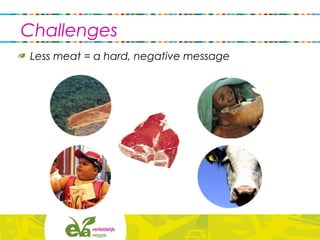
Less meat = a hard, negative message
Challenges
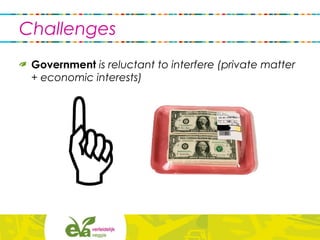
Government is reluctant to interfere (private matter
+ economic interests)
Challenges
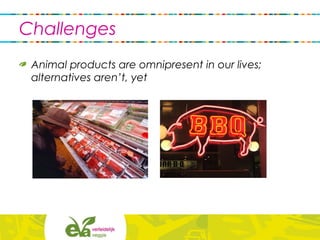
Animal products are omnipresent in our lives;
alternatives aren’t, yet
Challenges
Large lack of knowledge concerning the problem,
both in theory and practice
Challenges
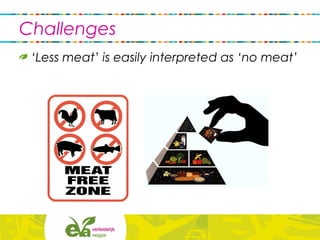
‘Less meat’ is easily interpreted as ‘no meat’
EVA: translating an important but difficult
message to something fun and doable
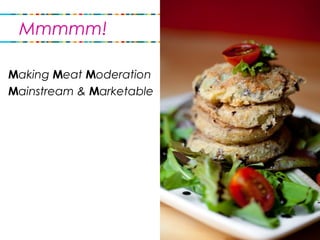
Making Meat Moderation
Mainstream & Marketable
Mmmmm!
‘Go veggie’  meat reduction
A little bit less every day?
A vegetarian day a year, a week?
Meatless: less meat in meat?
‘Vegetarian before six’?
A veggie day
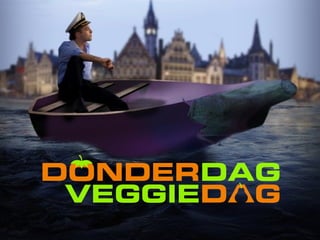
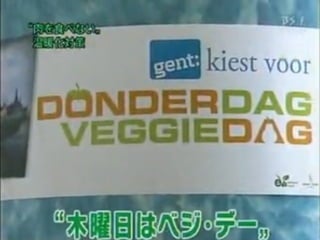
Thursday Veggie Day
Core messsage: Thursday = veggie day
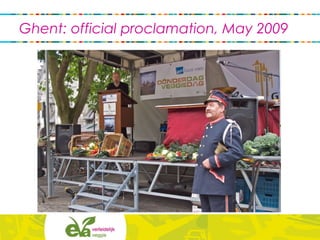
Ghent: official proclamation, May 2009
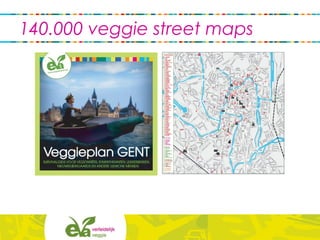
140.000 veggie street maps
1.000 guides for chefs & staff
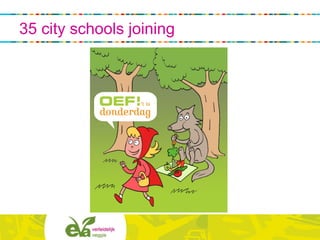
35 city schools joining
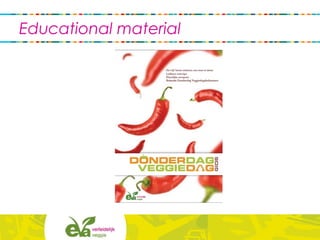
Educational material
Courses for citizens and professionals
Website, newsletterse
Campaign material: posters, flyers, t-shirts, stickers,
placemats, frocks…
And also…
Results (nationally)
Large participation in city schools (95%)
2 city restaurants skip meat on Thursday
Redelijke bekendheid van de campagne op twee
jaar tijd (met weinig middelen)
Imitation of the concept in other Belgian cities
(Hasselt, Mechelen), interest from others (Antwerp,
Aalst, Vilvoorde…)
Financial support by the city of Ghent
Results (internationally)
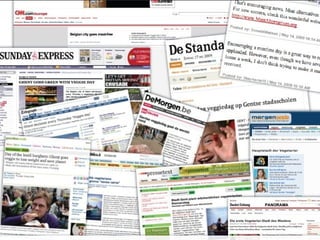
Press from Time Magazine to Tokyo
Governments interested (Nottingham, Genua, Colombia…)
Imitation in Bremen (Germany) and Sao Paulo (Brazil)
Visiting researches from different countries
Inviations to speak in Paris, Frankfurt, Milan, Washington.…
Support from IPCC chairman Rajendra Pachauri
Calls for veggie days at the Europees Parlement
Interest of NGO’s in many countries (France, Sweden, Taiwan,
US, UK…)
• concrete
• positive
• doable
• challenging
• fun
• credible
• empowering
• sticky
Shaping the message
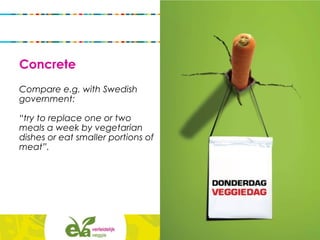
Concrete
Compare e.g. with Swedish
government:
“try to replace one or two
meals a week by vegetarian
dishes or eat smaller portions of
meat”.
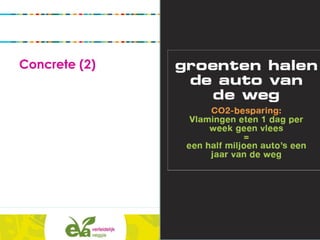
Concrete (2)
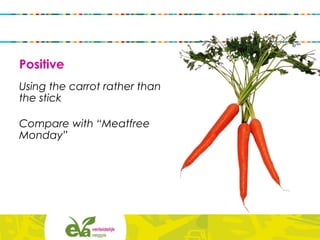
Positive
Using the carrot rather than
the stick
Compare with “Meatfree
Monday”
Doable
Daily portion of meat = a recent phenomenon
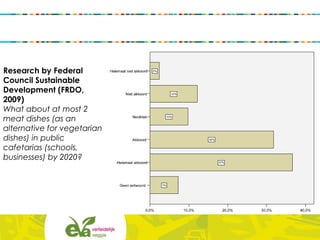
Research by Federal
Council Sustainable
Development (FRDO,
2009)
What about at most 2
meat dishes (as an
alternative for vegetarian
dishes) in public
cafetarias (schools,
businesses) by 2020?
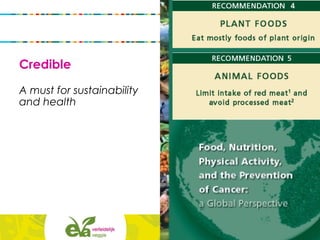
Credible
A must for sustainability
and health
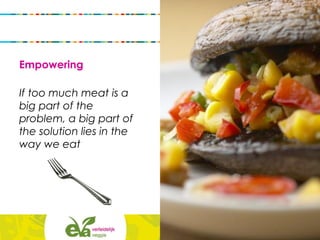
Empowering
If too much meat is a
big part of the
problem, a big part of
the solution lies in the
way we eat
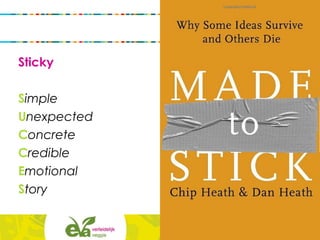
Sticky
Simple
Unexpected
Concrete
Credible
Emotional
Story
Marketing
This message is marketable to
- Consumers
- Business (production, distribution, catering)
- Government
Contact info
Tobias Leenaert
tobias@vegetarian.be
(++32) (+0) 494 64 69 38

EVA vzw
St.-Pietersnieuwstraat 130
9000 Gent
Belgium

Eva vegetarianism and sustainability

  • 1.
    Less meat, lessheat sustainability and our steak
  • 2.
    Content 1. The problem:high meat consumption - environmental crisis - food crisis - health crisis 2. Our solution - challenges - content - approach
  • 3.
    EVA’s aim isto maximally replace animal food by plant based food, thus helping to create a more people, animal and environmentally friendly society We inform, organize, lobby and campaign Our staff of 6 operates from our office in Ghent We were founded in 2000
  • 4.
  • 5.
  • 6.
    It’s about whatgoes in, and what comes out Food crisis Environmental crisis Health crisis
  • 7.
    « The livestock sectoremerges as one of the top two or three most significant contributors to the most serious environmental problems, at every scale from local to global. The findings of this report suggest that it should be a major policy focus when dealing with problems of land degradation, climate change and air pollution, water shortage and water pollution and loss of biodiversity.» Livestock’s Long Shadow, FAO 2006 1. Environmental crisis
  • 8.
    19 billion animalsat any moment or 55 billion per year (FAOSTAT) Did you think only humans have an ecological footprint?
  • 9.
    < Animal agriculture is responsiblefor 18% of global greenhouse gas emissions: methane (CH4) nitrous oxide (N2O) carbondioxide (CO2) (Livestock’s Long Shadow) Environmental crisis: climate
  • 10.
    Focus on methane? GWPvalues and lifetimes from 2007 IPCC AR4 [3] Lifetime (years) GWP time horizon 20 years 100 years 500 years Methane 12 72 25 7.6 (7) Nitrous oxide 114 289 298 153 (156) GWP (global warming potential) of methane increases when a time horizon of 20 years is used instead of one of 100.
  • 12.
    Mitigation? « Available technologiesfor reduction of emissions from livestock production, applied universally at realistic costs, would reduce non-carbon dioxide emissions by less than 20%. » (McMichael et al, 2007)
  • 13.
    Pasture land forcattle Crops for cattle feed An area the size of Belgium, every year*  global warming loss of biodiversity (*own calculations, based on Livestock’s Long Shadow data) Environmental crisis: deforestation
  • 15.
    1 kg pork= 16 kg of manure Environmental crisis: manure
  • 16.
  • 17.
  • 18.
    Out of almost7.000.000.000 people on this planet 1.000.000.000 suffer from hunger, of which 200.000.000 are children 25.000 people die of hunger or malnutrition every day Now how many is that, really?
  • 22.
    Feeding 55 billionanimals per year to feed 7 billion people
  • 23.
    Using large amountsof land 76% of all agricultural land or 29% of Earth’s global land mass
  • 24.
    44% of globalgrain production Using huge amounts of food and water… 15.000 liters of water for one kg of beef (enough to shower for a year!)
  • 25.
  • 26.
    Inefficient use offood 7 to 10 kg grain for 1 kg of beef 4 to 5.5 kg grain for 1 kg of pork 2 to 3 kg grain for 1 kg of chicken
  • 27.
    3. Health crisis:meanwhile, in the west…
  • 32.
  • 33.
    "The greatness ofa nation and it's moral progress can be judged by the way it's animals are treated.” Gandhi
  • 34.
  • 35.
  • 36.
    « The currentglobal average meat consumption is 100 g per person per day, with about a ten-fold variation between high-consuming and low- consuming populations. 90 g per day is proposed as a working global target, shared more evenly, with not more than 50 g per day coming from red meat from ruminants.» (McMichael et al, Food, livestock production, energy, climate change, and health, The Lancet, Oct 2007.)
  • 37.
    “The only environmentallyresponsible way to accommodate the world’s increasing demand for meat is to produce increased amounts of feed crops without using more land. The only way to accomplish that is to substantially increase yields.” (http://farmecon.com/Documents/Projections%20of%20Global%20Meat%20Production%20Through %202050.pdf)
  • 38.
    “Hence, some affectedcountries now face the double burden of under-nutrition due to nutritional deficits in parts of their populations and an increase in obesity-related chronic diseases due to increased availability of foods of animal origin, high in saturated fat, and energy-dense processed foods rich in fats and sugar. (…) Economic development and associated urbanism could lead to diets that are less protective against chronic diseases than are traditional diets. » McMichael et al.
  • 39.
    Heavy stress onthe meat production system because of: - Scarce land - scarce water - scarce fertilizer - climate change - rising consumer awareness - health costs The future
  • 40.
    70% increase infood production by 2050? Less people More land A new green revolution A significant dietary shift
  • 41.
    So far forthe bad news… If too much meat is a big part of the problem, a big part of the solution may lie in eating differently.
  • 43.
  • 44.
    Challenges Less meat =a hard, negative message
  • 45.
    Challenges Government is reluctantto interfere (private matter + economic interests)
  • 46.
    Challenges Animal products areomnipresent in our lives; alternatives aren’t, yet
  • 47.
    Challenges Large lack ofknowledge concerning the problem, both in theory and practice
  • 48.
    Challenges ‘Less meat’ iseasily interpreted as ‘no meat’
  • 49.
    EVA: translating animportant but difficult message to something fun and doable
  • 50.
  • 51.
    ‘Go veggie’ meat reduction A little bit less every day? A vegetarian day a year, a week? Meatless: less meat in meat? ‘Vegetarian before six’? A veggie day Thursday Veggie Day Core messsage: Thursday = veggie day
  • 53.
  • 55.
  • 56.
    1.000 guides forchefs & staff
  • 57.
  • 58.
  • 59.
    Courses for citizensand professionals Website, newsletterse Campaign material: posters, flyers, t-shirts, stickers, placemats, frocks… And also…
  • 61.
    Results (nationally) Large participationin city schools (95%) 2 city restaurants skip meat on Thursday Redelijke bekendheid van de campagne op twee jaar tijd (met weinig middelen) Imitation of the concept in other Belgian cities (Hasselt, Mechelen), interest from others (Antwerp, Aalst, Vilvoorde…) Financial support by the city of Ghent
  • 62.
    Results (internationally) Press fromTime Magazine to Tokyo Governments interested (Nottingham, Genua, Colombia…) Imitation in Bremen (Germany) and Sao Paulo (Brazil) Visiting researches from different countries Inviations to speak in Paris, Frankfurt, Milan, Washington.… Support from IPCC chairman Rajendra Pachauri Calls for veggie days at the Europees Parlement Interest of NGO’s in many countries (France, Sweden, Taiwan, US, UK…)
  • 65.
    • concrete • positive •doable • challenging • fun • credible • empowering • sticky Shaping the message
  • 66.
    Concrete Compare e.g. withSwedish government: “try to replace one or two meals a week by vegetarian dishes or eat smaller portions of meat”.
  • 67.
  • 68.
    Positive Using the carrotrather than the stick Compare with “Meatfree Monday”
  • 69.
    Doable Daily portion ofmeat = a recent phenomenon
  • 70.
    Research by Federal CouncilSustainable Development (FRDO, 2009) What about at most 2 meat dishes (as an alternative for vegetarian dishes) in public cafetarias (schools, businesses) by 2020?
  • 71.
    Credible A must forsustainability and health
  • 72.
    Empowering If too muchmeat is a big part of the problem, a big part of the solution lies in the way we eat
  • 73.
  • 74.
    Marketing This message ismarketable to - Consumers - Business (production, distribution, catering) - Government
  • 75.
    Contact info Tobias Leenaert tobias@vegetarian.be (++32)(+0) 494 64 69 38 EVA vzw St.-Pietersnieuwstraat 130 9000 Gent Belgium

Editor's Notes

  • #9 Voor elke mens op aarde lopen er nog eens 3 landbouwdieren (totaal 18 miljoen) rond, die ook vervuilen, mest produceren…
  • #20 Stel je voor dat er vandaag vijftig Boeings 747 zouden neerstorten. Dat zijn 50 x 500 = 25.000 doden, of evenveel mensen als er elke dag sterven van de honger.
  • #21 500 mensen
  • #22 50 x 50 mensen = 25.000 mensen, elke dag
  • #23 Voor elke mens op aarde lopen er nog eens 3 landbouwdieren (totaal 18 miljoen) rond, die ook vervuilen, mest produceren…
  • #26 Voor elke mens op aarde lopen er nog eens 3 landbouwdieren (totaal 18 miljoen) rond, die ook vervuilen, mest produceren…
  • #27 Niet alle plantaardige voeding wordt rechtstreeks in vlees omgezet. Elke tussenschakel is een omweg. Het dier gebruikt een deel van de energie voor zijn voortbeweging, temperatuursregeling, enz.