1
Reframing food:
from commodity to
commons
Dr. Jose Luis Vivero-Pol
University of Louvain, Belgium
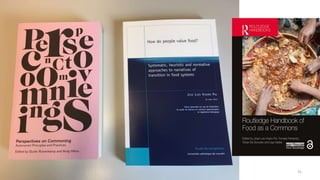
How do people value Food?
Essential for survival
(De Schutter & Pistor 2015)
Societal determinant (Ellul 1990)
Agent of power (Sumner 2011)
Commodity (Siegel et al. 2016)
Private Good (Samuelson 1954)
Public Good (Akram-Lodhi 2013)
Commons (Dalla Costa 2007)
Human Right (UN 1999)
Multiple meanings (Szymanski 2014)
Food has multiple meanings
a.- Situated (time, place, knowledge)
b.- Phenomenological
(meanings depend on the observer and circumstances)
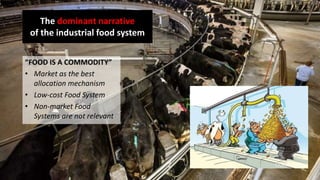
The dominant narrative
of the industrial food system
“FOOD IS A COMMODITY”
• Market as the best
allocation mechanism
• Low-cost Food System
• Non-market Food
Systems are not relevant
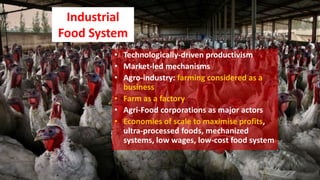
Industrial
Food System
• Technologically-driven productivism
• Market-led mechanisms
• Agro-industry: farming considered as a
business
• Farm as a factory
• Agri-Food corporations as major actors
• Economies of scale to maximise profits,
ultra-processed foods, mechanized
systems, low wages, low-cost food system
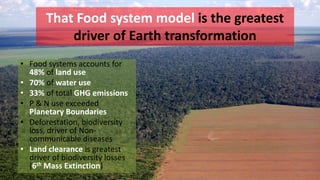
That Food system model is the greatest
driver of Earth transformation
• Food systems accounts for
48% of land use
• 70% of water use
• 33% of total GHG emissions
• P & N use exceeded
Planetary Boundaries
• Deforestation, biodiversity
loss, driver of Non-
communicable diseases
• Land clearance is greatest
driver of biodiversity losses
(6th Mass Extinction)
6
7
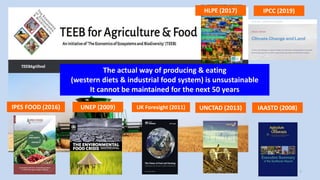
The actual way of producing & eating
(western diets & industrial food system) is unsustainable
It cannot be maintained for the next 50 years
IAASTD (2008)
UNEP (2009) UNCTAD (2013)
UK Foresight (2011)
IPES FOOD (2016)
IPCC (2019)
HLPE (2017)
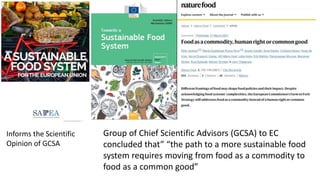
Group of Chief Scientific Advisors (GCSA) to EC
concluded that” “the path to a more sustainable food
system requires moving from food as a commodity to
food as a common good”
Informs the Scientific
Opinion of GCSA
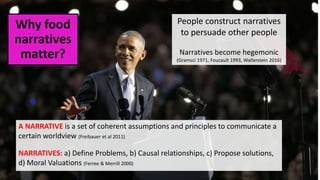
Why food
narratives
matter?
A NARRATIVE is a set of coherent assumptions and principles to communicate a
certain worldview (Freibauer et al 2011)
NARRATIVES: a) Define Problems, b) Causal relationships, c) Propose solutions,
d) Moral Valuations (Ferree & Merrill 2000)
People construct narratives
to persuade other people
Narratives become hegemonic
(Gramsci 1971, Foucault 1993, Wallerstein 2016)
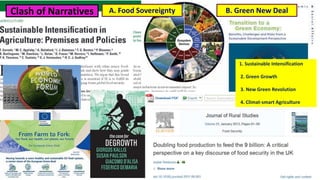
Clash of Narratives A. Food Sovereignty B. Green New Deal
1. Sustainable Intensification
2. Green Growth
3. New Green Revolution
4. Climat-smart Agriculture
13
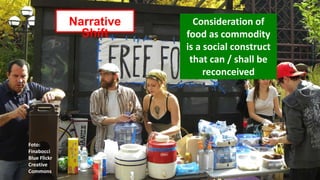
Consideration of
food as commodity
is a social construct
that can / shall be
reconceived
Foto:
Finabocci
Blue Flickr
Creative
Commons
Narrative
Shift
14
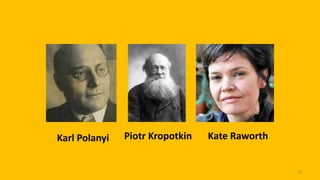
Karl Polanyi Piotr Kropotkin Kate Raworth
15
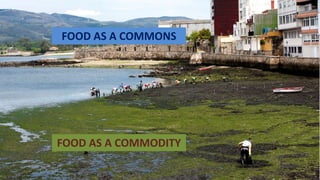
FOOD AS A COMMONS
FOOD AS A COMMODITY
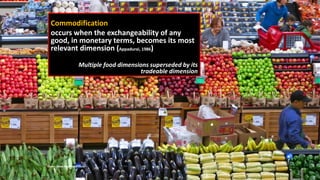
Commodification
occurs when the exchangeability of any
good, in monetary terms, becomes its most
relevant dimension (Appadurai, 1986)
Multiple food dimensions superseded by its
tradeable dimension
16
Photo: Dean Hochman, Flickr
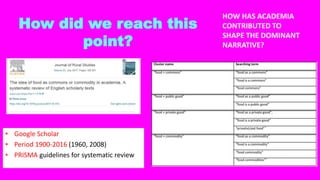
How did we reach this
point?
HOW HAS ACADEMIA
CONTRIBUTED TO
SHAPE THE DOMINANT
NARRATIVE?
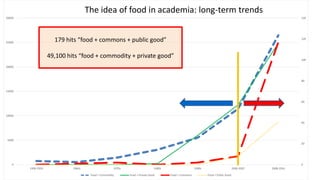
• Google Scholar
• Period 1900-2016 (1960, 2008)
• PRISMA guidelines for systematic review
0
20
40
60
80
100
120
140
0
5000
10000
15000
20000
25000
30000
1900-1959 1960s 1970s 1980s 1990s 2000-2007 2008-2016
The idea of food in academia: long-term trends
Food + Commodity Food + Private Good Food + Commons Food + Public Good
179 hits “food + commons + public good”
49,100 hits “food + commodity + private good”
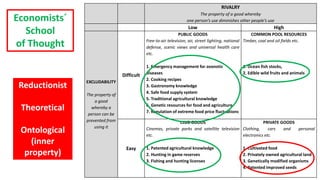
RIVALRY
The property of a good whereby
one person’s use diminishes other people’s use
Low High
EXCLUDABILITY
The property of
a good
whereby a
person can be
prevented from
using it
Difficult
PUBLIC GOODS
Free-to-air television, air, street lighting, national
defense, scenic views and universal health care
etc.
1. Emergency management for zoonotic
diseases
2. Cooking recipes
3. Gastronomy knowledge
4. Safe food supply system
5. Traditional agricultural knowledge
6. Genetic resources for food and agriculture
7. Regulation of extreme food price fluctuations
COMMON POOL RESOURCES
Timber, coal and oil fields etc.
1. Ocean fish stocks,
2. Edible wild fruits and animals
Easy
CLUB GOODS
Cinemas, private parks and satellite television
etc.
1. Patented agricultural knowledge
2. Hunting in game reserves
3. Fishing and hunting licenses
PRIVATE GOODS
Clothing, cars and personal
electronics etc.
1. Cultivated food
2. Privately owned agricultural land
3. Genetically modified organisms
4. Patented improved seeds
Reductionist
Theoretical
Ontological
(inner
property)
Economists´
School
of Thought
21
22
Photo: ukhvlid, Creative Commons, Flickr
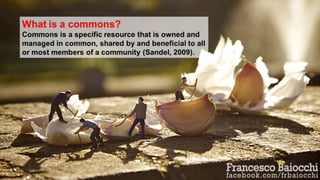
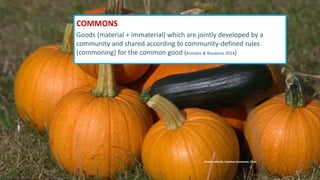
COMMONS
Goods (material + immaterial) which are jointly developed by a
community and shared according to community-defined rules
(commoning) for the common good (Kostakis & Bauwens 2014)
23
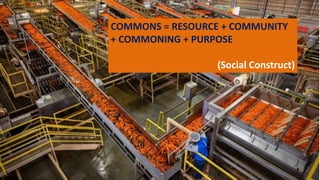
COMMONS = RESOURCE + COMMUNITY
+ COMMONING + PURPOSE
(Social Construct)
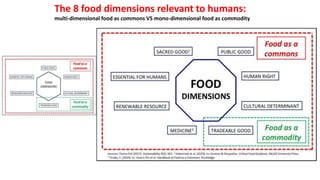
The 8 food dimensions relevant to humans:
multi-dimensional food as commons VS mono-dimensional food as commodity
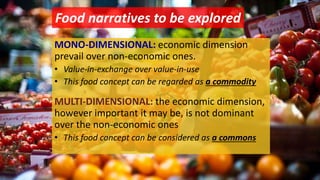
Food narratives to be explored
MONO-DIMENSIONAL: economic dimension
prevail over non-economic ones.
• Value-in-exchange over value-in-use
• This food concept can be regarded as a commodity
MULTI-DIMENSIONAL: the economic dimension,
however important it may be, is not dominant
over the non-economic ones
• This food concept can be considered as a commons
How does the normative valuation shape
political stance & food policy options?
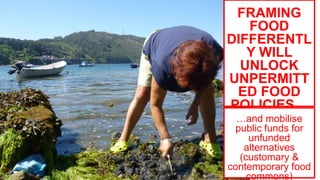
FRAMING
FOOD
DIFFERENTL
Y WILL
UNLOCK
UNPERMITT
ED FOOD
POLICIES…
…and mobilise
public funds for
unfunded
alternatives
(customary &
contemporary food
commons)
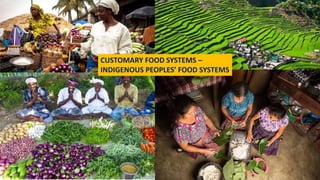
CUSTOMARY FOOD SYSTEMS –
INDIGENOUS PEOPLES’ FOOD SYSTEMS
30
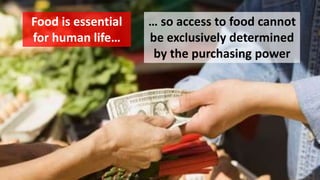
Food is essential
for human life…
… so access to food cannot
be exclusively determined
by the purchasing power
31

Reframing food From commodity to commons

  • 1.
    1 Reframing food: from commodityto commons Dr. Jose Luis Vivero-Pol University of Louvain, Belgium
  • 2.
    How do peoplevalue Food? Essential for survival (De Schutter & Pistor 2015) Societal determinant (Ellul 1990) Agent of power (Sumner 2011) Commodity (Siegel et al. 2016) Private Good (Samuelson 1954) Public Good (Akram-Lodhi 2013) Commons (Dalla Costa 2007) Human Right (UN 1999) Multiple meanings (Szymanski 2014)
  • 3.
    Food has multiplemeanings a.- Situated (time, place, knowledge) b.- Phenomenological (meanings depend on the observer and circumstances)
  • 4.
    The dominant narrative ofthe industrial food system “FOOD IS A COMMODITY” • Market as the best allocation mechanism • Low-cost Food System • Non-market Food Systems are not relevant
  • 5.
    Industrial Food System • Technologically-drivenproductivism • Market-led mechanisms • Agro-industry: farming considered as a business • Farm as a factory • Agri-Food corporations as major actors • Economies of scale to maximise profits, ultra-processed foods, mechanized systems, low wages, low-cost food system
  • 6.
    That Food systemmodel is the greatest driver of Earth transformation • Food systems accounts for 48% of land use • 70% of water use • 33% of total GHG emissions • P & N use exceeded Planetary Boundaries • Deforestation, biodiversity loss, driver of Non- communicable diseases • Land clearance is greatest driver of biodiversity losses (6th Mass Extinction) 6
  • 7.
    7 The actual wayof producing & eating (western diets & industrial food system) is unsustainable It cannot be maintained for the next 50 years IAASTD (2008) UNEP (2009) UNCTAD (2013) UK Foresight (2011) IPES FOOD (2016) IPCC (2019) HLPE (2017)
  • 8.
    Group of ChiefScientific Advisors (GCSA) to EC concluded that” “the path to a more sustainable food system requires moving from food as a commodity to food as a common good” Informs the Scientific Opinion of GCSA
  • 11.
    Why food narratives matter? A NARRATIVEis a set of coherent assumptions and principles to communicate a certain worldview (Freibauer et al 2011) NARRATIVES: a) Define Problems, b) Causal relationships, c) Propose solutions, d) Moral Valuations (Ferree & Merrill 2000) People construct narratives to persuade other people Narratives become hegemonic (Gramsci 1971, Foucault 1993, Wallerstein 2016)
  • 12.
    Clash of NarrativesA. Food Sovereignty B. Green New Deal 1. Sustainable Intensification 2. Green Growth 3. New Green Revolution 4. Climat-smart Agriculture
  • 13.
    13 Consideration of food ascommodity is a social construct that can / shall be reconceived Foto: Finabocci Blue Flickr Creative Commons Narrative Shift
  • 14.
    14 Karl Polanyi PiotrKropotkin Kate Raworth
  • 15.
    15 FOOD AS ACOMMONS FOOD AS A COMMODITY
  • 16.
    Commodification occurs when theexchangeability of any good, in monetary terms, becomes its most relevant dimension (Appadurai, 1986) Multiple food dimensions superseded by its tradeable dimension 16 Photo: Dean Hochman, Flickr
  • 17.
    How did wereach this point? HOW HAS ACADEMIA CONTRIBUTED TO SHAPE THE DOMINANT NARRATIVE? • Google Scholar • Period 1900-2016 (1960, 2008) • PRISMA guidelines for systematic review
  • 18.
    0 20 40 60 80 100 120 140 0 5000 10000 15000 20000 25000 30000 1900-1959 1960s 1970s1980s 1990s 2000-2007 2008-2016 The idea of food in academia: long-term trends Food + Commodity Food + Private Good Food + Commons Food + Public Good 179 hits “food + commons + public good” 49,100 hits “food + commodity + private good”
  • 19.
    RIVALRY The property ofa good whereby one person’s use diminishes other people’s use Low High EXCLUDABILITY The property of a good whereby a person can be prevented from using it Difficult PUBLIC GOODS Free-to-air television, air, street lighting, national defense, scenic views and universal health care etc. 1. Emergency management for zoonotic diseases 2. Cooking recipes 3. Gastronomy knowledge 4. Safe food supply system 5. Traditional agricultural knowledge 6. Genetic resources for food and agriculture 7. Regulation of extreme food price fluctuations COMMON POOL RESOURCES Timber, coal and oil fields etc. 1. Ocean fish stocks, 2. Edible wild fruits and animals Easy CLUB GOODS Cinemas, private parks and satellite television etc. 1. Patented agricultural knowledge 2. Hunting in game reserves 3. Fishing and hunting licenses PRIVATE GOODS Clothing, cars and personal electronics etc. 1. Cultivated food 2. Privately owned agricultural land 3. Genetically modified organisms 4. Patented improved seeds Reductionist Theoretical Ontological (inner property) Economists´ School of Thought
  • 21.
  • 22.
    22 Photo: ukhvlid, CreativeCommons, Flickr COMMONS Goods (material + immaterial) which are jointly developed by a community and shared according to community-defined rules (commoning) for the common good (Kostakis & Bauwens 2014)
  • 23.
    23 COMMONS = RESOURCE+ COMMUNITY + COMMONING + PURPOSE (Social Construct)
  • 24.
    The 8 fooddimensions relevant to humans: multi-dimensional food as commons VS mono-dimensional food as commodity
  • 25.
    Food narratives tobe explored MONO-DIMENSIONAL: economic dimension prevail over non-economic ones. • Value-in-exchange over value-in-use • This food concept can be regarded as a commodity MULTI-DIMENSIONAL: the economic dimension, however important it may be, is not dominant over the non-economic ones • This food concept can be considered as a commons
  • 26.
    How does thenormative valuation shape political stance & food policy options?
  • 28.
    FRAMING FOOD DIFFERENTL Y WILL UNLOCK UNPERMITT ED FOOD POLICIES… …andmobilise public funds for unfunded alternatives (customary & contemporary food commons)
  • 29.
    CUSTOMARY FOOD SYSTEMS– INDIGENOUS PEOPLES’ FOOD SYSTEMS
  • 30.
    30 Food is essential forhuman life… … so access to food cannot be exclusively determined by the purchasing power
  • 31.