Cargo Movements on Austria„s
Road Network (iMOVE)
EUROSTAT, Oct 11, 2012
Austria„s traffic model (current & future)

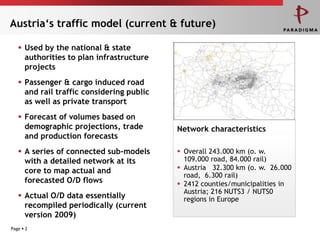
    Used by the national & state
     authorities to plan infrastructure
     projects
    Passenger & cargo induced road
     and rail traffic considering public
     as well as private transport
    Forecast of volumes based on
     demographic projections, trade        Network characteristics
     and production forecasts
    A series of connected sub-models       Overall 243.000 km (o. w.
     with a detailed network at its          109.000 road, 84.000 rail)
     core to map actual and                 Austria 32.300 km (o. w. 26.000
                                             road, 6.300 rail)
     forecasted O/D flows                   2412 counties/municipalities in
                                             Austria; 216 NUTS3 / NUTS0
    Actual O/D data essentially             regions in Europe
     recompiled periodically (current
     version 2009)
Page  2
Perceived weaknesses of the current approach

The model‘s empirical foundation
   Insufficient accuracy of total transportation volume
            Output of transportation sector 2004 estimates range between
             363,5 and 415,8 mio. t/km depending on source
            Underestimation by the European Road Freight Statistics ?

   Inhomogeneous data collections
            Spatial differences (NUTS3, highway sections, counties)
            Methodological differences between countries in collecting
             national road traffic data
            Periodical differences (quarterly, yearly (t+1), every four
             years) between surveys

   Laborious, expensive production process of base data
Page  3
Main objectives of the iMOVE project

Improve the production process and the quality of
             the O/D flow matrices
  Combine & harmonize different surveys
  Incorporate highway toll data into the O/D flows
   trips / between counties per truck category per day
  Calibrate the O/D flows, using traffic count numbers of
   permanent counting stations
  [Verify and consider the hypothesized growth in
   multimodal movements]
  Prototype a repeatable data production process
Major data sources used to compile the O/D matrix

              Austrian Road Freight Transport Statistics (SGVS)
               Sampling based on Austria‘s Vehicle Registry
               Political District Level
               Assumed underestimation (foreign (non EU) trucks/non-response)


              European Road Traffic Statistics (D-Tables)
               Only trucks registered nationally are surveyed, combined at EU level
               Movements at NUTS3 level
               Assumed underestimation (foreign (non EU) trucks/non-response)


              Cross Alpine Freight Data (CAFT)
               All trucks, irrespective of nationality are surveyed
               Survey performed by Alpine nations every 4 years (O/D, cargo)
               Performed at border crossings and major mountain passes


              Toll data records & Traffic counts
               Complete set of records collected at gantries for 2009 (highways)
               Traffic count data using automatic permanently installed systems
                (primary & secondary roads)
Page  5
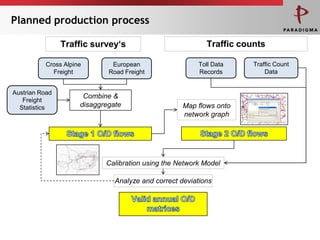
Planned production process

                Traffic survey‘s                            Traffic counts

           Cross Alpine        European                  Toll Data     Traffic Count
             Freight          Road Freight               Records           Data


Austrian Road
                       Combine &
   Freight
  Statistics          disaggregate                   Map flows onto
                                                     network graph


                             Calibration using the Network Model

                                Analyze and correct deviations
Experiences, Status

   Combining different survey„s and traffic count information
            Reconciling different value sets used in surveys to describe the same
             properties: Truck sizes, cargo types, goods classifications
            Harmonizing, separating the use of different NUTS3 levels for origin
             and destination

   Measuring the number of movements between two “traffic
    cells”
            Derivation of journey’s from data collected at toll bridges
            Disaggregating journeys from reported levels to „traffic cells“, using
             ecological inference approach.

   Calibrating the route allocation of movements to road links
            Minimizing deviations between calculated and counted traffic per link
             observing O/D movement bounds using non-linear optimization.

Page  7
Backup


Page  8
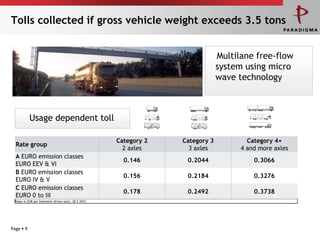
Tolls collected if gross vehicle weight exceeds 3.5 tons


                                                                                 Multilane free-flow
                                                                                 system using micro
                                                                                 wave technology


            Usage dependent toll

                                                       Category 2   Category 3           Category 4+
  Rate group
                                                         2 axles      3 axles          4 and more axles
  A EURO emission classes
                                                         0.146       0.2044                0.3066
  EURO EEV & VI
  B EURO emission classes
                                                         0.156       0.2184                0.3276
  EURO IV & V
  C EURO emission classes
                                                         0.178       0.2492                0.3738
  EURO 0 to III
  Rates in EUR per kilometer driven (excl. 20 % VAT)


Page  9
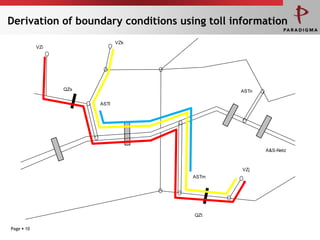
Derivation of boundary conditions using toll information
                               VZk
            VZi


                  QZs                         ASTn

                        ASTl


                                                     A&S-Netz


                                              VZj
                                     ASTm


                                     QZt

Page  10
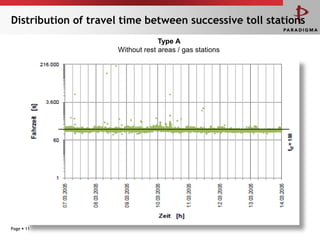
Distribution of travel time between successive toll stations
                                  Type A
                     Without rest areas / gas stations


Page  11
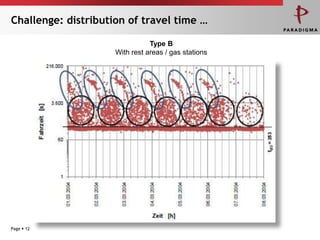
Challenge: distribution of travel time …

                                Type B
                     With rest areas / gas stations


Page  12
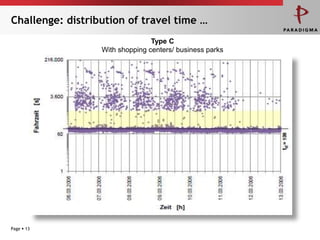
Challenge: distribution of travel time …
                                 Type C
                  With shopping centers/ business parks


Page  13

EUROSTAT Presentation

  • 1.
    Cargo Movements onAustria„s Road Network (iMOVE) EUROSTAT, Oct 11, 2012
  • 2.
    Austria„s traffic model(current & future)  Used by the national & state authorities to plan infrastructure projects  Passenger & cargo induced road and rail traffic considering public as well as private transport  Forecast of volumes based on demographic projections, trade Network characteristics and production forecasts  A series of connected sub-models  Overall 243.000 km (o. w. with a detailed network at its 109.000 road, 84.000 rail) core to map actual and  Austria 32.300 km (o. w. 26.000 road, 6.300 rail) forecasted O/D flows  2412 counties/municipalities in Austria; 216 NUTS3 / NUTS0  Actual O/D data essentially regions in Europe recompiled periodically (current version 2009) Page  2
  • 3.
    Perceived weaknesses ofthe current approach The model‘s empirical foundation  Insufficient accuracy of total transportation volume  Output of transportation sector 2004 estimates range between 363,5 and 415,8 mio. t/km depending on source  Underestimation by the European Road Freight Statistics ?  Inhomogeneous data collections  Spatial differences (NUTS3, highway sections, counties)  Methodological differences between countries in collecting national road traffic data  Periodical differences (quarterly, yearly (t+1), every four years) between surveys  Laborious, expensive production process of base data Page  3
  • 4.
    Main objectives ofthe iMOVE project Improve the production process and the quality of the O/D flow matrices  Combine & harmonize different surveys  Incorporate highway toll data into the O/D flows  trips / between counties per truck category per day  Calibrate the O/D flows, using traffic count numbers of permanent counting stations  [Verify and consider the hypothesized growth in multimodal movements]  Prototype a repeatable data production process
  • 5.
    Major data sourcesused to compile the O/D matrix Austrian Road Freight Transport Statistics (SGVS)  Sampling based on Austria‘s Vehicle Registry  Political District Level  Assumed underestimation (foreign (non EU) trucks/non-response) European Road Traffic Statistics (D-Tables)  Only trucks registered nationally are surveyed, combined at EU level  Movements at NUTS3 level  Assumed underestimation (foreign (non EU) trucks/non-response) Cross Alpine Freight Data (CAFT)  All trucks, irrespective of nationality are surveyed  Survey performed by Alpine nations every 4 years (O/D, cargo)  Performed at border crossings and major mountain passes Toll data records & Traffic counts  Complete set of records collected at gantries for 2009 (highways)  Traffic count data using automatic permanently installed systems (primary & secondary roads) Page  5
  • 6.
    Planned production process Traffic survey‘s Traffic counts Cross Alpine European Toll Data Traffic Count Freight Road Freight Records Data Austrian Road Combine & Freight Statistics disaggregate Map flows onto network graph Calibration using the Network Model Analyze and correct deviations
  • 7.
    Experiences, Status  Combining different survey„s and traffic count information  Reconciling different value sets used in surveys to describe the same properties: Truck sizes, cargo types, goods classifications  Harmonizing, separating the use of different NUTS3 levels for origin and destination  Measuring the number of movements between two “traffic cells”  Derivation of journey’s from data collected at toll bridges  Disaggregating journeys from reported levels to „traffic cells“, using ecological inference approach.  Calibrating the route allocation of movements to road links  Minimizing deviations between calculated and counted traffic per link observing O/D movement bounds using non-linear optimization. Page  7
  • 8.
  • 9.
    Tolls collected ifgross vehicle weight exceeds 3.5 tons Multilane free-flow system using micro wave technology Usage dependent toll Category 2 Category 3 Category 4+ Rate group 2 axles 3 axles 4 and more axles A EURO emission classes 0.146 0.2044 0.3066 EURO EEV & VI B EURO emission classes 0.156 0.2184 0.3276 EURO IV & V C EURO emission classes 0.178 0.2492 0.3738 EURO 0 to III Rates in EUR per kilometer driven (excl. 20 % VAT) Page  9
  • 10.
    Derivation of boundaryconditions using toll information VZk VZi QZs ASTn ASTl A&S-Netz VZj ASTm QZt Page  10
  • 11.
    Distribution of traveltime between successive toll stations Type A Without rest areas / gas stations Page  11
  • 12.
    Challenge: distribution oftravel time … Type B With rest areas / gas stations Page  12
  • 13.
    Challenge: distribution oftravel time … Type C With shopping centers/ business parks Page  13