Agricultural and
Industrial revolutions
     “Growing” an economy
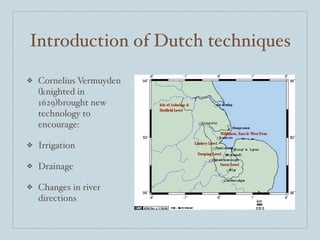
Introduction of Dutch techniques

❖   Cornelius Vermuyden
    (knighted in
    1629)brought new
    technology to
    encourage:

❖   Irrigation

❖   Drainage

❖   Changes in river
    directions
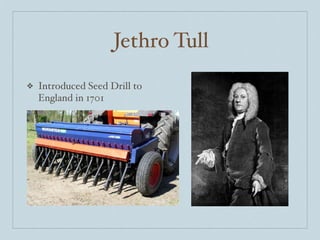
Jethro Tull
❖   Introduced Seed Drill to
    England in 1701
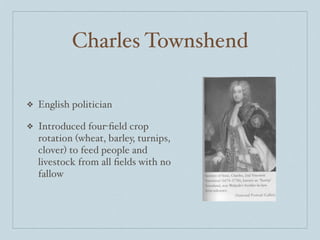
Charles Townshend

❖   English politician

❖   Introduced four-field crop
    rotation (wheat, barley, turnips,
    clover) to feed people and
    livestock from all fields with no
    fallow
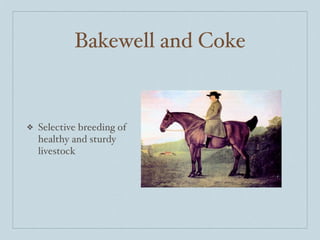
Bakewell and Coke


❖   Selective breeding of
    healthy and sturdy
    livestock
Inclosure Acts 1750-1845

❖   7 million public acres enclosed for private use

❖   21% of English farmland enclosed

❖   Fewer workers needed per acre due to new technology

❖   Large-scale migration to urban areas resulted, with
    unemployment and urban slums as a result
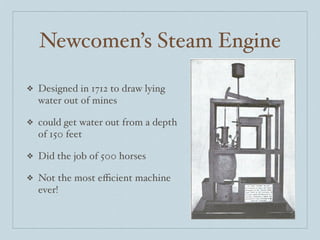
Newcomen’s Steam Engine

❖   Designed in 1712 to draw lying
    water out of mines

❖   could get water out from a depth
    of 150 feet

❖   Did the job of 500 horses

❖   Not the most efficient machine
    ever!
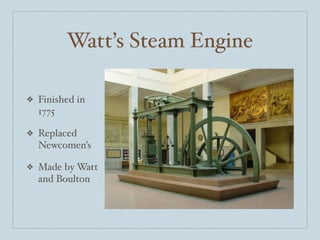
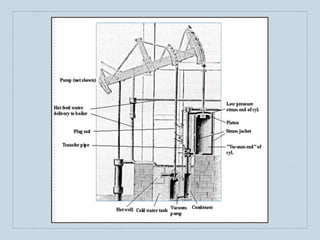
Watt’s Steam Engine

❖   Finished in
    1775

❖   Replaced
    Newcomen’s

❖   Made by Watt
    and Boulton
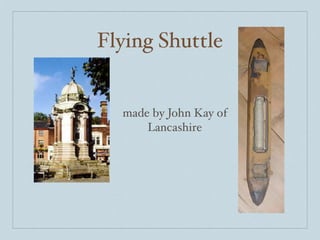
Flying Shuttle


  made by John Kay of
      Lancashire
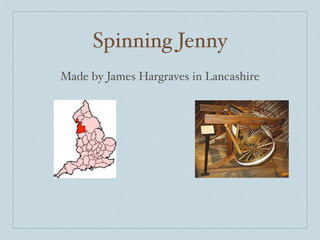
Spinning Jenny
Made by James Hargraves in Lancashire
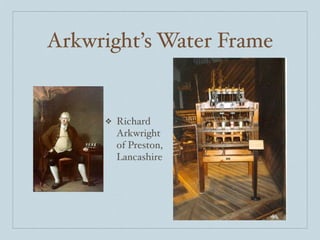
Arkwright’s Water Frame


     ❖   Richard
         Arkwright
         of Preston,
         Lancashire
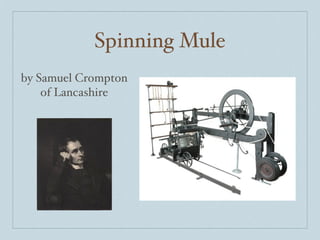
Spinning Mule
by Samuel Crompton
    of Lancashire
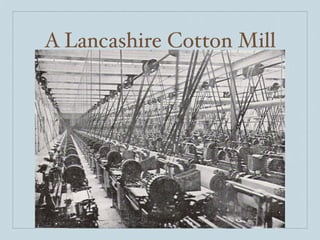
A Lancashire Cotton Mill
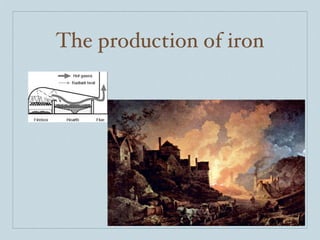
The production of iron
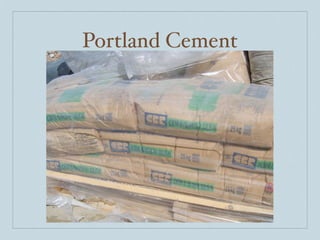
Portland Cement
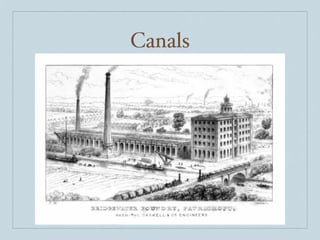
Canals
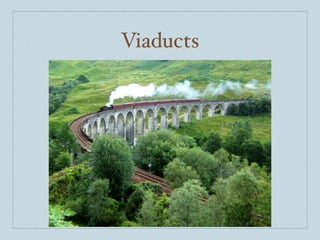
Viaducts
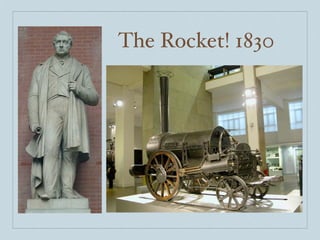
The Rocket! 1830
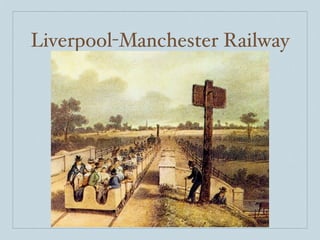
Liverpool-Manchester Railway
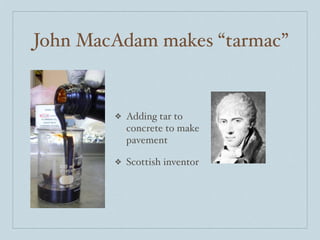
John MacAdam makes “tarmac”


        ❖   Adding tar to
            concrete to make
            pavement

        ❖   Scottish inventor
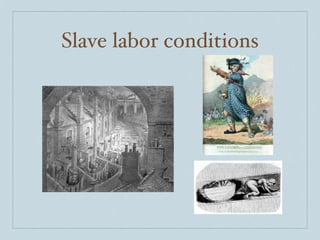
Slave labor conditions
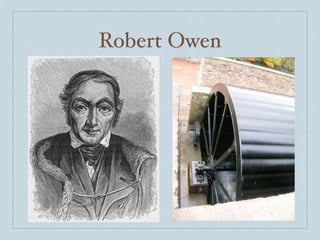
Robert Owen
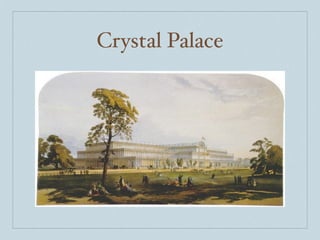
Crystal Palace

Euroargiandindusrev