Building	
  a	
  ci+zen’s	
  voice	
  on	
  educa+on	
  and	
  training	
  issues	
  
“Preparing	
  a	
  good	
  applica/on”	
  
Peer	
  learning	
  session,	
  24	
  November	
  2014	
  
Audrey	
  Frith,	
  Director	
  of	
  EUCIS-­‐LLL	
  
European	
  Civil	
  Society	
  Pla3orm	
  on	
  Lifelong	
  Learning	
  
European	
  civil	
  society	
  pla3orm	
  on	
  lifelong	
  learning	
  
GeKng	
  prepared	
  for	
  the	
  call	
  OSC	
  –	
  EUCIS-­‐LLL	
  peer	
  learning	
  session,	
  24	
  October	
  2014	
  
Award criteria	
  
European	
  civil	
  society	
  pla3orm	
  on	
  lifelong	
  learning	
  
GeKng	
  prepared	
  for	
  the	
  call	
  OSC	
  –	
  EUCIS-­‐LLL	
  peer	
  learning	
  session,	
  24	
  October	
  2014	
  
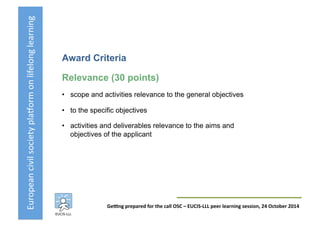
Award Criteria
Relevance (30 points)
•  scope and activities relevance to the general objectives
•  to the specific objectives
•  activities and deliverables relevance to the aims and
objectives of the applicant
European	
  civil	
  society	
  pla3orm	
  on	
  lifelong	
  learning	
  
GeKng	
  prepared	
  for	
  the	
  call	
  OSC	
  –	
  EUCIS-­‐LLL	
  peer	
  learning	
  session,	
  24	
  October	
  2014	
  
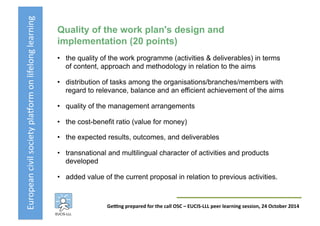
Quality of the work plan's design and
implementation (20 points)
•  the quality of the work programme (activities & deliverables) in terms
of content, approach and methodology in relation to the aims
•  distribution of tasks among the organisations/branches/members with
regard to relevance, balance and an efficient achievement of the aims
•  quality of the management arrangements
•  the cost-benefit ratio (value for money)
•  the expected results, outcomes, and deliverables
•  transnational and multilingual character of activities and products
developed
•  added value of the current proposal in relation to previous activities.
European	
  civil	
  society	
  pla3orm	
  on	
  lifelong	
  learning	
  
GeKng	
  prepared	
  for	
  the	
  call	
  OSC	
  –	
  EUCIS-­‐LLL	
  peer	
  learning	
  session,	
  24	
  October	
  2014	
  
Profile, number of participants and countries
involved in the activities (20 points)
•  profile and number of the participants/stakeholders involved in the
activities;
•  number of eligible countries involved in the activities.
European	
  civil	
  society	
  pla3orm	
  on	
  lifelong	
  learning	
  
GeKng	
  prepared	
  for	
  the	
  call	
  OSC	
  –	
  EUCIS-­‐LLL	
  peer	
  learning	
  session,	
  24	
  October	
  2014	
  
Impact, dissemination & sustainability (30 points)
scope of the work programme, multiplier effect, sustainable impact &
long-term viability of activities and deliverables:
•  expected short- long-term quantitative & qualitative impact of the
activities & deliverables on target groups, and on policies, strategies or
systems at all levels. Lot 1: on a significant number of issues in one
specific educational sector or in one of the key cross-sector areas
specified in the eligibility requirements.
•  how the work programme will facilitate exchanges & debates between
actors from different sectors & levels & different countries;
•  the measures planned to ensure the visibility of the activities/
deliverables/results;
•  how the dissemination & exploitation plans will ensure optimal use of
the results among & beyond members (during);
•  proposed contributions/recommendations to be addressed to target
groups
European	
  civil	
  society	
  pla3orm	
  on	
  lifelong	
  learning	
  
GeKng	
  prepared	
  for	
  the	
  call	
  OSC	
  –	
  EUCIS-­‐LLL	
  peer	
  learning	
  session,	
  24	
  October	
  2014	
  
Some ideas for discussion	
  
European	
  civil	
  society	
  pla3orm	
  on	
  lifelong	
  learning	
  
GeKng	
  prepared	
  for	
  the	
  call	
  OSC	
  –	
  EUCIS-­‐LLL	
  peer	
  learning	
  session,	
  24	
  October	
  2014	
  
Relevance (30 points)
The objective of the call is to provide structural support to organisations
pursuing the following general aims:
•  Raise stakeholder awareness of European policy agendas in
education training and youth
•  Increase stakeholder commitment and cooperation with public
authorities for the implementation of policies and reforms in the
fields of education and training and of youth;
•  Boost stakeholder participation in the fields of education, training
and youth;
•  Boost stakeholder involvement in the dissemination of policy and
Programme actions and results and of good practice among their
membership and beyond.
European	
  civil	
  society	
  pla3orm	
  on	
  lifelong	
  learning	
  
GeKng	
  prepared	
  for	
  the	
  call	
  OSC	
  –	
  EUCIS-­‐LLL	
  peer	
  learning	
  session,	
  24	
  October	
  2014	
  
Relevance (30 points)
The specific objectives of the call:
Education and training
•  The organisations active in the field of education and training are
expected to develop and implement innovative, targeted and
creative strategies and activities to support the effective
implementation of reforms and actions in the following areas:
•  Promoting excellence and innovation
•  Tackling the low-skills trap
•  Supporting a new generation of educators
•  Recognising and valuing competences
European	
  civil	
  society	
  pla3orm	
  on	
  lifelong	
  learning	
  
GeKng	
  prepared	
  for	
  the	
  call	
  OSC	
  –	
  EUCIS-­‐LLL	
  peer	
  learning	
  session,	
  24	
  October	
  2014	
  
Relevance (30 points)
The specific objectives of the call:
Youth
•  Promote the employability of young people
•  Foster the empowerment of young people in society
•  Contribute to the personal, socio-educational & professional
development of young people in Europe;
•  Contribute to the development of youth work at all levels;
•  Contribute to the debate on development of policy issues affecting
young people & youth organisations at all levels;
•  Promote intercultural learning, the respect of diversity, and the values
of solidarity, equal opportunities and human rights among young
people in Europe;
•  Promote the inclusion of young people with fewer opportunities in
society.
European	
  civil	
  society	
  pla3orm	
  on	
  lifelong	
  learning	
  
GeKng	
  prepared	
  for	
  the	
  call	
  OSC	
  –	
  EUCIS-­‐LLL	
  peer	
  learning	
  session,	
  24	
  October	
  2014	
  
Relevance (30 points)
Political references:
•  Political guidelines of Mr Juncker and letter of mission of
Commissioner Navracsics and Thyssen
•  ET2020 objectives
•  European Semester: Council Conclusions, Annual Growth Survey,
Country Specific Recommendations (clusters, number of countries
who have to work on a specific topic…)
•  Youth Strategy
•  Sectoral policies (Copenhagen, Bologna…)
European	
  civil	
  society	
  pla3orm	
  on	
  lifelong	
  learning	
  
GeKng	
  prepared	
  for	
  the	
  call	
  OSC	
  –	
  EUCIS-­‐LLL	
  peer	
  learning	
  session,	
  24	
  October	
  2014	
  
Relevance (30 points)
Political context: some indications in the introduction
•  Economic and financial crisis
•  Europe 2020 strategy for smart, sustainable and inclusive growth:
higher levels of employment, productivity and social cohesion
•  Commission Communication “Building Growth” of June 2014
•  Conclusions of 12 May 2009 on ET2020
•  Resolution of 27 November 2009 on a renewed framework for
European cooperation in the
•  Youth field (2010-2018),
•  The Council conclusions of February 2014 on Efficient and Innovative
Education and Training to Invest in Skills
European	
  civil	
  society	
  pla3orm	
  on	
  lifelong	
  learning	
  
GeKng	
  prepared	
  for	
  the	
  call	
  OSC	
  –	
  EUCIS-­‐LLL	
  peer	
  learning	
  session,	
  24	
  October	
  2014	
  
Relevance (30 points)
Other:
•  ET2020 and Europe 2020 Review (Spring council)
•  Sectoral policies priorities existing and upcoming legislation
•  New Commission and new Parliament
•  Other?
European	
  civil	
  society	
  pla3orm	
  on	
  lifelong	
  learning	
  
GeKng	
  prepared	
  for	
  the	
  call	
  OSC	
  –	
  EUCIS-­‐LLL	
  peer	
  learning	
  session,	
  24	
  October	
  2014	
  
Relevance (30 points)
Other:
•  ET2020 and Europe 2020 Review (Spring council)
•  Sectoral policies priorities existing and upcoming legislation
•  New Commission and new Parliament
•  Other?
European	
  civil	
  society	
  pla3orm	
  on	
  lifelong	
  learning	
  
GeKng	
  prepared	
  for	
  the	
  call	
  OSC	
  –	
  EUCIS-­‐LLL	
  peer	
  learning	
  session,	
  24	
  October	
  2014	
  
How to show the relevance of our
activities/organisations/actions/results?	
  
European	
  civil	
  society	
  pla3orm	
  on	
  lifelong	
  learning	
  
GeKng	
  prepared	
  for	
  the	
  call	
  OSC	
  –	
  EUCIS-­‐LLL	
  peer	
  learning	
  session,	
  24	
  October	
  2014	
  
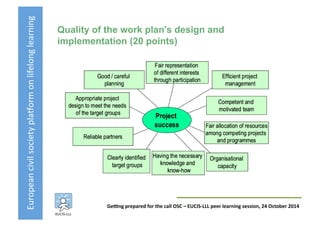
Quality of the work plan's design and
implementation (20 points)
European	
  civil	
  society	
  pla3orm	
  on	
  lifelong	
  learning	
  
GeKng	
  prepared	
  for	
  the	
  call	
  OSC	
  –	
  EUCIS-­‐LLL	
  peer	
  learning	
  session,	
  24	
  October	
  2014	
  
Quality
Key elements:
•  The organisation's purpose and activities meet the general and specific
objectives
•  The organisation capacity to involve the members & the way it does it
•  Mechanisms to review the implementation (board, staff, members)
•  The way the board, staff & members participate in the planning process
•  The plan was developed by researching the policy context (references)
and identifies current needs/challenges
•  The plan sets goals and measurable objectives that address these
issues
European	
  civil	
  society	
  pla3orm	
  on	
  lifelong	
  learning	
  
GeKng	
  prepared	
  for	
  the	
  call	
  OSC	
  –	
  EUCIS-­‐LLL	
  peer	
  learning	
  session,	
  24	
  October	
  2014	
  
Quality
Key elements:
•  The plan integrates all the organisation's activities around a focused
mission
•  The plan prioritises the goals and develops timelines for their
accomplishment
•  The plan establishes an evaluation process and performance indicators
to measure the progress toward the achievement of goals and objectives
•  Through work plans, human and financial resources are allocated to
ensure the accomplishment of the goals in a timely fashion
•  The plan is communicated to all target groups
European	
  civil	
  society	
  pla3orm	
  on	
  lifelong	
  learning	
  
GeKng	
  prepared	
  for	
  the	
  call	
  OSC	
  –	
  EUCIS-­‐LLL	
  peer	
  learning	
  session,	
  24	
  October	
  2014	
  
Quality
Examples of methodologies for project management:
• Logical framework:
o  What the project is going to achieve?
o  What activities will be carried out to achieve its outputs and purpose?
o  What resources (inputs) are required?
o  What are the potential problems which could affect the success of the
project?
o  How the progress and ultimate success of the project will be
measured and verified?
• Risk management
• SWOT analysis...
European	
  civil	
  society	
  pla3orm	
  on	
  lifelong	
  learning	
  
GeKng	
  prepared	
  for	
  the	
  call	
  OSC	
  –	
  EUCIS-­‐LLL	
  peer	
  learning	
  session,	
  24	
  October	
  2014	
  
Quality
Analysis of management capacity
Analysis of the capacity of applicant to manage the existing and planned
activities efficiently. Possible indicators for evaluators: management staff
with profiles matching their tasks.
Transnational and multilingual character of activities and products
developed
Activities: language used, translation
Products: translation, etc.
Website, media: use of Google translate possible with website and
newsletter (digital format)
Added value compared to previous grant
Strengthened communication strategy for a larger outreach (developed use
of social media), contribution to broader policy frameworks (European
Semester), working on thematic clusters...
European	
  civil	
  society	
  pla3orm	
  on	
  lifelong	
  learning	
  
GeKng	
  prepared	
  for	
  the	
  call	
  OSC	
  –	
  EUCIS-­‐LLL	
  peer	
  learning	
  session,	
  24	
  October	
  2014	
  
Showing the quality?	
  
European	
  civil	
  society	
  pla3orm	
  on	
  lifelong	
  learning	
  
GeKng	
  prepared	
  for	
  the	
  call	
  OSC	
  –	
  EUCIS-­‐LLL	
  peer	
  learning	
  session,	
  24	
  October	
  2014	
  
Profile, number of participants and countries
involved in the activities (20 points)
•  profile and number of the participants/stakeholders involved in the
activities;
•  number of eligible countries involved in the activities.
European	
  civil	
  society	
  pla3orm	
  on	
  lifelong	
  learning	
  
GeKng	
  prepared	
  for	
  the	
  call	
  OSC	
  –	
  EUCIS-­‐LLL	
  peer	
  learning	
  session,	
  24	
  October	
  2014	
  
Making the best of our networks/profile	
  
European	
  civil	
  society	
  pla3orm	
  on	
  lifelong	
  learning	
  
GeKng	
  prepared	
  for	
  the	
  call	
  OSC	
  –	
  EUCIS-­‐LLL	
  peer	
  learning	
  session,	
  24	
  October	
  2014	
  
Impact (30 points)
Short- and long term quantitative and qualitative impact:
•  increased awareness of the EU agenda..
•  better policy making thanks to the contribution of stakeholders in
identifying bottle necks
•  use of impact indicators
Facilitation of exchanges and debates:
Use of working groups, criteria for selection of experts, etc.
European	
  civil	
  society	
  pla3orm	
  on	
  lifelong	
  learning	
  
GeKng	
  prepared	
  for	
  the	
  call	
  OSC	
  –	
  EUCIS-­‐LLL	
  peer	
  learning	
  session,	
  24	
  October	
  2014	
  
Impact (30 points)
Measures for the visibility:
•  dissemination plan (identification of target groups, timeline...)
•  publication of results (policy papers, brochures, minutes with results –
outreach)
•  Strong media presence (website, social media, newsletter with outreach
numbers)
•  Partnerships (i.e. media partners)
•  Systematic use of social media
European	
  civil	
  society	
  pla3orm	
  on	
  lifelong	
  learning	
  
GeKng	
  prepared	
  for	
  the	
  call	
  OSC	
  –	
  EUCIS-­‐LLL	
  peer	
  learning	
  session,	
  24	
  October	
  2014	
  
Impact (30 points)
Optimal use of results by members (during):
•  resources adapted to the needs with guidelines on their further
dissemination at all levels...
•  use of national ambassadors
•  Other ideas…
Proposed contributions/recommendations to be addressed to target groups
•  policy recommendation, amendments, good practices, ... relevant to the
target group because... (link to policy framework, need assessment...)
•  Other ideas…
European	
  civil	
  society	
  pla3orm	
  on	
  lifelong	
  learning	
  
GeKng	
  prepared	
  for	
  the	
  call	
  OSC	
  –	
  EUCIS-­‐LLL	
  peer	
  learning	
  session,	
  24	
  October	
  2014	
  
On the use of indicators
The European Commission describes (planning) indicators as:
“a description of the project’s objectives in terms of quantity, quality,
target group(s), time and place”
Source: Manual Project Cycle Management, March 2001
European	
  civil	
  society	
  pla3orm	
  on	
  lifelong	
  learning	
  
GeKng	
  prepared	
  for	
  the	
  call	
  OSC	
  –	
  EUCIS-­‐LLL	
  peer	
  learning	
  session,	
  24	
  October	
  2014	
  
On the use of indicators
What are indicators?
•  An indicator is a specific, observable & measurable characteristic that
can be used to show changes or progress a programme is making
toward achieving a specific outcome.
•  There should be at least one indicator for each outcome. The indicator
should be focused, clear and specific. The change measured by the
indicator should represent progress that the programme hopes to make.
•  An indicator should be defined in precise, unambiguous terms that
describe clearly and exactly what is being measured. Where practical,
the indicator should give a relatively good idea of the data required and
the population among whom the indicator is measured.
•  Indicators do not specify a particular level of achievement - the words
“improved”, “increased”, or “decreased” do not belong in an indicator.
European	
  civil	
  society	
  pla3orm	
  on	
  lifelong	
  learning	
  
GeKng	
  prepared	
  for	
  the	
  call	
  OSC	
  –	
  EUCIS-­‐LLL	
  peer	
  learning	
  session,	
  24	
  October	
  2014	
  
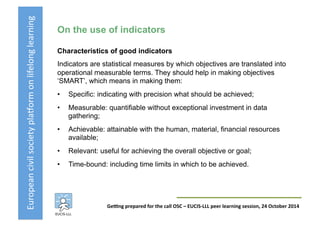
On the use of indicators
Characteristics of good indicators
Indicators are statistical measures by which objectives are translated into
operational measurable terms. They should help in making objectives
‘SMART’, which means in making them:
•  Specific: indicating with precision what should be achieved;
•  Measurable: quantifiable without exceptional investment in data
gathering;
•  Achievable: attainable with the human, material, financial resources
available;
•  Relevant: useful for achieving the overall objective or goal;
•  Time-bound: including time limits in which to be achieved.
European	
  civil	
  society	
  pla3orm	
  on	
  lifelong	
  learning	
  
GeKng	
  prepared	
  for	
  the	
  call	
  OSC	
  –	
  EUCIS-­‐LLL	
  peer	
  learning	
  session,	
  24	
  October	
  2014	
  
European	
  civil	
  society	
  pla3orm	
  on	
  lifelong	
  learning	
  
GeKng	
  prepared	
  for	
  the	
  call	
  OSC	
  –	
  EUCIS-­‐LLL	
  peer	
  learning	
  session,	
  24	
  October	
  2014	
  
How to show our impact?	
  

Eucis lll-pla november14-osc

  • 1.
    Building  a  ci+zen’s  voice  on  educa+on  and  training  issues   “Preparing  a  good  applica/on”   Peer  learning  session,  24  November  2014   Audrey  Frith,  Director  of  EUCIS-­‐LLL   European  Civil  Society  Pla3orm  on  Lifelong  Learning  
  • 2.
    European  civil  society  pla3orm  on  lifelong  learning   GeKng  prepared  for  the  call  OSC  –  EUCIS-­‐LLL  peer  learning  session,  24  October  2014   Award criteria  
  • 3.
    European  civil  society  pla3orm  on  lifelong  learning   GeKng  prepared  for  the  call  OSC  –  EUCIS-­‐LLL  peer  learning  session,  24  October  2014   Award Criteria Relevance (30 points) •  scope and activities relevance to the general objectives •  to the specific objectives •  activities and deliverables relevance to the aims and objectives of the applicant
  • 4.
    European  civil  society  pla3orm  on  lifelong  learning   GeKng  prepared  for  the  call  OSC  –  EUCIS-­‐LLL  peer  learning  session,  24  October  2014   Quality of the work plan's design and implementation (20 points) •  the quality of the work programme (activities & deliverables) in terms of content, approach and methodology in relation to the aims •  distribution of tasks among the organisations/branches/members with regard to relevance, balance and an efficient achievement of the aims •  quality of the management arrangements •  the cost-benefit ratio (value for money) •  the expected results, outcomes, and deliverables •  transnational and multilingual character of activities and products developed •  added value of the current proposal in relation to previous activities.
  • 5.
    European  civil  society  pla3orm  on  lifelong  learning   GeKng  prepared  for  the  call  OSC  –  EUCIS-­‐LLL  peer  learning  session,  24  October  2014   Profile, number of participants and countries involved in the activities (20 points) •  profile and number of the participants/stakeholders involved in the activities; •  number of eligible countries involved in the activities.
  • 6.
    European  civil  society  pla3orm  on  lifelong  learning   GeKng  prepared  for  the  call  OSC  –  EUCIS-­‐LLL  peer  learning  session,  24  October  2014   Impact, dissemination & sustainability (30 points) scope of the work programme, multiplier effect, sustainable impact & long-term viability of activities and deliverables: •  expected short- long-term quantitative & qualitative impact of the activities & deliverables on target groups, and on policies, strategies or systems at all levels. Lot 1: on a significant number of issues in one specific educational sector or in one of the key cross-sector areas specified in the eligibility requirements. •  how the work programme will facilitate exchanges & debates between actors from different sectors & levels & different countries; •  the measures planned to ensure the visibility of the activities/ deliverables/results; •  how the dissemination & exploitation plans will ensure optimal use of the results among & beyond members (during); •  proposed contributions/recommendations to be addressed to target groups
  • 7.
    European  civil  society  pla3orm  on  lifelong  learning   GeKng  prepared  for  the  call  OSC  –  EUCIS-­‐LLL  peer  learning  session,  24  October  2014   Some ideas for discussion  
  • 8.
    European  civil  society  pla3orm  on  lifelong  learning   GeKng  prepared  for  the  call  OSC  –  EUCIS-­‐LLL  peer  learning  session,  24  October  2014   Relevance (30 points) The objective of the call is to provide structural support to organisations pursuing the following general aims: •  Raise stakeholder awareness of European policy agendas in education training and youth •  Increase stakeholder commitment and cooperation with public authorities for the implementation of policies and reforms in the fields of education and training and of youth; •  Boost stakeholder participation in the fields of education, training and youth; •  Boost stakeholder involvement in the dissemination of policy and Programme actions and results and of good practice among their membership and beyond.
  • 9.
    European  civil  society  pla3orm  on  lifelong  learning   GeKng  prepared  for  the  call  OSC  –  EUCIS-­‐LLL  peer  learning  session,  24  October  2014   Relevance (30 points) The specific objectives of the call: Education and training •  The organisations active in the field of education and training are expected to develop and implement innovative, targeted and creative strategies and activities to support the effective implementation of reforms and actions in the following areas: •  Promoting excellence and innovation •  Tackling the low-skills trap •  Supporting a new generation of educators •  Recognising and valuing competences
  • 10.
    European  civil  society  pla3orm  on  lifelong  learning   GeKng  prepared  for  the  call  OSC  –  EUCIS-­‐LLL  peer  learning  session,  24  October  2014   Relevance (30 points) The specific objectives of the call: Youth •  Promote the employability of young people •  Foster the empowerment of young people in society •  Contribute to the personal, socio-educational & professional development of young people in Europe; •  Contribute to the development of youth work at all levels; •  Contribute to the debate on development of policy issues affecting young people & youth organisations at all levels; •  Promote intercultural learning, the respect of diversity, and the values of solidarity, equal opportunities and human rights among young people in Europe; •  Promote the inclusion of young people with fewer opportunities in society.
  • 11.
    European  civil  society  pla3orm  on  lifelong  learning   GeKng  prepared  for  the  call  OSC  –  EUCIS-­‐LLL  peer  learning  session,  24  October  2014   Relevance (30 points) Political references: •  Political guidelines of Mr Juncker and letter of mission of Commissioner Navracsics and Thyssen •  ET2020 objectives •  European Semester: Council Conclusions, Annual Growth Survey, Country Specific Recommendations (clusters, number of countries who have to work on a specific topic…) •  Youth Strategy •  Sectoral policies (Copenhagen, Bologna…)
  • 12.
    European  civil  society  pla3orm  on  lifelong  learning   GeKng  prepared  for  the  call  OSC  –  EUCIS-­‐LLL  peer  learning  session,  24  October  2014   Relevance (30 points) Political context: some indications in the introduction •  Economic and financial crisis •  Europe 2020 strategy for smart, sustainable and inclusive growth: higher levels of employment, productivity and social cohesion •  Commission Communication “Building Growth” of June 2014 •  Conclusions of 12 May 2009 on ET2020 •  Resolution of 27 November 2009 on a renewed framework for European cooperation in the •  Youth field (2010-2018), •  The Council conclusions of February 2014 on Efficient and Innovative Education and Training to Invest in Skills
  • 13.
    European  civil  society  pla3orm  on  lifelong  learning   GeKng  prepared  for  the  call  OSC  –  EUCIS-­‐LLL  peer  learning  session,  24  October  2014   Relevance (30 points) Other: •  ET2020 and Europe 2020 Review (Spring council) •  Sectoral policies priorities existing and upcoming legislation •  New Commission and new Parliament •  Other?
  • 14.
    European  civil  society  pla3orm  on  lifelong  learning   GeKng  prepared  for  the  call  OSC  –  EUCIS-­‐LLL  peer  learning  session,  24  October  2014   Relevance (30 points) Other: •  ET2020 and Europe 2020 Review (Spring council) •  Sectoral policies priorities existing and upcoming legislation •  New Commission and new Parliament •  Other?
  • 15.
    European  civil  society  pla3orm  on  lifelong  learning   GeKng  prepared  for  the  call  OSC  –  EUCIS-­‐LLL  peer  learning  session,  24  October  2014   How to show the relevance of our activities/organisations/actions/results?  
  • 16.
    European  civil  society  pla3orm  on  lifelong  learning   GeKng  prepared  for  the  call  OSC  –  EUCIS-­‐LLL  peer  learning  session,  24  October  2014   Quality of the work plan's design and implementation (20 points)
  • 17.
    European  civil  society  pla3orm  on  lifelong  learning   GeKng  prepared  for  the  call  OSC  –  EUCIS-­‐LLL  peer  learning  session,  24  October  2014   Quality Key elements: •  The organisation's purpose and activities meet the general and specific objectives •  The organisation capacity to involve the members & the way it does it •  Mechanisms to review the implementation (board, staff, members) •  The way the board, staff & members participate in the planning process •  The plan was developed by researching the policy context (references) and identifies current needs/challenges •  The plan sets goals and measurable objectives that address these issues
  • 18.
    European  civil  society  pla3orm  on  lifelong  learning   GeKng  prepared  for  the  call  OSC  –  EUCIS-­‐LLL  peer  learning  session,  24  October  2014   Quality Key elements: •  The plan integrates all the organisation's activities around a focused mission •  The plan prioritises the goals and develops timelines for their accomplishment •  The plan establishes an evaluation process and performance indicators to measure the progress toward the achievement of goals and objectives •  Through work plans, human and financial resources are allocated to ensure the accomplishment of the goals in a timely fashion •  The plan is communicated to all target groups
  • 19.
    European  civil  society  pla3orm  on  lifelong  learning   GeKng  prepared  for  the  call  OSC  –  EUCIS-­‐LLL  peer  learning  session,  24  October  2014   Quality Examples of methodologies for project management: • Logical framework: o  What the project is going to achieve? o  What activities will be carried out to achieve its outputs and purpose? o  What resources (inputs) are required? o  What are the potential problems which could affect the success of the project? o  How the progress and ultimate success of the project will be measured and verified? • Risk management • SWOT analysis...
  • 20.
    European  civil  society  pla3orm  on  lifelong  learning   GeKng  prepared  for  the  call  OSC  –  EUCIS-­‐LLL  peer  learning  session,  24  October  2014   Quality Analysis of management capacity Analysis of the capacity of applicant to manage the existing and planned activities efficiently. Possible indicators for evaluators: management staff with profiles matching their tasks. Transnational and multilingual character of activities and products developed Activities: language used, translation Products: translation, etc. Website, media: use of Google translate possible with website and newsletter (digital format) Added value compared to previous grant Strengthened communication strategy for a larger outreach (developed use of social media), contribution to broader policy frameworks (European Semester), working on thematic clusters...
  • 21.
    European  civil  society  pla3orm  on  lifelong  learning   GeKng  prepared  for  the  call  OSC  –  EUCIS-­‐LLL  peer  learning  session,  24  October  2014   Showing the quality?  
  • 22.
    European  civil  society  pla3orm  on  lifelong  learning   GeKng  prepared  for  the  call  OSC  –  EUCIS-­‐LLL  peer  learning  session,  24  October  2014   Profile, number of participants and countries involved in the activities (20 points) •  profile and number of the participants/stakeholders involved in the activities; •  number of eligible countries involved in the activities.
  • 23.
    European  civil  society  pla3orm  on  lifelong  learning   GeKng  prepared  for  the  call  OSC  –  EUCIS-­‐LLL  peer  learning  session,  24  October  2014   Making the best of our networks/profile  
  • 24.
    European  civil  society  pla3orm  on  lifelong  learning   GeKng  prepared  for  the  call  OSC  –  EUCIS-­‐LLL  peer  learning  session,  24  October  2014   Impact (30 points) Short- and long term quantitative and qualitative impact: •  increased awareness of the EU agenda.. •  better policy making thanks to the contribution of stakeholders in identifying bottle necks •  use of impact indicators Facilitation of exchanges and debates: Use of working groups, criteria for selection of experts, etc.
  • 25.
    European  civil  society  pla3orm  on  lifelong  learning   GeKng  prepared  for  the  call  OSC  –  EUCIS-­‐LLL  peer  learning  session,  24  October  2014   Impact (30 points) Measures for the visibility: •  dissemination plan (identification of target groups, timeline...) •  publication of results (policy papers, brochures, minutes with results – outreach) •  Strong media presence (website, social media, newsletter with outreach numbers) •  Partnerships (i.e. media partners) •  Systematic use of social media
  • 26.
    European  civil  society  pla3orm  on  lifelong  learning   GeKng  prepared  for  the  call  OSC  –  EUCIS-­‐LLL  peer  learning  session,  24  October  2014   Impact (30 points) Optimal use of results by members (during): •  resources adapted to the needs with guidelines on their further dissemination at all levels... •  use of national ambassadors •  Other ideas… Proposed contributions/recommendations to be addressed to target groups •  policy recommendation, amendments, good practices, ... relevant to the target group because... (link to policy framework, need assessment...) •  Other ideas…
  • 27.
    European  civil  society  pla3orm  on  lifelong  learning   GeKng  prepared  for  the  call  OSC  –  EUCIS-­‐LLL  peer  learning  session,  24  October  2014   On the use of indicators The European Commission describes (planning) indicators as: “a description of the project’s objectives in terms of quantity, quality, target group(s), time and place” Source: Manual Project Cycle Management, March 2001
  • 28.
    European  civil  society  pla3orm  on  lifelong  learning   GeKng  prepared  for  the  call  OSC  –  EUCIS-­‐LLL  peer  learning  session,  24  October  2014   On the use of indicators What are indicators? •  An indicator is a specific, observable & measurable characteristic that can be used to show changes or progress a programme is making toward achieving a specific outcome. •  There should be at least one indicator for each outcome. The indicator should be focused, clear and specific. The change measured by the indicator should represent progress that the programme hopes to make. •  An indicator should be defined in precise, unambiguous terms that describe clearly and exactly what is being measured. Where practical, the indicator should give a relatively good idea of the data required and the population among whom the indicator is measured. •  Indicators do not specify a particular level of achievement - the words “improved”, “increased”, or “decreased” do not belong in an indicator.
  • 29.
    European  civil  society  pla3orm  on  lifelong  learning   GeKng  prepared  for  the  call  OSC  –  EUCIS-­‐LLL  peer  learning  session,  24  October  2014   On the use of indicators Characteristics of good indicators Indicators are statistical measures by which objectives are translated into operational measurable terms. They should help in making objectives ‘SMART’, which means in making them: •  Specific: indicating with precision what should be achieved; •  Measurable: quantifiable without exceptional investment in data gathering; •  Achievable: attainable with the human, material, financial resources available; •  Relevant: useful for achieving the overall objective or goal; •  Time-bound: including time limits in which to be achieved.
  • 30.
    European  civil  society  pla3orm  on  lifelong  learning   GeKng  prepared  for  the  call  OSC  –  EUCIS-­‐LLL  peer  learning  session,  24  October  2014  
  • 31.
    European  civil  society  pla3orm  on  lifelong  learning   GeKng  prepared  for  the  call  OSC  –  EUCIS-­‐LLL  peer  learning  session,  24  October  2014   How to show our impact?