Downloaded 513 times





![DIRECT EFFECT & REGULATIONS
• Regulations have general applicability
• & are directly applicable.
• Create obligations with no need for
further implementation.
• Satisfy Van Gend en Loos criteria
>>>Direct effect.
• Never conditional, recognizable right?
The only test required is if it is sufficiently
clear & precise.
• If too vague… NO direct effect.
ERIDANA:
Case was considered to involve an article that was
considered too vague
Held to give no direct effect because of this. (HAS TO
BE SUFFICIENTLY CLEAR AND PRECISE… GOD.]
“By reason of their nature & their function in the system of
the sources of the community law, regulations have direct
effect and as such as capable of creating individual rights
which national courts have to protect.”](https://image.slidesharecdn.com/directeffectrevisionpowerpoint-140424163611-phpapp02/85/Direct-effect-EU-LAW-7-320.jpg)


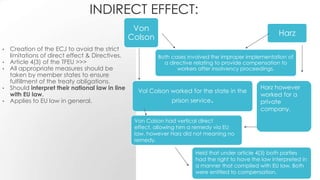

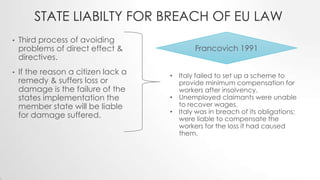




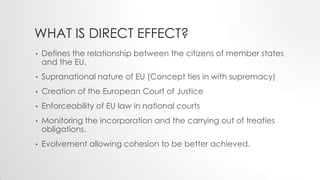
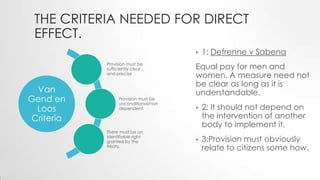
1) Direct effect allows EU law to confer rights on individuals that can be enforced in national courts. This was established in the 1963 case Van Gend en Loos, where the ECJ found that article 30 of the Treaty of Rome had direct effect. 2) For a provision to have direct effect, it must be clear and unconditional, conferring identifiable rights. Directives only have vertical direct effect against member states, while regulations can have both vertical and horizontal direct effect. 3) Indirect effect means that national law must be interpreted in line with EU law. This allows individuals to rely on unimplemented directives in national courts through purposive interpretation. 4) Member states can be liable to compensate individuals


![[NALL OCR] HALL, Basil (1824). Extracts from a journal written on the coasts ...](https://cdn.slidesharecdn.com/ss_thumbnails/nallocrhallbasil1824-260202221936-b93ec330-thumbnail.jpg?width=640&height=640&fit=bounds)


