AsliMAMMADOV
A
AssocProf.SuhalSEMSIT
EU Environmental Policy
CONTENTS
1. INTRODUCTION TO THE EUROPEAN COMISSION
2. EUROPEAN COMISSION OVERALL TARGETS
3. EU ENVIRONMENTAL PRIORITIES: ENERGY AND CLIMATE CHANGE
4. POLLUTION: WASTE MANAGEMENT
5. GREEN ECONOMY
6. RESEARCH AND INNOVATIONS
7. EU’S CONTRIBUTION TO INTERNATIONAL GOALS
8. CONCLUSION
STRATEGIES
ROLESAND PRINCIPLES
EUROPEAN COMISSION
1.
The European Commission is the EU's executive body.
It represents the interests of the European Union as a whole.
The Commission's main roles are to:
• Propose legislation which is then adopted by the co-legislators, the European
Parliament and the Council of Ministers,
• Enforce European law where necessary with the help of the Court of Justice of the EU,
• Set objectives and priorities for action, outlined yearly in the Commission Work
Programme and work towards delivering them,
• Manage and implement EU policies and the budget,
• Represent the Union outside Europe.
The European Commission has its headquarters in Brussels, Belgium, and some services
also in Luxembourg.
The Commission has Representations in all EU Member States and 139 Delegations
across the globe.
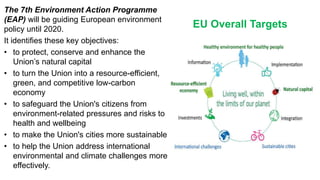
EU Overall Targets
The 7th Environment Action Programme
(EAP) will be guiding European environment
policy until 2020.
It identifies these key objectives:
• to protect, conserve and enhance the
Union’s natural capital
• to turn the Union into a resource-efficient,
green, and competitive low-carbon
economy
• to safeguard the Union's citizens from
environment-related pressures and risks to
health and wellbeing
• to make the Union's cities more sustainable
• to help the Union address international
environmental and climate challenges more
effectively.
EU Environmental
Priorities
1.Preserving, protecting and improving the quality of
the environment
2.Protecting human health
3.Prudent and rational utilization of resources
4.Promoting measures at the international level
5.Improvement of the quality of life
6.Increased environmental efficiency
ENERGY
• The European Commission launched in February
2015 a new strategy for a resilient Energy Union
with a forward-looking climate change policy.
• The goal of the Energy Union is to give EU
consumers - households and businesses - secure,
sustainable, competitive and affordable energy.
Achieving this goal will require a fundamental
transformation of Europe's energy system.
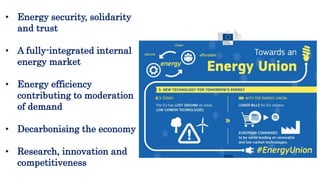
• Energy security, solidarity
and trust
• A fully-integrated internal
energy market
• Energy efficiency
contributing to moderation
of demand
• Decarbonising the economy
• Research, innovation and
competitiveness
• One of the priorities of the Energy Union strategy is to increase energy efficiency
in an attempt to reduce energy consumption by 32.5 % by 2030.
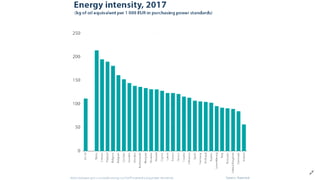
• Energy intensity is a measure of an economy’s energy efficiency and shows how
much energy is needed in order to produce a unit of gross domestic product (GDP).
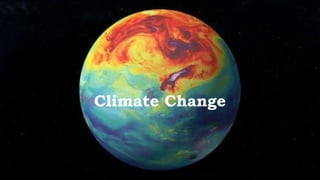
Climate Change
Causes of Climate Change
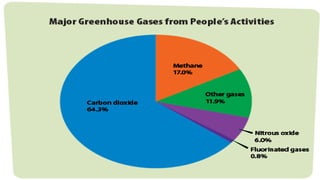
• Humans are increasingly influencing the climate and the earth's
temperature by burning fossil fuels, cutting down rainforests
and farming livestock.
• This adds enormous amounts of greenhouse gases to those
naturally occurring in the atmosphere, increasing the
greenhouse effect and global warming.
Consequences of Climate Change
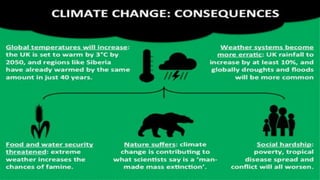
• Climate change affects all regions around the world. Polar
ice shields are melting and the sea is rising. In some
regions extreme weather events and rainfall are becoming
more common while others are experiencing more
extreme heat waves and droughts.
• These impacts are expected to intensify in the coming
decades.
Consequences for Europe
• Southern and central Europe are seeing more frequent
heat waves, forest fires and droughts.
• The Mediterranean area is becoming drier, making it
even more vulnerable to drought and wildfires.
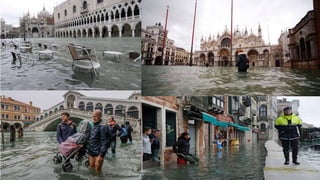
• Northern Europe is getting significantly wetter, and
winter floods could become common.
• Urban areas, where 4 out of 5 Europeans now live, are
exposed to heat waves, flooding or rising sea levels, but
are often ill-equipped for adapting to climate change.
Key EU Legislation and Policies in Climate
Action
• National targets for sectors outside emissions
• Ensuring our forests and land contribute to the fight against
climate change
• Reducing greenhouse gas emissions from transport
• Boosting energy efficiency, renewable energy
• Promoting innovative low-carbon technologies
• Protecting the ozone layer
• Adapting to the impacts of climate change
• Funding climate action
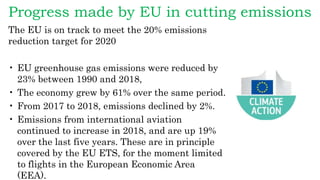
Progress made by EU in cutting emissions
The EU is on track to meet the 20% emissions
reduction target for 2020
• EU greenhouse gas emissions were reduced by
23% between 1990 and 2018,
• The economy grew by 61% over the same period.
• From 2017 to 2018, emissions declined by 2%.
• Emissions from international aviation
continued to increase in 2018, and are up 19%
over the last five years. These are in principle
covered by the EU ETS, for the moment limited
to flights in the European Economic Area
(EEA).
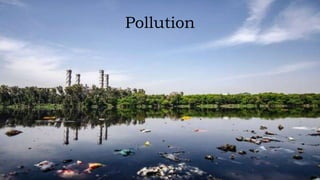
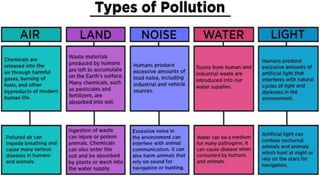
Pollution
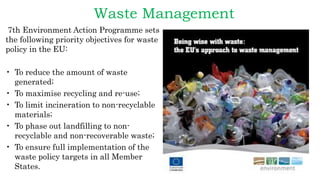
Waste Management
7th Environment Action Programme sets
the following priority objectives for waste
policy in the EU:
• To reduce the amount of waste
generated;
• To maximise recycling and re-use;
• To limit incineration to non-recyclable
materials;
• To phase out landfilling to non-
recyclable and non-recoverable waste;
• To ensure full implementation of the
waste policy targets in all Member
States.
Reuse and recycle!
• Recycling saves energy and emissions.
Recycling one aluminium can saves 90% of the
energy needed to produce a new one.
Recycling 1 kg of paper instead of landfilling
it avoids almost 1 kg of CO2 emissions, as
well as methane emissions.
• Compost. Your organic waste – such as fruit
and vegetables, eggshells or coffee grounds –
is much better off in a compost heap at home
than in a landfill site. In a compost heap,
exposed to air, the waste decomposes and will
become a natural fertiliser. In a landfill,
without air, it ferments and then emits
methane, a powerful greenhouse gas.
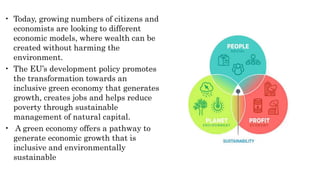
• Today, growing numbers of citizens and
economists are looking to different
economic models, where wealth can be
created without harming the
environment.
• The EU’s development policy promotes
the transformation towards an
inclusive green economy that generates
growth, creates jobs and helps reduce
poverty through sustainable
management of natural capital.
• A green economy offers a pathway to
generate economic growth that is
inclusive and environmentally
sustainable
Environmental research, knowledge and
innovation
• The current EU Research and Innovation programme - Horizon 2020
• To strengthen the links between science and policy, the European Commission's
Directorate-General Environment launched "Science for Environment Policy"
• The main EU services involved in environmental knowledge have created an
informal platform in 2015 – the Environment Knowledge Community
• The European Environment Agency provides sound, independent information on
the environment
• The EU funding programme devoted to environment, LIFE, was set up in 1992 to
improve the quality of the environment.
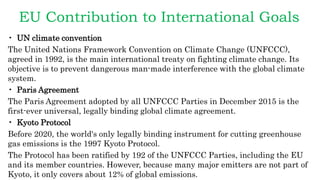
EU Contribution to International Goals
• UN climate convention
The United Nations Framework Convention on Climate Change (UNFCCC),
agreed in 1992, is the main international treaty on fighting climate change. Its
objective is to prevent dangerous man-made interference with the global climate
system.
• Paris Agreement
The Paris Agreement adopted by all UNFCCC Parties in December 2015 is the
first-ever universal, legally binding global climate agreement.
• Kyoto Protocol
Before 2020, the world's only legally binding instrument for cutting greenhouse
gas emissions is the 1997 Kyoto Protocol.
The Protocol has been ratified by 192 of the UNFCCC Parties, including the EU
and its member countries. However, because many major emitters are not part of
Kyoto, it only covers about 12% of global emissions.
Other International Fora:
• Intergovernmental Panel on Climate Change (IPCC)
• G8 and G20
• Major Economies Forum on Energy and Climate (MEF)
• Organisation for Economic Cooperation and Development (OECD)
• International Energy Agency (IEA).
Conclusion
EU citizens benefit from some of the highest environmental standards
in the world. The EU and national governments have set clear
objectives to guide European environment policy until 2020 and a
vision beyond that, of where to be by 2050, with the support of
dedicated research programmes, legislation and funding:
• protect, conserve and enhance the EU’s natural capital
• turn the EU into a resource-efficient, green, and competitive low-
carbon economy
• safeguard EU citizens from environment-related pressures and
risks to health and wellbeing

EU Environmental Policy

  • 1.
  • 2.
    CONTENTS 1. INTRODUCTION TOTHE EUROPEAN COMISSION 2. EUROPEAN COMISSION OVERALL TARGETS 3. EU ENVIRONMENTAL PRIORITIES: ENERGY AND CLIMATE CHANGE 4. POLLUTION: WASTE MANAGEMENT 5. GREEN ECONOMY 6. RESEARCH AND INNOVATIONS 7. EU’S CONTRIBUTION TO INTERNATIONAL GOALS 8. CONCLUSION
  • 3.
  • 4.
    The European Commissionis the EU's executive body. It represents the interests of the European Union as a whole. The Commission's main roles are to: • Propose legislation which is then adopted by the co-legislators, the European Parliament and the Council of Ministers, • Enforce European law where necessary with the help of the Court of Justice of the EU, • Set objectives and priorities for action, outlined yearly in the Commission Work Programme and work towards delivering them, • Manage and implement EU policies and the budget, • Represent the Union outside Europe. The European Commission has its headquarters in Brussels, Belgium, and some services also in Luxembourg. The Commission has Representations in all EU Member States and 139 Delegations across the globe.
  • 6.
    EU Overall Targets The7th Environment Action Programme (EAP) will be guiding European environment policy until 2020. It identifies these key objectives: • to protect, conserve and enhance the Union’s natural capital • to turn the Union into a resource-efficient, green, and competitive low-carbon economy • to safeguard the Union's citizens from environment-related pressures and risks to health and wellbeing • to make the Union's cities more sustainable • to help the Union address international environmental and climate challenges more effectively.
  • 7.
    EU Environmental Priorities 1.Preserving, protectingand improving the quality of the environment 2.Protecting human health 3.Prudent and rational utilization of resources 4.Promoting measures at the international level 5.Improvement of the quality of life 6.Increased environmental efficiency
  • 8.
  • 9.
    • The EuropeanCommission launched in February 2015 a new strategy for a resilient Energy Union with a forward-looking climate change policy. • The goal of the Energy Union is to give EU consumers - households and businesses - secure, sustainable, competitive and affordable energy. Achieving this goal will require a fundamental transformation of Europe's energy system.
  • 10.
    • Energy security,solidarity and trust • A fully-integrated internal energy market • Energy efficiency contributing to moderation of demand • Decarbonising the economy • Research, innovation and competitiveness
  • 13.
    • One ofthe priorities of the Energy Union strategy is to increase energy efficiency in an attempt to reduce energy consumption by 32.5 % by 2030. • Energy intensity is a measure of an economy’s energy efficiency and shows how much energy is needed in order to produce a unit of gross domestic product (GDP).
  • 14.
  • 15.
    Causes of ClimateChange • Humans are increasingly influencing the climate and the earth's temperature by burning fossil fuels, cutting down rainforests and farming livestock. • This adds enormous amounts of greenhouse gases to those naturally occurring in the atmosphere, increasing the greenhouse effect and global warming.
  • 17.
    Consequences of ClimateChange • Climate change affects all regions around the world. Polar ice shields are melting and the sea is rising. In some regions extreme weather events and rainfall are becoming more common while others are experiencing more extreme heat waves and droughts. • These impacts are expected to intensify in the coming decades.
  • 19.
    Consequences for Europe •Southern and central Europe are seeing more frequent heat waves, forest fires and droughts. • The Mediterranean area is becoming drier, making it even more vulnerable to drought and wildfires. • Northern Europe is getting significantly wetter, and winter floods could become common. • Urban areas, where 4 out of 5 Europeans now live, are exposed to heat waves, flooding or rising sea levels, but are often ill-equipped for adapting to climate change.
  • 23.
    Key EU Legislationand Policies in Climate Action • National targets for sectors outside emissions • Ensuring our forests and land contribute to the fight against climate change • Reducing greenhouse gas emissions from transport • Boosting energy efficiency, renewable energy • Promoting innovative low-carbon technologies • Protecting the ozone layer • Adapting to the impacts of climate change • Funding climate action
  • 24.
    Progress made byEU in cutting emissions The EU is on track to meet the 20% emissions reduction target for 2020 • EU greenhouse gas emissions were reduced by 23% between 1990 and 2018, • The economy grew by 61% over the same period. • From 2017 to 2018, emissions declined by 2%. • Emissions from international aviation continued to increase in 2018, and are up 19% over the last five years. These are in principle covered by the EU ETS, for the moment limited to flights in the European Economic Area (EEA).
  • 25.
  • 27.
    Waste Management 7th EnvironmentAction Programme sets the following priority objectives for waste policy in the EU: • To reduce the amount of waste generated; • To maximise recycling and re-use; • To limit incineration to non-recyclable materials; • To phase out landfilling to non- recyclable and non-recoverable waste; • To ensure full implementation of the waste policy targets in all Member States.
  • 28.
    Reuse and recycle! •Recycling saves energy and emissions. Recycling one aluminium can saves 90% of the energy needed to produce a new one. Recycling 1 kg of paper instead of landfilling it avoids almost 1 kg of CO2 emissions, as well as methane emissions. • Compost. Your organic waste – such as fruit and vegetables, eggshells or coffee grounds – is much better off in a compost heap at home than in a landfill site. In a compost heap, exposed to air, the waste decomposes and will become a natural fertiliser. In a landfill, without air, it ferments and then emits methane, a powerful greenhouse gas.
  • 30.
    • Today, growingnumbers of citizens and economists are looking to different economic models, where wealth can be created without harming the environment. • The EU’s development policy promotes the transformation towards an inclusive green economy that generates growth, creates jobs and helps reduce poverty through sustainable management of natural capital. • A green economy offers a pathway to generate economic growth that is inclusive and environmentally sustainable
  • 31.
    Environmental research, knowledgeand innovation • The current EU Research and Innovation programme - Horizon 2020 • To strengthen the links between science and policy, the European Commission's Directorate-General Environment launched "Science for Environment Policy" • The main EU services involved in environmental knowledge have created an informal platform in 2015 – the Environment Knowledge Community • The European Environment Agency provides sound, independent information on the environment • The EU funding programme devoted to environment, LIFE, was set up in 1992 to improve the quality of the environment.
  • 33.
    EU Contribution toInternational Goals • UN climate convention The United Nations Framework Convention on Climate Change (UNFCCC), agreed in 1992, is the main international treaty on fighting climate change. Its objective is to prevent dangerous man-made interference with the global climate system. • Paris Agreement The Paris Agreement adopted by all UNFCCC Parties in December 2015 is the first-ever universal, legally binding global climate agreement. • Kyoto Protocol Before 2020, the world's only legally binding instrument for cutting greenhouse gas emissions is the 1997 Kyoto Protocol. The Protocol has been ratified by 192 of the UNFCCC Parties, including the EU and its member countries. However, because many major emitters are not part of Kyoto, it only covers about 12% of global emissions.
  • 34.
    Other International Fora: •Intergovernmental Panel on Climate Change (IPCC) • G8 and G20 • Major Economies Forum on Energy and Climate (MEF) • Organisation for Economic Cooperation and Development (OECD) • International Energy Agency (IEA).
  • 35.
    Conclusion EU citizens benefitfrom some of the highest environmental standards in the world. The EU and national governments have set clear objectives to guide European environment policy until 2020 and a vision beyond that, of where to be by 2050, with the support of dedicated research programmes, legislation and funding: • protect, conserve and enhance the EU’s natural capital • turn the EU into a resource-efficient, green, and competitive low- carbon economy • safeguard EU citizens from environment-related pressures and risks to health and wellbeing