

Multilateral Seminar
Dubrovnik, 24-26 Oct. 2013

www.etwinning.net

How to define
a good eTwinning project
Massimiliano D’Innocenzo
NSS eTwinning Italia
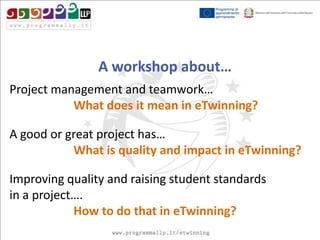
A workshop about…
Project management and teamwork…
What does it mean in eTwinning?
A good or great project has…
What is quality and impact in eTwinning?
Improving quality and raising student standards
in a project….
How to do that in eTwinning?
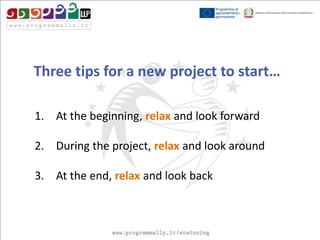
Three tips for a new project to start…
1. At the beginning, relax and look forward
2. During the project, relax and look around

3. At the end, relax and look back
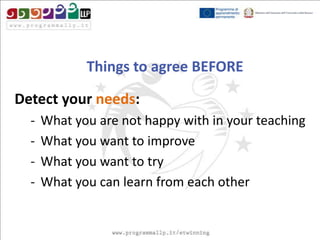
Things to agree BEFORE
Detect your needs:
-

What you are not happy with in your teaching
What you want to improve
What you want to try
What you can learn from each other
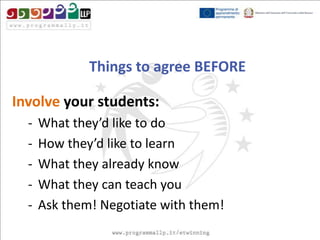
Things to agree BEFORE
Involve your students:
-

What they’d like to do
How they’d like to learn
What they already know
What they can teach you
Ask them! Negotiate with them!
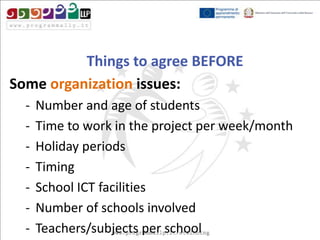
Things to agree BEFORE
Some organization issues:
-

Number and age of students
Time to work in the project per week/month
Holiday periods
Timing
School ICT facilities
Number of schools involved
Teachers/subjects per school
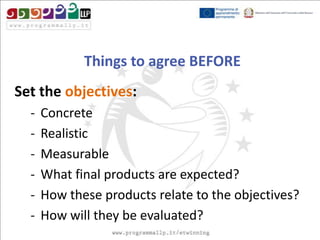
Things to agree BEFORE
Set the objectives:
-

Concrete
Realistic
Measurable
What final products are expected?
How these products relate to the objectives?
How will they be evaluated?
Things to agree BEFORE
Done?
Now, try to point out
the strengths and weaknesses of your plan…

and Revise!
Aim at quality!
A quality project doesn’t have to be
spectacular,
difficult,
complex,
long,
or sophisticated.

A quality project just has to be EFFICIENT
Ask your NSS for quality criteria before starting
BEFORE – keyword

Planning
Things to do DURING
Think on the activities:
-

Are they motivating?
Are they relevant?
Do they require collaboration?
Do NOT choose the tools first. Think upside
down!
Things to do DURING
Monitoring:
-

Use the Project Cards
Evaluate
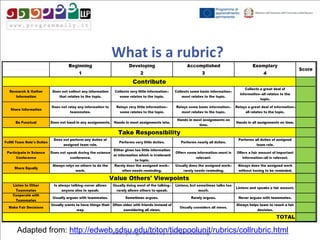
How will you evaluate? Use rubrics
Reflect, rethink, revise
What is a rubric?

Adapted from: http://edweb.sdsu.edu/triton/tidepoolunit/rubrics/collrubric.html
DURING – keyword

Collaborate
Things to make you think AFTER

Evaluate the project (remember the rubrics?):
- Ask students and teachers
- Check objectives and results
- What would you change in further projects?
Things to make you think AFTER
Reorganize material:
- Can a third person follow the development of the
project?
- Is the TwinSpace clear?
- Is there enough documentation?
- What should be public and what should be kept
private?
Things to make you think AFTER
Are you satisfied?
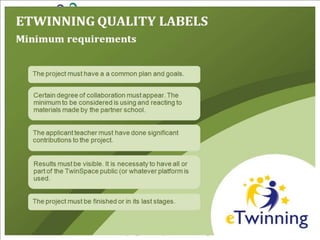
Then, why don’t you go for a Quality Label?
- Ask your NSS
- Create a “visitor” for evaluators
- QL application is only a guide for evaluators: if you have more
documentation, add it in the TwinSpace
- Put yourself in the place of an evaluator: is everything clear?
AFTER – keywords

Reflect
& Share
One most important tip

Have fun!
Thanks for your attention
Massimiliano D’Innocenzo, eTwinning NSS Italy m.dinnocenzo@indire.it

A special thank to Diego Rojas, former eTwinning NSS Spain

eTwinning project management

  • 1.
    Multilateral Seminar Dubrovnik, 24-26Oct. 2013 www.etwinning.net How to define a good eTwinning project Massimiliano D’Innocenzo NSS eTwinning Italia
  • 2.
    A workshop about… Projectmanagement and teamwork… What does it mean in eTwinning? A good or great project has… What is quality and impact in eTwinning? Improving quality and raising student standards in a project…. How to do that in eTwinning?
  • 3.
    Three tips fora new project to start… 1. At the beginning, relax and look forward 2. During the project, relax and look around 3. At the end, relax and look back
  • 4.
    Things to agreeBEFORE Detect your needs: - What you are not happy with in your teaching What you want to improve What you want to try What you can learn from each other
  • 5.
    Things to agreeBEFORE Involve your students: - What they’d like to do How they’d like to learn What they already know What they can teach you Ask them! Negotiate with them!
  • 6.
    Things to agreeBEFORE Some organization issues: - Number and age of students Time to work in the project per week/month Holiday periods Timing School ICT facilities Number of schools involved Teachers/subjects per school
  • 7.
    Things to agreeBEFORE Set the objectives: - Concrete Realistic Measurable What final products are expected? How these products relate to the objectives? How will they be evaluated?
  • 8.
    Things to agreeBEFORE Done? Now, try to point out the strengths and weaknesses of your plan… and Revise!
  • 9.
    Aim at quality! Aquality project doesn’t have to be spectacular, difficult, complex, long, or sophisticated. A quality project just has to be EFFICIENT Ask your NSS for quality criteria before starting
  • 10.
  • 11.
    Things to doDURING Think on the activities: - Are they motivating? Are they relevant? Do they require collaboration? Do NOT choose the tools first. Think upside down!
  • 12.
    Things to doDURING Monitoring: - Use the Project Cards Evaluate How will you evaluate? Use rubrics Reflect, rethink, revise
  • 13.
    What is arubric? Adapted from: http://edweb.sdsu.edu/triton/tidepoolunit/rubrics/collrubric.html
  • 14.
  • 15.
    Things to makeyou think AFTER Evaluate the project (remember the rubrics?): - Ask students and teachers - Check objectives and results - What would you change in further projects?
  • 16.
    Things to makeyou think AFTER Reorganize material: - Can a third person follow the development of the project? - Is the TwinSpace clear? - Is there enough documentation? - What should be public and what should be kept private?
  • 17.
    Things to makeyou think AFTER Are you satisfied? Then, why don’t you go for a Quality Label? - Ask your NSS - Create a “visitor” for evaluators - QL application is only a guide for evaluators: if you have more documentation, add it in the TwinSpace - Put yourself in the place of an evaluator: is everything clear?
  • 18.
  • 26.
    One most importanttip Have fun!
  • 27.
    Thanks for yourattention Massimiliano D’Innocenzo, eTwinning NSS Italy m.dinnocenzo@indire.it A special thank to Diego Rojas, former eTwinning NSS Spain