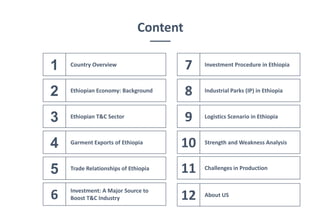
Country Overview
Ethiopian Economy: Background
Ethiopian T&C Sector
Garment Exports of Ethiopia
Investment Procedure in Ethiopia
Industrial Parks (IP) in Ethiopia
Logistics Scenario in Ethiopia
1
2
3
4
7
8
9
Trade Relationships of Ethiopia
5
Strength and Weakness Analysis10
Content
Challenges in Production11
Investment: A Major Source to
Boost T&C Industry6 About US12
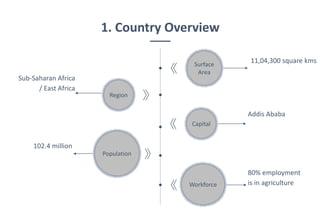
1. Country Overview
Region
Population
102.4 million
Surface
Area
Capital
Addis Ababa
Workforce
80% employment
is in agriculture
Sub-Saharan Africa
/ East Africa
11,04,300 square kms
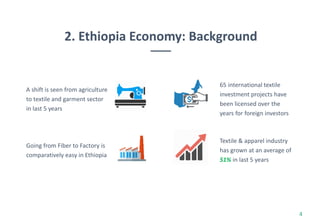
2. Ethiopia Economy: Background
4
A shift is seen from agriculture
to textile and garment sector
in last 5 years
Going from Fiber to Factory is
comparatively easy in Ethiopia
65 international textile
investment projects have
been licensed over the
years for foreign investors
Textile & apparel industry
has grown at an average of
51% in last 5 years
3. Ethiopian T&C Sector
5
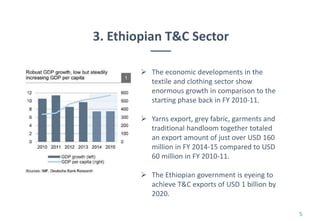
 The economic developments in the
textile and clothing sector show
enormous growth in comparison to the
starting phase back in FY 2010-11.
 Yarns export, grey fabric, garments and
traditional handloom together totaled
an export amount of just over USD 160
million in FY 2014-15 compared to USD
60 million in FY 2010-11.
 The Ethiopian government is eyeing to
achieve T&C exports of USD 1 billion by
2020.
6
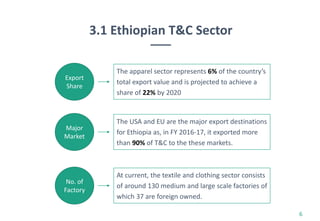
The apparel sector represents 6% of the country’s
total export value and is projected to achieve a
share of 22% by 2020
Export
Share
3.1 Ethiopian T&C Sector
The USA and EU are the major export destinations
for Ethiopia as, in FY 2016-17, it exported more
than 90% of T&C to the these markets.
Major
Market
At current, the textile and clothing sector consists
of around 130 medium and large scale factories of
which 37 are foreign owned.
No. of
Factory
4. Garment Exports of Ethiopia
7
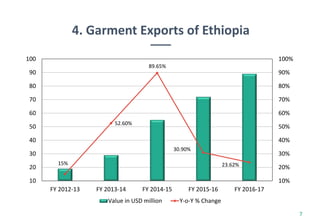
15%
52.60%
89.65%
30.90%
23.62%
10%
20%
30%
40%
50%
60%
70%
80%
90%
100%
10
20
30
40
50
60
70
80
90
100
FY 2012-13 FY 2013-14 FY 2014-15 FY 2015-16 FY 2016-17
Value in USD million Y-o-Y % Change
8
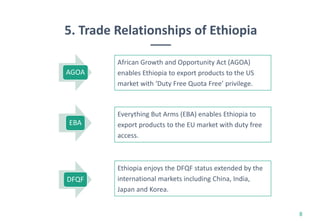
African Growth and Opportunity Act (AGOA)
enables Ethiopia to export products to the US
market with ‘Duty Free Quota Free’ privilege.
AGOA
5. Trade Relationships of Ethiopia
Everything But Arms (EBA) enables Ethiopia to
export products to the EU market with duty free
access.
EBA
Ethiopia enjoys the DFQF status extended by the
international markets including China, India,
Japan and Korea.
DFQF
6. Investment: A Major Source to Boost T&C
Industry
9
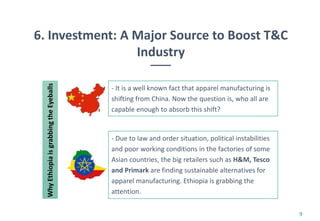
- It is a well known fact that apparel manufacturing is
shifting from China. Now the question is, who all are
capable enough to absorb this shift?
- Due to law and order situation, political instabilities
and poor working conditions in the factories of some
Asian countries, the big retailers such as H&M, Tesco
and Primark are finding sustainable alternatives for
apparel manufacturing. Ethiopia is grabbing the
attention.
WhyEthiopiaisgrabbingtheEyeballs
6.1 Investment: A Major Source to Boost T&C
Industry
10
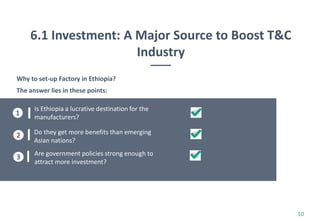
Is Ethiopia a lucrative destination for the
manufacturers?
1
Do they get more benefits than emerging
Asian nations?
2
Are government policies strong enough to
attract more investment?
3
Why to set-up Factory in Ethiopia?
The answer lies in these points:
6.2 Investment: A Major Source to Boost T&C
Industry
11
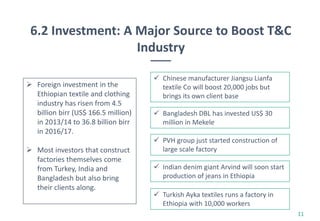
 Foreign investment in the
Ethiopian textile and clothing
industry has risen from 4.5
billion birr (US$ 166.5 million)
in 2013/14 to 36.8 billion birr
in 2016/17.
 Most investors that construct
factories themselves come
from Turkey, India and
Bangladesh but also bring
their clients along.
 Chinese manufacturer Jiangsu Lianfa
textile Co will boost 20,000 jobs but
brings its own client base
 Bangladesh DBL has invested US$ 30
million in Mekele
 PVH group just started construction of
large scale factory
 Indian denim giant Arvind will soon start
production of jeans in Ethiopia
 Turkish Ayka textiles runs a factory in
Ethiopia with 10,000 workers
7. Investment Procedure in Ethiopia
12
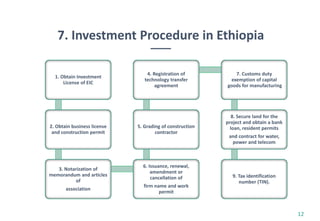
1. Obtain Investment
License of EIC
2. Obtain business license
and construction permit
3. Notarization of
memorandum and articles
of
association
6. Issuance, renewal,
amendment or
cancellation of
firm name and work
permit
5. Grading of construction
contractor
4. Registration of
technology transfer
agreement
7. Customs duty
exemption of capital
goods for manufacturing
8. Secure land for the
project and obtain a bank
loan, resident permits
and contract for water,
power and telecom
9. Tax identification
number (TIN).
8. Industrial Parks (IP) in Ethiopia
13
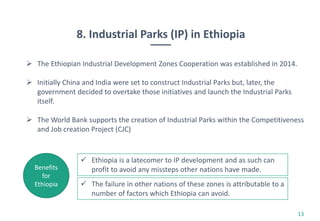
 The Ethiopian Industrial Development Zones Cooperation was established in 2014.
 Initially China and India were set to construct Industrial Parks but, later, the
government decided to overtake those initiatives and launch the Industrial Parks
itself.
 The World Bank supports the creation of Industrial Parks within the Competitiveness
and Job creation Project (CJC)
 Ethiopia is a latecomer to IP development and as such can
profit to avoid any missteps other nations have made.Benefits
for
Ethiopia  The failure in other nations of these zones is attributable to a
number of factors which Ethiopia can avoid.
8.1 Industrial Parks in Ethiopia
14
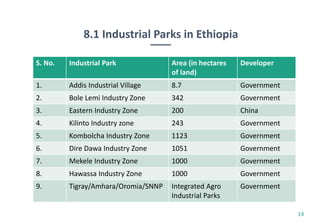
S. No. Industrial Park Area (in hectares
of land)
Developer
1. Addis Industrial Village 8.7 Government
2. Bole Lemi Industry Zone 342 Government
3. Eastern Industry Zone 200 China
4. Kilinto Industry zone 243 Government
5. Kombolcha Industry Zone 1123 Government
6. Dire Dawa Industry Zone 1051 Government
7. Mekele Industry Zone 1000 Government
8. Hawassa Industry Zone 1000 Government
9. Tigray/Amhara/Oromia/SNNP Integrated Agro
Industrial Parks
Government
9. Logistics Scenario in Ethiopia
15
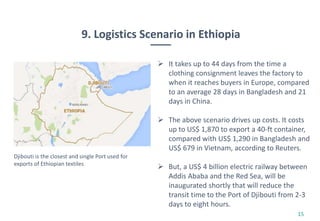
 It takes up to 44 days from the time a
clothing consignment leaves the factory to
when it reaches buyers in Europe, compared
to an average 28 days in Bangladesh and 21
days in China.
 The above scenario drives up costs. It costs
up to US$ 1,870 to export a 40-ft container,
compared with US$ 1,290 in Bangladesh and
US$ 679 in Vietnam, according to Reuters.
 But, a US$ 4 billion electric railway between
Addis Ababa and the Red Sea, will be
inaugurated shortly that will reduce the
transit time to the Port of Djibouti from 2-3
days to eight hours.
Djibouti is the closest and single Port used for
exports of Ethiopian textiles
10. Strength and Weakness Analysis
16
Strengths
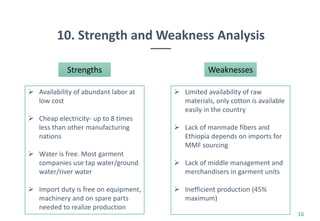
 Availability of abundant labor at
low cost
 Cheap electricity- up to 8 times
less than other manufacturing
nations
 Water is free. Most garment
companies use tap water/ground
water/river water
 Import duty is free on equipment,
machinery and on spare parts
needed to realize production
Weaknesses
 Limited availability of raw
materials, only cotton is available
easily in the country
 Lack of manmade fibers and
Ethiopia depends on imports for
MMF sourcing
 Lack of middle management and
merchandisers in garment units
 Inefficient production (45%
maximum)
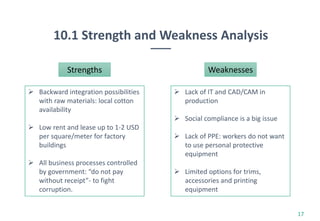
10.1 Strength and Weakness Analysis
17
Strengths
 Backward integration possibilities
with raw materials: local cotton
availability
 Low rent and lease up to 1-2 USD
per square/meter for factory
buildings
 All business processes controlled
by government: “do not pay
without receipt”- to fight
corruption.
Weaknesses
 Lack of IT and CAD/CAM in
production
 Social compliance is a big issue
 Lack of PPE: workers do not want
to use personal protective
equipment
 Limited options for trims,
accessories and printing
equipment
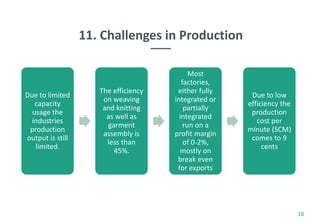
11. Challenges in Production
18
Due to limited
capacity
usage the
industries
production
output is still
limited.
The efficiency
on weaving
and knitting
as well as
garment
assembly is
less than
45%.
Most
factories,
either fully
integrated or
partially
integrated
run on a
profit margin
of 0-2%,
mostly on
break even
for exports
Due to low
efficiency the
production
cost per
minute (SCM)
comes to 9
cents
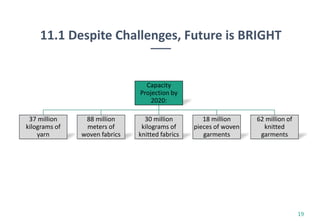
11.1 Despite Challenges, Future is BRIGHT
19
Capacity
Projection by
2020:
37 million
kilograms of
yarn
88 million
meters of
woven fabrics
30 million
kilograms of
knitted fabrics
18 million
pieces of woven
garments
62 million of
knitted
garments
11.2 Because of the Government Initiatives
20
 Ethiopia has over 30 bilateral investment promotion and protection
agreements
 Ethiopian government invests largely in infrastructure
 Ethiopian government has installed a scheme of incentives for business
financing and trading terms: opening an LC regularly would cost a company 3%
during the production lead-time in Ethiopia
 Ethiopian government has reduced the cost of freight and transport with 25%
and is about to launch its own transportation company providing trucks that
run to Djibouti port.
STAY CONNECTED FOR MORE PRESENTATIONS!
THANK YOU
https://apparelresources.com/
Delivering Transparent Apparel and Textile News for the Last 25 Years.
Apparel Resources brings the two worlds of Buyers and Sellers in the Apparel and Textile
industry together on a single platform through its vast pool of contemporary, insightful
and compelling information. Though the portal tracks in real-time the news that matters,
its each and every article is an analysis of apparel, textile and fashion industry written
and vetted by industry experts who have rich experience and deep understanding of the
local as well as the export markets.
Our Publications:
Our print verticals are among the most read magazines in their respective domains. Our
successful magazines include:
• Apparel Online India
• Apparel Online Bangladesh
• Apparel Online Vietnam
• StitchWorld
Why Apparel Resources?
Need relevant, in-depth information on the latest happenings and developments in
the apparel, textile and fashion industry? You have landed at the right place!
 Highlighting the best companies to source from
 Delivering real-time industry news that matters
 Covering all the industry events for innovation in products
 Foretelling the trending apparel products
 Tracking emerging markets
 Tracking retailers & brands for their growth strategies
 Forecasting fashion through street fashion and fashion weeks
 Monitoring Trade data and projections
 Discovering technology to improve quality and productivity
 Interviewing companies for their best manufacturing practices

Ethiopia Garment Industry

  • 2.
    Country Overview Ethiopian Economy:Background Ethiopian T&C Sector Garment Exports of Ethiopia Investment Procedure in Ethiopia Industrial Parks (IP) in Ethiopia Logistics Scenario in Ethiopia 1 2 3 4 7 8 9 Trade Relationships of Ethiopia 5 Strength and Weakness Analysis10 Content Challenges in Production11 Investment: A Major Source to Boost T&C Industry6 About US12
  • 3.
    1. Country Overview Region Population 102.4million Surface Area Capital Addis Ababa Workforce 80% employment is in agriculture Sub-Saharan Africa / East Africa 11,04,300 square kms
  • 4.
    2. Ethiopia Economy:Background 4 A shift is seen from agriculture to textile and garment sector in last 5 years Going from Fiber to Factory is comparatively easy in Ethiopia 65 international textile investment projects have been licensed over the years for foreign investors Textile & apparel industry has grown at an average of 51% in last 5 years
  • 5.
    3. Ethiopian T&CSector 5  The economic developments in the textile and clothing sector show enormous growth in comparison to the starting phase back in FY 2010-11.  Yarns export, grey fabric, garments and traditional handloom together totaled an export amount of just over USD 160 million in FY 2014-15 compared to USD 60 million in FY 2010-11.  The Ethiopian government is eyeing to achieve T&C exports of USD 1 billion by 2020.
  • 6.
    6 The apparel sectorrepresents 6% of the country’s total export value and is projected to achieve a share of 22% by 2020 Export Share 3.1 Ethiopian T&C Sector The USA and EU are the major export destinations for Ethiopia as, in FY 2016-17, it exported more than 90% of T&C to the these markets. Major Market At current, the textile and clothing sector consists of around 130 medium and large scale factories of which 37 are foreign owned. No. of Factory
  • 7.
    4. Garment Exportsof Ethiopia 7 15% 52.60% 89.65% 30.90% 23.62% 10% 20% 30% 40% 50% 60% 70% 80% 90% 100% 10 20 30 40 50 60 70 80 90 100 FY 2012-13 FY 2013-14 FY 2014-15 FY 2015-16 FY 2016-17 Value in USD million Y-o-Y % Change
  • 8.
    8 African Growth andOpportunity Act (AGOA) enables Ethiopia to export products to the US market with ‘Duty Free Quota Free’ privilege. AGOA 5. Trade Relationships of Ethiopia Everything But Arms (EBA) enables Ethiopia to export products to the EU market with duty free access. EBA Ethiopia enjoys the DFQF status extended by the international markets including China, India, Japan and Korea. DFQF
  • 9.
    6. Investment: AMajor Source to Boost T&C Industry 9 - It is a well known fact that apparel manufacturing is shifting from China. Now the question is, who all are capable enough to absorb this shift? - Due to law and order situation, political instabilities and poor working conditions in the factories of some Asian countries, the big retailers such as H&M, Tesco and Primark are finding sustainable alternatives for apparel manufacturing. Ethiopia is grabbing the attention. WhyEthiopiaisgrabbingtheEyeballs
  • 10.
    6.1 Investment: AMajor Source to Boost T&C Industry 10 Is Ethiopia a lucrative destination for the manufacturers? 1 Do they get more benefits than emerging Asian nations? 2 Are government policies strong enough to attract more investment? 3 Why to set-up Factory in Ethiopia? The answer lies in these points:
  • 11.
    6.2 Investment: AMajor Source to Boost T&C Industry 11  Foreign investment in the Ethiopian textile and clothing industry has risen from 4.5 billion birr (US$ 166.5 million) in 2013/14 to 36.8 billion birr in 2016/17.  Most investors that construct factories themselves come from Turkey, India and Bangladesh but also bring their clients along.  Chinese manufacturer Jiangsu Lianfa textile Co will boost 20,000 jobs but brings its own client base  Bangladesh DBL has invested US$ 30 million in Mekele  PVH group just started construction of large scale factory  Indian denim giant Arvind will soon start production of jeans in Ethiopia  Turkish Ayka textiles runs a factory in Ethiopia with 10,000 workers
  • 12.
    7. Investment Procedurein Ethiopia 12 1. Obtain Investment License of EIC 2. Obtain business license and construction permit 3. Notarization of memorandum and articles of association 6. Issuance, renewal, amendment or cancellation of firm name and work permit 5. Grading of construction contractor 4. Registration of technology transfer agreement 7. Customs duty exemption of capital goods for manufacturing 8. Secure land for the project and obtain a bank loan, resident permits and contract for water, power and telecom 9. Tax identification number (TIN).
  • 13.
    8. Industrial Parks(IP) in Ethiopia 13  The Ethiopian Industrial Development Zones Cooperation was established in 2014.  Initially China and India were set to construct Industrial Parks but, later, the government decided to overtake those initiatives and launch the Industrial Parks itself.  The World Bank supports the creation of Industrial Parks within the Competitiveness and Job creation Project (CJC)  Ethiopia is a latecomer to IP development and as such can profit to avoid any missteps other nations have made.Benefits for Ethiopia  The failure in other nations of these zones is attributable to a number of factors which Ethiopia can avoid.
  • 14.
    8.1 Industrial Parksin Ethiopia 14 S. No. Industrial Park Area (in hectares of land) Developer 1. Addis Industrial Village 8.7 Government 2. Bole Lemi Industry Zone 342 Government 3. Eastern Industry Zone 200 China 4. Kilinto Industry zone 243 Government 5. Kombolcha Industry Zone 1123 Government 6. Dire Dawa Industry Zone 1051 Government 7. Mekele Industry Zone 1000 Government 8. Hawassa Industry Zone 1000 Government 9. Tigray/Amhara/Oromia/SNNP Integrated Agro Industrial Parks Government
  • 15.
    9. Logistics Scenarioin Ethiopia 15  It takes up to 44 days from the time a clothing consignment leaves the factory to when it reaches buyers in Europe, compared to an average 28 days in Bangladesh and 21 days in China.  The above scenario drives up costs. It costs up to US$ 1,870 to export a 40-ft container, compared with US$ 1,290 in Bangladesh and US$ 679 in Vietnam, according to Reuters.  But, a US$ 4 billion electric railway between Addis Ababa and the Red Sea, will be inaugurated shortly that will reduce the transit time to the Port of Djibouti from 2-3 days to eight hours. Djibouti is the closest and single Port used for exports of Ethiopian textiles
  • 16.
    10. Strength andWeakness Analysis 16 Strengths  Availability of abundant labor at low cost  Cheap electricity- up to 8 times less than other manufacturing nations  Water is free. Most garment companies use tap water/ground water/river water  Import duty is free on equipment, machinery and on spare parts needed to realize production Weaknesses  Limited availability of raw materials, only cotton is available easily in the country  Lack of manmade fibers and Ethiopia depends on imports for MMF sourcing  Lack of middle management and merchandisers in garment units  Inefficient production (45% maximum)
  • 17.
    10.1 Strength andWeakness Analysis 17 Strengths  Backward integration possibilities with raw materials: local cotton availability  Low rent and lease up to 1-2 USD per square/meter for factory buildings  All business processes controlled by government: “do not pay without receipt”- to fight corruption. Weaknesses  Lack of IT and CAD/CAM in production  Social compliance is a big issue  Lack of PPE: workers do not want to use personal protective equipment  Limited options for trims, accessories and printing equipment
  • 18.
    11. Challenges inProduction 18 Due to limited capacity usage the industries production output is still limited. The efficiency on weaving and knitting as well as garment assembly is less than 45%. Most factories, either fully integrated or partially integrated run on a profit margin of 0-2%, mostly on break even for exports Due to low efficiency the production cost per minute (SCM) comes to 9 cents
  • 19.
    11.1 Despite Challenges,Future is BRIGHT 19 Capacity Projection by 2020: 37 million kilograms of yarn 88 million meters of woven fabrics 30 million kilograms of knitted fabrics 18 million pieces of woven garments 62 million of knitted garments
  • 20.
    11.2 Because ofthe Government Initiatives 20  Ethiopia has over 30 bilateral investment promotion and protection agreements  Ethiopian government invests largely in infrastructure  Ethiopian government has installed a scheme of incentives for business financing and trading terms: opening an LC regularly would cost a company 3% during the production lead-time in Ethiopia  Ethiopian government has reduced the cost of freight and transport with 25% and is about to launch its own transportation company providing trucks that run to Djibouti port.
  • 21.
    STAY CONNECTED FORMORE PRESENTATIONS! THANK YOU https://apparelresources.com/
  • 22.
    Delivering Transparent Appareland Textile News for the Last 25 Years. Apparel Resources brings the two worlds of Buyers and Sellers in the Apparel and Textile industry together on a single platform through its vast pool of contemporary, insightful and compelling information. Though the portal tracks in real-time the news that matters, its each and every article is an analysis of apparel, textile and fashion industry written and vetted by industry experts who have rich experience and deep understanding of the local as well as the export markets. Our Publications: Our print verticals are among the most read magazines in their respective domains. Our successful magazines include: • Apparel Online India • Apparel Online Bangladesh • Apparel Online Vietnam • StitchWorld
  • 23.
    Why Apparel Resources? Needrelevant, in-depth information on the latest happenings and developments in the apparel, textile and fashion industry? You have landed at the right place!  Highlighting the best companies to source from  Delivering real-time industry news that matters  Covering all the industry events for innovation in products  Foretelling the trending apparel products  Tracking emerging markets  Tracking retailers & brands for their growth strategies  Forecasting fashion through street fashion and fashion weeks  Monitoring Trade data and projections  Discovering technology to improve quality and productivity  Interviewing companies for their best manufacturing practices