Ethiopia
Geographical
  aspects
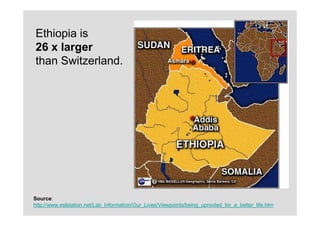
Ethiopia is
26 x larger
than Switzerland.


Source:
http://www.eslstation.net/Lab_Information/Our_Lives/Viewpoints/being_uprooted_for_a_better_life.htm
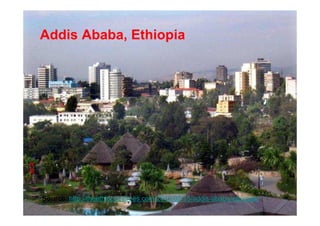
Addis Ababa, Ethiopia


Source: http://theethiopiantimes.com/2012/02/15/addis-ababa-ethiopia/
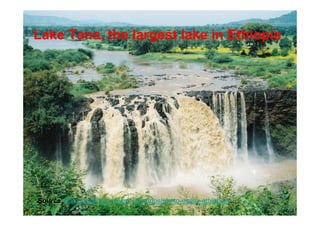
Lake Tana, the largest lake in Ethiopia


Source: http://matadornetwork.com/trips/photo-essay-ethiopia/
Regions in Ethiopia above 1,500 meters have
     temperate climate with temperatures between 16°C
     and 30°C and cool nights. They receive by far the
     most rainfall - most of it between mid-June and mid-
     September.

     The lowlands in Ethiopia below 1,500 meters have
     higher temperatures and receive much less rain.


Source: http://lcweb2.loc.gov/frd/cs/profiles/Ethiopia.pdf
In the last 50 years, Ethiopia lost
                   98% of its forests.


Source
http://lab.colorsmagazine.com/pdf/colors-for-good.pdf, p. 10.
Economic
 aspects
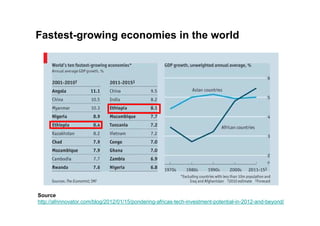
Fastest-growing economies in the world


Source
http://afrinnovator.com/blog/2012/01/15/pondering-africas-tech-investment-potential-in-2012-and-beyond/
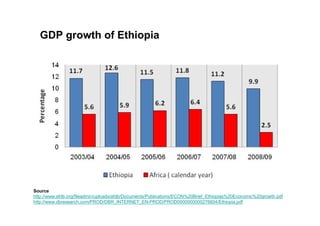
GDP growth of Ethiopia


Source
http://www.afdb.org/fileadmin/uploads/afdb/Documents/Publications/ECON%20Brief_Ethiopias%20Economic%20growth.pdf
http://www.dbresearch.com/PROD/DBR_INTERNET_EN-PROD/PROD0000000000276604/Ethiopia.pdf
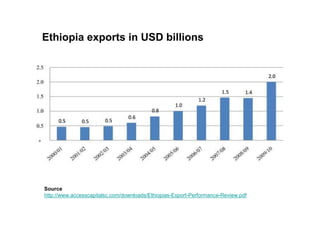
Ethiopia exports in USD billions


Source
http://www.accesscapitalsc.com/downloads/Ethiopias-Export-Performance-Review.pdf
Real GDP growth of Ethiopia is set to stay
          around 8% over the coming years.

          Key challenges are high dependency on
          rain-fed agriculture and limited private
          sector growth.


Source
http://www.dbresearch.com/PROD/DBR_INTERNET_EN-PROD/PROD0000000000276604/Ethiopia.pdf
Example: ACOS

       ACOS is an agricultural processing facility that is
       processing and shipping a variety of beans to
       European markets.

       ACOS is jointly owned by an Italian company and
       Ethiopian investors and is a great example of
       private investment in developing countries.

       Acos has been present in Ethiopia since 2005.

       The ACOS Ethiopia plant employs 350 people.

Source
http://www.thegatesnotes.com/Topics/Development/Ethiopia-Exciting-Innovations-in-Agriculture-and-Health
http://www.acosnet.it/
Coffee
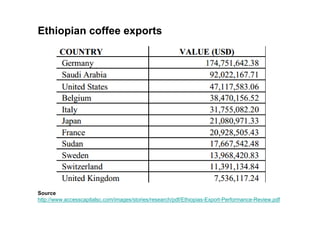
Ethiopian coffee exports


Source
http://www.accesscapitalsc.com/images/stories/research/pdf/Ethiopias-Export-Performance-Review.pdf
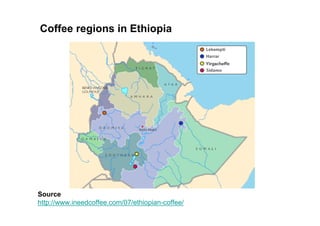
Coffee regions in Ethiopia


Source
http://www.ineedcoffee.com/07/ethiopian-coffee/
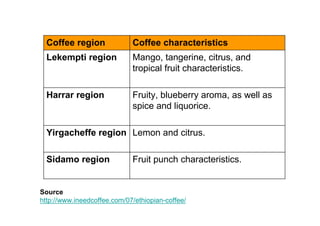
Coffee region              Coffee characteristics
  Lekempti region            Mango, tangerine, citrus, and
                             tropical fruit characteristics.

  Harrar region              Fruity, blueberry aroma, as well as
                             spice and liquorice.

  Yirgacheffe region Lemon and citrus.

  Sidamo region              Fruit punch characteristics.


Source
http://www.ineedcoffee.com/07/ethiopian-coffee/
Flowers
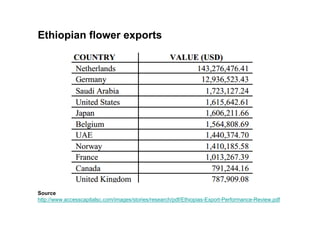
Ethiopian flower exports


Source
http://www.accesscapitalsc.com/images/stories/research/pdf/Ethiopias-Export-Performance-Review.pdf
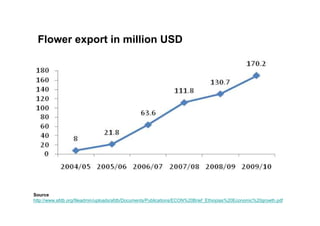
Flower export in million USD


Source
http://www.afdb.org/fileadmin/uploads/afdb/Documents/Publications/ECON%20Brief_Ethiopias%20Economic%20growth.pdf
About 70% of the total volume of
        Ethiopian rose exports is now sold to
        the Dutch Auction.


Source: http://www.et.emb-japan.go.jp/Eco_Research_E.pdf
Gold
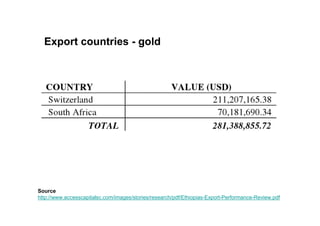
Export countries - gold


Source
http://www.accesscapitalsc.com/images/stories/research/pdf/Ethiopias-Export-Performance-Review.pdf
Energy
Ethiopia derives about 90% of its electricity
    needs from hydropower, which means that
    electricity generation, as with agriculture, is
    dependent on abundant rainfall.

    Less than 50% of Ethiopia’s towns and cities
    are connected to the national grid.


Source: http://lcweb2.loc.gov/frd/cs/profiles/Ethiopia.pdf
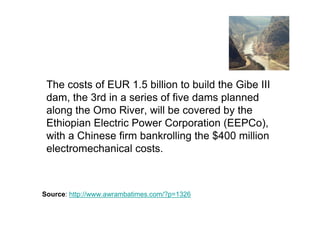
The costs of EUR 1.5 billion to build the Gibe III
 dam, the 3rd in a series of five dams planned
 along the Omo River, will be covered by the
 Ethiopian Electric Power Corporation (EEPCo),
 with a Chinese firm bankrolling the $400 million
 electromechanical costs.


Source: http://www.awrambatimes.com/?p=1326
Transportation
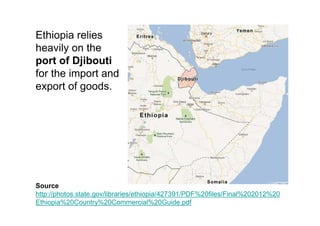
Ethiopia relies
heavily on the
port of Djibouti
for the import and
export of goods.


Source
http://photos.state.gov/libraries/ethiopia/427391/PDF%20files/Final%202012%20
Ethiopia%20Country%20Commercial%20Guide.pdf
In Ethiopia, almost all primary roads are
      gravel roads, including those that connect
      Addis Ababa with major cities and towns
      across the country.


Source: http://lcweb2.loc.gov/frd/cs/profiles/Ethiopia.pdf
Cut flowers and fresh fruits and vegetables
      are transported via air from Addis Ababa's
      Bole International Airport.


Source
http://photos.state.gov/libraries/ethiopia/427391/PDF%20files/Final%202012%20
Ethiopia%20Country%20Commercial%20Guide.pdf
Ethiopian Airlines is the fastest
             growing airline in Africa.


Source
http://www.ethiopianairlines.com/en/news/prarchive.aspx?id=312
Most distribution in Ethiopia, particularly to
      regional towns, is done through informal
      business arrangements.

      For example, after being cleared through
      customs, many goods will be sold to
      wholesalers in Addis Ababa's largest open
      market (Merkato) and then distributed to
      retailers and small vendors.

Source
http://photos.state.gov/libraries/ethiopia/427391/PDF%20files/Final%202012%20
Ethiopia%20Country%20Commercial%20Guide.pdf
Political and
legal aspects
Farming is in the hands of peasants,
          who cultivate individual plots.

          All land belongs to the state and can
          be leased for up to 99 years.


Sources
http://lcweb2.loc.gov/frd/cs/profiles/Ethiopia.pdf
http://photos.state.gov/libraries/ethiopia/427391/PDF%20files/Final%202012%2
0Ethiopia%20Country%20Commercial%20Guide.pdf
Foreign-owned financial institutions
          are not permitted in Ethiopia.


Source: http://lcweb2.loc.gov/frd/cs/profiles/Ethiopia.pdf
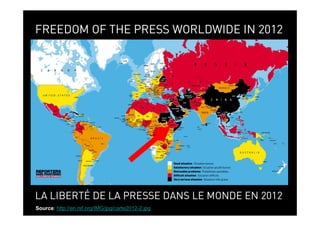
Radio and television are under the
          control of the Ethiopian government.


Source: http://lcweb2.loc.gov/frd/cs/profiles/Ethiopia.pdf
Source: http://en.rsf.org/IMG/jpg/carte2012-2.jpg
Population
 aspects
About 91 million people live in Ethiopia.
      In 2025, there will be 120 million people.
      Life expectancy is 56 years.
      85% of the population work in agriculture.
      17% of the population live in cities.
      42% of the population has access to safe water.


Sources
http://www.ethlife.ethz.ch/archive_articles/091009_ethiopia_lul/index
https://www.cia.gov/library/publications/the-world-factbook/geos/et.html
http://www.redcross.org.uk/What-we-do/Health-and-social-care/Health-issues/Water-and-sanitation/Water-and-sanitation-in-Ethiopia
http://csis.org/files/publication/110623_Lyons_Ethiopia_Web.pdf
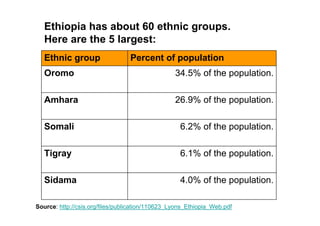
Ethiopia has about 60 ethnic groups.
   Here are the 5 largest:
   Ethnic group                   Percent of population
   Oromo                                          34.5% of the population.

   Amhara                                         26.9% of the population.

   Somali                                           6.2% of the population.

   Tigray                                           6.1% of the population.

   Sidama                                           4.0% of the population.

Source: http://csis.org/files/publication/110623_Lyons_Ethiopia_Web.pdf
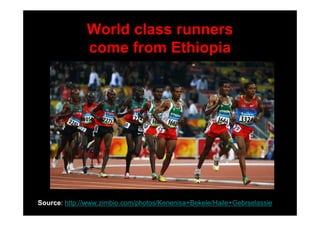
World class runners
              come from Ethiopia


Source: http://www.zimbio.com/photos/Kenenisa+Bekele/Haile+Gebrselassie

Ethiopia

  • 1.
  • 2.
  • 3.
    Ethiopia is 26 xlarger than Switzerland. Source: http://www.eslstation.net/Lab_Information/Our_Lives/Viewpoints/being_uprooted_for_a_better_life.htm
  • 4.
    Addis Ababa, Ethiopia Source:http://theethiopiantimes.com/2012/02/15/addis-ababa-ethiopia/
  • 5.
    Lake Tana, thelargest lake in Ethiopia Source: http://matadornetwork.com/trips/photo-essay-ethiopia/
  • 6.
    Regions in Ethiopiaabove 1,500 meters have temperate climate with temperatures between 16°C and 30°C and cool nights. They receive by far the most rainfall - most of it between mid-June and mid- September. The lowlands in Ethiopia below 1,500 meters have higher temperatures and receive much less rain. Source: http://lcweb2.loc.gov/frd/cs/profiles/Ethiopia.pdf
  • 7.
    In the last50 years, Ethiopia lost 98% of its forests. Source http://lab.colorsmagazine.com/pdf/colors-for-good.pdf, p. 10.
  • 8.
  • 9.
    Fastest-growing economies inthe world Source http://afrinnovator.com/blog/2012/01/15/pondering-africas-tech-investment-potential-in-2012-and-beyond/
  • 10.
    GDP growth ofEthiopia Source http://www.afdb.org/fileadmin/uploads/afdb/Documents/Publications/ECON%20Brief_Ethiopias%20Economic%20growth.pdf http://www.dbresearch.com/PROD/DBR_INTERNET_EN-PROD/PROD0000000000276604/Ethiopia.pdf
  • 11.
    Ethiopia exports inUSD billions Source http://www.accesscapitalsc.com/downloads/Ethiopias-Export-Performance-Review.pdf
  • 12.
    Real GDP growthof Ethiopia is set to stay around 8% over the coming years. Key challenges are high dependency on rain-fed agriculture and limited private sector growth. Source http://www.dbresearch.com/PROD/DBR_INTERNET_EN-PROD/PROD0000000000276604/Ethiopia.pdf
  • 13.
    Example: ACOS ACOS is an agricultural processing facility that is processing and shipping a variety of beans to European markets. ACOS is jointly owned by an Italian company and Ethiopian investors and is a great example of private investment in developing countries. Acos has been present in Ethiopia since 2005. The ACOS Ethiopia plant employs 350 people. Source http://www.thegatesnotes.com/Topics/Development/Ethiopia-Exciting-Innovations-in-Agriculture-and-Health http://www.acosnet.it/
  • 14.
  • 15.
  • 16.
    Coffee regions inEthiopia Source http://www.ineedcoffee.com/07/ethiopian-coffee/
  • 17.
    Coffee region Coffee characteristics Lekempti region Mango, tangerine, citrus, and tropical fruit characteristics. Harrar region Fruity, blueberry aroma, as well as spice and liquorice. Yirgacheffe region Lemon and citrus. Sidamo region Fruit punch characteristics. Source http://www.ineedcoffee.com/07/ethiopian-coffee/
  • 18.
  • 19.
  • 20.
    Flower export inmillion USD Source http://www.afdb.org/fileadmin/uploads/afdb/Documents/Publications/ECON%20Brief_Ethiopias%20Economic%20growth.pdf
  • 21.
    About 70% ofthe total volume of Ethiopian rose exports is now sold to the Dutch Auction. Source: http://www.et.emb-japan.go.jp/Eco_Research_E.pdf
  • 22.
  • 23.
    Export countries -gold Source http://www.accesscapitalsc.com/images/stories/research/pdf/Ethiopias-Export-Performance-Review.pdf
  • 24.
  • 25.
    Ethiopia derives about90% of its electricity needs from hydropower, which means that electricity generation, as with agriculture, is dependent on abundant rainfall. Less than 50% of Ethiopia’s towns and cities are connected to the national grid. Source: http://lcweb2.loc.gov/frd/cs/profiles/Ethiopia.pdf
  • 26.
    The costs ofEUR 1.5 billion to build the Gibe III dam, the 3rd in a series of five dams planned along the Omo River, will be covered by the Ethiopian Electric Power Corporation (EEPCo), with a Chinese firm bankrolling the $400 million electromechanical costs. Source: http://www.awrambatimes.com/?p=1326
  • 27.
  • 28.
    Ethiopia relies heavily onthe port of Djibouti for the import and export of goods. Source http://photos.state.gov/libraries/ethiopia/427391/PDF%20files/Final%202012%20 Ethiopia%20Country%20Commercial%20Guide.pdf
  • 29.
    In Ethiopia, almostall primary roads are gravel roads, including those that connect Addis Ababa with major cities and towns across the country. Source: http://lcweb2.loc.gov/frd/cs/profiles/Ethiopia.pdf
  • 30.
    Cut flowers andfresh fruits and vegetables are transported via air from Addis Ababa's Bole International Airport. Source http://photos.state.gov/libraries/ethiopia/427391/PDF%20files/Final%202012%20 Ethiopia%20Country%20Commercial%20Guide.pdf
  • 31.
    Ethiopian Airlines isthe fastest growing airline in Africa. Source http://www.ethiopianairlines.com/en/news/prarchive.aspx?id=312
  • 32.
    Most distribution inEthiopia, particularly to regional towns, is done through informal business arrangements. For example, after being cleared through customs, many goods will be sold to wholesalers in Addis Ababa's largest open market (Merkato) and then distributed to retailers and small vendors. Source http://photos.state.gov/libraries/ethiopia/427391/PDF%20files/Final%202012%20 Ethiopia%20Country%20Commercial%20Guide.pdf
  • 33.
  • 34.
    Farming is inthe hands of peasants, who cultivate individual plots. All land belongs to the state and can be leased for up to 99 years. Sources http://lcweb2.loc.gov/frd/cs/profiles/Ethiopia.pdf http://photos.state.gov/libraries/ethiopia/427391/PDF%20files/Final%202012%2 0Ethiopia%20Country%20Commercial%20Guide.pdf
  • 35.
    Foreign-owned financial institutions are not permitted in Ethiopia. Source: http://lcweb2.loc.gov/frd/cs/profiles/Ethiopia.pdf
  • 36.
    Radio and televisionare under the control of the Ethiopian government. Source: http://lcweb2.loc.gov/frd/cs/profiles/Ethiopia.pdf
  • 37.
  • 38.
  • 39.
    About 91 millionpeople live in Ethiopia. In 2025, there will be 120 million people. Life expectancy is 56 years. 85% of the population work in agriculture. 17% of the population live in cities. 42% of the population has access to safe water. Sources http://www.ethlife.ethz.ch/archive_articles/091009_ethiopia_lul/index https://www.cia.gov/library/publications/the-world-factbook/geos/et.html http://www.redcross.org.uk/What-we-do/Health-and-social-care/Health-issues/Water-and-sanitation/Water-and-sanitation-in-Ethiopia http://csis.org/files/publication/110623_Lyons_Ethiopia_Web.pdf
  • 40.
    Ethiopia has about60 ethnic groups. Here are the 5 largest: Ethnic group Percent of population Oromo 34.5% of the population. Amhara 26.9% of the population. Somali 6.2% of the population. Tigray 6.1% of the population. Sidama 4.0% of the population. Source: http://csis.org/files/publication/110623_Lyons_Ethiopia_Web.pdf
  • 41.
    World class runners come from Ethiopia Source: http://www.zimbio.com/photos/Kenenisa+Bekele/Haile+Gebrselassie