Group Members:
1. Aniqa Asghar
2. Mahrukh Zehra
3. Zainab Jamal
4. Turab Raza
What is Ethics of Technology?
Ethics in technology is a sub-field of ethics addressing the ethical
questions specific to the Technology Age.
It is often held that technology itself is incapable of possessing moral or
ethical qualities, since "technology" is merely tool making.
FOUR ETHICAL ISSUES OF THE
INFORMATION AGE
1. PRIVACY: Two forces threaten our privacy. One is the growth of
information technology, with its enhanced capacity for surveillance,
communication, computation, storage, and retrieval. A second, and more
insidious threat, is the increased value of information in decision-making.
Information is increasingly valuable to policy makers; they covet it even if
acquiring it invades another's privacy.
2. ACCURACY: Misinformation has a way of fouling up people's lives,
especially when the party with the inaccurate information has an advantage
in power and authority.
3. PROPERTY: One of the most complex issues we face as a society is the
question of intellectual property rights. Any individual item of information
can be extremely costly to produce in the first instance. Yet, once it is
produced, that information has the illusive quality of being easy to reproduce
and to share with others. We currently have several imperfect institutions
that try to protect intellectual property rights. Copyrights, patents,
encryption, oaths of confidentiality, and such old fashioned values as trust
worthiness and loyalty are the most commonly used protectors of our
intellectual property. Problem issues, however, still abound in this area. Let
us focus on just one aspect: artificial intelligence and its expanding subfield,
expert systems.
4. ACCESS: In an information society a citizen must possess at least three things to
be literate:
 - One must have the intellectual skills to deal with information. These are skill such as
reading, writing, reasoning, and calculating. This is a task for education.
 - One must have access to the information technologies which store, convey and
process information. This includes libraries, radios, televisions, telephones, and
increasingly, personal computers or terminals linked via networks to mainframes.
This is a problem in social economics.
 - Finally, one must have access to the information itself. This requirement returns to
the issue of property and is also a problem in social economics.
IS TECHNOLOGY VALUE LOADED OR
VALUE NEUTRAL?
 According to most researches ethics is known to be value-neutral.
Like any tool, it is not the tool itself that does anything of any value.
Hence its Value free. But rather it is the user that is responsible for
whatever comes from using the tool. I think technology is simply
another tool in a long line and history of tools that have been available
to preachers for a very long time. What people do with technology is
entirely up to them.
WEAPONS
 CHEMICAL WEAPONS:
They are defined as chemical substances that can be delivered using munitions
dispersal devices to cause death or severe harm to people, animals and plants.
Example: Nerve gas, tear gas and pepper gas.
BIOLOGICAL WEAPONS:
They are defined as harmful biological agents as in pathogenic micro organisms
or neurotoxins as weapons to cause death or disease usually o a large scale.
Example: Anthrax, small pox, wheat stem rust.
History Of Biological Weapons
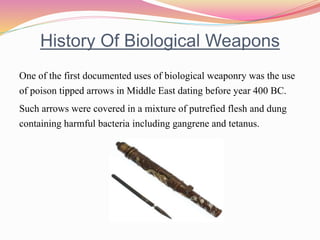
One of the first documented uses of biological weaponry was the use
of poison tipped arrows in Middle East dating before year 400 BC.
Such arrows were covered in a mixture of putrefied flesh and dung
containing harmful bacteria including gangrene and tetanus.
Peloponnesian war:
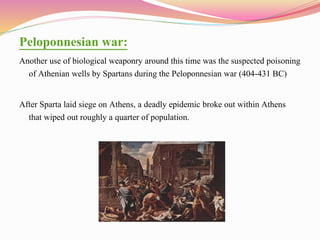
Another use of biological weaponry around this time was the suspected poisoning
of Athenian wells by Spartans during the Peloponnesian war (404-431 BC)
After Sparta laid siege on Athens, a deadly epidemic broke out within Athens
that wiped out roughly a quarter of population.
History Of Chemical Weapons
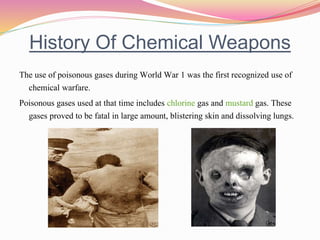
The use of poisonous gases during World War 1 was the first recognized use of
chemical warfare.
Poisonous gases used at that time includes chlorine gas and mustard gas. These
gases proved to be fatal in large amount, blistering skin and dissolving lungs.
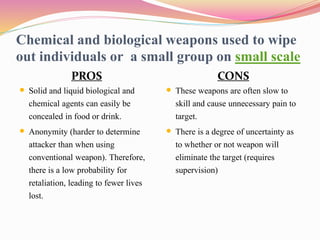
Chemical and biological weapons used to wipe
out individuals or a small group on small scale
PROS
 Solid and liquid biological and
chemical agents can easily be
concealed in food or drink.
 Anonymity (harder to determine
attacker than when using
conventional weapon). Therefore,
there is a low probability for
retaliation, leading to fewer lives
lost.
CONS
 These weapons are often slow to
skill and cause unnecessary pain to
target.
 There is a degree of uncertainty as
to whether or not weapon will
eliminate the target (requires
supervision)
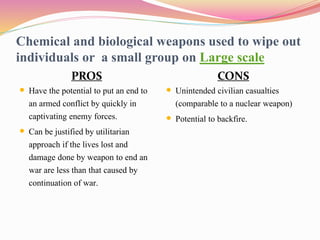
Chemical and biological weapons used to wipe out
individuals or a small group on Large scale
PROS
 Have the potential to put an end to
an armed conflict by quickly in
captivating enemy forces.
 Can be justified by utilitarian
approach if the lives lost and
damage done by weapon to end an
war are less than that caused by
continuation of war.
CONS
 Unintended civilian casualties
(comparable to a nuclear weapon)
 Potential to backfire.
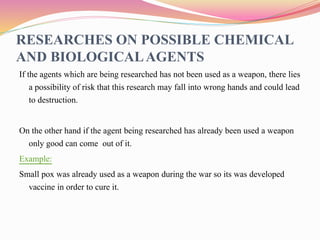
RESEARCHES ON POSSIBLE CHEMICAL
AND BIOLOGICALAGENTS
If the agents which are being researched has not been used as a weapon, there lies
a possibility of risk that this research may fall into wrong hands and could lead
to destruction.
On the other hand if the agent being researched has already been used a weapon
only good can come out of it.
Example:
Small pox was already used as a weapon during the war so its was developed
vaccine in order to cure it.
PRIVACY
Privacy is the claim of individuals, groups or institutions
to determine for themselves when, how, and to what
extent their information should be communicated to
other.
PRIVACY HARM:
There are four types of privacy harms which are as follows:
 Intrusion
 Information collection
 Information processing
 Information dissemination
Ways To Protect Privacy
There are four ways to protect privacy i.e technology, law, markets and your
choice.
EXAMPLE: Reducing spam
Technology: Spam filters
Law: The CAN-SPAM Act
1- Illegal to send commercial email with false headers
2- You can unsubscribe from the sender
Markets: You choose an email provider that does a good job of reducing spam
Your choice: You decide not to open that email with the unpleasant header
Internet ethics- Introduction
 It describes a code of conduct for the users of internet.
 Organizations that introduce new information systems must first address
legal and ethical issues related to technologies.
Ethical and moral issues associated
with the internet
 Cyber bullying
 Provision of misleading information on websites
 Plagiarism
 Use of photo editors to distort reality
 Privacy
 Hacking
 Inappropriate websites with illicit material
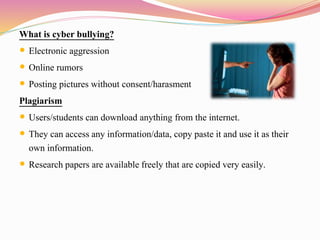
What is cyber bullying?
 Electronic aggression
 Online rumors
 Posting pictures without consent/harasment
Plagiarism
 Users/students can download anything from the internet.
 They can access any information/data, copy paste it and use it as their
own information.
 Research papers are available freely that are copied very easily.
HACKING
 Into bank accounts of
online users, website hacking, computer hacking, password hacking, etc
REMEDIES
 Copyrights to avoid plagiarism
 More developed filtering software
 AUP – acceptable use policy
 Privacy policies
 Censorship of certain websites
CELL PHONES
Inappropriate cell phone usage may include
 Texting while driving
 Invading other’s privacy
 Bullying
 Harassment from wrong numbers
 Frauds/misleading dealers
 Spreading rumors
ETHICS OF HEIDDEGER
 The question concerning Technology
 Published in 1954
 Heidegger observes that because of technology, “all distances in time
and space are shrinking” and “yet the hasty setting aside of all distances
brings no nearness; for nearness does not consist in a small amount of
distance”
 Technology also brought some draw backs with it
 Workers are being treated as merely means of production only

Ethics of technology

  • 2.
    Group Members: 1. AniqaAsghar 2. Mahrukh Zehra 3. Zainab Jamal 4. Turab Raza
  • 3.
    What is Ethicsof Technology? Ethics in technology is a sub-field of ethics addressing the ethical questions specific to the Technology Age. It is often held that technology itself is incapable of possessing moral or ethical qualities, since "technology" is merely tool making.
  • 4.
    FOUR ETHICAL ISSUESOF THE INFORMATION AGE 1. PRIVACY: Two forces threaten our privacy. One is the growth of information technology, with its enhanced capacity for surveillance, communication, computation, storage, and retrieval. A second, and more insidious threat, is the increased value of information in decision-making. Information is increasingly valuable to policy makers; they covet it even if acquiring it invades another's privacy.
  • 5.
    2. ACCURACY: Misinformationhas a way of fouling up people's lives, especially when the party with the inaccurate information has an advantage in power and authority.
  • 6.
    3. PROPERTY: Oneof the most complex issues we face as a society is the question of intellectual property rights. Any individual item of information can be extremely costly to produce in the first instance. Yet, once it is produced, that information has the illusive quality of being easy to reproduce and to share with others. We currently have several imperfect institutions that try to protect intellectual property rights. Copyrights, patents, encryption, oaths of confidentiality, and such old fashioned values as trust worthiness and loyalty are the most commonly used protectors of our intellectual property. Problem issues, however, still abound in this area. Let us focus on just one aspect: artificial intelligence and its expanding subfield, expert systems.
  • 7.
    4. ACCESS: Inan information society a citizen must possess at least three things to be literate:  - One must have the intellectual skills to deal with information. These are skill such as reading, writing, reasoning, and calculating. This is a task for education.  - One must have access to the information technologies which store, convey and process information. This includes libraries, radios, televisions, telephones, and increasingly, personal computers or terminals linked via networks to mainframes. This is a problem in social economics.  - Finally, one must have access to the information itself. This requirement returns to the issue of property and is also a problem in social economics.
  • 8.
    IS TECHNOLOGY VALUELOADED OR VALUE NEUTRAL?  According to most researches ethics is known to be value-neutral. Like any tool, it is not the tool itself that does anything of any value. Hence its Value free. But rather it is the user that is responsible for whatever comes from using the tool. I think technology is simply another tool in a long line and history of tools that have been available to preachers for a very long time. What people do with technology is entirely up to them.
  • 9.
    WEAPONS  CHEMICAL WEAPONS: Theyare defined as chemical substances that can be delivered using munitions dispersal devices to cause death or severe harm to people, animals and plants. Example: Nerve gas, tear gas and pepper gas. BIOLOGICAL WEAPONS: They are defined as harmful biological agents as in pathogenic micro organisms or neurotoxins as weapons to cause death or disease usually o a large scale. Example: Anthrax, small pox, wheat stem rust.
  • 10.
    History Of BiologicalWeapons One of the first documented uses of biological weaponry was the use of poison tipped arrows in Middle East dating before year 400 BC. Such arrows were covered in a mixture of putrefied flesh and dung containing harmful bacteria including gangrene and tetanus.
  • 11.
    Peloponnesian war: Another useof biological weaponry around this time was the suspected poisoning of Athenian wells by Spartans during the Peloponnesian war (404-431 BC) After Sparta laid siege on Athens, a deadly epidemic broke out within Athens that wiped out roughly a quarter of population.
  • 12.
    History Of ChemicalWeapons The use of poisonous gases during World War 1 was the first recognized use of chemical warfare. Poisonous gases used at that time includes chlorine gas and mustard gas. These gases proved to be fatal in large amount, blistering skin and dissolving lungs.
  • 13.
    Chemical and biologicalweapons used to wipe out individuals or a small group on small scale PROS  Solid and liquid biological and chemical agents can easily be concealed in food or drink.  Anonymity (harder to determine attacker than when using conventional weapon). Therefore, there is a low probability for retaliation, leading to fewer lives lost. CONS  These weapons are often slow to skill and cause unnecessary pain to target.  There is a degree of uncertainty as to whether or not weapon will eliminate the target (requires supervision)
  • 14.
    Chemical and biologicalweapons used to wipe out individuals or a small group on Large scale PROS  Have the potential to put an end to an armed conflict by quickly in captivating enemy forces.  Can be justified by utilitarian approach if the lives lost and damage done by weapon to end an war are less than that caused by continuation of war. CONS  Unintended civilian casualties (comparable to a nuclear weapon)  Potential to backfire.
  • 15.
    RESEARCHES ON POSSIBLECHEMICAL AND BIOLOGICALAGENTS If the agents which are being researched has not been used as a weapon, there lies a possibility of risk that this research may fall into wrong hands and could lead to destruction. On the other hand if the agent being researched has already been used a weapon only good can come out of it. Example: Small pox was already used as a weapon during the war so its was developed vaccine in order to cure it.
  • 16.
    PRIVACY Privacy is theclaim of individuals, groups or institutions to determine for themselves when, how, and to what extent their information should be communicated to other. PRIVACY HARM: There are four types of privacy harms which are as follows:  Intrusion  Information collection  Information processing  Information dissemination
  • 17.
    Ways To ProtectPrivacy There are four ways to protect privacy i.e technology, law, markets and your choice. EXAMPLE: Reducing spam Technology: Spam filters Law: The CAN-SPAM Act 1- Illegal to send commercial email with false headers 2- You can unsubscribe from the sender Markets: You choose an email provider that does a good job of reducing spam Your choice: You decide not to open that email with the unpleasant header
  • 18.
    Internet ethics- Introduction It describes a code of conduct for the users of internet.  Organizations that introduce new information systems must first address legal and ethical issues related to technologies.
  • 19.
    Ethical and moralissues associated with the internet  Cyber bullying  Provision of misleading information on websites  Plagiarism  Use of photo editors to distort reality  Privacy  Hacking  Inappropriate websites with illicit material
  • 20.
    What is cyberbullying?  Electronic aggression  Online rumors  Posting pictures without consent/harasment Plagiarism  Users/students can download anything from the internet.  They can access any information/data, copy paste it and use it as their own information.  Research papers are available freely that are copied very easily.
  • 21.
    HACKING  Into bankaccounts of online users, website hacking, computer hacking, password hacking, etc REMEDIES  Copyrights to avoid plagiarism  More developed filtering software  AUP – acceptable use policy  Privacy policies  Censorship of certain websites
  • 22.
    CELL PHONES Inappropriate cellphone usage may include  Texting while driving  Invading other’s privacy  Bullying  Harassment from wrong numbers  Frauds/misleading dealers  Spreading rumors
  • 23.
    ETHICS OF HEIDDEGER The question concerning Technology  Published in 1954  Heidegger observes that because of technology, “all distances in time and space are shrinking” and “yet the hasty setting aside of all distances brings no nearness; for nearness does not consist in a small amount of distance”
  • 24.
     Technology alsobrought some draw backs with it  Workers are being treated as merely means of production only