CYBER ETHICS
What Is Cyberethics?
 Cyber ethics is the study of moral, legal, and social issues
involving cyber technology.
 It examines the impact that cyber technology has for our
social, legal, and moral systems
 It also evaluates the social policies and laws that we frame
in response to issues generated by the development and
use of cyber technology.
FOUNDATION OF CYBERETHICS
 Computer ethics was first coined by Walter Maner, a
professor at Bowling Green State University. Maner
noticed ethical concerns that were brought up
duringhis Medical Ethics course at Old Dominion
University became more complex and difficult when
the use of technology and computers became
involved. The conceptual foundations of computer
ethics are investigated by information ethics, a
branch of philosophical ethics promoted, among
others, by Luciano Floridi..
IMPORTANT OF CYBERETHICS
 To protect personal & commercial information such as login &
password info, credit card and account information and
government and commercial databases. It also controls
unwanted internet mail and ads (Spam)
 .• To control plagiarism, student identity fraud, and the use of
copyrighted material, etc.
 To make ICT available and accessible to all peoples, including
the disabled and the deprived
 . Accessibility needs to be kept in mind during curriculum
design (in educational contexts), inorder to maximize the
capabilities of the technology
 • To suppress dishonest business practices and toprotect and
encourage fair competition
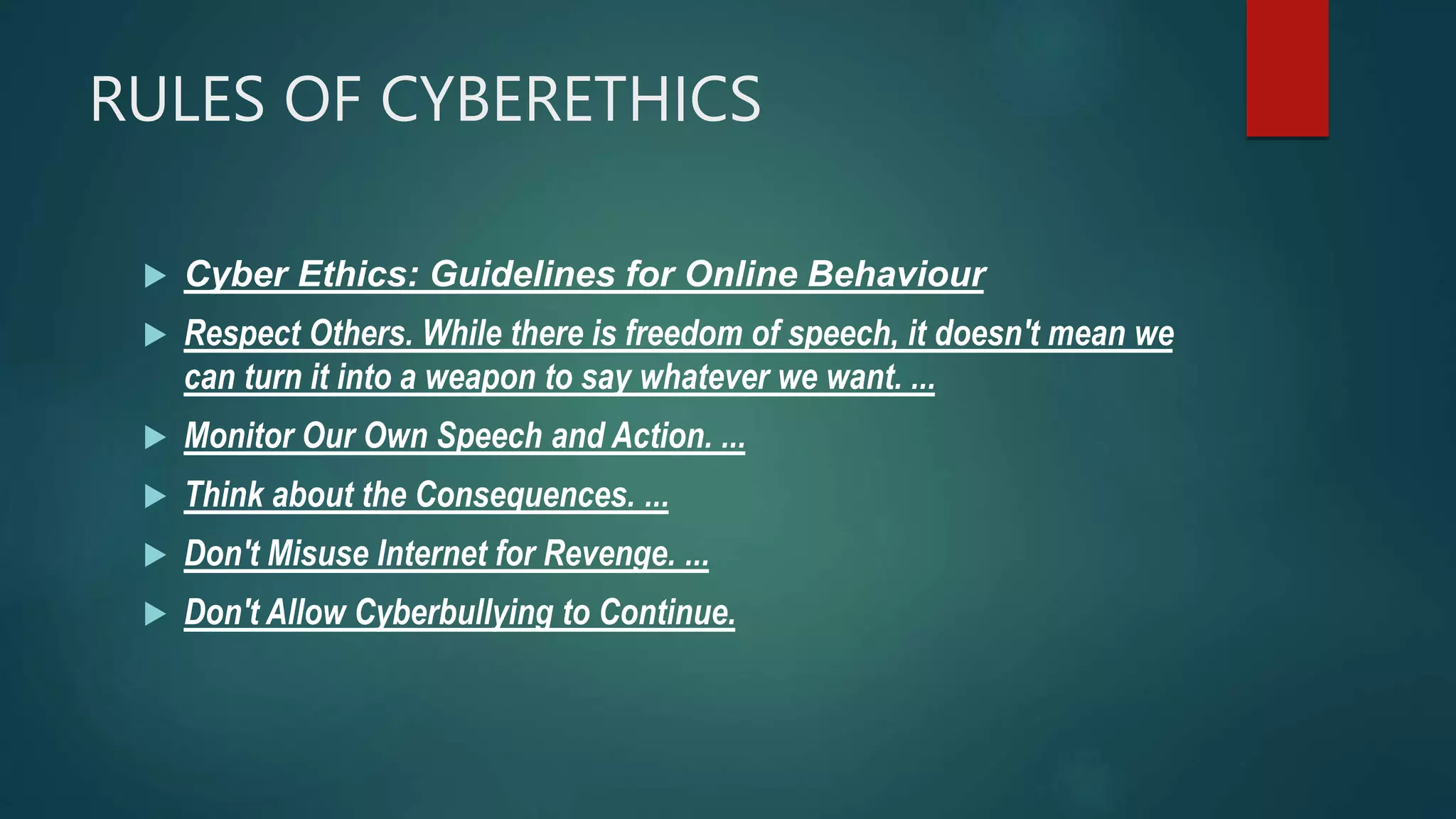
RULES OF CYBERETHICS
 Cyber Ethics: Guidelines for Online Behaviour
 Respect Others. While there is freedom of speech, it doesn't mean we
can turn it into a weapon to say whatever we want. ...
 Monitor Our Own Speech and Action. ...
 Think about the Consequences. ...
 Don't Misuse Internet for Revenge. ...
 Don't Allow Cyberbullying to Continue.
HISTORY OF CYBERETHICS
 The concept of computer ethics originated in the 1940s
with MIT professor Nobert Wiener, the American
mathematician and philosopher. While working on anti-
aircraft artillery during World War II, Wiener and his
fellow engineers developed a system of communication
between the part of a cannon that tracked a warplane, the
part that performed calculations to estimate a trajectory,
and the part responsible for firing. Wiener termed the
science of such information feedback systems,
"cybernetics", and he discussed this new field with its
related ethical concerns in his 1948 book, Cybernetics.
THANK YOU

a.pptx

  • 1.
  • 2.
    What Is Cyberethics? Cyber ethics is the study of moral, legal, and social issues involving cyber technology.  It examines the impact that cyber technology has for our social, legal, and moral systems  It also evaluates the social policies and laws that we frame in response to issues generated by the development and use of cyber technology.
  • 3.
    FOUNDATION OF CYBERETHICS Computer ethics was first coined by Walter Maner, a professor at Bowling Green State University. Maner noticed ethical concerns that were brought up duringhis Medical Ethics course at Old Dominion University became more complex and difficult when the use of technology and computers became involved. The conceptual foundations of computer ethics are investigated by information ethics, a branch of philosophical ethics promoted, among others, by Luciano Floridi..
  • 4.
    IMPORTANT OF CYBERETHICS To protect personal & commercial information such as login & password info, credit card and account information and government and commercial databases. It also controls unwanted internet mail and ads (Spam)  .• To control plagiarism, student identity fraud, and the use of copyrighted material, etc.  To make ICT available and accessible to all peoples, including the disabled and the deprived  . Accessibility needs to be kept in mind during curriculum design (in educational contexts), inorder to maximize the capabilities of the technology  • To suppress dishonest business practices and toprotect and encourage fair competition
  • 5.
    RULES OF CYBERETHICS Cyber Ethics: Guidelines for Online Behaviour  Respect Others. While there is freedom of speech, it doesn't mean we can turn it into a weapon to say whatever we want. ...  Monitor Our Own Speech and Action. ...  Think about the Consequences. ...  Don't Misuse Internet for Revenge. ...  Don't Allow Cyberbullying to Continue.
  • 6.
    HISTORY OF CYBERETHICS The concept of computer ethics originated in the 1940s with MIT professor Nobert Wiener, the American mathematician and philosopher. While working on anti- aircraft artillery during World War II, Wiener and his fellow engineers developed a system of communication between the part of a cannon that tracked a warplane, the part that performed calculations to estimate a trajectory, and the part responsible for firing. Wiener termed the science of such information feedback systems, "cybernetics", and he discussed this new field with its related ethical concerns in his 1948 book, Cybernetics.
  • 7.