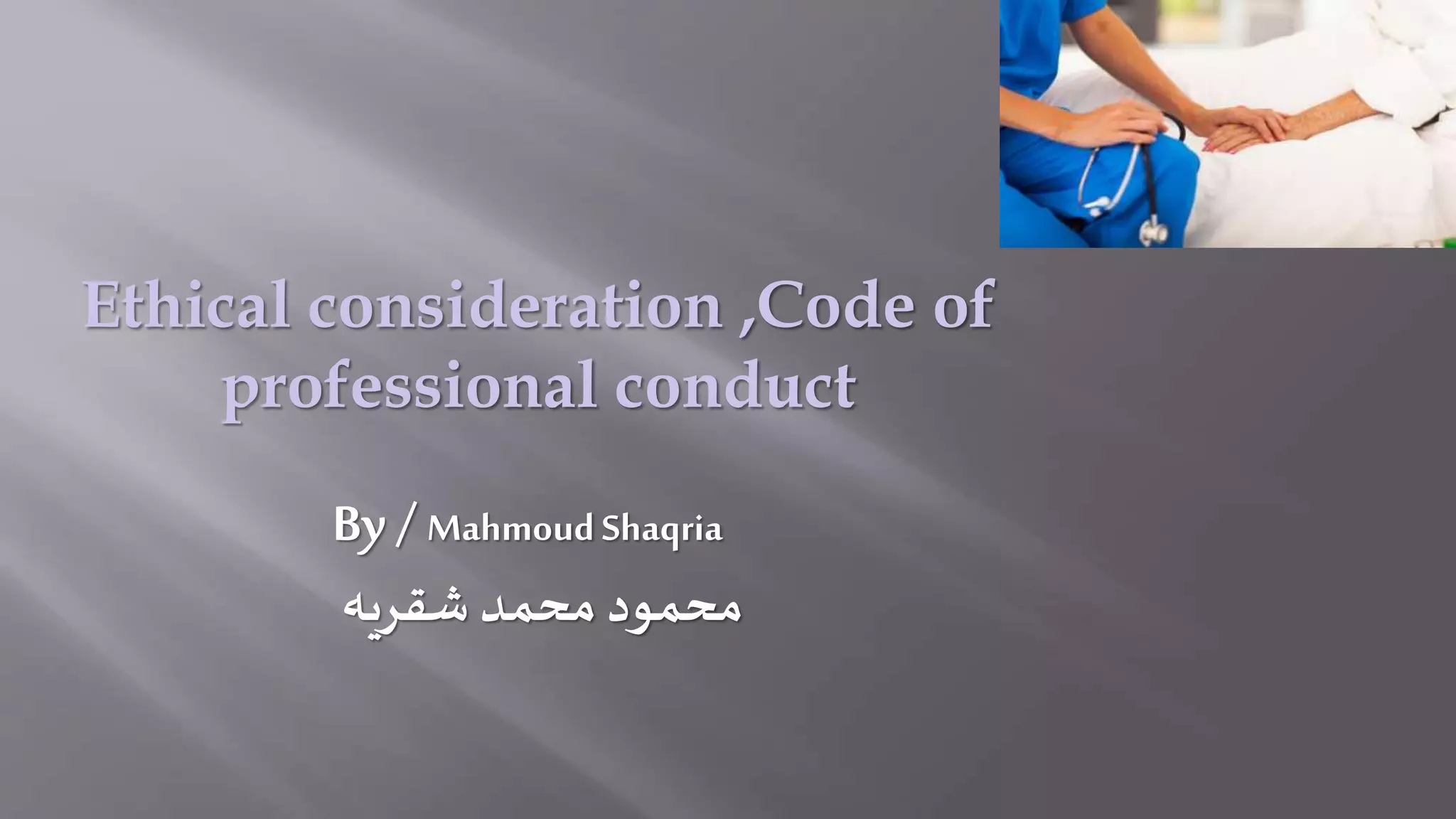
Ethical consideration ,Code of
professional conduct
By/ MahmoudShaqria
‫شقريه‬ ‫محمد‬ ‫محمود‬
Introduction
Learning objectives
Definition of ethics, code of ethics .
Value and morals
Ethical principles
Code of ethics
Purpose of code of ethics
Use of code of ethics
Elements of the code
Ethical dilemma
Common issues
Legal and ethical implication
Various nursing situations
references
Outlines
Learning objectives
define the meaning of ethics , and code of ethics .
recognize morals and values.
List ethical principles , purpose and uses.
Mention elements of the code of ethics .
Define the ethical dilemma.
Classify common issues .
apply right solution towards various nursing situations
Introduction
The codes of ethics nurses are responsible to provide their clients/patients
with the high-quality care. They are undoubtedly confronted with various
ethical challenges in their professional practice, so they should be familiar
with ethical codes of conduct and the essentials of ethical decision making.
The codes outline how the nurses should behave ethically as a profession,
and how they should decide when encounter barriers preventing them from
fulfilling their professional obligations. The codes can also support nurses in
their practice and reduce their moral distress.
Definitions of Ethics
The word ethics has Greek roots:
• Ta ethika, referring to philosophical inquiry into good and evil
• Ethos, meaning personal character
(Burns, 2012)
Ethics is:
“Our concern for good behavior. We feel an obligation to consider not only our own
personal well-being, but also that of other human being.” (Albert Schweitzer in Certo
& Certo, 2009)
Ethics is
• The discipline of dealing with what is good and bad, and with moral duty and
obligation
• A set of moral principles or values
• The principles of conduct governing an individual or group (Burns, 2012)
A Code of Ethics
is an attempt to define basic rules, or principles for determining what
constitutes "good" or "right" behavior. In other words, to determine
what we ought to do next.
A code of ethics is a set of ethical principles, ideals and values shared
by members of the group , and serves as a standard for their
professional actions.
VALUE AND MORALS
A value
is a personal belief about the worth you hold for an idea, a custom, or
an object. The values reflect your cultural and social influences. For
e.g. if you live in rural place, you may value the environment
differently from someone who visits rural areas for a short time.
Morals
usually refer to judgment about behavior and ethics is the study of
ideals of right and wrong behavior.
Ethical principles
 AUTONOMY
Non maleficence
JUSTICE
FIDELITY
Beneficence
VERACITY
Confidentially
respect for persons
Sanctity of Life
 Double Effect
Pt has the right to make decisions for themselves. May see this
come up with consent for treatment issues, informed consent.
Pt has right to know procedure, complications, other options,
that they can to not have the procedure/treatment.
This principle expresses the concept that professionals have a duty to
protect the patient from harm
 AUTONOMY
Non maleficence
Seeks fairness
More specifically, distributive justice refers to distribution of benefits and
burdens
Duty to be faithful to one’s commitments
includes implicit and explicit promises
Make a promise, follow it
Implicit – those promises that are implied, not verbally communicated
Like when pt comes into the hospital, they expect to be cared for
Explicit – those that we verbally communicate
JUSTICE
FIDELITY
Actively seeking benefits; promotion of good
The obligation to tell the truth and not
to lie or deceive others
VERACITY
Beneficence:
Confidentially
Keep privileged information private
Exceptions
Protecting one person’s privacy harms another or threatens social
good (direct threat to another person)
Drug abuse in employees, elder and child abuse
respect for persons
Closely tied to autonomy
Promotes ability of individuals to make autonomous choices and should be
treated accordingly
Autonomy is preserved through advanced directives.
Sanctity of Life
Life is the highest good
All forms of life, including more biologic existence, should take
precedence over external criteria for judging quality of life
Double Effect
Some actions can be morally justified even though consequences
may be a mixture of good and evil
The International Council of Nursing (ICN) Code for
Nurses (1973) is similar to the foundations of the ANA
code. It speaks to the responsibilities of the nurse to other
people, to practice, to society, to co-workers, and to the
profession as a whole.
The fundamental responsibility of the nurse is fourfold : to
promote health, to prevent illness, to restore health, and to
alleviate suffering. The need for nursing is universal.
Inherent in nursing is respect for life, dignity and rights of
man. It is unrestricted by considerations of ethics
ICN CODE OF ETHICS
Ethical Concepts Applied to Nursing
Standards for the behavior of nurses& provide general
guideline for nursing actions
helps to distinguish between right and wrong .
Enables a correct decision .
protect the right of individuals
Purpose of code of ethics
.
Acknowledges the rightful place of Individuals in health care delivery
system.
Contributes towards empowerment of individuals to become responsible
for their health and well-being.
Contributes to quality care.
Identifies obligations in practice, research and relationships
Informs the individuals, families, community and other professionals
about expectations of a nurse
Uses
1) Nurses and people
2) Nurses and practice
3) Nurses and society
4) Nurses and co-worker
5) Nurses and profession
ELEMENTS OF THE CODE
ETHICAL DILEMMA
Occurs when there is conflict
between two or more ethical
principles.
No correct decision exists
COMMON ISSUES
Clinical : patient and family issues
 Patient rights
Surrogate decision making
 Goals of care
 Code status
 End of life
 Culture and religion
 Medication
 Patient rights
1 Healthy And Safe Environment
2 Participation In Decision-making
3 Access To Health Care
4 Knowledge Of One’s Health Insurance/Medical Aid Scheme
5 Choice Of Health Services
.6 Treated By A Health Care Provider
.7 Confidentiality And Privacy
 Patient rights ( cont)
.10 A Second Opinion
.11 Continuity Of Care
.12 Complaints About Health Services
8 Informed Consent
.9 Refusal Of Treatment
COMMON ISSUES (cont)
• Organizational : Hospital and system health
Allocation of resources
Conflict resolution
Conflicts of interest
 Confidentiality
 Research
 Public action
LEGAL AND ETHICAL IMPLICATIONS IN
VARIOUS NURSING SITUATIONS
• Legal Implications in Admission and Discharge
• Examination of Female Patient
• Legal Responsibility of Nurse while Administering Medication
• Practice by the Nurses Which may be Considered Unethical
Admission and Discharge of Medico Legal Cases (MLC)
After receiving the patient , immediately inform the physician.
• All the OPD records, admission cards, and other records of patient
should be kept under lock and key.
• No records of patient should be shown to anyone else than the
physician looking after the patient.
• All the belongings of the patient should be kept under safe custody.
Admission and Discharge of Medico Legal Cases (MLC) cont
• If relatives or police want to take the belongings of patient, the prior permission of
physician is important. Description of the belonging should be written. Relationship with
the patient, signature and thumb impression should be obtained from the person
collecting the belongings.
• Body discharge of the patient should not be thrown until confirmed by the physician.
• Accurate recording of body discharge, its quantity, color and consistency should be
maintained.
Admission and Discharge of Medico Legal Cases (MLC)
Don’t destroy/discard any evidence without discussing with
physician.
Take consent of relative or patient (if patient is conscious) for
any kind of procedure/treatment.
 Allow the relative to be with the patient on request of patient.
Admission and Discharge of Medico Legal Cases (MLC) cont
The condition of patient should be reported verbally and recorded .
 It is not obligatory on the part of nurse to provide information to the police
officer, to the press reporter or any agent of the public. In case of any difficulty
she / he may inform the immediate higher authority
• On Discharge
 If patient is transferred from one ward to another, or to any other
hospital, it should be clearly entered and signed.
 No records should be handed over to police. If required,
physician attending the patient should give in writing to Nurse.
 Name and address of the relative should be written clearly before
allowing the patient to leave the hospital.
 Discharge notes should be kept under lock and key, until
handed over to the department concerned.
In Case of Death of Patient
• If death occurs in the hospital, Physician on duty must inform the CMO and
withhold the body for post mortem examination according to hospital policy.
• Nurse must get written instruction from the medical officer for handing over
the body to mortuary/relative/police officer with: – complete name and
signature – complete address of the person from mortuary/relative/police
officer – identification number – signature of witness
In Case of Death of Patient (cont)
• Maintain the privacy of the dead body while attending last offices or care
of the dead.
• All the articles should be disposed off, after making list and with approval
of medical officer.
Discharging a Patient with Mental Illness
As a nurse you must remember that:
• Voluntarily admitted patient may ask for discharge and
psychiatrist/medical officer on duty will make discharge slip.
• Check the signature of the patient and relatives/witness.
• Note the address of patient on discharge.
L AMA(Left Against Medical Advice )
If the patient is in a critical condition, as a Nurse, your
responsibility is to:
1) explain about the critical condition of the patient to relatives
2) inform the medical officer, and get it written from the medical
officer that patient can go on LAMA,
L AMA(Left Against Medical Advice ) cont
3) signature of relative should be taken in which s/he writes that s/he is
taking full responsibility of taking away the patient, that the Doctors and
nurses have explained the critical condition, and the risk of taking away the
patient
4) if it is a hospital policy, the life support system should not be withdrawn,
5) all the records should be kept under lock and key.
Absconding
If the patient runs away from the ward/hospital, it becomes a
major responsibility of a nurse. To avoid this problem you must
remember the following:
• Check the number of patients admitted, with the actual number of patients
present in the ward while handing over, and taking over, during change of
shifts.
• Inform immediately the CMO, if any patient is reported absconded, in writing
and get is signed. Record of absconded patient should be kept under lock and
key.
Examination of Female Patient When the female patient
is being examined by male Dr., nurse must ensure that she should:
• maintain total privacy during the physical examination.
• be present during the physical examination of the female patient.
• expose the patient as little as possible.
• protect the right of the patient if she refuses to be examined by a male doctor.
• discourage repeated examination of breast, abdomen and perianal part of
patient.
Legal Responsibility of Nurse while
Administering Medication
 “10 R” must be kept in mind while giving medication to the patient, that is
right medicine, to right patient, in right dose, through right route, and at
right time right patient education , right documentation , right to refuse ,
right assessment , right evaluation .
 No verbal instructions from physician should be carried on for giving
medicine.
 There are limited number of days for administering antibiotics.
Legal Responsibility of Nurse while Administering Medication cont
 Strict monitoring of medicine, especially ones which may change the blood
chemistry (Heparin, Digoxin).
 Measuring of liquid medicines at eye level.
 Error cause in medication, by a nurse should be reported immediately,
 Ensure that all the medicine containers are labeled clearly. Nursing Records
and it
Practice by the Nurses Which may be Considered Unethical
 prescribing medicines
 conducting obstructed labor, which may cause threat to the life of the mother or the baby
delivery when the presentation is placenta Previa
 getting registration done by false means
 dishonest use of certificates (may be for higher education)
 taking bribes
 conduct of derogatory to nursing profession. Theft, cheating, immoral act, habitual use of drugs
 Colonel John S. Murray P. Moral Courage in Healthcare: Acting Ethically Even in the Presence of Risk. American Nurses
Association [Web Page]. 2010. Available at:
http://www.nursingworld.org/MainMenuCategories/EthicsStandards/Courage-and-Distress/Moral-Courage-and-Risk.html.
Accessed 2016.
2. International Council of Nurses. ICN – International Council of Nurses. International Council of Nurses [PDF]. 2012.
Available at: http://www.icn.ch/images/stories/documents/about/icncode_english.pdf. Accessed 2016.
3. Brown JW LVSE. Code of Ethics 2015 Part 1. American Nurses Association [PDF]. 2015. Available at:
http://www.nursingworld.org/MainMenuCategories/EthicsStandards/CodeofEthicsforNurses/Code-of-Ethics-2015-Part-
1.pdf. Accessed 2016.
4. Canadian Nurses Association. Code of Ethics for Registered Nurses. Canadian Nurses Association [PDF]. 2008.
Available at: https://www.cna-aiic.ca/~/media/cna/page-content/pdf-fr/code-of-ethics-for-registered-nurses.pdf?la=en.
Accessed 2016
 https://www.icn.ch/sites/default/files/inline-files/2012_ICN_Codeofethicsfornurses_%20eng.pdf
 https://www.ncbi.nlm.nih.gov/pmc/articles/PMC3712593/
Ethical consideration-code-ofprofeesional-conduct

Ethical consideration-code-ofprofeesional-conduct

  • 1.
    Ethical consideration ,Codeof professional conduct By/ MahmoudShaqria ‫شقريه‬ ‫محمد‬ ‫محمود‬
  • 2.
    Introduction Learning objectives Definition ofethics, code of ethics . Value and morals Ethical principles Code of ethics Purpose of code of ethics Use of code of ethics Elements of the code Ethical dilemma Common issues Legal and ethical implication Various nursing situations references Outlines
  • 3.
    Learning objectives define themeaning of ethics , and code of ethics . recognize morals and values. List ethical principles , purpose and uses. Mention elements of the code of ethics . Define the ethical dilemma. Classify common issues . apply right solution towards various nursing situations
  • 4.
    Introduction The codes ofethics nurses are responsible to provide their clients/patients with the high-quality care. They are undoubtedly confronted with various ethical challenges in their professional practice, so they should be familiar with ethical codes of conduct and the essentials of ethical decision making. The codes outline how the nurses should behave ethically as a profession, and how they should decide when encounter barriers preventing them from fulfilling their professional obligations. The codes can also support nurses in their practice and reduce their moral distress.
  • 5.
    Definitions of Ethics Theword ethics has Greek roots: • Ta ethika, referring to philosophical inquiry into good and evil • Ethos, meaning personal character (Burns, 2012) Ethics is: “Our concern for good behavior. We feel an obligation to consider not only our own personal well-being, but also that of other human being.” (Albert Schweitzer in Certo & Certo, 2009) Ethics is • The discipline of dealing with what is good and bad, and with moral duty and obligation • A set of moral principles or values • The principles of conduct governing an individual or group (Burns, 2012)
  • 6.
    A Code ofEthics is an attempt to define basic rules, or principles for determining what constitutes "good" or "right" behavior. In other words, to determine what we ought to do next. A code of ethics is a set of ethical principles, ideals and values shared by members of the group , and serves as a standard for their professional actions.
  • 7.
    VALUE AND MORALS Avalue is a personal belief about the worth you hold for an idea, a custom, or an object. The values reflect your cultural and social influences. For e.g. if you live in rural place, you may value the environment differently from someone who visits rural areas for a short time. Morals usually refer to judgment about behavior and ethics is the study of ideals of right and wrong behavior.
  • 8.
    Ethical principles  AUTONOMY Nonmaleficence JUSTICE FIDELITY Beneficence VERACITY Confidentially respect for persons Sanctity of Life  Double Effect
  • 9.
    Pt has theright to make decisions for themselves. May see this come up with consent for treatment issues, informed consent. Pt has right to know procedure, complications, other options, that they can to not have the procedure/treatment. This principle expresses the concept that professionals have a duty to protect the patient from harm  AUTONOMY Non maleficence
  • 10.
    Seeks fairness More specifically,distributive justice refers to distribution of benefits and burdens Duty to be faithful to one’s commitments includes implicit and explicit promises Make a promise, follow it Implicit – those promises that are implied, not verbally communicated Like when pt comes into the hospital, they expect to be cared for Explicit – those that we verbally communicate JUSTICE FIDELITY
  • 11.
    Actively seeking benefits;promotion of good The obligation to tell the truth and not to lie or deceive others VERACITY Beneficence:
  • 12.
    Confidentially Keep privileged informationprivate Exceptions Protecting one person’s privacy harms another or threatens social good (direct threat to another person) Drug abuse in employees, elder and child abuse respect for persons Closely tied to autonomy Promotes ability of individuals to make autonomous choices and should be treated accordingly Autonomy is preserved through advanced directives.
  • 13.
    Sanctity of Life Lifeis the highest good All forms of life, including more biologic existence, should take precedence over external criteria for judging quality of life Double Effect Some actions can be morally justified even though consequences may be a mixture of good and evil
  • 14.
    The International Councilof Nursing (ICN) Code for Nurses (1973) is similar to the foundations of the ANA code. It speaks to the responsibilities of the nurse to other people, to practice, to society, to co-workers, and to the profession as a whole. The fundamental responsibility of the nurse is fourfold : to promote health, to prevent illness, to restore health, and to alleviate suffering. The need for nursing is universal. Inherent in nursing is respect for life, dignity and rights of man. It is unrestricted by considerations of ethics ICN CODE OF ETHICS Ethical Concepts Applied to Nursing
  • 15.
    Standards for thebehavior of nurses& provide general guideline for nursing actions helps to distinguish between right and wrong . Enables a correct decision . protect the right of individuals Purpose of code of ethics
  • 16.
    . Acknowledges the rightfulplace of Individuals in health care delivery system. Contributes towards empowerment of individuals to become responsible for their health and well-being. Contributes to quality care. Identifies obligations in practice, research and relationships Informs the individuals, families, community and other professionals about expectations of a nurse Uses
  • 17.
    1) Nurses andpeople 2) Nurses and practice 3) Nurses and society 4) Nurses and co-worker 5) Nurses and profession ELEMENTS OF THE CODE
  • 18.
    ETHICAL DILEMMA Occurs whenthere is conflict between two or more ethical principles. No correct decision exists
  • 19.
    COMMON ISSUES Clinical :patient and family issues  Patient rights Surrogate decision making  Goals of care  Code status  End of life  Culture and religion  Medication
  • 20.
     Patient rights 1Healthy And Safe Environment 2 Participation In Decision-making 3 Access To Health Care 4 Knowledge Of One’s Health Insurance/Medical Aid Scheme 5 Choice Of Health Services .6 Treated By A Health Care Provider .7 Confidentiality And Privacy
  • 21.
     Patient rights( cont) .10 A Second Opinion .11 Continuity Of Care .12 Complaints About Health Services 8 Informed Consent .9 Refusal Of Treatment
  • 22.
    COMMON ISSUES (cont) •Organizational : Hospital and system health Allocation of resources Conflict resolution Conflicts of interest  Confidentiality  Research  Public action
  • 23.
    LEGAL AND ETHICALIMPLICATIONS IN VARIOUS NURSING SITUATIONS • Legal Implications in Admission and Discharge • Examination of Female Patient • Legal Responsibility of Nurse while Administering Medication • Practice by the Nurses Which may be Considered Unethical
  • 24.
    Admission and Dischargeof Medico Legal Cases (MLC) After receiving the patient , immediately inform the physician. • All the OPD records, admission cards, and other records of patient should be kept under lock and key. • No records of patient should be shown to anyone else than the physician looking after the patient. • All the belongings of the patient should be kept under safe custody.
  • 25.
    Admission and Dischargeof Medico Legal Cases (MLC) cont • If relatives or police want to take the belongings of patient, the prior permission of physician is important. Description of the belonging should be written. Relationship with the patient, signature and thumb impression should be obtained from the person collecting the belongings. • Body discharge of the patient should not be thrown until confirmed by the physician. • Accurate recording of body discharge, its quantity, color and consistency should be maintained.
  • 26.
    Admission and Dischargeof Medico Legal Cases (MLC) Don’t destroy/discard any evidence without discussing with physician. Take consent of relative or patient (if patient is conscious) for any kind of procedure/treatment.  Allow the relative to be with the patient on request of patient.
  • 27.
    Admission and Dischargeof Medico Legal Cases (MLC) cont The condition of patient should be reported verbally and recorded .  It is not obligatory on the part of nurse to provide information to the police officer, to the press reporter or any agent of the public. In case of any difficulty she / he may inform the immediate higher authority
  • 28.
    • On Discharge If patient is transferred from one ward to another, or to any other hospital, it should be clearly entered and signed.  No records should be handed over to police. If required, physician attending the patient should give in writing to Nurse.  Name and address of the relative should be written clearly before allowing the patient to leave the hospital.  Discharge notes should be kept under lock and key, until handed over to the department concerned.
  • 29.
    In Case ofDeath of Patient • If death occurs in the hospital, Physician on duty must inform the CMO and withhold the body for post mortem examination according to hospital policy. • Nurse must get written instruction from the medical officer for handing over the body to mortuary/relative/police officer with: – complete name and signature – complete address of the person from mortuary/relative/police officer – identification number – signature of witness
  • 30.
    In Case ofDeath of Patient (cont) • Maintain the privacy of the dead body while attending last offices or care of the dead. • All the articles should be disposed off, after making list and with approval of medical officer.
  • 31.
    Discharging a Patientwith Mental Illness As a nurse you must remember that: • Voluntarily admitted patient may ask for discharge and psychiatrist/medical officer on duty will make discharge slip. • Check the signature of the patient and relatives/witness. • Note the address of patient on discharge.
  • 32.
    L AMA(Left AgainstMedical Advice ) If the patient is in a critical condition, as a Nurse, your responsibility is to: 1) explain about the critical condition of the patient to relatives 2) inform the medical officer, and get it written from the medical officer that patient can go on LAMA,
  • 33.
    L AMA(Left AgainstMedical Advice ) cont 3) signature of relative should be taken in which s/he writes that s/he is taking full responsibility of taking away the patient, that the Doctors and nurses have explained the critical condition, and the risk of taking away the patient 4) if it is a hospital policy, the life support system should not be withdrawn, 5) all the records should be kept under lock and key.
  • 34.
    Absconding If the patientruns away from the ward/hospital, it becomes a major responsibility of a nurse. To avoid this problem you must remember the following: • Check the number of patients admitted, with the actual number of patients present in the ward while handing over, and taking over, during change of shifts. • Inform immediately the CMO, if any patient is reported absconded, in writing and get is signed. Record of absconded patient should be kept under lock and key.
  • 35.
    Examination of FemalePatient When the female patient is being examined by male Dr., nurse must ensure that she should: • maintain total privacy during the physical examination. • be present during the physical examination of the female patient. • expose the patient as little as possible. • protect the right of the patient if she refuses to be examined by a male doctor. • discourage repeated examination of breast, abdomen and perianal part of patient.
  • 36.
    Legal Responsibility ofNurse while Administering Medication  “10 R” must be kept in mind while giving medication to the patient, that is right medicine, to right patient, in right dose, through right route, and at right time right patient education , right documentation , right to refuse , right assessment , right evaluation .  No verbal instructions from physician should be carried on for giving medicine.  There are limited number of days for administering antibiotics.
  • 37.
    Legal Responsibility ofNurse while Administering Medication cont  Strict monitoring of medicine, especially ones which may change the blood chemistry (Heparin, Digoxin).  Measuring of liquid medicines at eye level.  Error cause in medication, by a nurse should be reported immediately,  Ensure that all the medicine containers are labeled clearly. Nursing Records and it
  • 38.
    Practice by theNurses Which may be Considered Unethical  prescribing medicines  conducting obstructed labor, which may cause threat to the life of the mother or the baby delivery when the presentation is placenta Previa  getting registration done by false means  dishonest use of certificates (may be for higher education)  taking bribes  conduct of derogatory to nursing profession. Theft, cheating, immoral act, habitual use of drugs
  • 39.
     Colonel JohnS. Murray P. Moral Courage in Healthcare: Acting Ethically Even in the Presence of Risk. American Nurses Association [Web Page]. 2010. Available at: http://www.nursingworld.org/MainMenuCategories/EthicsStandards/Courage-and-Distress/Moral-Courage-and-Risk.html. Accessed 2016. 2. International Council of Nurses. ICN – International Council of Nurses. International Council of Nurses [PDF]. 2012. Available at: http://www.icn.ch/images/stories/documents/about/icncode_english.pdf. Accessed 2016. 3. Brown JW LVSE. Code of Ethics 2015 Part 1. American Nurses Association [PDF]. 2015. Available at: http://www.nursingworld.org/MainMenuCategories/EthicsStandards/CodeofEthicsforNurses/Code-of-Ethics-2015-Part- 1.pdf. Accessed 2016. 4. Canadian Nurses Association. Code of Ethics for Registered Nurses. Canadian Nurses Association [PDF]. 2008. Available at: https://www.cna-aiic.ca/~/media/cna/page-content/pdf-fr/code-of-ethics-for-registered-nurses.pdf?la=en. Accessed 2016  https://www.icn.ch/sites/default/files/inline-files/2012_ICN_Codeofethicsfornurses_%20eng.pdf  https://www.ncbi.nlm.nih.gov/pmc/articles/PMC3712593/