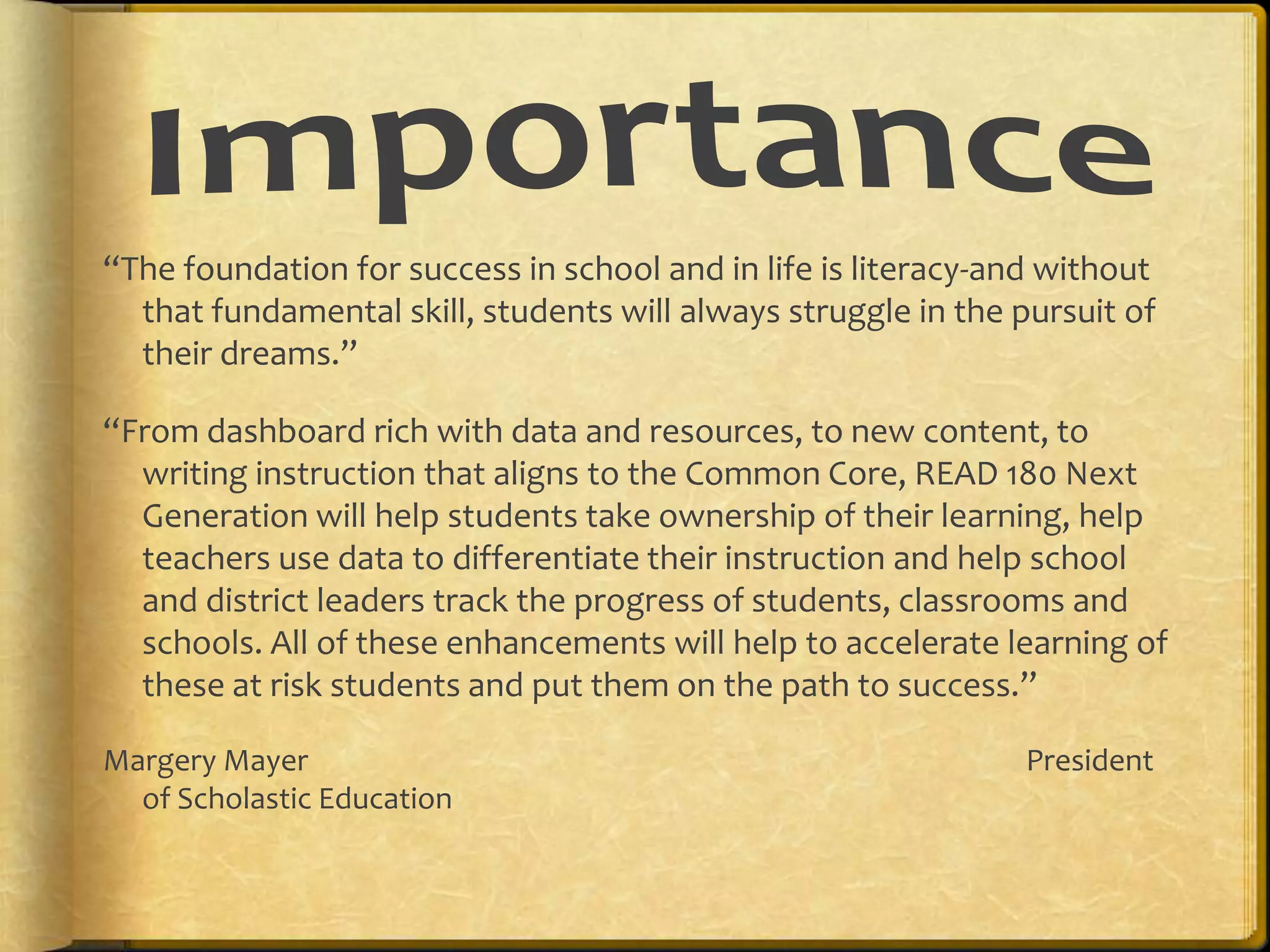
“The foundation for success in school and in life is literacy-and without
that fundamental skill, students will always struggle in the pursuit of
their dreams.”
“From dashboard rich with data and resources, to new content, to
writing instruction that aligns to the Common Core, READ 180 Next
Generation will help students take ownership of their learning, help
teachers use data to differentiate their instruction and help school
and district leaders track the progress of students, classrooms and
schools. All of these enhancements will help to accelerate learning of
these at risk students and put them on the path to success.”
Margery Mayer President
of Scholastic Education
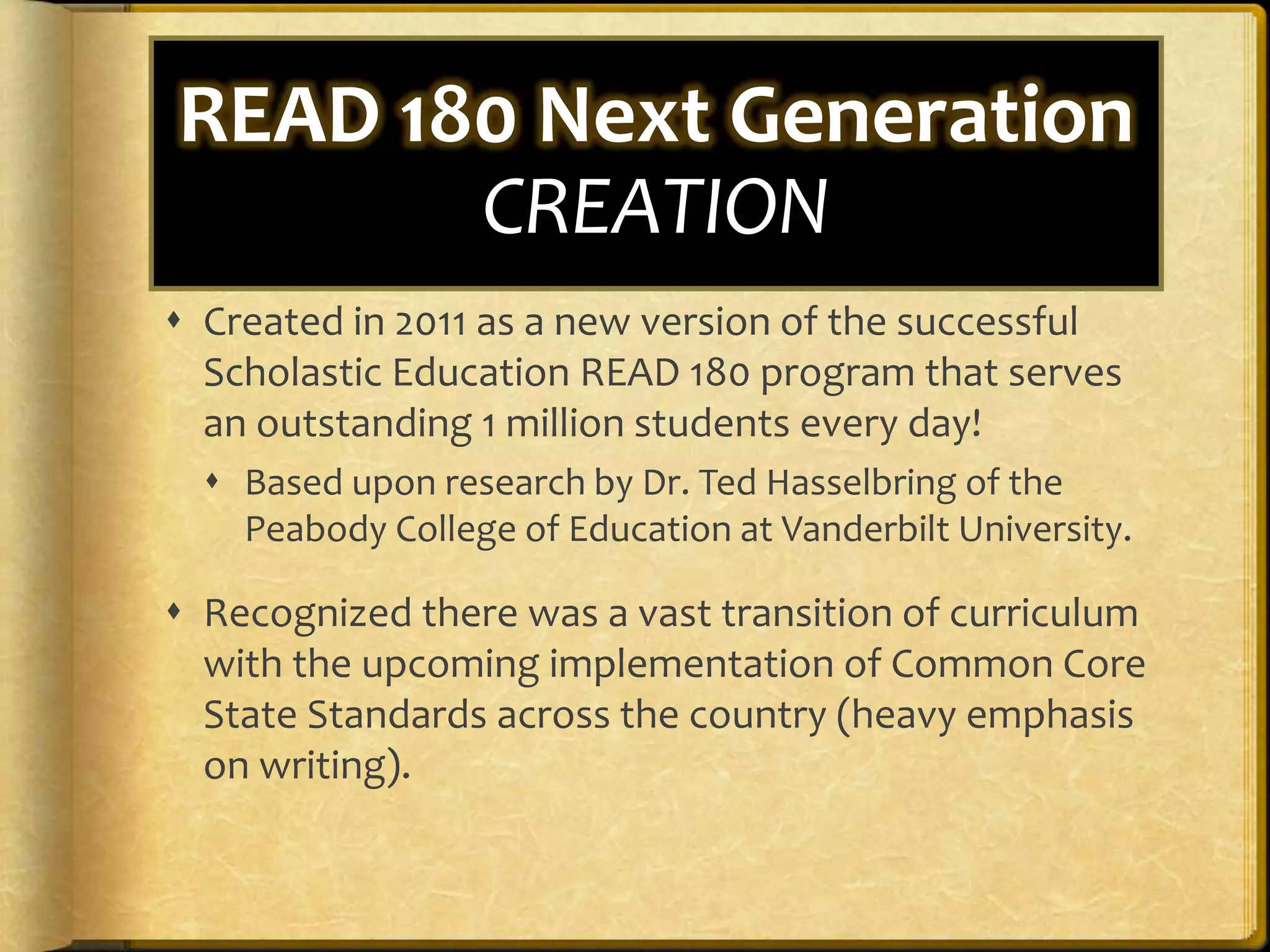
READ 180 Next Generation
CREATION
 Created in 2011 as a new version of the successful
Scholastic Education READ 180 program that serves
an outstanding 1 million students every day!
 Based upon research by Dr. Ted Hasselbring of the
Peabody College of Education at Vanderbilt University.
 Recognized there was a vast transition of curriculum
with the upcoming implementation of Common Core
State Standards across the country (heavy emphasis
on writing).
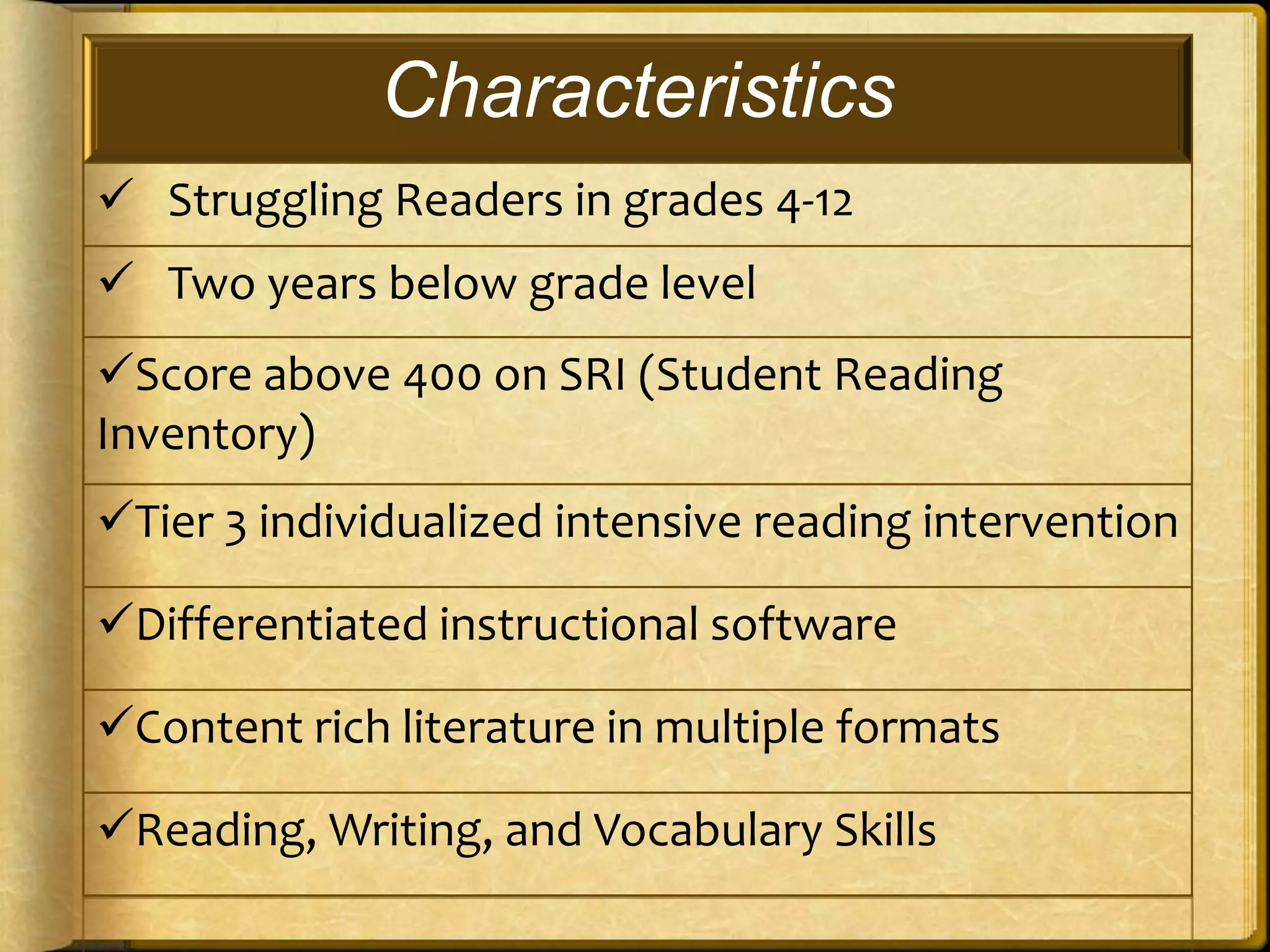
Characteristics
 Struggling Readers in grades 4-12
 Two years below grade level
Score above 400 on SRI (Student Reading
Inventory)
Tier 3 individualized intensive reading intervention
Differentiated instructional software
Content rich literature in multiple formats
Reading, Writing, and Vocabulary Skills
o “Students are able to focus
on instruction and benefit
from multisensory learning
experiences…”
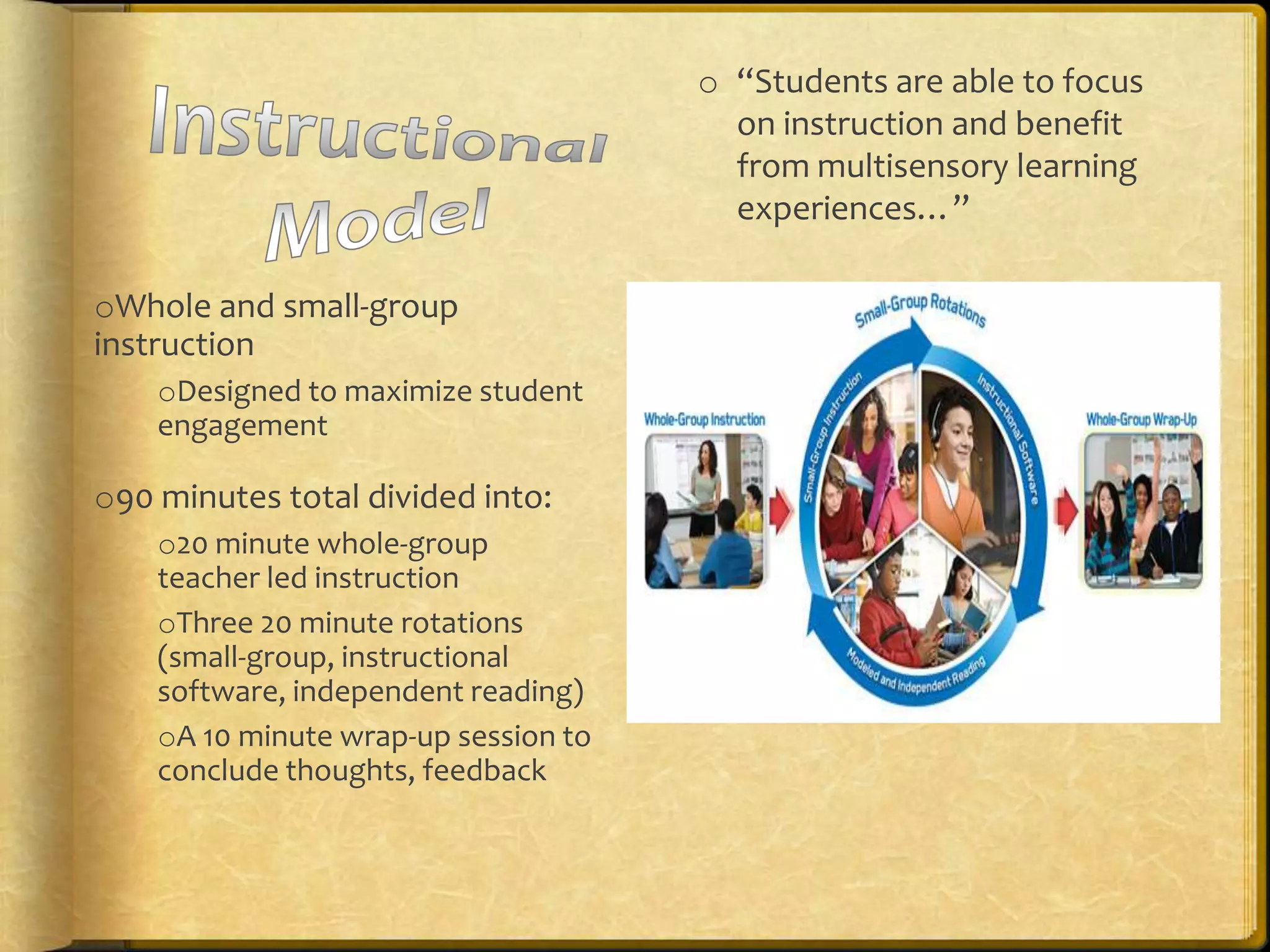
oWhole and small-group
instruction
oDesigned to maximize student
engagement
o90 minutes total divided into:
o20 minute whole-group
teacher led instruction
oThree 20 minute rotations
(small-group, instructional
software, independent reading)
oA 10 minute wrap-up session to
conclude thoughts, feedback
Common Core
•Direct connection to the Common Core State Standards.
•More rigor, writing, nonfiction and independent practice with text
than ever before. “To ensure that struggling readers have an explicit and
accelerated path to college and career readiness.”
•Staircase of increasing Text Complexity
•Three Dimensions of text complexity
•Quantitative
•Qualitative
•Reader & Task
•A proven instructional model
•Text-based questions accompany every type of reading
•Based on the Gradual Release Model!
Element of Literacy:
Comprehension
 READ 180 Next Generation was found to have potentially
positive effects on comprehension and general literacy
achievement for adolescent learners.
 Based on studies done with students’ from the KIPP Academy: “22
percent of students made the equivalent of two years’ worth of
growth in reading, and nearly 50 percent of students made the
equivalent of at least a year’s worth of growth.”
 Anchor videos help struggling readers build schema and
background knowledge to understand academic text.
 Direct instruction in essential comprehension skills and
strategies, such as sequencing, main idea/detail, summarizing,
and cause and effect.
References
 Reed, T. (2011). Scholastic launches “READ 180” Next
Generation. Scholastic. Retrieved from
http://mediaroom.scholastic.com/node/424
 Shaprio, E. S. (2012). Tiered instruction and intervention in a
response-to-intervention model. RTI Network. Retrieved from
http://www.rtinetwork.org/essential/tieredinstruction/tiered-
instruction-and-intervention-rti-model
 Scholastic READ 180 Next Generation. (2012). Scholastic.
Retrieved from http://read180.scholastic.com/reading-
intervention-program/about

Ethan pendergraft read 180 next generation research presentation

  • 3.
    “The foundation forsuccess in school and in life is literacy-and without that fundamental skill, students will always struggle in the pursuit of their dreams.” “From dashboard rich with data and resources, to new content, to writing instruction that aligns to the Common Core, READ 180 Next Generation will help students take ownership of their learning, help teachers use data to differentiate their instruction and help school and district leaders track the progress of students, classrooms and schools. All of these enhancements will help to accelerate learning of these at risk students and put them on the path to success.” Margery Mayer President of Scholastic Education
  • 4.
    READ 180 NextGeneration CREATION  Created in 2011 as a new version of the successful Scholastic Education READ 180 program that serves an outstanding 1 million students every day!  Based upon research by Dr. Ted Hasselbring of the Peabody College of Education at Vanderbilt University.  Recognized there was a vast transition of curriculum with the upcoming implementation of Common Core State Standards across the country (heavy emphasis on writing).
  • 5.
    Characteristics  Struggling Readersin grades 4-12  Two years below grade level Score above 400 on SRI (Student Reading Inventory) Tier 3 individualized intensive reading intervention Differentiated instructional software Content rich literature in multiple formats Reading, Writing, and Vocabulary Skills
  • 6.
    o “Students areable to focus on instruction and benefit from multisensory learning experiences…” oWhole and small-group instruction oDesigned to maximize student engagement o90 minutes total divided into: o20 minute whole-group teacher led instruction oThree 20 minute rotations (small-group, instructional software, independent reading) oA 10 minute wrap-up session to conclude thoughts, feedback
  • 7.
    Common Core •Direct connectionto the Common Core State Standards. •More rigor, writing, nonfiction and independent practice with text than ever before. “To ensure that struggling readers have an explicit and accelerated path to college and career readiness.” •Staircase of increasing Text Complexity •Three Dimensions of text complexity •Quantitative •Qualitative •Reader & Task •A proven instructional model •Text-based questions accompany every type of reading •Based on the Gradual Release Model!
  • 8.
    Element of Literacy: Comprehension READ 180 Next Generation was found to have potentially positive effects on comprehension and general literacy achievement for adolescent learners.  Based on studies done with students’ from the KIPP Academy: “22 percent of students made the equivalent of two years’ worth of growth in reading, and nearly 50 percent of students made the equivalent of at least a year’s worth of growth.”  Anchor videos help struggling readers build schema and background knowledge to understand academic text.  Direct instruction in essential comprehension skills and strategies, such as sequencing, main idea/detail, summarizing, and cause and effect.
  • 9.
    References  Reed, T.(2011). Scholastic launches “READ 180” Next Generation. Scholastic. Retrieved from http://mediaroom.scholastic.com/node/424  Shaprio, E. S. (2012). Tiered instruction and intervention in a response-to-intervention model. RTI Network. Retrieved from http://www.rtinetwork.org/essential/tieredinstruction/tiered- instruction-and-intervention-rti-model  Scholastic READ 180 Next Generation. (2012). Scholastic. Retrieved from http://read180.scholastic.com/reading- intervention-program/about