READ180 by Scholastic Presented by: Tracy Duzen Bradley
What is READ180? READ180 is a comprehensive reading intervention program designed to help educators address reading problems by using technology, print, and professional development.  http://teacher.scholastic.com/products/read180/overview/ Retrieved 10/03/2008
Research and Development 1985: Dr. Hasselbring of Vanderbilt University helps develop “breakthrough prototype” software. 1994-1996: Using  this software, Vanderbilt and University of Florida collaborate to create the Orange County Literacy Program. 1997: Scholastic enters into the collaboration integrating the “Lexile Framework” into the program. http://teacher.scholastic.com/products/read180/research/timeline.htm Retrieved 10/05/2008
Research and Development, cont. 1998-1999: The Council of Great City Schools pilots READ180  and enters into a partnership to study the program.  Scholastic publishes READ180. 2002-2004: Scientific research reveals significant growth on multiple reading measures across subgroups. 2005: Using the observation and best practice, READ180 Enterprise edition was published.  http://teacher.scholastic.com/products/read180/research/timeline.htm Retrieved 10/05/2008
How does READ180 work? READ180 addresses individual needs through Differentiated instruction Adaptive and instructional software High-interest literature Direct instruction in reading, writing, and vocabulary skills
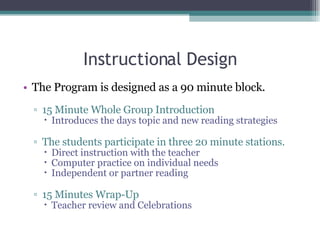
Instructional Design The Program is designed as a 90 minute block. 15 Minute Whole Group Introduction Introduces the days topic and new reading strategies  The students participate in three 20 minute stations. Direct instruction with the teacher Computer practice on individual needs Independent or partner reading 15 Minutes Wrap-Up Teacher review and Celebrations
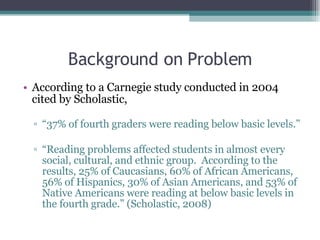
Background on Problem According to a Carnegie study conducted in 2004 cited by Scholastic,  “ 37% of fourth graders were reading below basic levels.” “ Reading problems affected students in almost every social, cultural, and ethnic group.  According to the results, 25% of Caucasians, 60% of African Americans, 56% of Hispanics, 30% of Asian Americans, and 53% of Native Americans were reading at below basic levels in the fourth grade.” (Scholastic, 2008)
Instructional Success READ180 has shown reading improvement Across Grade Level Elementary Middle High School Across subgroups Special Education Students English Language Learners At-Risk Students
Instructional Alignment READ180 is aligned with the NCLB Act because it contains the five literacy elements. Phonemic Awareness Phonics Fluency Vocabulary Reading Comprehension http://teacher.scholastic.com/products/read180/overview/ncllb.asp Retrieved 10/19/2008
Instructional Alignment, cont. Furthermore, it meets NCLB guidelines because it addresses  technology, Adequate Yearly Progress (AYP), is Research-Based, encourages parental involvement, and  provides continuing professional development. http://teacher.scholastic.com/products/read180/overview/ncllb.asp Retrieved 10/19/2008
North Carolina Standard Course of Study It is aligned to the English Language Arts standard course of study.  http://teacher.scholastic.com/products/statehomepages/uploadfile/resource/nc_read180ee_a_gr_4-5.pdf http://teacher.scholastic.com/products/statehomepages/uploadfile/resource/nc_read180ee-b_gr_6-8.pdf http://teacher.scholastic.com/products/statehomepages/uploadfile/resource/nc_read180ee_c_gr_9-12.pdf
Approved Funding Options •  Title I, Part A and Part A—SES •  Title II, Part D—Ed Tech •  Title III, English Language Acquisition •  Enhancing Education Through Technology •  21st Century Community Learning Centers •  Smaller Learning Communities •  Striving Readers •  IDEA,  Response to Intervention •  GEAR UP
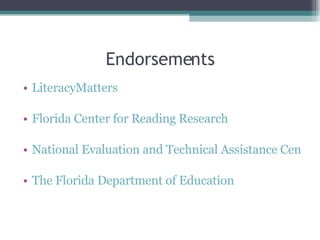
Endorsements LiteracyMatters Florida Center for Reading Research National Evaluation and Technical Assistance Center for the Education of Children and Youth who are neglected, delinquent, or At Risk The Florida Department of Education
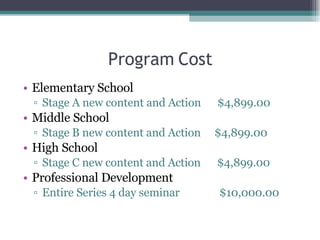
Program Cost Elementary School Stage A new content and Action  $4,899.00 Middle School Stage B new content and Action  $4,899.00 High School Stage C new content and Action  $4,899.00 Professional Development Entire Series 4 day seminar   $10,000.00
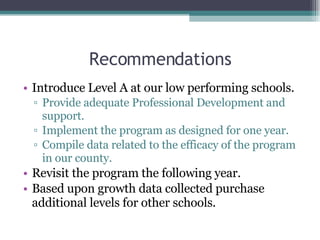
Recommendations Introduce Level A at our low performing schools.  Provide adequate Professional Development and support. Implement the program as designed for one year. Compile data related to the efficacy of the program in our county. Revisit the program the following year. Based upon growth data collected purchase additional levels for other schools.
References Scholastic.com The Florida Department of Education LiteracyMatters

Read180 By Scholastic 3

  • 1.
    READ180 by ScholasticPresented by: Tracy Duzen Bradley
  • 2.
    What is READ180?READ180 is a comprehensive reading intervention program designed to help educators address reading problems by using technology, print, and professional development. http://teacher.scholastic.com/products/read180/overview/ Retrieved 10/03/2008
  • 3.
    Research and Development1985: Dr. Hasselbring of Vanderbilt University helps develop “breakthrough prototype” software. 1994-1996: Using this software, Vanderbilt and University of Florida collaborate to create the Orange County Literacy Program. 1997: Scholastic enters into the collaboration integrating the “Lexile Framework” into the program. http://teacher.scholastic.com/products/read180/research/timeline.htm Retrieved 10/05/2008
  • 4.
    Research and Development,cont. 1998-1999: The Council of Great City Schools pilots READ180 and enters into a partnership to study the program. Scholastic publishes READ180. 2002-2004: Scientific research reveals significant growth on multiple reading measures across subgroups. 2005: Using the observation and best practice, READ180 Enterprise edition was published. http://teacher.scholastic.com/products/read180/research/timeline.htm Retrieved 10/05/2008
  • 5.
    How does READ180work? READ180 addresses individual needs through Differentiated instruction Adaptive and instructional software High-interest literature Direct instruction in reading, writing, and vocabulary skills
  • 6.
    Instructional Design TheProgram is designed as a 90 minute block. 15 Minute Whole Group Introduction Introduces the days topic and new reading strategies The students participate in three 20 minute stations. Direct instruction with the teacher Computer practice on individual needs Independent or partner reading 15 Minutes Wrap-Up Teacher review and Celebrations
  • 7.
    Background on ProblemAccording to a Carnegie study conducted in 2004 cited by Scholastic, “ 37% of fourth graders were reading below basic levels.” “ Reading problems affected students in almost every social, cultural, and ethnic group. According to the results, 25% of Caucasians, 60% of African Americans, 56% of Hispanics, 30% of Asian Americans, and 53% of Native Americans were reading at below basic levels in the fourth grade.” (Scholastic, 2008)
  • 8.
    Instructional Success READ180has shown reading improvement Across Grade Level Elementary Middle High School Across subgroups Special Education Students English Language Learners At-Risk Students
  • 9.
    Instructional Alignment READ180is aligned with the NCLB Act because it contains the five literacy elements. Phonemic Awareness Phonics Fluency Vocabulary Reading Comprehension http://teacher.scholastic.com/products/read180/overview/ncllb.asp Retrieved 10/19/2008
  • 10.
    Instructional Alignment, cont.Furthermore, it meets NCLB guidelines because it addresses technology, Adequate Yearly Progress (AYP), is Research-Based, encourages parental involvement, and provides continuing professional development. http://teacher.scholastic.com/products/read180/overview/ncllb.asp Retrieved 10/19/2008
  • 11.
    North Carolina StandardCourse of Study It is aligned to the English Language Arts standard course of study. http://teacher.scholastic.com/products/statehomepages/uploadfile/resource/nc_read180ee_a_gr_4-5.pdf http://teacher.scholastic.com/products/statehomepages/uploadfile/resource/nc_read180ee-b_gr_6-8.pdf http://teacher.scholastic.com/products/statehomepages/uploadfile/resource/nc_read180ee_c_gr_9-12.pdf
  • 12.
    Approved Funding Options• Title I, Part A and Part A—SES • Title II, Part D—Ed Tech • Title III, English Language Acquisition • Enhancing Education Through Technology • 21st Century Community Learning Centers • Smaller Learning Communities • Striving Readers • IDEA, Response to Intervention • GEAR UP
  • 13.
    Endorsements LiteracyMatters FloridaCenter for Reading Research National Evaluation and Technical Assistance Center for the Education of Children and Youth who are neglected, delinquent, or At Risk The Florida Department of Education
  • 14.
    Program Cost ElementarySchool Stage A new content and Action $4,899.00 Middle School Stage B new content and Action $4,899.00 High School Stage C new content and Action $4,899.00 Professional Development Entire Series 4 day seminar $10,000.00
  • 15.
    Recommendations Introduce LevelA at our low performing schools. Provide adequate Professional Development and support. Implement the program as designed for one year. Compile data related to the efficacy of the program in our county. Revisit the program the following year. Based upon growth data collected purchase additional levels for other schools.
  • 16.
    References Scholastic.com TheFlorida Department of Education LiteracyMatters