REWARDS
INTERVENTION
PROGRAM
Crissy Hancock
CIED 4123
April 25, 2013
Penny Ezell and Angelia Arguello
R
E
W
A
R
D
S
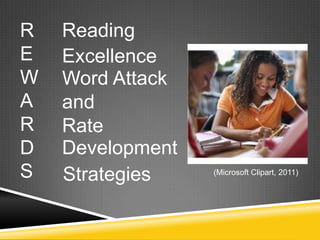
Reading
Excellence
Word Attack
and
Rate
Development
Strategies (Microsoft Clipart, 2011)
REWARDS INTERVENTION
PROGRAM
 REWARDS is reading
and writing program
aimed to teach
intermediate and
secondary students a
flexible strategy for
decoding long words.
 REWARDS increases
oral and silent reading
fluency.
 Supports content-area
success
 Builds background
knowledge in Science and
Social Studies
 Explicit systematic
approach
 Tier II, Response to
Intervention solution
 Strategic supplemental
support
(Sopris Learning, n.d.)
REWARDS = SUCCESS
REWARDS INTERVENTION
PROGRAM
 Emerged from Dr. Anita Archer’s ideas
 Students were significantly below grade level in
reading skills
 Incorporates the Gradual Release model
 I do
 We do
 You do
 Focuses on decoding long words
 Identifying Prefixes, suffixes, and vowels sounds
 Segmenting longer words
(Archer, Gleason, & Vachon, 2006)
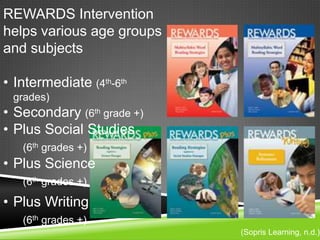
REWARDS Intervention
helps various age groups
and subjects
• Intermediate (4th-6th
grades)
• Secondary (6th grade +)
• Plus Social Studies
(6th grades +)
• Plus Science
(6th grades +)
• Plus Writing
(6th grades +)
(Sopris Learning, n.d.)
REWARDS INTERMEDIATE (4-6
GRADES)
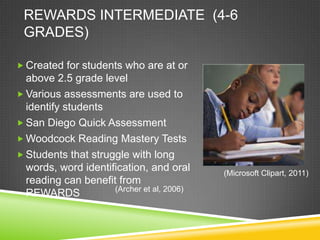
 Created for students who are at or
above 2.5 grade level
 Various assessments are used to
identify students
 San Diego Quick Assessment
 Woodcock Reading Mastery Tests
 Students that struggle with long
words, word identification, and oral
reading can benefit from
REWARDS (Archer et al, 2006)
(Microsoft Clipart, 2011)
REWARDS INTERMEDIATE
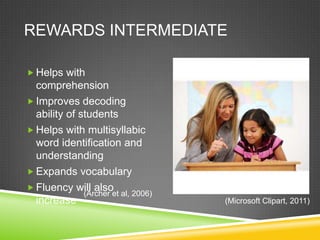
 Helps with
comprehension
 Improves decoding
ability of students
 Helps with multisyllabic
word identification and
understanding
 Expands vocabulary
 Fluency will also
increase
(Archer et al, 2006)
(Microsoft Clipart, 2011)
REWARDS INTERMEDIATE
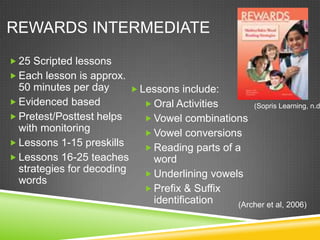
 25 Scripted lessons
 Each lesson is approx.
50 minutes per day
 Evidenced based
 Pretest/Posttest helps
with monitoring
 Lessons 1-15 preskills
 Lessons 16-25 teaches
strategies for decoding
words
 Lessons include:
 Oral Activities
 Vowel combinations
 Vowel conversions
 Reading parts of a
word
 Underlining vowels
 Prefix & Suffix
identification (Archer et al, 2006)
(Sopris Learning, n.d
REWARDS INTERMEDIATE
LESSONS
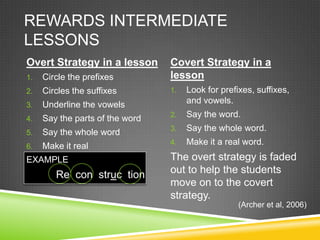
Covert Strategy in a
lesson
1. Look for prefixes, suffixes,
and vowels.
2. Say the word.
3. Say the whole word.
4. Make it a real word.
The overt strategy is faded
out to help the students
move on to the covert
strategy.
Overt Strategy in a lesson
1. Circle the prefixes
2. Circles the suffixes
3. Underline the vowels
4. Say the parts of the word
5. Say the whole word
6. Make it real
EXAMPLE
Re con struc tion
(Archer et al, 2006)
EVIDENCED-BASED
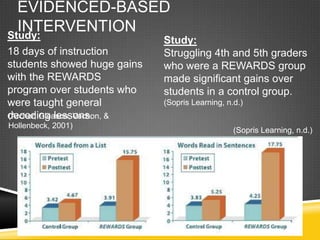
INTERVENTIONStudy:
18 days of instruction
students showed huge gains
with the REWARDS
program over students who
were taught general
decoding lessons.(Archer, Gleason, Vachon, &
Hollenbeck, 2001)
Study:
Struggling 4th and 5th graders
who were a REWARDS group
made significant gains over
students in a control group.
(Sopris Learning, n.d.)
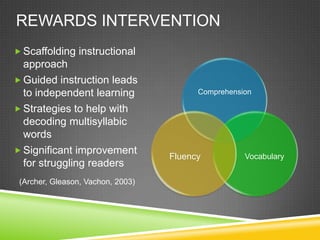
REWARDS INTERVENTION
 Scaffolding instructional
approach
 Guided instruction leads
to independent learning
 Strategies to help with
decoding multisyllabic
words
 Significant improvement
for struggling readers
Comprehension
VocabularyFluency
(Archer, Gleason, Vachon, 2003)
REFERENCES
 Archer, A., Gleason, M., Vachon, V. (2003). DECODING AND FLUENCY: FOUNDATION
SKILLS FOR STRUGGLING OLDER READERS. Learning Disability Quarterly, 26(2), 89.
 Archer, A., Gleason, M., & Vachon, V. (2006). REWARDS. New York, New York: Sopris West
Educational Services.
 Microsoft Clipart. (2011). Student Working [Photograph]. Retrieved from
http://office.microsoft.com/en-us/images/results.aspx?qu=students&ex=1#ai:MP900427825|
 Microsoft Clipart. (2011). Student Testing [Photograph]. Retrieved from
http://office.microsoft.com/en-
us/images/results.aspx?qu=students+testing&ex=1#ai:MP900408982|
 Microsoft Clipart. (2011). Teacher with Student [Photograph]. Retrieved from
http://office.microsoft.com/en-us/images/results.aspxqu=student&ex=1#ai:MP900448524|mt:2|
 Sopris Learning. (n.d.). The REWARDS Overview. Retrieved from
http://www.soprislearning.com/docs/librariesprovider3/other-products-
items/rewards_overview.pdf?sfvrsn=0
 Sopris Learning. (n.d.). REWARDS Research. [Iage of Graph]. Retrieved from
http://www.soprislearning.com/literacy/rewards-program/research-and-results
 Sopris Learning. (n.d.). REWARDS Workbooks [Photograph]. Retrieved from
http://www.soprislearning.com/literacy/rewards-program/rewards-sample

Rewards Intervention Program (Crissy)

  • 1.
    REWARDS INTERVENTION PROGRAM Crissy Hancock CIED 4123 April25, 2013 Penny Ezell and Angelia Arguello
  • 2.
  • 3.
    REWARDS INTERVENTION PROGRAM  REWARDSis reading and writing program aimed to teach intermediate and secondary students a flexible strategy for decoding long words.  REWARDS increases oral and silent reading fluency.  Supports content-area success  Builds background knowledge in Science and Social Studies  Explicit systematic approach  Tier II, Response to Intervention solution  Strategic supplemental support (Sopris Learning, n.d.) REWARDS = SUCCESS
  • 4.
    REWARDS INTERVENTION PROGRAM  Emergedfrom Dr. Anita Archer’s ideas  Students were significantly below grade level in reading skills  Incorporates the Gradual Release model  I do  We do  You do  Focuses on decoding long words  Identifying Prefixes, suffixes, and vowels sounds  Segmenting longer words (Archer, Gleason, & Vachon, 2006)
  • 5.
    REWARDS Intervention helps variousage groups and subjects • Intermediate (4th-6th grades) • Secondary (6th grade +) • Plus Social Studies (6th grades +) • Plus Science (6th grades +) • Plus Writing (6th grades +) (Sopris Learning, n.d.)
  • 6.
    REWARDS INTERMEDIATE (4-6 GRADES) Created for students who are at or above 2.5 grade level  Various assessments are used to identify students  San Diego Quick Assessment  Woodcock Reading Mastery Tests  Students that struggle with long words, word identification, and oral reading can benefit from REWARDS (Archer et al, 2006) (Microsoft Clipart, 2011)
  • 7.
    REWARDS INTERMEDIATE  Helpswith comprehension  Improves decoding ability of students  Helps with multisyllabic word identification and understanding  Expands vocabulary  Fluency will also increase (Archer et al, 2006) (Microsoft Clipart, 2011)
  • 8.
    REWARDS INTERMEDIATE  25Scripted lessons  Each lesson is approx. 50 minutes per day  Evidenced based  Pretest/Posttest helps with monitoring  Lessons 1-15 preskills  Lessons 16-25 teaches strategies for decoding words  Lessons include:  Oral Activities  Vowel combinations  Vowel conversions  Reading parts of a word  Underlining vowels  Prefix & Suffix identification (Archer et al, 2006) (Sopris Learning, n.d
  • 9.
    REWARDS INTERMEDIATE LESSONS Covert Strategyin a lesson 1. Look for prefixes, suffixes, and vowels. 2. Say the word. 3. Say the whole word. 4. Make it a real word. The overt strategy is faded out to help the students move on to the covert strategy. Overt Strategy in a lesson 1. Circle the prefixes 2. Circles the suffixes 3. Underline the vowels 4. Say the parts of the word 5. Say the whole word 6. Make it real EXAMPLE Re con struc tion (Archer et al, 2006)
  • 10.
    EVIDENCED-BASED INTERVENTIONStudy: 18 days ofinstruction students showed huge gains with the REWARDS program over students who were taught general decoding lessons.(Archer, Gleason, Vachon, & Hollenbeck, 2001) Study: Struggling 4th and 5th graders who were a REWARDS group made significant gains over students in a control group. (Sopris Learning, n.d.) (Sopris Learning, n.d.)
  • 11.
    REWARDS INTERVENTION  Scaffoldinginstructional approach  Guided instruction leads to independent learning  Strategies to help with decoding multisyllabic words  Significant improvement for struggling readers Comprehension VocabularyFluency (Archer, Gleason, Vachon, 2003)
  • 12.
    REFERENCES  Archer, A.,Gleason, M., Vachon, V. (2003). DECODING AND FLUENCY: FOUNDATION SKILLS FOR STRUGGLING OLDER READERS. Learning Disability Quarterly, 26(2), 89.  Archer, A., Gleason, M., & Vachon, V. (2006). REWARDS. New York, New York: Sopris West Educational Services.  Microsoft Clipart. (2011). Student Working [Photograph]. Retrieved from http://office.microsoft.com/en-us/images/results.aspx?qu=students&ex=1#ai:MP900427825|  Microsoft Clipart. (2011). Student Testing [Photograph]. Retrieved from http://office.microsoft.com/en- us/images/results.aspx?qu=students+testing&ex=1#ai:MP900408982|  Microsoft Clipart. (2011). Teacher with Student [Photograph]. Retrieved from http://office.microsoft.com/en-us/images/results.aspxqu=student&ex=1#ai:MP900448524|mt:2|  Sopris Learning. (n.d.). The REWARDS Overview. Retrieved from http://www.soprislearning.com/docs/librariesprovider3/other-products- items/rewards_overview.pdf?sfvrsn=0  Sopris Learning. (n.d.). REWARDS Research. [Iage of Graph]. Retrieved from http://www.soprislearning.com/literacy/rewards-program/research-and-results  Sopris Learning. (n.d.). REWARDS Workbooks [Photograph]. Retrieved from http://www.soprislearning.com/literacy/rewards-program/rewards-sample