


Bibliometric research evaluation. The case of Sub-department Environmental Technology Wouter Gerritsma Information spcialist, Wageningen UR Library
Contents Midterm review 2005 Citation analysis Explained Journal selection What’s in a name?
The incentive for this presentation Wimek midterm evaluation 2005
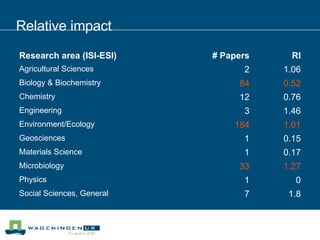
Relative impact 1.8 7 Social Sciences, General  0 1 Physics 1.27 33 Microbiology 0.17 1 Materials Science 0.15 1 Geosciences 1.01 184 Environment/Ecology 1.46 3 Engineering 0.76 12 Chemistry 0.52 84 Biology & Biochemistry 1.06 2 Agricultural Sciences RI # Papers Research area (ISI-ESI)
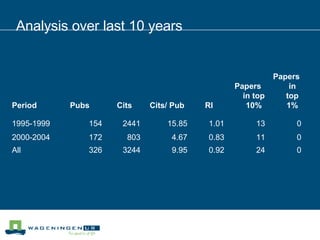
Analysis over last 10 years 0 24 0.92 9.95 3244 326 All 0 11 0.83 4.67 803 172 2000-2004 0 13 1.01 15.85 24 41 154 1995-1999 Papers in top 1% Papers in top 10% RI Cits/ Pub Cits Pubs Period
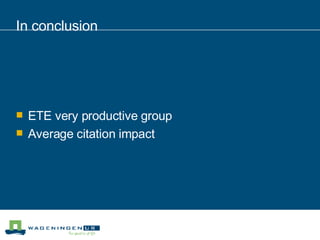
In conclusion ETE very productive group Average citation impact
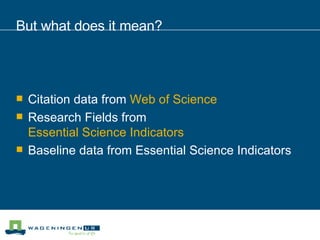
But what does it mean? Citation data from  Web of Science Research Fields from  Essential Science Indicators Baseline data from Essential Science Indicators
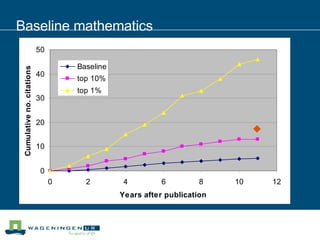
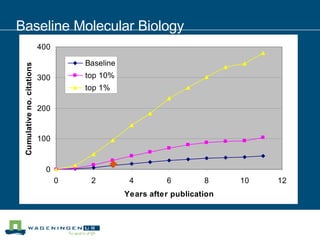
How do we compare numbers? Scientist Z. Math has a publication from 1996 with 17 citations Scientist M. Biology has a publication from 2003 with 24 citations
Baseline mathematics
Baseline Molecular Biology
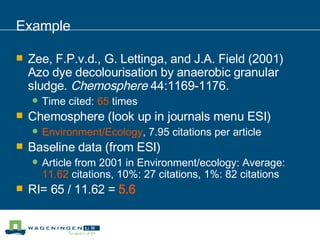
Example Zee, F.P.v.d., G. Lettinga, and J.A. Field (2001) Azo dye decolourisation by anaerobic granular sludge.  Chemosphere  44:1169-1176. Time cited:  65  times Chemosphere (look up in journals menu ESI) Environment/Ecology , 7.95 citations per article Baseline data (from ESI) Article from 2001 in Environment/ecology: Average:  11.62  citations, 10%: 27 citations, 1%: 82 citations RI= 65 / 11.62 =  5.6
Journal selection
Where to publish It is better to publish one paper in a quality journal than multiple papers in lesser journals. …………. Try to publish in journals that have high impact factors; chances are your paper will have high impact, too, if accepted.  Bourne PE (2005) Ten Simple Rules for Getting Published .  PLoS Comput Biol  1(5): e57  doi:10.1371/journal.pcbi.0010057   or at  SciVee
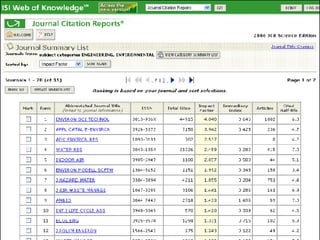
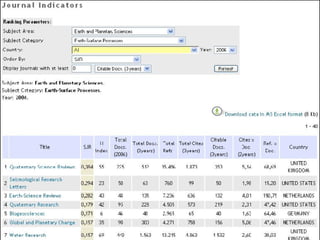
Journal selection Quantitative tools Journal citations reports Journal information from Essential Science Indicators ScimagoJR
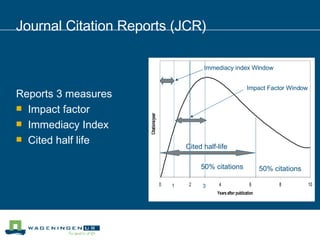
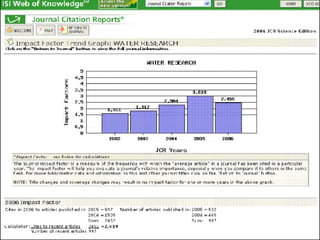
Journal Citation Reports (JCR) Reports 3 measures Impact factor Immediacy Index Cited half life Cited half-life 50% citations 50% citations 3 1 Immediacy index Window Impact Factor Window
 
 
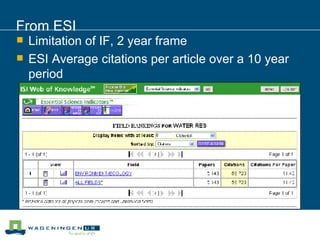
From ESI Limitation of IF, 2 year frame ESI Average citations per article over a 10 year period
 
Impact factor Performance measure for journals “…  it is also used for assessment of the quality of individual papers, scientists and departments. For the latter a scientific basis is lacking, as we will demonstrate in this contribution” (Opthof, 1997) Opthof, T.  (1997). Sense and nonsense about the impact factor.  Cardiovascular Research   33 (1): 1-7.  http:// dx.doi.org /10.1016/S0008-6363(96)00215-5
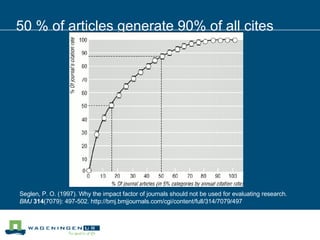
50 % of articles generate 90% of all cites Seglen, P. O. (1997). Why the impact factor of journals should not be used for evaluating research.  BMJ   314 (7079): 497-502. http://bmj.bmjjournals.com/cgi/content/full/314/7079/497
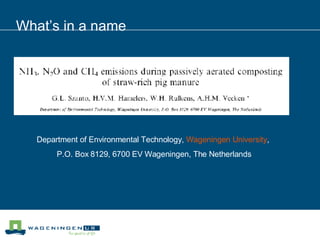
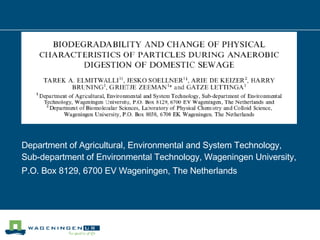
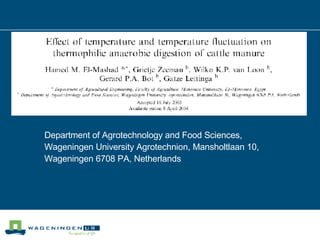
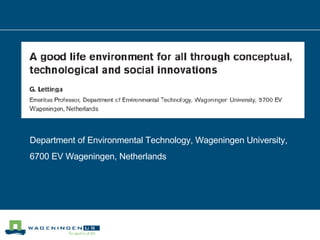
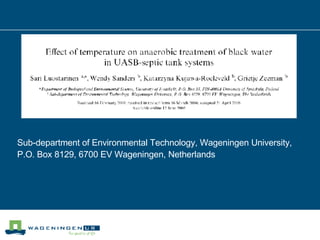
What’s in a name Department of Environmental Technology,  Wageningen University ,  P.O. Box 8129, 6700 EV Wageningen, The Netherlands
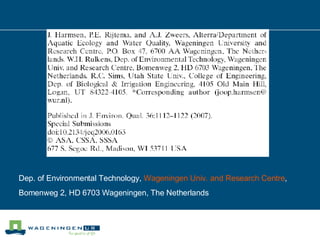
Dep. of Environmental Technology,  Wageningen Univ. and Research Centre ,  Bomenweg 2, HD 6703 Wageningen, The Netherlands
 
Department of Agricultural, Environmental and System Technology,  Sub-department of Environmental Technology, Wageningen University,  P.O. Box 8129, 6700 EV Wageningen, The Netherlands
Department of Agrotechnology and Food Sciences,  Wageningen University Agrotechnion, Mansholtlaan 10,  Wageningen 6708 PA, Netherlands
Department of Environmental Technology, Wageningen University,  6700 EV Wageningen, Netherlands
Sub-department of Environmental Technology, Wageningen University,  P.O. Box 8129, 6700 EV Wageningen, Netherlands
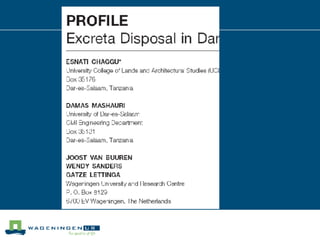
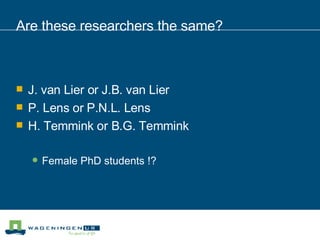
Are these researchers the same? J. van Lier or J.B. van Lier P. Lens or P.N.L. Lens H. Temmink or B.G. Temmink Female PhD students !?
Library course Citation analysis: 18 March 2008, 9.00 am-12.30 pm, room PC421  http://wowter.net/2007/12/12/citation-analysis-for-research-evaluation/
Publish, be cited or perish!
Thank you ! More info:  http://wowter.net This presentation:  http:// www.slideshare.net/wowter/ete -presentation

ETE presentation

  • 1.
    Bibliometric research evaluation.The case of Sub-department Environmental Technology Wouter Gerritsma Information spcialist, Wageningen UR Library
  • 2.
    Contents Midterm review2005 Citation analysis Explained Journal selection What’s in a name?
  • 3.
    The incentive forthis presentation Wimek midterm evaluation 2005
  • 4.
    Relative impact 1.87 Social Sciences, General 0 1 Physics 1.27 33 Microbiology 0.17 1 Materials Science 0.15 1 Geosciences 1.01 184 Environment/Ecology 1.46 3 Engineering 0.76 12 Chemistry 0.52 84 Biology & Biochemistry 1.06 2 Agricultural Sciences RI # Papers Research area (ISI-ESI)
  • 5.
    Analysis over last10 years 0 24 0.92 9.95 3244 326 All 0 11 0.83 4.67 803 172 2000-2004 0 13 1.01 15.85 24 41 154 1995-1999 Papers in top 1% Papers in top 10% RI Cits/ Pub Cits Pubs Period
  • 6.
    In conclusion ETEvery productive group Average citation impact
  • 7.
    But what doesit mean? Citation data from Web of Science Research Fields from Essential Science Indicators Baseline data from Essential Science Indicators
  • 8.
    How do wecompare numbers? Scientist Z. Math has a publication from 1996 with 17 citations Scientist M. Biology has a publication from 2003 with 24 citations
  • 9.
  • 10.
  • 11.
    Example Zee, F.P.v.d.,G. Lettinga, and J.A. Field (2001) Azo dye decolourisation by anaerobic granular sludge. Chemosphere 44:1169-1176. Time cited: 65 times Chemosphere (look up in journals menu ESI) Environment/Ecology , 7.95 citations per article Baseline data (from ESI) Article from 2001 in Environment/ecology: Average: 11.62 citations, 10%: 27 citations, 1%: 82 citations RI= 65 / 11.62 = 5.6
  • 12.
  • 13.
    Where to publishIt is better to publish one paper in a quality journal than multiple papers in lesser journals. …………. Try to publish in journals that have high impact factors; chances are your paper will have high impact, too, if accepted. Bourne PE (2005) Ten Simple Rules for Getting Published . PLoS Comput Biol 1(5): e57 doi:10.1371/journal.pcbi.0010057 or at SciVee
  • 14.
    Journal selection Quantitativetools Journal citations reports Journal information from Essential Science Indicators ScimagoJR
  • 15.
    Journal Citation Reports(JCR) Reports 3 measures Impact factor Immediacy Index Cited half life Cited half-life 50% citations 50% citations 3 1 Immediacy index Window Impact Factor Window
  • 16.
  • 17.
  • 18.
    From ESI Limitationof IF, 2 year frame ESI Average citations per article over a 10 year period
  • 19.
  • 20.
    Impact factor Performancemeasure for journals “… it is also used for assessment of the quality of individual papers, scientists and departments. For the latter a scientific basis is lacking, as we will demonstrate in this contribution” (Opthof, 1997) Opthof, T. (1997). Sense and nonsense about the impact factor. Cardiovascular Research 33 (1): 1-7. http:// dx.doi.org /10.1016/S0008-6363(96)00215-5
  • 21.
    50 % ofarticles generate 90% of all cites Seglen, P. O. (1997). Why the impact factor of journals should not be used for evaluating research. BMJ 314 (7079): 497-502. http://bmj.bmjjournals.com/cgi/content/full/314/7079/497
  • 22.
    What’s in aname Department of Environmental Technology, Wageningen University , P.O. Box 8129, 6700 EV Wageningen, The Netherlands
  • 23.
    Dep. of EnvironmentalTechnology, Wageningen Univ. and Research Centre , Bomenweg 2, HD 6703 Wageningen, The Netherlands
  • 24.
  • 25.
    Department of Agricultural,Environmental and System Technology, Sub-department of Environmental Technology, Wageningen University, P.O. Box 8129, 6700 EV Wageningen, The Netherlands
  • 26.
    Department of Agrotechnologyand Food Sciences, Wageningen University Agrotechnion, Mansholtlaan 10, Wageningen 6708 PA, Netherlands
  • 27.
    Department of EnvironmentalTechnology, Wageningen University, 6700 EV Wageningen, Netherlands
  • 28.
    Sub-department of EnvironmentalTechnology, Wageningen University, P.O. Box 8129, 6700 EV Wageningen, Netherlands
  • 29.
    Are these researchersthe same? J. van Lier or J.B. van Lier P. Lens or P.N.L. Lens H. Temmink or B.G. Temmink Female PhD students !?
  • 30.
    Library course Citationanalysis: 18 March 2008, 9.00 am-12.30 pm, room PC421 http://wowter.net/2007/12/12/citation-analysis-for-research-evaluation/
  • 31.
  • 32.
    Thank you !More info: http://wowter.net This presentation: http:// www.slideshare.net/wowter/ete -presentation